The Complete Crawl Space Glossary: 63 Guides, 50+ Terms, Every NC & SC Crawl Space Topic in One Place
This crawl space glossary defines the 35 terms Carolina homeowners run into most often — from access hatch and vapor barrier to encapsulation ROI and joist sistering — and links each one straight to the in-depth article on this site that covers it. Below the glossary, you'll find every one of our 15 NC and SC city-specific crawl space guides, and then a complete index of all 63 crawl space articles currently live on Carolina Home Problem Report, organized by topic, so nothing gets missed.
- ✓35 core crawl space terms are defined here in plain language, each linked to the full article that covers it in depth
- ✓15 NC and SC cities have their own dedicated crawl space guide covering local soil, code, and pricing conditions
- ✓This page indexes all 63 crawl space articles currently live on the site, grouped into 9 topic categories
- ✓Definitions and links were verified directly against the live site — not written from memory — on September 28, 2026
- ✓Use this page as a starting point when you don't yet know the term for what you're dealing with, or as a directory when you already know the topic
If you've spent any time researching a crawl space problem, you've probably run into a term you weren't quite sure about — capillary break, encapsulation ROI, R409, sistering — usually right in the middle of trying to understand a contractor's quote or diagnose what's actually wrong under your house. This page exists to fix that. It's a working crawl space glossary built specifically for NC and SC homeowners, and because it was written after every article in our Crawl Space category was already live, it also works as a complete map of everything we've published on the topic — encapsulation, moisture, structural repair, pests, code, and 15 city-specific guides — in one place.
How to Use This Glossary
This page is organized in three layers, from general to specific. Start with the glossary if you're not yet sure what to call the problem you're looking at — each definition is short, plain-language, and points you to the one article that goes deep on that specific topic. If you already know you want NC- or SC-city-specific information — local soil conditions, code enforcement, or typical contractor pricing — skip to the local guides table. And if you want to see everything at once, organized by topic instead of alphabetically, the complete article index at the bottom lists all 63 live articles in nine groups.
Glossary: A–Z
These are the 35 terms that come up most often across our crawl space coverage — structural, moisture, encapsulation, and code terminology a Carolina homeowner is likely to hit while researching a problem or reading a contractor's quote.
The door or panel — usually on an exterior wall or inside a closet — that provides entry into the crawl space. Code requires a minimum size so a technician can physically get through it. Read more: what a crawl space actually is, including its access hatch and other components.
Closing the gaps, penetrations, and open vents that let outside or attic air move freely into the crawl space, so a conditioned or encapsulated space actually stays conditioned. Read more: how floor vs. wall insulation and air sealing work together.
Mold spores, dust mite debris, and pest droppings generated in a damp crawl space that travel upward into living space air and trigger allergy or asthma symptoms. Read more: how crawl space moisture and mold trigger allergy and asthma symptoms.
The residential building code section — Chapter R409 in the NC and SC codes — that sets the legal minimum requirements for crawl space foundations, ventilation, vapor barriers, and access. Read more: the R409 crawl space code requirements for NC and SC.
A layer (usually the ground vapor barrier) that physically interrupts moisture from wicking upward out of soil into the crawl space air and structural wood. Read more: how a vapor barrier creates that break and where installations commonly fail.
Air supplied to fuel-burning appliances (like an older gas water heater) so they can burn safely. Sealing a crawl space without accounting for combustion air is a code and safety issue. Read more: crawl space fire safety and combustion appliance code requirements.
A crawl space that has been sealed, insulated at the walls instead of the floor, and tied into the home's heating/cooling or a dedicated dehumidifier — treated as part of the home's envelope rather than outside air. Read more: what a crawl space is and how conditioning changes the whole system.
Water that forms when warm, moist air contacts a cooler surface — ductwork, pipes, or the underside of subfloor — and drops below its dew point. Read more: the hidden danger of crawl space condensation and the 3 types that matter.
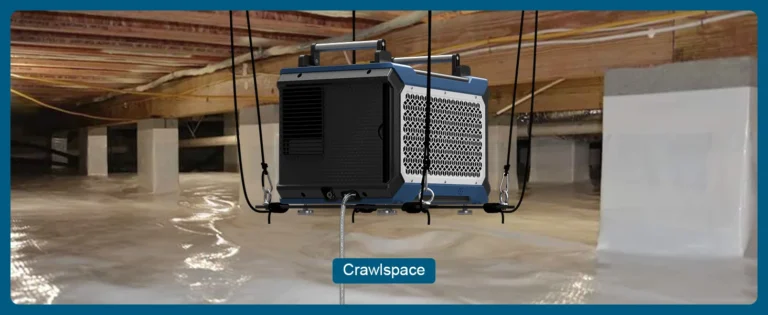
A dehumidifier sized and built specifically for the sealed, low-airflow environment of a crawl space — different from, and generally more effective than, a portable home dehumidifier moved downstairs. Read more: why standard consumer dehumidifiers fail in a crawl space and how to size the right unit.
A crawl space with persistently elevated moisture that hasn't yet produced standing water — the early-stage condition most homeowners actually notice first. Read more: the 7 most common causes of a damp crawl space.
The temperature at which air becomes fully saturated and releases its moisture as condensation. When a duct or pipe surface drops below the surrounding air's dew point, it sweats. Read more: why ducts, pipes, and surfaces sweat in a Carolina crawl space.
Installing a full encapsulation system — vapor barrier, seam sealing, vents closed, dehumidifier — yourself rather than hiring a contractor, to save the labor portion of the cost. Read more: what commonly goes wrong with DIY encapsulation and the step-by-step guide to do it right.
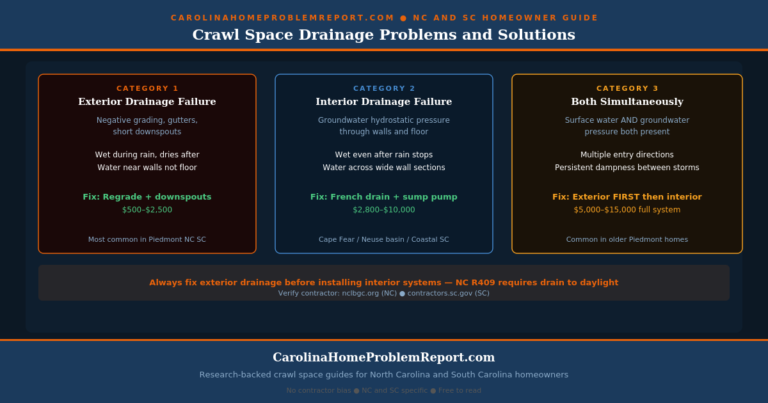
A perforated pipe (French drain) or dimpled plastic matting installed at or below the crawl space floor to intercept and channel groundwater to a sump pump or daylight discharge. Read more: the 3-category framework for diagnosing crawl space drainage problems.
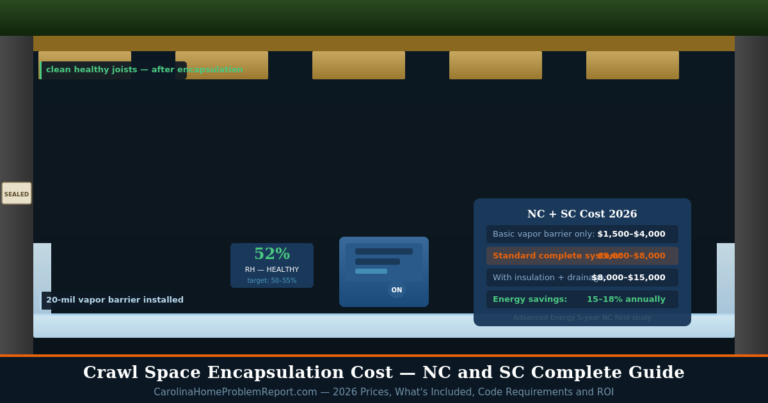
The full process of sealing a crawl space from outside moisture and air: heavy-gauge vapor barrier on the floor and walls, sealed seams, closed vents, and usually a dedicated dehumidifier. Read more: the complete crawl space guide, including what encapsulation covers.
The total price of a full encapsulation job, which varies with square footage, drainage work needed, and dehumidifier size — commonly quoted with hidden line items. Read more: the full NC and SC encapsulation price guide and what's hidden in every quote.
The return on an encapsulation investment, measured in energy savings, avoided structural repair costs, and resale value — not just the upfront price. Read more: the complete ROI analysis for crawl space encapsulation in NC and SC.
The horizontal structural framing members that support the subfloor above a crawl space — the first thing to show rot, sagging, or insect damage when moisture goes unmanaged. Read more: the sistering vs. replacement cost guide for damaged floor joists.
The slope of the soil around a home's foundation. Poor grading directs rainwater toward the crawl space instead of away from it and is one of the most common root causes of moisture problems. Read more: the 6 hidden sources of crawl space moisture, including grading.
Ductwork, and sometimes the air handler itself, routed through the crawl space. A wet crawl space directly raises energy bills and shortens the life of this equipment. Read more: how a wet crawl space raises energy bills and shortens HVAC equipment life.
Two competing approaches: insulating the crawl space floor (older, vented approach) vs. insulating the crawl space walls (used with sealed/encapsulated crawl spaces). Mixing the two wrong is a common and costly mistake. Read more: the hidden R-value mistake and the complete floor vs. wall insulation guide.
A structured walkthrough — moisture, pests, structural, insulation, and air quality checks — used to evaluate a crawl space's condition, commonly done before buying a home or before encapsulating. Read more: the full crawl space inspection checklist with pass/fail criteria.
A repair technique that bolts or screws a new piece of lumber alongside a damaged joist to restore structural strength without full replacement — cheaper than replacement when rot hasn't progressed too far. Read more: when sistering is enough versus when full joist replacement is required.
The immediate, correct sequence of steps — identify, ventilate/dry, assess extent, then remediate — that determines whether crawl space mold is a manageable fix or an expensive one. Read more: the correct first-response action sequence for crawl space mold.
The direct, well-documented relationship between sustained relative humidity above roughly 60% and active mold growth on wood framing and subfloor. Read more: the deadly mold-moisture connection and the proven remediation guide.
Treating and preventing termites, rodents, and other pests that are drawn into a crawl space specifically because of standing moisture — pest activity is often the first visible confirmation of a moisture problem. Read more: the complete guide to termites, rodents, and the bugs that confirm a moisture problem.
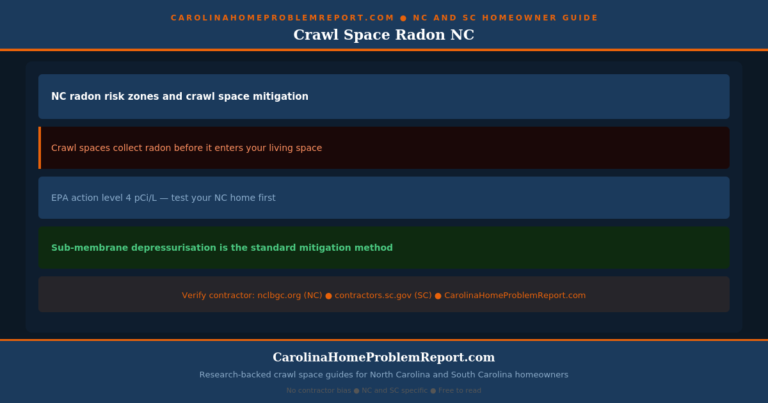
A naturally occurring radioactive gas that can seep from soil into a crawl space and from there into living space air. North Carolina has meaningful regional risk zones for radon. Read more: NC radon risk zones and how a crawl space increases exposure.
Visible dip or bounce in a floor above a crawl space, usually caused by joist rot, undersized support, or a failed support post — ranges from cosmetic to a genuine emergency. Read more: the 4 causes of sagging floors and when it's an emergency.
An alternative foundation type poured directly on grade with no accessible space underneath — the main comparison point homeowners and builders weigh against a crawl space foundation. Read more: the complete slab vs. crawl space comparison for NC and SC.
Visible pooled water in a crawl space, as opposed to elevated humidity alone — always treated as an active, time-sensitive problem rather than a maintenance item. Read more: the 24-hour action plan for standing water in a crawl space.
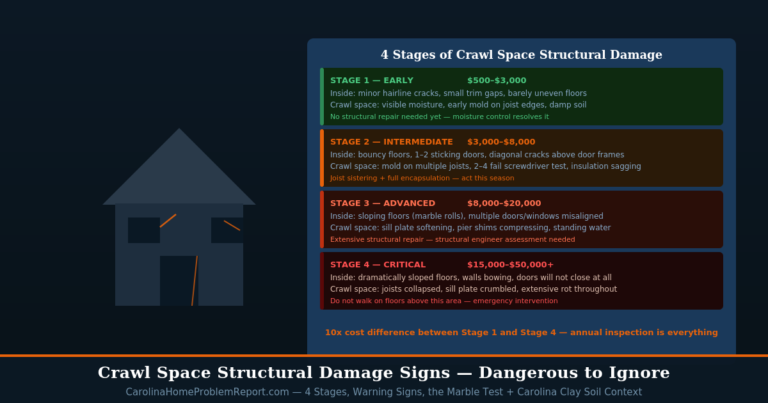
Progressive warning signs — from cosmetic wood discoloration through active rot to compromised load-bearing members — that a moisture problem has moved from cosmetic to structural. Read more: the 4-stage warning system for crawl space structural damage.
A pump installed in a low point (sump basin) of the crawl space floor that automatically removes collected groundwater, typically paired with drainage matting or a French drain. Read more: how sump pumps fit into a full crawl space drainage solution.
Moisture and wood-to-soil contact conditions in a crawl space that specifically attract termites — a documented biological link, not a coincidence. Read more: the biological connection between crawl space moisture and termites.
Heavy-gauge plastic sheeting installed across the crawl space floor (and often the walls) to block soil moisture from evaporating into the crawl space air. The single most common encapsulation component installed incorrectly. Read more: the 7 vapor barrier installation mistakes that cause failures.
The two competing crawl space design philosophies: traditional vented (open foundation vents to outside air) vs. unvented/sealed (closed vents, vapor barrier, often conditioned) — code and building science have shifted toward unvented in humid climates. Read more: why closing vents the wrong way makes things worse, and the correct answer for the Carolinas.
Structural decay caused by wood-decay fungi that require sustained moisture to grow — identifiable by type (brown rot, white rot, soft rot) and typically confirmed with a screwdriver test. Read more: the 3 types of wood rot and the complete repair cost guide.

Local Crawl Space Guides by City
Crawl space conditions vary meaningfully by region — coastal salt air and flood zones, Piedmont clay soil, mountain terrain, or Midlands humidity all change what actually goes wrong and what it costs to fix. We've written a dedicated guide for each of these 15 NC and SC metro areas:
| City | What the Guide Covers |
|---|---|
| Charlotte, NC | Mecklenburg County costs, moisture patterns, and finding the right contractor. |
| Raleigh, NC | Wake County costs, soil conditions, and licensed Triangle contractors. |
| Durham, NC | Older housing stock, clay soil, and Triangle-area encapsulation costs. |
| Cary, NC | Triangle premium market guide to full-spec encapsulation and resale stakes. |
| Greensboro, NC | Guilford County Cecil clay, lake-area humidity, and the best-value market in NC. |
| Winston-Salem, NC | Forsyth County tobacco-era housing, clay soil, and best-value Triad encapsulation. |
| Asheville, NC | Mountain terrain challenges, post-Helene assessment, and the highest encapsulation costs in NC. |
| Wilmington, NC | Coastal flood zone requirements, salt-air corrosion, and termite pressure. |
| Fayetteville, NC | Cumberland County VA loan requirements, flood history, and pricing. |
| Concord, NC | Cabarrus County Charlotte-metro contractor access and dual housing stock. |
| Charleston, SC | Lowcountry water table, flood zones, and historic-home considerations. |
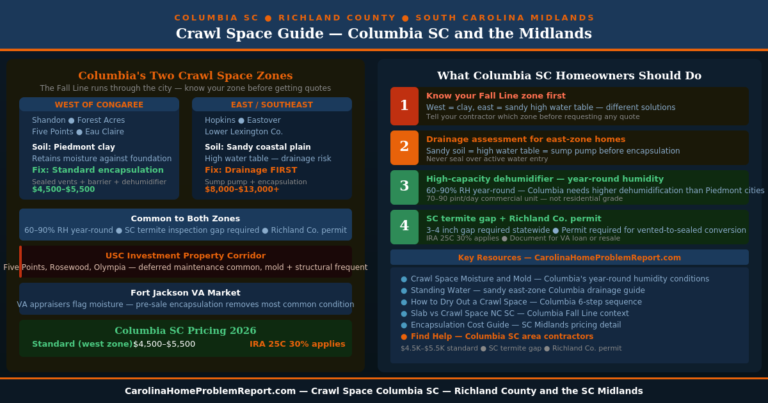
| Columbia, SC | Midlands Fall Line soils, year-round humidity, and encapsulation costs. |
| Greenville, SC | Upstate Piedmont clay and I-85 corridor pricing. |
| Rock Hill, SC | York County Charlotte-metro contractor access and cross-border pricing. |
| Myrtle Beach, SC | Grand Strand vacation-home neglect, coastal conditions, and off-season savings. |
Complete Article Index (All 63 Articles)
Every crawl space article currently live on Carolina Home Problem Report, grouped by topic instead of alphabetically. This list was built by fetching the live category archive pages and the site's sitemap directly — not from memory — and cross-checked so nothing published under Crawl Space or under Homeowner Solutions (the dehumidifier buying guides and product review) was left out.

- What Causes Crawl Space Moisture
- Why Is My Crawl Space Damp? (7 Causes)
- Crawl Space Moisture in Winter
- Crawl Space Moisture in Summer
- Wet Crawl Space After Rain
- Standing Water in Crawl Space
- Crawl Space Drainage Problems
- Water Under House After Rain
- Crawl Space Condensation
- Why Is My Crawl Space Sweating?
- Humidity in Crawl Space
Key Facts for Carolina Homeowners:
- NC and SC crawl space code sits in Chapter R409 — see our full building code guide for what it actually requires
- 15 NC and SC metro areas each have their own local pricing, soil, and code guide — find yours in the table above
- If you don't know where to start, the inspection checklist and the complete crawl space guide are the two most useful entry points
- This index reflects every crawl space article live on the site as of September 28, 2026 — bookmark this page, as it's the most complete single map of our crawl space coverage
Methodology & Sources
The article count and links on this page were compiled by fetching Carolina Home Problem Report's live Crawl Space category archive (all 6 pages) and Homeowner Solutions category archive directly, then cross-referencing that list against the site's XML sitemap to confirm nothing was missed and nothing was duplicated. That gave a verified total of 63 distinct, currently-published crawl space articles — 58 filed under the Crawl Space category and 5 filed under Homeowner Solutions (the dehumidifier sizing, buying-guide, and product-review content). Term definitions reflect standard building-science and residential construction usage, adapted to plain language, and each links to the specific article on this site that treats that topic in the most depth.
Frequently Asked Questions
No. Our Complete Crawl Space Guide is a standalone how-to article that walks through the topic start to finish. This glossary page is a reference tool — it defines terms and indexes every article we've published, including the guide itself, so you can jump directly to the specific topic you need.
Our dehumidifier buying guides and the Argendon product review are filed under Homeowner Solutions because they're product-focused rather than diagnostic. They're still crawl space content, which is why they're included in this index — the category on the backend doesn't change what the article is actually about.
Yes — this page is designed to be the living index for the category, so new crawl space articles should be added to the relevant topic group here going forward.
Use the glossary above to find the term closest to your situation, click through to that article, and start there. If you're not sure your crawl space has a problem at all, the inspection checklist is the best starting point.
We research and verify home-problem solutions specific to Carolina homes and climate, so you can fix issues right the first time — or know exactly what to ask a pro before you hire one.
This glossary is for general informational purposes. Term definitions reflect common residential building-science usage; always confirm specific code requirements with your local building department and get a written scope from any contractor before work begins.