Can You Fill In a Crawl Space? [The 4 Options, What Each Costs, and the Right Answer for Carolina Homeowners]
Yes — but what you can do and what you should do depend entirely on what problem you are trying to solve. NC building code R409.2.3 permits pouring a 2-inch concrete surface over the vapour barrier in a sealed crawl space. Completely filling in the crawl space with fill dirt or concrete is structurally complex, expensive, and almost never the right solution. In most cases, the problem driving the "fill it in" question — moisture, pests, structural fear, discomfort — is solved far more effectively and cheaply by encapsulation.
⭐ Key Takeaways
- ✓There are four different things homeowners mean when they say "fill in the crawl space" — and each has a different answer, different cost, and different feasibility in NC and SC
- ✓NC building code explicitly permits pouring a 2-inch concrete surface over the vapour barrier in a sealed crawl space (R409.2.3) — this is the concrete floor option, not filling the space in
- ✓A permit is required in NC for any crawl space conversion regardless of cost — confirmed by NC Office of State Fire Marshal
- ✓Completely filling a crawl space with fill dirt or concrete buries all utility access permanently — future plumbing or HVAC repairs require demolition to reach anything below the floor
- ✓In almost every case, the problem driving the "fill it in" impulse is solved better, cheaper, and without losing utility access by encapsulation at ~$5,100 average in NC
"Can you fill in a crawl space" is one of those questions that sounds simple but contains at least four different questions depending on what the homeowner is actually trying to accomplish. The homeowner who is terrified of what is under the house, the one who wants to stop moisture from getting in, the one whose kids have been playing near the access door, and the one who just wants a concrete floor instead of soil are all asking different versions of the same question — and they all have different right answers.
According to Advanced Energy's North Carolina crawl space research, the conditions that make homeowners want to eliminate their crawl space — moisture, pests, musty smells, structural concerns — are almost always addressable through encapsulation without losing the utility access that the crawl space provides. The "fill it in" impulse is usually a reaction to a mismanaged crawl space, not a genuine preference for a slab.
This article maps every version of the "fill in" question to its specific answer — what is technically possible, what the NC and SC code requirements are, what it costs, when it makes sense, and when encapsulation is the better answer.
In This Article
- The Four Things People Mean by "Fill In the Crawl Space"
- Option 1 — Pour a Concrete Floor Over the Vapour Barrier (Code Permitted)
- Option 2 — Completely Fill the Space with Fill Dirt or Concrete
- Option 3 — Convert to a Conditioned Basement
- Option 4 — Encapsulate (Seal Without Filling)
- NC and SC Permit Requirements
- Which Option Is Right for Your Situation
- Frequently Asked Questions
The Four Things People Mean by "Fill In the Crawl Space"
Before answering the question, it is important to clarify which question is actually being asked:
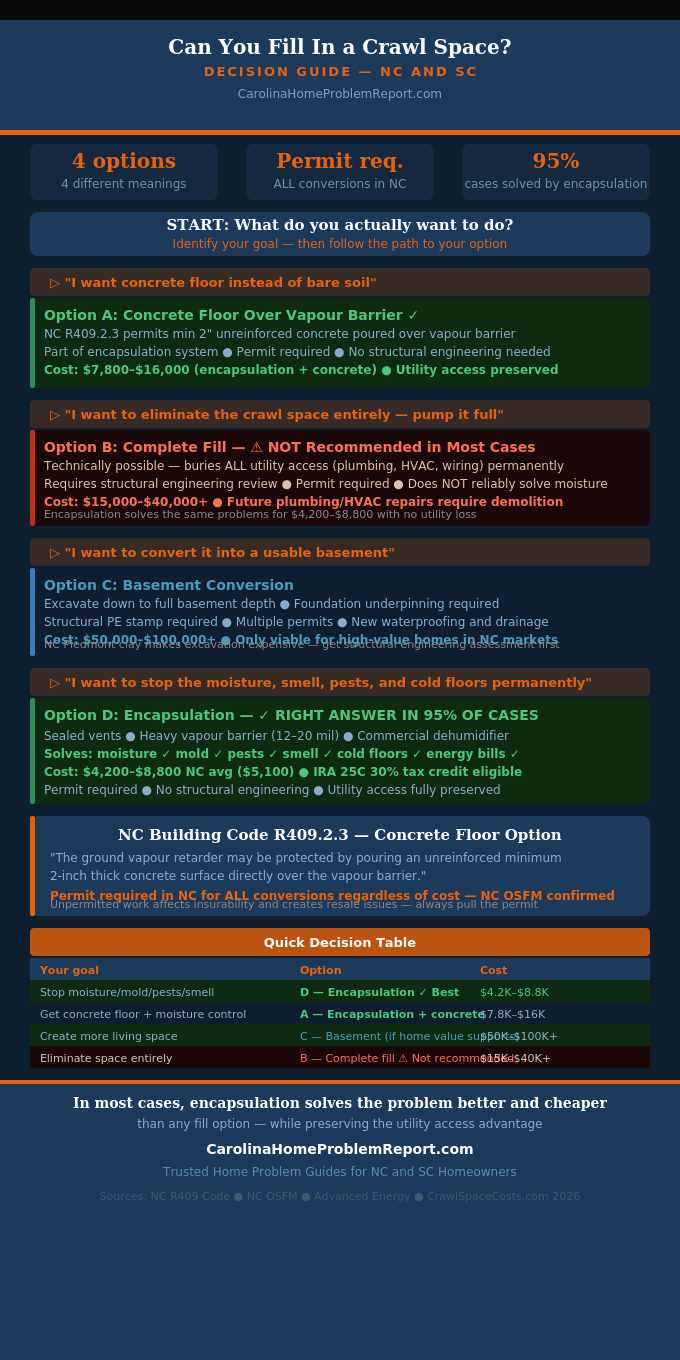
"I want to pour concrete on the crawl space floor instead of having bare soil"
Answer: Yes — NC code R409.2.3 explicitly permits this as part of the encapsulation system. Minimum 2-inch unreinforced concrete poured over the vapour barrier. Requires permit. Cost: $3–$6/sqft for the concrete work.
"I want to fill the entire crawl space in — pump it full of fill dirt or concrete to eliminate the space entirely"
Answer: Technically possible but structurally complex, expensive, requires engineering review, eliminates all utility access permanently, and almost never makes financial sense. This is the most common thing homeowners think they want — and almost never the right answer.
"I want to dig down and convert the crawl space into a full basement"
Answer: Possible in some situations — costs $50,000–$100,000+ in NC/SC conditions, requires structural engineering, underpinning the foundation, and significant permit work. Rarely cost-effective unless the home has significant market value to justify the investment.
"I want to stop the moisture, smell, and pest problems — I just want it dealt with permanently"
Answer: This is encapsulation — sealed vents, vapour barrier, dehumidifier, and optionally a concrete floor over the barrier. Average cost $5,100 in NC. This solves the problem in essentially every case and preserves utility access. Almost always the right answer.
Option 1 — Pour a Concrete Floor Over the Vapour Barrier
This is the most legitimate version of "filling in" the crawl space and NC building code explicitly permits it:
What NC code R409.2.3 says:
"The ground vapour retarder may be protected against ripping and displacement by pouring an unreinforced minimum 2-inch thick concrete surface directly over the vapour barrier."
— NC Residential Code R409.2.3 / Johnston County NC Building Inspections confirmed
What this means in practice:
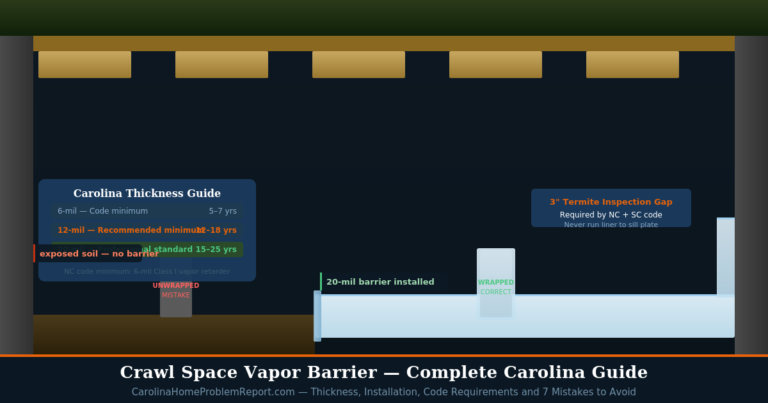
- The vapour barrier goes down first as part of the encapsulation system
- A minimum 2-inch unreinforced concrete surface is poured over the barrier — thin enough not to affect structural loads but thick enough to protect the barrier from foot traffic and sharp debris
- The crawl space floor becomes a cleanable concrete surface — much more usable than bare soil
- Drainage must be maintained — the concrete surface must slope to drains or a sump pump
- This does NOT convert the crawl space to a slab — the structure above still rests on the floor framing, not on the concrete floor
Cost: $3–$6 per square foot for the concrete work on top of the encapsulation system cost. For a 1,200 sqft crawl space: $3,600–$7,200 for concrete, added to the $4,200–$8,800 encapsulation cost. Total: $7,800–$16,000. Some homeowners elect to do encapsulation without the concrete floor and achieve the same moisture control at lower cost.
Option 2 — Completely Fill the Space with Fill Dirt or Concrete
This is what most homeowners visualise when they ask the question. It is technically possible in some configurations but carries significant consequences that make it the wrong choice in almost every situation:
⚠ What you permanently lose when you fill in a crawl space
- All utility access — permanently. Every plumbing line, drain pipe, HVAC duct, electrical run, and gas line currently in the crawl space is buried. Future repairs require concrete cutting or demolition — the exact problem slab home owners face, now in a home that was not designed for it.
- Structural load path. The floor framing above a crawl space is designed to span between foundation walls and piers. Filling the space changes the load conditions — what is supporting the floor framing now? Fill dirt is not a structural foundation element. A licensed structural engineer must assess whether and how the fill affects the floor system.
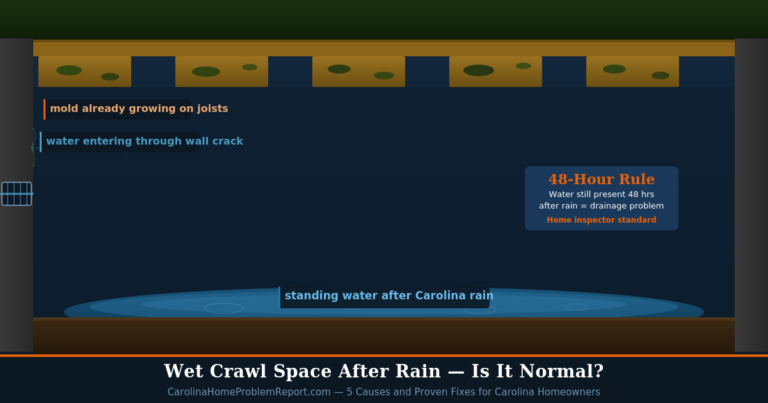
- Moisture pathway remains. Filling with dirt does not solve moisture — it can make it worse. Soil retains moisture. Concrete cracking creates water pathways. The moisture problem that drove the question is often not solved by filling in the space.
When complete filling might be considered:
- A very shallow crawl space (under 12 inches) with no mechanical systems running through it — rare in NC/SC homes with HVAC ductwork
- A portion of the crawl space under an addition where structural clearance is genuinely insufficient for any access — with engineering sign-off and utility rerouting
- Abandonment of an outbuilding or non-primary structure where the utility access issue is moot
In every case, a licensed structural engineer must review the plan before any fill work begins. A permit is required.
Option 3 — Convert to a Conditioned Basement
The opposite of filling in — digging down to create more space rather than filling it. This is technically possible but rarely cost-effective in NC and SC:
Option 4 — Encapsulate (Seal Without Filling)
In the overwhelming majority of cases, the problem driving the "fill it in" question is solved completely by encapsulation — and at a fraction of the cost of any fill option:
What encapsulation solves — the problems behind the "fill it in" request:
- Musty smell rising through the floor → Eliminated within 2–4 weeks
- Active mold on joists → Dormant when RH drops below 60%
- Standing water or damp soil → Addressed by drainage + vapour barrier
- Pest entry → Eliminated by sealed vents and entry points
- Cold floors in winter → Eliminated by R-10 wall insulation
- High energy bills → 15–20% reduction documented
- Fear of what is under the floor → Becomes a clean accessible space
- Utility access → Preserved — still accessible after encapsulation
Cost: $4,200–$8,800 in NC (average $5,100) — with optional 2-inch concrete floor over the barrier for an additional $3,600–$7,200
NC and SC Permit Requirements
NC permit requirement — confirmed by NC Office of State Fire Marshal
Converting a conventional (vented) crawl space to a closed (sealed) crawl space in NC requires a permit regardless of the cost of the work — per NC General Statute 160D-1110 and the NC Residential Code. This applies to encapsulation, adding a concrete floor, or any structural modification of the crawl space. Always pull the permit — unpermitted work affects your home's insurability and creates complications at resale when the buyer's inspector flags the work.
What the permit covers:
- Building permit for the encapsulation or structural work
- Mechanical permit if the dehumidifier is wired to the electrical system
- Any plumbing work required (condensate drain rerouting, drain additions)
A reputable NC crawl space contractor will pull the required permits as part of the project. If a contractor offers to do encapsulation work without pulling a permit to save time or cost — this is a red flag. The permit inspection confirms the work meets R409 standards and protects you at resale.
Which Option Is Right for Your Situation
Use this decision framework to determine which path makes sense:
| Your goal | Right option | Approx. cost |
|---|---|---|
| Stop moisture, mold, pests, smell | Encapsulation (Option D) | $4,200–$8,800 NC |
| Get a concrete floor instead of bare soil | Encapsulation + concrete floor (Option A) | $7,800–$16,000 |
| Create more storage or living space | Basement conversion (Option C) — if home value supports it | $50,000–$100,000+ |
| Eliminate the crawl space entirely | Complete fill (Option B) — requires engineering, not recommended | $15,000–$40,000+ |
| None of the above — you just have a very shallow inaccessible space | Professional assessment to determine feasibility of all options | Assessment $150–$350 |
Frequently Asked Questions
Can you fill in a crawl space with dirt?
Technically possible in some configurations but almost never the right answer. Filling with dirt buries all utility access permanently, changes structural load conditions in ways that require engineering review, and does not solve moisture — soil retains and transmits moisture readily. In almost every case, the goal behind filling with dirt (eliminate moisture, pests, smell) is achieved far more effectively by encapsulation. A permit and structural engineering review are required for any fill work in NC.
Can you pour concrete in a crawl space?
Yes — NC building code R409.2.3 explicitly permits pouring a minimum 2-inch unreinforced concrete surface directly over the vapour barrier as part of an encapsulated crawl space system. This gives the crawl space a concrete floor that protects the barrier and makes the space much more usable. It does not convert the home to a slab foundation — the structural floor above still rests on the floor framing. A permit is required.
How much does it cost to fill in a crawl space?
The concrete floor option (poured over vapour barrier) adds $3,600–$7,200 to the encapsulation cost for a 1,200 sqft crawl space — total project $7,800–$16,000. Complete fill of the crawl space (fill dirt or concrete pumped to eliminate the space) costs $15,000–$40,000+ and requires engineering review. Basement conversion costs $50,000–$100,000+. Encapsulation alone without a concrete floor costs $4,200–$8,800 in NC and solves all the moisture, pest, and air quality issues without the fill expense.
Do I need a permit to fill in or modify a crawl space in NC?
Yes. According to NC State Extension guidance and confirmed by the NC Office of State Fire Marshal, converting a conventional vented crawl space to a closed (sealed) crawl space requires a permit in NC regardless of the cost of the work — per NCGS 160D-1110. Any structural modification including adding a concrete floor, filling in the space, or major alterations requires permits. Always work with a licensed contractor who pulls the required permits.
Is encapsulation better than filling in a crawl space?
In almost every case yes — for four reasons. First, it costs less ($4,200–$8,800 vs $15,000+ for fill). Second, it solves the actual problems (moisture, mold, pests, smell) permanently without the structural complications of fill. Third, it preserves the utility access that makes future plumbing and HVAC repairs affordable. Fourth, it is code-compliant under NC R409 and previously qualified for the IRA 25C tax credit (expired December 31, 2025 — check IRS.gov for current programs). Filling in the crawl space is an irreversible decision that costs more, solves the same problems less reliably, and eliminates an asset that is expensive to replace.
In almost every scenario, the answer to "can you fill in a crawl space" should be reframed to "should you fill in a crawl space — and is there a better way to solve the problem?" NC code permits a concrete floor over the vapour barrier. Complete fill is technically possible but structurally complex, expensive, and permanently eliminates utility access. Basement conversion is possible but rarely economical in Carolina. And in nearly every case, the problem driving the question — moisture, mold, pests, fear — is solved completely by encapsulation at a fraction of the fill cost, while preserving the utility access advantage that makes crawl space homes more affordable to maintain for their entire lifespan.
Get a Free Crawl Space Assessment →Research draws on NC R409 building code, NC Office of State Fire Marshal guidance, Advanced Energy field studies, CrawlSpaceCosts.com NC pricing data 2026, Johnston County NC Building Inspections, and NC State Extension Publications.
Carolina Home Problem Report is an informational resource for homeowners. We are not licensed contractors or engineers. Structural modifications to crawl spaces require permits and may require a licensed structural engineer. See our Disclaimer.