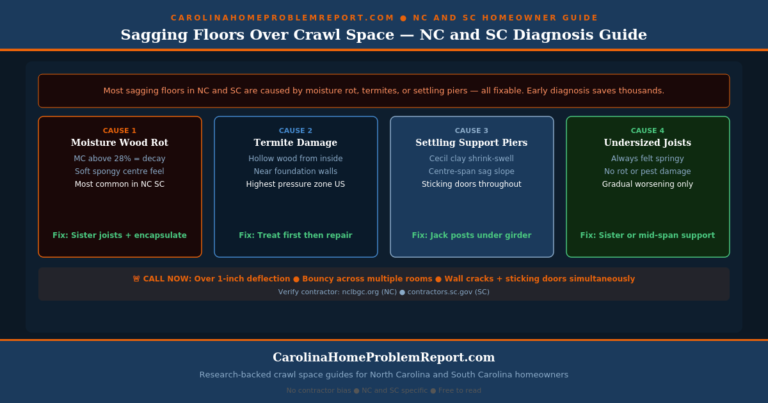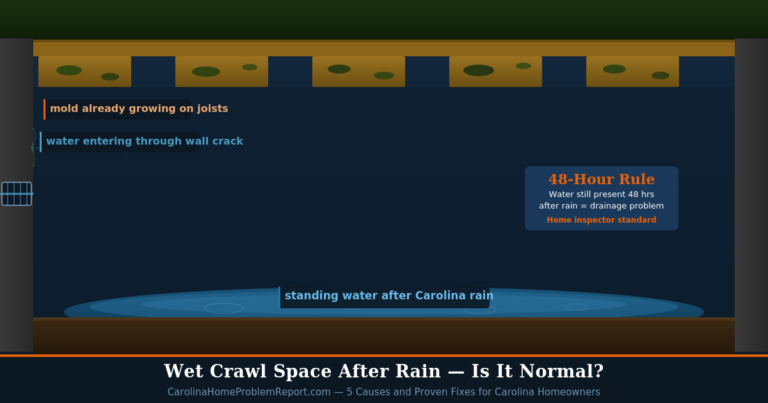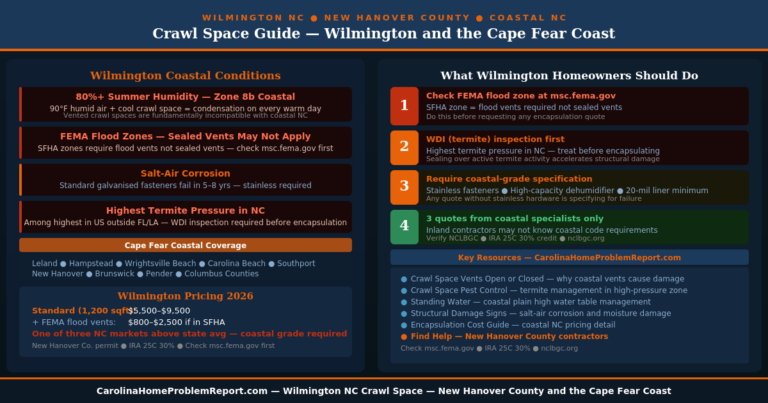
How to Dry Out a Crawl Space [Complete 6-Step Carolina Guide — The Sequence That Actually Works]
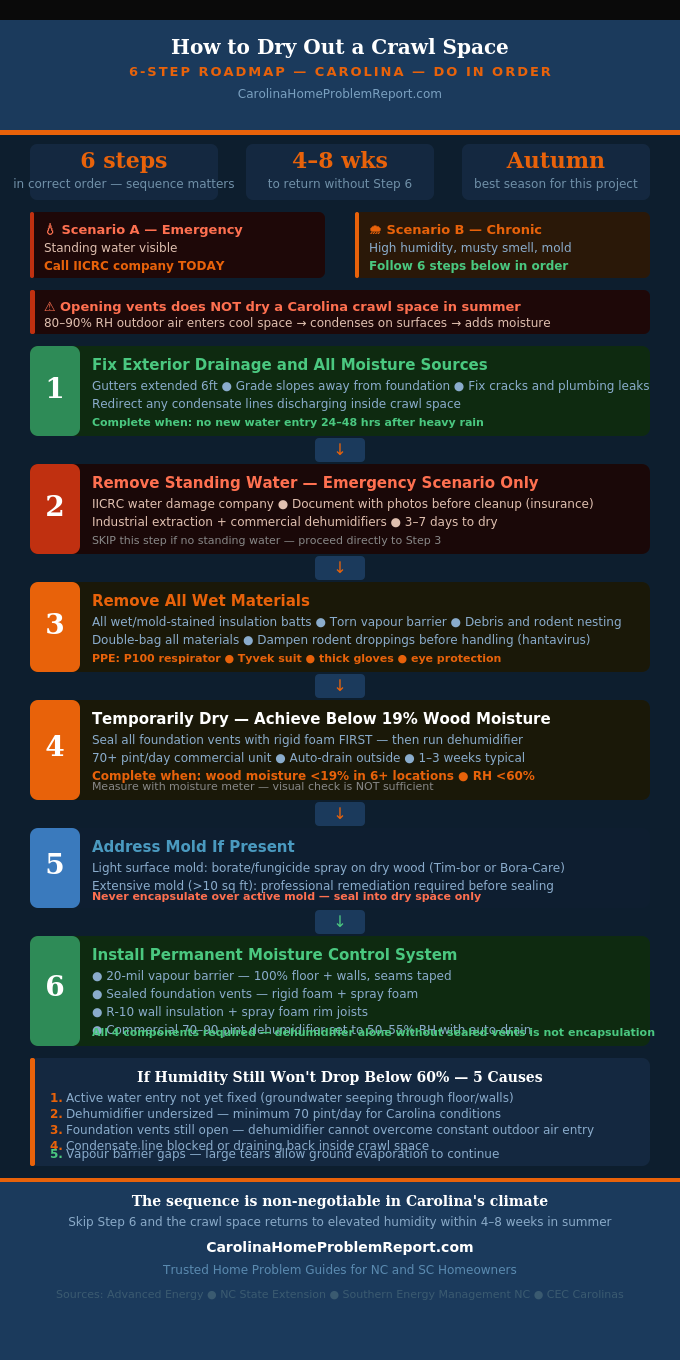
How to dry out a crawl space follows a non-negotiable 6-step sequence: (1) fix exterior drainage, (2) remove standing water if present, (3) remove wet materials, (4) dry the space with temporary dehumidification, (5) address mold if found, (6) install the permanent moisture control system. In a Carolina home, skipping or reordering any of these steps means the crawl space will return to the same conditions — often within a single summer season. The permanent fix is encapsulation. Everything before it is preparation.
⭐ Key Takeaways
- ✓There are two completely different scenarios — emergency drying after standing water (call a water damage company today) and chronic moisture drying (systematic 6-step process). The steps and contractors are different.
- ✓You cannot dry a crawl space in Carolina by opening vents — outdoor air in Carolina summer is 80–90% RH and adds more moisture than it removes when introduced into a cooler crawl space
- ✓The target for a properly dried Carolina crawl space is below 55% RH and wood moisture below 19% — measured with instruments, not estimated visually
- ✓Drying without permanent moisture control is temporary — a dried but unencapsulated Carolina crawl space returns to elevated humidity within 4–8 weeks in summer
- ✓The best time to dry and encapsulate a Carolina crawl space is autumn — lower outdoor humidity, lower contractor demand, space stays dry through winter before its first summer season
Learning how to dry out a crawl space in Carolina is not a single action — it is a sequence of actions that must happen in the correct order to produce a lasting result. Most homeowners who attempt to address a wet or humid crawl space either try to dry a space that still has active moisture sources entering it, or achieve temporary dryness without the permanent system that maintains it. Both approaches fail within one season in Carolina’s climate.
The reason the sequence matters is simple: you cannot dry a space that is still being wetted. Exterior drainage must be corrected before any interior work produces lasting results. Standing water must be removed before dehumidification can work. Wet materials must be removed before the space can dry. Mold must be treated before the space is sealed. And the permanent moisture control system must be installed before any temporary drying is considered complete.
This guide gives Carolina homeowners the complete step-by-step process for drying out a crawl space — including which scenario you have, what to do in each step, how long each step takes, and the specific measurements that confirm you are ready to move to the next stage. According to Advanced Energy’s North Carolina crawl space research, the combination of correct sequencing and permanent moisture control is what separates a crawl space fix that lasts from one that requires repeating every few years.
In This Article
- Two Scenarios — Emergency Drying vs Chronic Moisture Drying
- Why Opening Vents Does Not Dry a Carolina Crawl Space
- Step 1 — Fix Exterior Drainage and Moisture Sources
- Step 2 — Remove Standing Water (Emergency Scenario)
- Step 3 — Remove Wet Materials
- Step 4 — Temporarily Dry the Space
- Step 5 — Treat Mold if Present
- Step 6 — Install the Permanent Moisture Control System
- How Long Does It Take to Dry Out a Crawl Space?
- What to Do When the Humidity Will Not Drop
- Frequently Asked Questions
Two Scenarios — Emergency Drying vs Chronic Moisture Drying
Before following any process, confirm which scenario you are in. The steps and the contractors involved are different:
Why Opening Vents Does Not Dry a Carolina Crawl Space
This is the most common incorrect approach Carolina homeowners try first. Understanding why it fails prevents wasted effort and time.
The condensation trap — why summer ventilation makes things worse
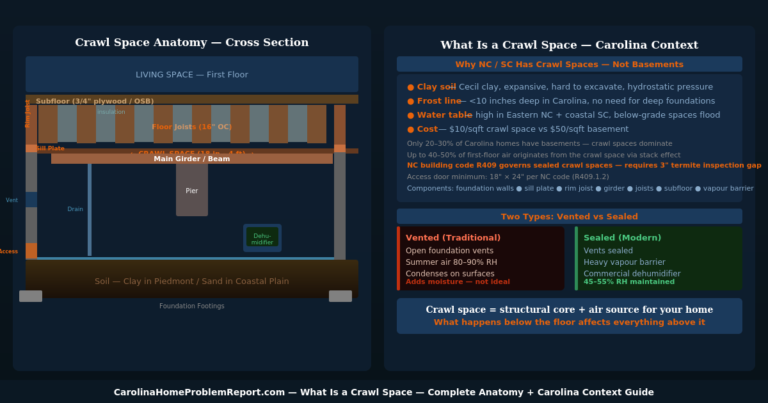
On a typical Carolina summer day, outdoor air is 80–90% relative humidity at 85°F. When this warm, humid air enters a crawl space through foundation vents, it encounters cooler surfaces — the soil, the concrete foundation walls, and the undersides of the floor joists. When warm humid air contacts a cooler surface, it deposits its moisture as condensation. You are literally pumping moisture into the crawl space by opening the vents.
NC State Extension’s home inspection guide identifies crawl space moisture conditions and moisture barrier coverage as critical checkpoints — consistent with current building science consensus that sealed crawl spaces outperform vented ones in Carolina’s humid climate.
The 6-Step Process — In Order

How Long Does It Take to Dry Out a Crawl Space?
| Scenario | Step 2–4 Duration | Full Project Duration | Notes |
|---|---|---|---|
| Standing water — recent | 3–7 days | 2–4 weeks | Emergency restoration + encapsulation. Professional equipment required. |
| Chronic moisture — moderate | 1–3 weeks | 3–6 weeks | No standing water. Temporary dehumidification then encapsulation. Most common scenario. |
| Chronic moisture — severe | 2–4 weeks | 4–8 weeks | Structural repairs, mold remediation, and drainage installation may add to timeline. |
| Autumn installation (ideal) | Days only | 1–2 weeks | Low outdoor humidity speeds drying. Best time of year to perform the project in NC/SC. |
What to Do When the Humidity Will Not Drop
If you have followed the steps and the humidity still will not drop below 60% RH consistently, one of these specific conditions is almost certainly present:
Active water entry you have not found: Groundwater seeping through the foundation floor or walls. Check after the next significant rain. If water is entering from below, a sump pump and perimeter drainage system is required.
Dehumidifier is undersized: A consumer 30–50 pint dehumidifier is typically insufficient for a Carolina crawl space in summer. Minimum 70 pint/day is the standard recommendation. For spaces above 1,000 sq ft, a 90-pint commercial unit is more appropriate.
Vents are still open: If foundation vents are not sealed, the dehumidifier is fighting a continuous supply of humid outdoor air. Seal the vents with rigid foam board and spray foam before running the dehumidifier.
Condensate line is blocked or discharging indoors: The dehumidifier’s condensate must drain to the outside or a sump. If it is draining back into the crawl space floor, it is recycling moisture.
Vapour barrier gaps: An incomplete vapour barrier with large uncovered areas or damaged seams allows ground evaporation to continue. Walk the entire liner and tape any gaps or tears found.
Frequently Asked Questions
How do I dry out my crawl space myself?
For chronic moisture without structural damage or standing water, a DIY approach is possible: fix exterior drainage, remove wet insulation and old vapour barrier, seal foundation vents with rigid foam, install a 70+ pint dehumidifier with auto-drain, and install a new heavy-duty vapour barrier. Any standing water, structural damage, or extensive mold warrants professional involvement. A permit is required in NC for the vent sealing component — confirm before starting.
How long does it take a crawl space to dry out?
For emergency drying with professional equipment: 3–7 days to reach below 19% wood moisture content. For chronic moisture in a typical Carolina home: 1–3 weeks of commercial dehumidification. For autumn installation: often just days. The complete project from assessment through permanent encapsulation typically runs 2–6 weeks depending on scope. For a full breakdown of what each phase costs in NC and SC, see our crawl space drying cost guide.
Will a dehumidifier dry out a crawl space?
A dehumidifier alone is not sufficient — it must be combined with sealed foundation vents and a vapour barrier. If foundation vents remain open, the dehumidifier fights a continuous supply of 80–90% RH outdoor summer air and cannot win. Seal the vents first, install the vapour barrier, then the dehumidifier maintains the dry conditions that the barrier and sealed vents create. The dehumidifier is the maintenance component, not the primary solution.
What is the best time of year to dry out a crawl space in NC or SC?
Autumn — September through November — is the optimal time. Outdoor humidity is lower than summer, making temporary drying faster. Contractor scheduling is more flexible than peak spring/summer demand season. The encapsulated space then faces its first summer humidity season with the permanent system already in place and tested.
How do I know when my crawl space is dry enough?
Two measurements confirm dryness — not visual assessment. First, wood moisture content must read below 19% in at least 6 locations measured with a wood moisture meter. Second, relative humidity must read below 60% RH with a hygrometer. Visual inspection is not sufficient — wood that appears dry may still have 22–25% moisture content in its core. Both measurements must be met before encapsulation proceeds.
💡 Ready to Install the Permanent Dehumidifier for Step 6?
Once exterior drainage is fixed, vapor barrier is in, and vents are sealed, a properly sized commercial crawl space dehumidifier holds everything at 50–55% RH permanently. Argendon’s range covers every crawl space size. Use code CHPR3 for 3% off.
Shop Argendon Dehumidifiers → Code CHPR3 saves 3% at checkout- Drying a crawl space in Carolina follows a non-negotiable 6-step sequence — fix exterior drainage first, dry the space second, treat mold third, encapsulate last. Skipping or reordering any step means the project fails.
- You cannot dry a Carolina crawl space by opening vents — summer outdoor air at 80–90% RH deposits more moisture onto cooler crawl space surfaces than it removes. Sealing vents is a prerequisite of drying, not an alternative to it.
- Both measurements must confirm dryness before encapsulation proceeds: wood moisture below 19% in at least 6 locations (meter reading, not visual), and relative humidity below 60% RH. Neither measurement alone is sufficient.
- A dried-but-unencapsulated Carolina crawl space returns to elevated humidity within 4–8 weeks in summer. The permanent system — sealed vents, vapor barrier, wall insulation, and commercial dehumidifier — is what converts temporary drying into a lasting result.
- Autumn (September–November) is the optimal time to dry and encapsulate — lower outdoor humidity means faster temporary drying, contractor availability is higher, and the permanent system goes in before the next summer humidity season.
The Carolina Home Problem Report editorial team researches and writes guides for homeowners across North and South Carolina. Our research draws on Advanced Energy field studies, NC State Extension publications, Southern Energy Management NC building science guidance, and insights from licensed Carolina crawl space contractors. We are not contractors — we are a research team dedicated to giving Carolina homeowners clear, locally specific, unbiased answers.
📚 Key Concepts — Reference Sources
- Dehumidifier (Wikipedia) — How dehumidifiers remove moisture from air through refrigeration cycles — explains why commercial units outperform consumer units for crawl space applications
- Relative Humidity (Wikipedia) — The 60% RH threshold and 19% wood moisture content targets referenced throughout this guide
- Wood-Decay Fungus (Wikipedia) — The fungi species that colonise crawl space floor joists when wood moisture content exceeds 19% — why Step 5 (mold treatment) must precede encapsulation
Carolina Home Problem Report is an informational resource for homeowners. We are not licensed contractors. Always consult a qualified professional before making decisions about structural or moisture control work. A permit is required in NC for vented-to-closed crawl space conversion. See our Disclaimer and Affiliate Disclosure.