Crawl Space Insulation [The Hidden R-Value Mistake Carolina Homeowners Make + Ultimate Floor vs Wall Guide]
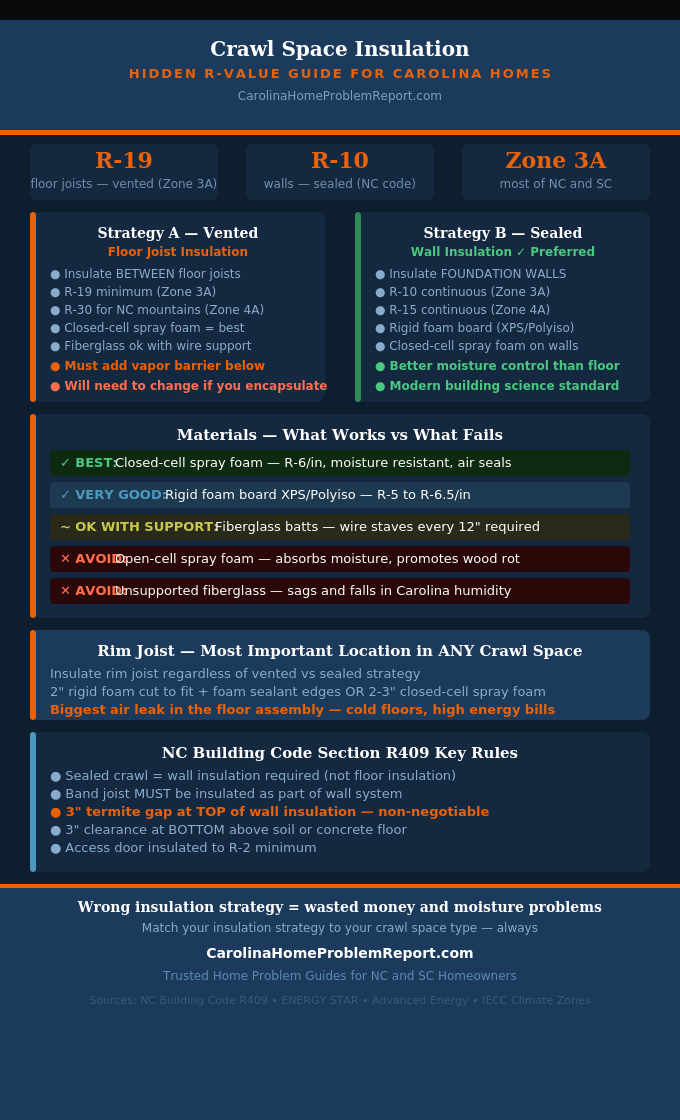
The right crawl space insulation strategy for a Carolina home depends entirely on one decision: is your crawl space vented or sealed? In a vented crawl space, insulation goes in the floor joists above — minimum R-19 for Climate Zone 3A (most of NC and SC). In a sealed encapsulated crawl space, insulation goes on the foundation walls — minimum R-10 continuous per NC code Section R409. These are two completely different approaches and using the wrong one for your crawl space type wastes money and can create moisture problems.
⭐ Key Takeaways
- ✓Vented crawl space = floor joist insulation (R-19 minimum). Sealed crawl space = wall insulation (R-10 continuous minimum). Never swap these.
- ✓Fiberglass batts fall out of floor joists in Carolina's humid conditions — they absorb moisture, sag, and lose R-value. Rigid foam and closed-cell spray foam are the correct materials for Carolina crawl spaces.
- ✓Most of NC and SC is in Climate Zone 3A — the mountains of NC are Zone 4A with higher R-value requirements
- ✓The rim joist is the most important and most overlooked insulation location in any Carolina crawl space — it is the biggest thermal bridge and air leak point in the entire floor assembly
- ✓Wall insulation in a sealed crawl space must maintain the 3-inch termite inspection gap at the top — the same requirement that applies to the vapor barrier
Crawl space insulation is the most misunderstood component in the crawl space improvement conversation — and the one where the most money gets wasted by Carolina homeowners who install the wrong type in the wrong location. The reason is simple: there are two completely different insulation strategies for crawl spaces, and which one is correct depends entirely on whether your crawl space is vented or sealed. Apply the floor joist strategy to a sealed crawl space and you waste money on insulation that does nothing useful for energy performance. Apply the wall strategy to a vented crawl space and you create moisture traps inside the floor cavity.
According to ENERGY STAR's crawl space guidance, the modern building science consensus is clear: a sealed, conditioned crawl space insulated at the walls outperforms a vented crawl space insulated at the floor joists in virtually every climate — and this is especially true in the humid subtropical climate that covers most of North and South Carolina. Wall insulation in a sealed crawl space treats the space as part of the home's thermal envelope. Floor joist insulation in a vented space treats it as an outdoor buffer — a strategy that building science has largely moved away from for Carolina conditions.
This guide walks Carolina homeowners through the complete crawl space insulation decision — which strategy is right for your specific crawl space, what R-values NC and SC code requires, which materials work and which fail in Carolina conditions, and the installation details that determine whether the insulation actually performs.
In This Article
- The Two Crawl Space Insulation Strategies — Which One Applies to Your Home
- NC and SC Climate Zones — R-Value Requirements by Location
- Insulation Materials — What Works and What Fails in Carolina Conditions
- Rim Joist Insulation — The Most Important Location Nobody Talks About
- Floor Joist Insulation — How to Do It Right in a Vented Crawl Space
- Wall Insulation — The Correct Approach for Sealed Crawl Spaces
- NC Building Code Section R409 — What Is Required
- Frequently Asked Questions
The Two Crawl Space Insulation Strategies — Which One Applies to Your Home
Before choosing an R-value or a material, the fundamental question is where the insulation goes. This is determined by your crawl space type — and confusing the two approaches is the source of most crawl space insulation failures in Carolina homes.
What if you have floor joist insulation but want to encapsulate?
This is the most common transition scenario in older Carolina homes. When you seal a crawl space that previously had floor joist insulation, you have two options: remove the floor joist insulation and install wall insulation instead, or leave the floor joist insulation in place and add wall insulation in addition. Leaving existing floor joist insulation in an encapsulated space is acceptable per building science as long as it is dry and intact — but the primary thermal control will shift to the wall insulation. If the existing floor joist batts are wet, damaged, or fallen they must be removed before encapsulation proceeds.
NC and SC Climate Zones — R-Value Requirements by Location
The IECC Climate Zone system divides the country by heating and cooling demand. The R-value requirements for insulation vary by zone. Here is where Carolina homes fall:
| Climate Zone | NC and SC Counties | Floor Joist (Vented) | Wall (Sealed) |
|---|---|---|---|
| Zone 3A | All of SC and most of NC — Piedmont, Coastal Plain, Charlotte, Raleigh, Wilmington, Eastern NC, Fayetteville, Greenville SC, Columbia SC, Charleston SC | R-19 minimum | R-10 continuous |
| Zone 4A | NC mountain counties — Asheville, Boone, Brevard, Hendersonville, Murphy, western NC highlands | R-30 minimum | R-15 continuous |
💡 Zone 3A vs Zone 4A — how to know which zone your home is in
If your home is in the NC mountain counties — roughly west of I-26 and north of US-64 — you are likely in Zone 4A with higher R-value requirements. If you are anywhere in South Carolina or in the NC Piedmont or Coastal Plain, you are in Zone 3A. The Department of Energy's climate zone map is available at basc.pnnl.gov — enter your county for a definitive answer. When in doubt, use the higher Zone 4A requirements — they provide better performance and add minimal cost to the project.
Insulation Materials — What Works and What Fails in Carolina Conditions
Carolina's humid subtropical climate creates a challenging environment for insulation materials. What works in a dry climate may fail within a few years in a Carolina crawl space. Here is an honest assessment of each material:
Rim Joist Insulation — The Most Important Location Nobody Talks About
The rim joist — also called the band joist — is where the floor framing meets the top of the foundation wall. It is a continuous ring around the entire perimeter of your home at crawl space level, and it is typically the single most significant air leak and thermal bridge in the entire floor assembly.
In older Carolina homes the rim joist is often completely uninsulated — exposed framing lumber directly above the foundation wall with no insulation and no air sealing. Cold air infiltrates through here in winter, causing cold floors on the first story. Hot humid air infiltrates in summer, contributing to crawl space humidity. The rim joist is where insulation money has the highest per-dollar return of anywhere in the crawl space.
How to insulate the rim joist — the correct method:
Cut rigid foam to fit: Cut 2-inch XPS or polyiso board to fit snugly inside each joist bay at the rim joist location. The piece should fill the bay from the sill plate to the rim joist, and fit side to side between joists with no gaps.
Seal all edges with spray foam: Run a bead of one-component spray foam around all four edges of each rigid foam piece. This creates the air seal that prevents infiltration around the insulation. The rigid foam provides thermal resistance; the foam sealant creates the air barrier. Both are required for full performance.
Alternative — spray foam directly: Two-component closed-cell spray foam applied 2–3 inches deep across the entire rim joist area simultaneously insulates and air seals in one step. More expensive than rigid foam but faster and eliminates cut-and-fit labor. R-12 to R-19 achieved in a single application. This is the preferred contractor method.
Work around the entire perimeter: Every joist bay around the entire rim joist perimeter must be insulated — skipping any bay leaves a thermal bypass that undermines the performance of every bay you did insulate. This is not a partial job.
Floor Joist Insulation — How to Do It Right in a Vented Crawl Space
If you have a vented crawl space and are not planning to encapsulate, floor joist insulation is the correct strategy. Follow these principles for installation that actually performs:
- Install a vapor barrier on the soil first — floor joist insulation without a vapor barrier below is significantly less effective. The ground evaporation reaches the insulation from below and degrades its performance. A 6-mil minimum vapor barrier is required by code even in vented spaces.
- Insulation must be in full contact with the subfloor above — any gap between the insulation and the subfloor allows convective air movement that bypasses the insulation entirely. Press insulation up firmly to the subfloor and secure it.
- Support fiberglass batts with wire staves every 12 inches — unsupported batts sag and fall within 1–3 years in Carolina's humidity. Wire support rods (staves) installed between joists every 12 inches hold the insulation in contact with the subfloor. Without them the insulation will be on the ground within a few seasons.
- Do not compress insulation — compressing a batt reduces its effective R-value. An R-19 batt compressed to 3.5 inches provides approximately R-11. Match the batt thickness to the joist depth.
- Closed-cell spray foam is better than fiberglass for floor joists in Carolina — if budget allows, 3 inches of closed-cell spray foam applied directly to the subfloor from below provides R-19, never sags, never absorbs moisture, and air seals simultaneously. This is the premium floor joist insulation solution.
- Insulate the rim joist in every case — regardless of whether you use fiberglass or spray foam in the floor joist bays, the rim joist must be insulated separately. It is a code requirement and a significant energy performance item.
Wall Insulation — The Correct Approach for Sealed Crawl Spaces
According to Advanced Energy's closed crawl space research, wall insulation in a sealed crawl space is the higher-performing system for Carolina conditions — delivering better energy savings and moisture control than floor joist insulation in a vented space. Here is what installation requires:
Start 3 inches below the top of the foundation wall. This is the termite inspection gap required by NC code Section R409. The insulation must begin below the wood sill plate — never run it to or above the sill plate. This gap allows visual inspection for mud tubes during annual termite inspections.
Extend down to 3 inches above the footing or soil. NC code requires the wall insulation to extend down close to the footing — but it must maintain a 3-inch clearance gap at the bottom above the soil or concrete floor. The bottom gap prevents moisture wicking from the soil into the insulation base.
Use rigid foam board or closed-cell spray foam only. Fiberglass, mineral wool, or open-cell spray foam on foundation walls in a sealed crawl space absorbs moisture from the concrete and from residual crawl space humidity. Only moisture-resistant materials are appropriate for direct foundation wall contact.
Insulate the band joist area at the top. NC code Section R409 specifically requires that wall insulation systems include the band joist area — the floor framing zone at the top of the foundation wall. This is the rim joist location. The wall insulation and the rim joist insulation must work together as a continuous thermal system around the top of the foundation.
Ignition barrier over foam if required. If the crawl space is used as an air plenum or if local code requires it, foam plastic insulation on walls must be covered with an approved ignition barrier. Check with your local building department before installation.
NC Building Code Section R409 — What Is Required
Section R409 of the NC Residential Building Code governs closed crawl spaces. These are the insulation-specific requirements directly from the code:
- Where the floor above a closed crawl space is not insulated, the walls shall be insulated — this is the foundational NC code rule: in a sealed crawl space, insulation must be on the walls
- Wall insulation may be on exterior or interior surfaces or within structural cavities — most Carolina homes use interior surface installation
- Band joist area must be insulated as part of any wall insulation system
- Wall insulation begins 3 inches below the top of the masonry foundation wall — the termite inspection gap
- Wall insulation extends down to 3 inches above the footing, 3 inches above interior ground surface, or 24 inches below outside finished grade — whichever is least
- No insulation required on masonry walls 9 inches height or less
- 3-inch minimum clearance gap at bottom between foam plastic insulation and earth floor surface
- R-value from Table N1102.1 — Zone 3A requires R-10 continuous, Zone 4A requires R-15 continuous for wall insulation in a closed crawl space
- Access door insulated to minimum R-2
Frequently Asked Questions
What R-value do I need for crawl space insulation in North Carolina?
It depends on your crawl space type and location. For a vented crawl space in most of NC (Climate Zone 3A), R-19 minimum in the floor joists. For a sealed crawl space, R-10 continuous on the foundation walls. For NC mountain counties (Climate Zone 4A), R-30 in floor joists or R-15 continuous on walls. When in doubt use the higher value — the performance improvement is worth the modest additional cost.
Should I insulate the floor or the walls of my crawl space?
If your crawl space is vented with open foundation vents — insulate the floor joists. If your crawl space is sealed or encapsulated with vents blocked — insulate the walls. Never put wall insulation in a vented crawl space and never rely solely on floor joist insulation in a sealed space. The strategy must match the crawl space type or the insulation will underperform or create moisture problems.
Why is my crawl space insulation falling down?
Fiberglass batts in crawl space floor joists sag and fall because they absorb moisture from the humid crawl space air, losing stiffness, and because they were not supported with wire staves when installed. In Carolina's humidity fiberglass batts need wire support rods every 12 inches to stay in contact with the subfloor above. Replacing fallen fiberglass with closed-cell spray foam eliminates this problem permanently — spray foam adheres to the subfloor and joists and never falls.
Can I DIY crawl space insulation in NC?
Rigid foam board installation on foundation walls is DIY-accessible for a motivated homeowner — cut, fit, adhere, and seal edges with spray foam. Floor joist batt installation is also DIY-accessible with proper support. Spray foam application requires professional equipment and training — two-component closed-cell spray foam is not a DIY product. One-component can foam from a can is suitable for sealing gaps and rim joist edges but not for broad surface coverage. If a permit is required for the work confirm requirements with your local building department before starting.
How much does crawl space insulation cost in NC or SC?
Crawl space insulation cost in NC and SC depends on the material, location (floor joists vs foundation walls), and whether the work is DIY or professional. Here is the complete 2026 cost breakdown for the Carolina market:
| Insulation Type and Location | Cost per sq ft | 1,000 sq ft total |
|---|---|---|
| Fiberglass batts — floor joists | $1.50–$3.00 | $1,500–$3,000 |
| Rigid foam board — foundation walls | $1.50–$3.50 | $1,500–$3,500 |
| Closed-cell spray foam — floor joists | $3.00–$5.00 | $3,000–$5,000 |
| Closed-cell spray foam — foundation walls | $3.00–$6.00 | $3,000–$6,000 |
| Rim joist insulation (per home) | — | $300–$800 |
All costs are professional installation. DIY rigid foam board on walls saves approximately 50–60% of the professional cost. These insulation costs are separate from vapor barrier, vent sealing, and dehumidifier costs — a complete encapsulation system in NC averages $5,100 total.
Crawl space insulation in a Carolina home is not one decision — it is a sequence of decisions that starts with knowing what type of crawl space you have. Vented spaces need R-19 in the floor joists with closed-cell spray foam or properly supported fiberglass. Sealed spaces need R-10 continuous on the foundation walls with rigid foam board or spray foam. The rim joist needs insulation in both scenarios. And regardless of which insulation strategy you use, a vapor barrier and moisture control system must be in place — insulation cannot compensate for a wet crawl space, and a wet crawl space will destroy any insulation you install.
If you are unsure which strategy is right for your specific crawl space, a qualified contractor assessment is the most efficient starting point — they can evaluate your current conditions and recommend the correct approach for your home's specific configuration.
Find a Crawl Space Professional Near You →The Carolina Home Problem Report editorial team researches and writes guides for homeowners across North and South Carolina. Our research draws on NC State Extension Service publications, Advanced Energy field studies, ENERGY STAR guidelines, NC Building Code research, and insights from licensed Carolina contractors. We are not contractors — we are a research team dedicated to giving Carolina homeowners clear, locally specific, unbiased answers.
Carolina Home Problem Report is an informational resource for homeowners. We are not licensed contractors. Always consult a qualified professional before making home repair decisions. See our Disclaimer and Affiliate Disclosure.