Crawl Space Pest Control [Warning — Termites, Rodents, and the Bugs That Confirm Your Moisture Problem — Complete Carolina Guide]
Effective crawl space pest control in Carolina requires addressing two separate problems in the correct order: first the moisture that attracts pests, then the pests themselves. A dry, sealed crawl space is naturally inhospitable to every common Carolina crawl space pest — termites, rodents, cockroaches, and camel crickets all require humidity and accessible entry points. Treating pests without fixing the moisture is a temporary solution that requires repeating. Fixing the moisture first makes pest control both easier and more lasting.
⭐ Key Takeaways
- ✓The Eastern subterranean termite is the most destructive crawl space pest in NC and SC — it causes structural wood damage from below while remaining invisible from above. Annual termite inspections are the minimum standard.
- ✓Rodents in crawl spaces are a health hazard — droppings contaminate the air above, and gnawed wires create fire risk. A mouse can squeeze through a gap as small as 1/4 inch.
- ✓The Carolina crawl space pest season runs differently for each pest — termites swarm February–May, rodents invade September–December, cockroaches are year-round in coastal SC
- ✓Camel crickets (cave crickets) are the most common insect found in Carolina crawl spaces — they are a nuisance, not a structural threat, and their presence confirms high humidity
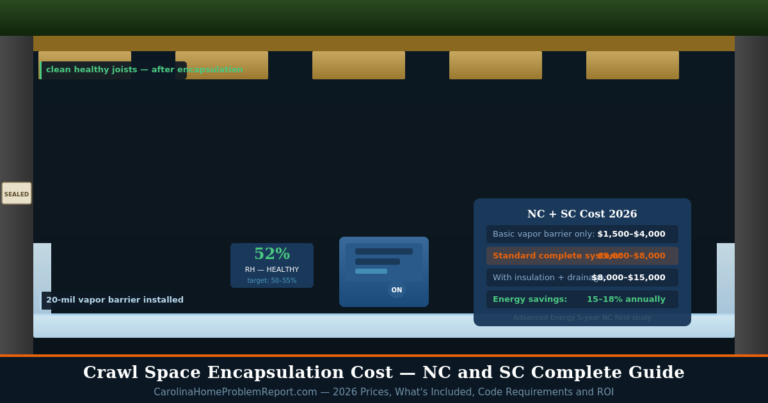
- ✓Encapsulation is the most effective long-term pest deterrent — a dry, sealed crawl space with no accessible entry points eliminates the conditions that attract and support every common crawl space pest
Crawl space pest control in Carolina is fundamentally a moisture management problem with a pest consequence — not a pest problem that happens to have moisture nearby. Every common pest found in Carolina crawl spaces is there because of the same conditions: high humidity, accessible entry points, and undisturbed darkness. Fix those conditions and pests have no reason to establish. Leave them and no pesticide treatment, trap, or bait station delivers a permanent solution.
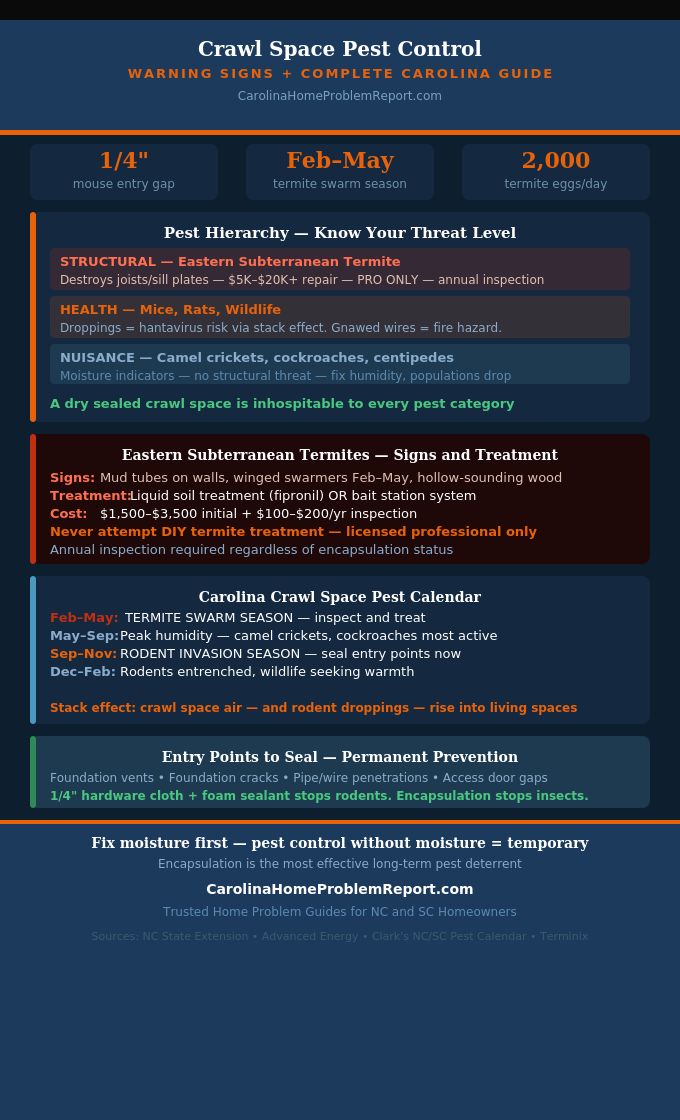
The pests themselves are not equivalent. Eastern subterranean termites cause structural damage to floor joists and sill plates that can cost $5,000–$20,000 to repair and requires professional licensed treatment. Rodents create health hazards from droppings and fire hazards from gnawed wiring. Camel crickets and centipedes are nuisances that confirm high humidity but cause no direct structural damage. Understanding which pest you have — and its consequence — determines the urgency and type of response needed.
This guide gives Carolina homeowners the complete picture of crawl space pest control — the specific pests by name and consequence, the Carolina seasonal pest calendar, the entry points every pest uses, the treatment approach for each pest category, and the permanent moisture-based prevention that makes other pest control measures last. According to NC State Extension's Healthy Homes program, moisture control is the foundation of any effective long-term pest prevention strategy in Carolina homes.
In This Article
- The Carolina Crawl Space Pest Hierarchy — Structural vs Health vs Nuisance
- Eastern Subterranean Termites — The Structural Threat
- Rodents — Mice, Rats, and Wildlife in Crawl Spaces
- Insects — Camel Crickets, Cockroaches, Ants, and Centipedes
- The Carolina Crawl Space Pest Calendar
- How Pests Get In — Entry Points to Seal
- Treatment Approaches — By Pest Type
- Frequently Asked Questions
The Carolina Crawl Space Pest Hierarchy — Structural vs Health vs Nuisance
Not all crawl space pests demand the same response urgency. Understanding the consequence category of the pest you are dealing with determines whether you need a licensed pest control professional today, whether rodent trapping is an appropriate first step, or whether you can simply improve humidity control and monitor.
| Pest | Category | Urgency | Primary Consequence |
|---|---|---|---|
| Eastern subterranean termite | STRUCTURAL | Immediate | Destroys floor joists, sill plates, and subfloor from within — $5,000–$20,000+ repair cost if unaddressed |
| Mice and rats | HEALTH | Prompt | Droppings contaminate air via stack effect — hantavirus risk. Gnawed wiring creates fire hazard. |
| Wildlife — squirrels, raccoons, opossums | HEALTH | Prompt | Larger damage to vapour barrier, insulation, and access openings. Requires wildlife removal specialist. |
| American cockroaches | NUISANCE | Monitor | Confirm moisture problem and entry points. Invade living spaces via stack effect. |
| Camel crickets (cave crickets) | NUISANCE | Monitor | Most common crawl space insect in Carolina — no structural damage. Large populations confirm high humidity. |
| Centipedes, millipedes | NUISANCE | Monitor | Moisture indicators only. Eliminate by reducing humidity — pesticide treatment rarely necessary. |
Eastern Subterranean Termites — The Structural Threat
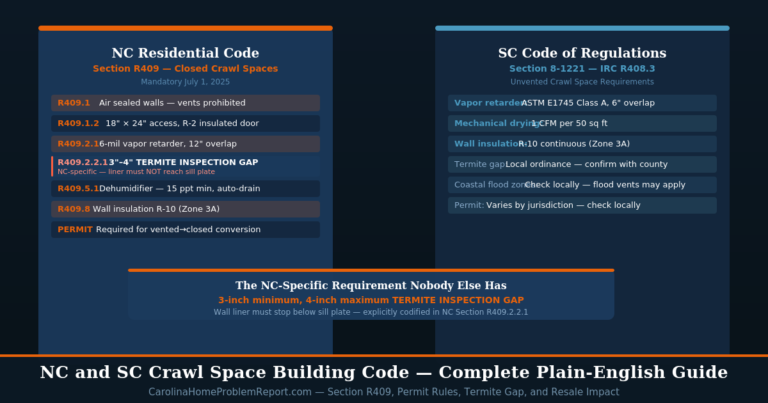
The Eastern subterranean termite is the most economically destructive pest in North Carolina and South Carolina. It is the species referenced in every crawl space building code requirement, the reason for the 3-inch termite inspection gap in NC Section R409, and the reason annual termite inspections are standard practice for Carolina homeowners. A colony is capable of causing structural damage within days of establishing contact with wood.
Why termites are so dangerous in Carolina crawl spaces
Eastern subterranean termites live in underground colonies in the moist soil surrounding and beneath your home. They travel through mud tubes — pencil-thin tunnels of soil and cellulose they build to protect themselves from open air as they move between the soil and the wood above. The NC Section R409 termite inspection gap requirement exists specifically so that annual pest inspectors can see these mud tubes at the foundation wall/sill plate junction — the most common entry point into a home's framing.
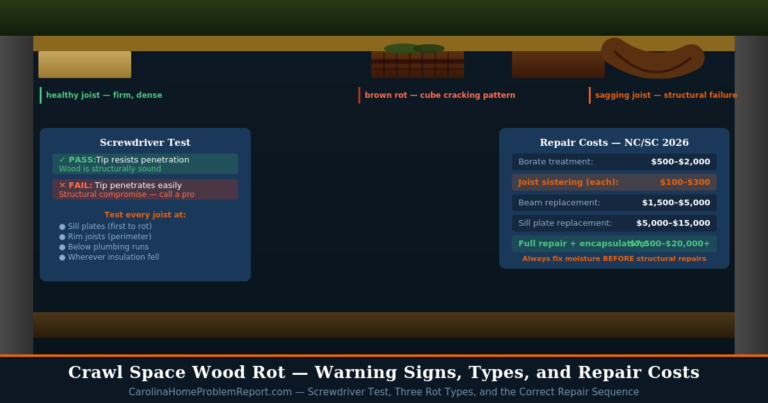
The conditions that attract termites to a specific home are the same conditions that produce wood rot: moist soil, moist wood, and high crawl space humidity. A crawl space with persistent moisture above 60% RH is significantly more attractive to termite activity than a properly sealed and dehumidified space.
Signs of termite activity in a crawl space:
- Mud tubes — pencil-thin soil tubes running vertically on foundation walls, piers, or from soil to sill plate
- Swarmers — winged termites (often confused with flying ants) around foundation vents or windows, especially February through May
- Hollow-sounding wood — joists that sound hollow when tapped but appear intact from the outside — termites consume from within
- Frass — powdery wood-coloured droppings near affected areas (more common with drywood termites but occasionally present)
- Buckling or sagging floors — advanced termite damage produces the same floor symptoms as advanced rot
Treatment options for Eastern subterranean termites:
- Liquid soil treatment (Termidor/fipronil): A liquid termiticide is applied to the soil around and beneath the foundation, creating a chemical zone termites cannot cross. The gold standard treatment for subterranean termites. Professional only — requires licensed applicator. Annual renewal typically not required but follow-up inspection is.
- Bait station systems (Sentricon): Bait stations installed in the soil around the perimeter intercept termite workers and deliver a slow-acting toxicant back to the colony. Effective but requires annual monitoring and station replenishment. Lower disruption than liquid treatment.
- Borate wood treatment: A borate-based preservative applied to accessible wood surfaces — prevents termites from establishing on treated wood. Used as a preventative and as a secondary treatment alongside liquid or bait systems. Not effective against established active infestations on its own.
- What does NOT work for subterranean termites: DIY foam sprays, over-the-counter pesticide products, and vinegar or orange oil treatments have no reliable efficacy against Eastern subterranean termite colonies. This pest requires licensed professional treatment.
Rodents — Mice, Rats, and Wildlife in Crawl Spaces
Rodents in crawl spaces are a year-round concern in Carolina, with peak invasion periods in autumn when temperatures drop and mice and rats seek shelter. A mouse needs a gap of only 1/4 inch — smaller than a dime — to enter a crawl space. Rats need approximately 1/2 inch. Given the typical number of pipe penetrations, foundation cracks, and vent gaps in an older Carolina home, rodent exclusion without deliberate sealing is essentially impossible.
Signs of rodent activity in a crawl space:
- Dark rice-grain-sized droppings on the vapour barrier or crawl space floor
- Gnaw marks on wiring, insulation, vapour barrier, or wood
- Nesting material — shredded insulation, paper, or fabric in secluded areas
- Grease marks along the foundation walls or at entry points — rodents follow the same routes repeatedly and leave grease trails
- Scratching or scurrying sounds, especially at night
- A strong ammonia-like smell from rodent urine concentration
⚠️ The stack effect — how rodent droppings reach your living space
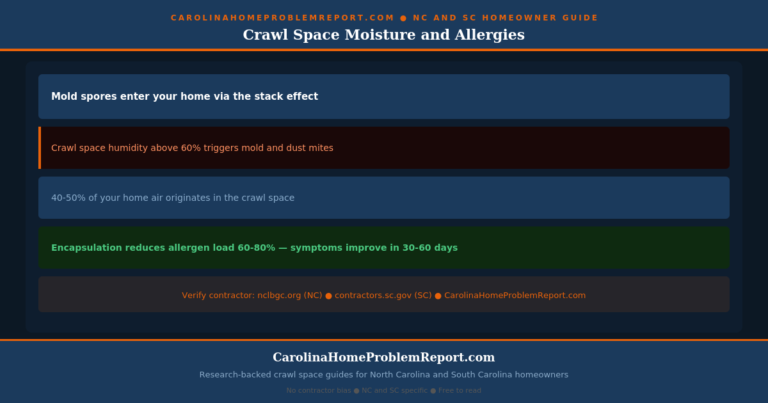
In any home with a crawl space, air moves upward continuously through the building via the stack effect — warm air rises from the crawl space into living areas through floor gaps, HVAC penetrations, and around pipes. This air movement carries crawl space air — including airborne particles from rodent droppings — directly into the living space above. Rodent droppings in a crawl space are not safely isolated from the indoor environment. This is why hantavirus risk is a legitimate concern with rodent infestations in crawl spaces.
Rodent control — correct sequence:
Identify and seal all entry points — 1/4 inch minimum clearance to hardware cloth (1/4-inch galvanised steel mesh) or caulk and foam. Steel wool stuffed into gaps holds rodents temporarily but must be combined with hard blocking.
Trap existing population — snap traps placed along the foundation walls and in corners where grease trails indicate rodent runs. Glue boards for supplemental monitoring. Check every 1–2 days.
Remove contaminated material — rodent droppings, nesting material, and damaged insulation should be removed and disposed of with full PPE (N95 minimum). Do not vacuum dry droppings — this aerosolises particles. Dampen first with a bleach solution.
Fix moisture to remove the attraction — a sealed, dehumidified crawl space with a high-quality vapour barrier is significantly less attractive to rodents than a damp open crawl space with abundant insulation for nesting.
Insects — Camel Crickets, Cockroaches, Ants, and Centipedes
The Carolina Crawl Space Pest Calendar
| Season | Primary Pest Activity | Action |
|---|---|---|
| Feb–May (Spring) | Termite swarm season — peak swarming after warm rain events. Ants search for food indoors. Cockroaches become more active. | Schedule annual termite inspection. Check for mud tubes. Review foundation perimeter. |
| May–Sep (Summer) | Peak humidity — camel crickets, cockroaches, centipedes most active. Termite workers feeding continuously. Insects breed rapidly. | Confirm dehumidifier running. Monitor RH monthly. Large insect populations confirm humidity control is needed. |
| Sep–Nov (Autumn) | Peak rodent invasion season — mice and rats seek shelter as temperatures drop. Leaf piles and wood stacks attract pests near foundation. | Inspect and seal entry points before November. Clear organic material from foundation perimeter. Install snap traps. |
| Dec–Feb (Winter) | Rodents entrenched in shelter. Cockroaches move indoors for warmth. Squirrels and opossums may access crawl space for warmth. | Continue trapping. Inspect crawl space access for new wildlife entry. Schedule termite pre-season inspection late February. |
How Pests Get In — Entry Points to Seal
Every pest in a crawl space entered through a specific gap, crack, or opening. Sealing those entry points is the most durable pest prevention measure available. The complete list of entry points to address:
- Foundation vents (open): The largest entry point for insects and rodents. Rigid foam inserts with spray foam sealant edges (for encapsulation) or pest-proof vent covers with 1/4-inch galvanised hardware cloth (for vented spaces)
- Foundation cracks: Any crack in the masonry foundation wall larger than 1/4 inch is a potential mouse entry point. Seal with hydraulic cement or appropriate masonry patching compound
- Pipe and conduit penetrations: Every pipe and wire entering the crawl space through the foundation or sill plate has a gap around it. Seal with one-component spray foam for small gaps, steel wool plus foam for larger gaps, or pipe collar for large penetrations
- Access door gaps: The crawl space access hatch or door is often poorly sealed. Add weatherstripping and a latch to minimise the air gap around the perimeter of the access
- Sill plate and rim joist gaps: The junction between the sill plate and foundation wall, and between the rim joist and sill plate, often has air gaps. Sealing these is part of the encapsulation air sealing requirement and simultaneously removes pest entry pathways
- Foundation wall/soil junction: Where the foundation meets the soil grade is often a gap zone for insects. Maintaining clear, bare soil around the foundation — no mulch, no wood, no organic material within 12 inches of the foundation wall — reduces the concealment that insects use to reach this entry zone
Treatment Approaches — By Pest Type
Termites — Professional treatment required — always
Never attempt DIY termite treatment for Eastern subterranean termites. Licensed pest control — soil treatment with fipronil or bait station programme — is the only effective approach. Cost: $1,500–$3,500 for initial treatment plus annual renewal/monitoring contracts. Annual inspection: $100–$200/year.
Rodents — DIY accessible with commitment; professional escalation for large infestations
Snap traps, entry point sealing, and contaminated material removal are all achievable DIY work. For large infestations or for homes with repeated rodent problems despite sealing, a licensed pest control company with a rodent exclusion programme is the most reliable solution. Cost DIY: $50–$200 materials. Professional exclusion programme: $400–$1,000 initial, $200–$400/year for monitoring contracts.
Camel crickets, centipedes, millipedes — humidity control first
Pesticide treatment for these species is rarely necessary or effective as a standalone measure because they recolonise from outside as long as conditions are favourable. Reduce crawl space humidity below 60% RH with a properly sized dehumidifier and the population declines within one season. Glue traps placed inside the crawl space can reduce existing populations during transition.
Cockroaches — perimeter treatment plus sealing
Gel bait stations inside the crawl space near entry points and along the foundation walls address existing populations. Sealing plumbing penetrations through the subfloor and encapsulating the crawl space removes the moist environment they prefer. Perimeter liquid sprays by a licensed pest control company provide additional population reduction. Persistent cockroach problems in coastal SC and Eastern NC often require quarterly professional treatment.
Frequently Asked Questions
What pests are most common in Carolina crawl spaces?
The most common crawl space pests in NC and SC are camel crickets (most prevalent insect — humidity indicator, no structural threat), Eastern subterranean termites (most destructive — structural threat requiring professional treatment), mice and rats (health hazard from droppings and wire gnawing), and American cockroaches (moisture indicators that invade living spaces). The specific mix depends on your location — coastal SC and Eastern NC see higher cockroach and termite pressure; Piedmont homes deal more with rodents and moisture insects.
Does crawl space encapsulation prevent pests?
Yes — significantly. A properly encapsulated crawl space with sealed vents, a 20-mil vapour barrier, and a running dehumidifier eliminates the moisture and accessibility conditions that attract and support every common Carolina crawl space pest. Eastern subterranean termites still require an active protection programme regardless of encapsulation, but every other pest category is substantially deterred by a properly sealed and dehumidified crawl space. Many Carolina homeowners report that pest activity dropped dramatically in the first season after encapsulation without any additional pest treatment.
How do I know if I have termites in my crawl space?
The most reliable signs are mud tubes — pencil-thin soil tunnels running vertically along foundation walls or piers — and winged swarmers, which appear near foundation vents and windows in February through May in NC and SC. Hollow-sounding wood that appears intact is another indicator. Annual professional termite inspections are the most reliable detection method — Eastern subterranean termites are specifically designed by evolution to remain hidden, and homeowner visual inspection catches only the most advanced or obvious infestations.
What are the jumping bugs in my crawl space?
Almost certainly camel crickets — the most common crawl space insect in Carolina homes. They are large (up to 1.5 inches), humpbacked, tan-brown, with extremely long antennae and long jumping legs. Despite their alarming appearance they are completely harmless — they do not bite, do not sting, and do not damage structures. Their population size directly reflects crawl space humidity levels. Large numbers of camel crickets are a reliable indicator that your crawl space is too humid and needs moisture control attention.
How do I get rid of mice in my crawl space?
The correct sequence is: seal all entry points (1/4-inch or larger gaps with hardware cloth and foam), set snap traps along foundation walls where grease trails indicate rodent runs, check and reset traps every 1–2 days, and once the population is controlled, remove all contaminated insulation and droppings using PPE. The permanent solution is encapsulation — a sealed crawl space with no open vent or foundation gaps gives rodents no accessible entry point. For large infestations or persistent recurrence, a licensed pest control company's exclusion programme is the most effective resolution.
Crawl space pest control in Carolina comes back to the same principle that governs every other crawl space problem: moisture is the root cause, and every pest control measure that does not also address moisture is a temporary fix. A dry, sealed crawl space is naturally inhospitable to Eastern subterranean termites (which need moist soil and wood), rodents (which need water and nesting materials), cockroaches (which need humidity and warmth), and camel crickets (which need moisture and darkness). Fix the moisture — through encapsulation, dehumidification, and vapour barrier — and the pest problem becomes significantly more manageable with or without any additional treatment.
The exception is Eastern subterranean termites, which require active professional protection regardless of crawl space moisture status — a dry crawl space makes you less attractive to new colony establishment but does not eliminate risk from existing nearby colonies. Annual termite inspections are non-negotiable in NC and SC regardless of how well-sealed your crawl space is.
Find a Crawl Space Professional Near You →The Carolina Home Problem Report editorial team researches and writes guides for homeowners across North and South Carolina. Our research draws on NC State Extension Healthy Homes publications, Advanced Energy field studies, Clark's Termite and Pest Control pest calendar data, and insights from licensed Carolina pest control and crawl space contractors. We are not contractors or pest control professionals — we are a research team dedicated to giving Carolina homeowners clear, locally specific, unbiased answers.
Carolina Home Problem Report is an informational resource for homeowners. We are not licensed pest control professionals or contractors. Always consult a licensed pest control company for termite treatment and significant pest infestations. See our Disclaimer.