Crawl Space Encapsulation Before and After [Shocking Real Results — Humidity, Energy, Air Quality, and Resale Value in Carolina]
After crawl space encapsulation in a Carolina home, humidity typically drops from 80–90% RH to below 55% RH within days. Wood moisture content stabilises below 19%. The musty smell that rose through the floor is gone within weeks. Energy bills drop by approximately 15%. Pest activity declines dramatically. The transformation is measurable, documented, and permanent — provided the system is installed correctly and maintained.
⭐ Key Takeaways
- ✓Humidity change is the fastest result — dehumidifier operation begins dropping RH readings within 24–48 hours of a completed installation
- ✓Up to 40% of first-floor indoor air in a crawl space home comes directly from the crawl space — sealing the space directly improves indoor air quality above the floor
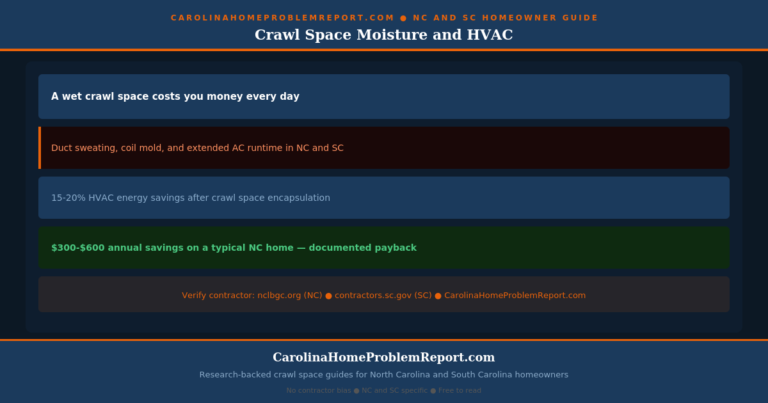
- ✓Energy bill reduction of approximately 15% is documented for Southeast homes after encapsulation — HVAC runs less when crawl space heat and humidity are no longer entering the conditioned space
- ✓An encapsulated crawl space is a documented selling point in the Carolina real estate market — buyers and their agents specifically look for it and it reduces liability from moisture-related issues at resale
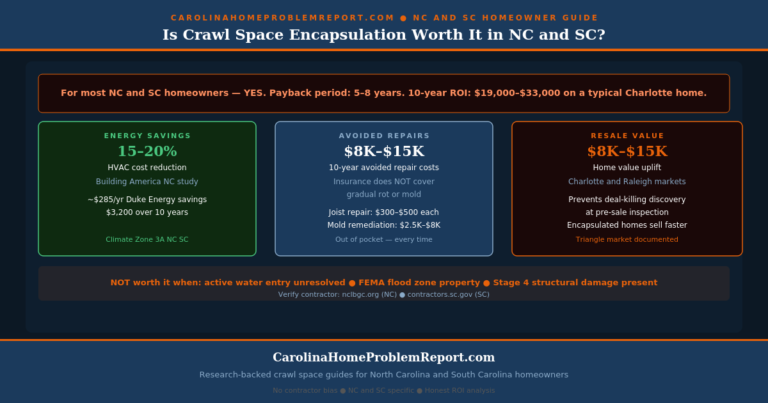
- ✓Encapsulation pays for itself within 5–10 years in the Southeast from energy savings alone — before accounting for avoided structural repair costs
Crawl space encapsulation before and after is the question homeowners ask when they are trying to justify a $5,000–$10,000 project to themselves and their family. The concept makes intuitive sense — seal the space, add a dehumidifier, improve the conditions under the home. But what does it actually look like in measurable terms? What changes and by how much? How quickly? And does the investment deliver the results contractors promise?
According to Advanced Energy's North Carolina crawl space research, 70–90% of older Southeast homes already have moisture-damaged insulation or mold when first professionally inspected. For those homes, encapsulation does not just improve conditions — it stops an active deterioration process. The before state is a crawl space progressively damaging the home above it. The after state is a stable, controlled environment that protects structural wood, discourages pests, and improves the air quality in every room above.
This article gives Carolina homeowners the specific, measurable before-and-after data for every category that encapsulation affects — humidity, wood moisture, energy performance, indoor air quality, pest activity, visual transformation, and resale value. Each category includes the typical before state for a Carolina home, the expected after state, and the timeline for that change to occur.
In This Article
- What Changes After Crawl Space Encapsulation — Overview
- Humidity — Before and After Numbers
- Wood Moisture Content — Before and After
- Energy Performance — Before and After
- Indoor Air Quality — Before and After
- Pest Activity — Before and After
- Visual Transformation — What the Space Looks Like
- Resale Value — Before and After Impact
- Timeline — When Each Change Occurs
- Frequently Asked Questions
What Changes After Crawl Space Encapsulation — Overview
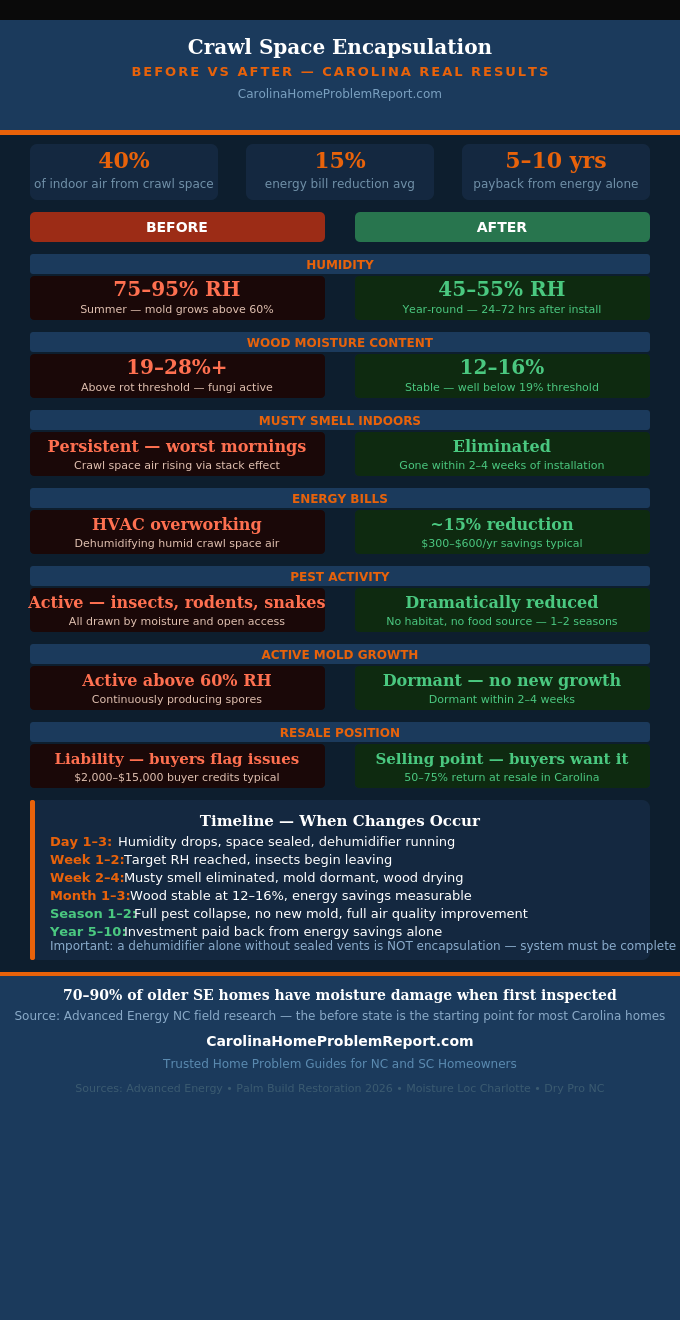
Encapsulation changes seven measurable aspects of a Carolina home. Some changes occur within hours. Others develop over months. Understanding the timeline sets realistic expectations and helps homeowners confirm the installation is performing correctly:
| Category | Before | After | Timeline |
|---|---|---|---|
| Crawl space RH | 70–90%+ in summer | Below 55% year-round | 24–72 hours |
| Wood moisture content | 19–30%+ in damp areas | Below 15% stabilised | 2–8 weeks |
| Musty smell indoors | Persistent — worst mornings | Eliminated | 2–4 weeks |
| Energy bills | HVAC overworking in summer | ~15% reduction | First full billing cycle |
| Pest activity | Insects, rodents, snakes | Dramatically reduced | 1–2 seasons |
| Active mold growth | Active if humidity above 60% | Dormant — no new growth | 2–4 weeks |
| Resale position | Potential liability — buyers flag | Documented selling point | Immediate on completion |
Humidity — Before and After Numbers
What to measure and when
A reputable contractor will take before readings before installation begins and document after readings 48–72 hours after completion. Ask for both sets of readings as part of your project documentation — they confirm the system is working and provide baseline data for future inspections. A data-logging hygrometer left in the crawl space for the first month after installation shows the full performance curve and confirms the dehumidifier is adequately sized for your specific crawl space volume.
Wood Moisture Content — Before and After
Energy Performance — Before and After
The energy impact of crawl space encapsulation in Carolina homes comes from two mechanisms — reduced moisture load on the HVAC system, and improved thermal performance from wall insulation.
Indoor Air Quality — Before and After
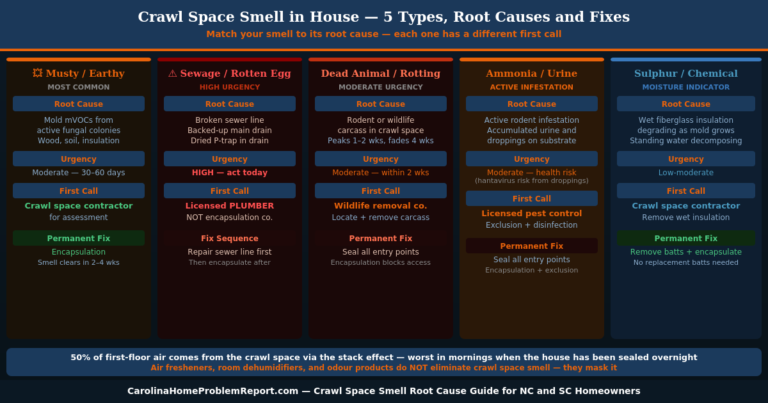
The stack effect means the crawl space and the living space above it share air — not completely, but significantly. Up to 40% of first-floor indoor air in a crawl space home comes directly from the crawl space. This makes what happens below the floor directly relevant to indoor air quality above it.
The morning smell test
One of the most common homeowner-reported results after encapsulation is the elimination of the morning musty smell. This smell — strongest first thing in the morning before the home has aired — is the direct product of crawl space air rising overnight via the stack effect. When homeowners report this smell is gone within 3–4 weeks of encapsulation, it is a reliable indicator that the system is working and the mold/moisture source below the floor has been addressed.
Pest Activity — Before and After
Visual Transformation — What the Space Looks Like
The visual transformation is the most immediately striking aspect of encapsulation — contractors often show before/after photos precisely because the contrast is so dramatic:
Before — What you typically see:
- Exposed dark soil or old torn vapour barrier
- Fallen or sagging insulation in bays
- Dark stained joists with mold or discolouration
- Condensation on pipes and ducts
- Spider webs throughout
- Open foundation vents with broken screens
- Rodent droppings on substrate
- Rust on metal components
After — What a completed encapsulation looks like:
- Bright white or silver heavy-duty liner covering all soil and walls
- Sealed vents with no outdoor air entry
- Insulated foundation walls and rim joists
- Clean, accessible space — some homeowners use it for storage
- Commercial dehumidifier running quietly with auto-drain
- All piers wrapped and taped
- No condensation on any surfaces
- Air in the space smells clean — no earthy or musty odour
Resale Value — Before and After Impact
The resale impact of crawl space encapsulation in Carolina real estate has become increasingly significant as buyer awareness of crawl space conditions has grown.
⚠ Before encapsulation — resale risks:
- A buyer's home inspector flagging moisture damage, mold, or structural concerns in the crawl space triggers buyer credit requests — typically $2,000–$15,000 depending on severity
- FHA and VA loan appraisals may note crawl space moisture conditions as repair requirements before loan approval
- Buyers with crawl space awareness — increasingly common in the Carolina market — negotiate harder on homes with vented, unencapsulated crawl spaces
- Unpermitted prior crawl space work compounds the issue if the work is sub-standard
✅ After encapsulation — resale benefits:
- Permitted, documented encapsulation with contractor close-out paperwork is a genuine selling point — listing agents in the Raleigh, Charlotte, and Greenville SC markets increasingly include it in listings
- Home inspectors give positive reports on properly encapsulated spaces — reduces the friction and negotiation in the sale process
- The encapsulation investment partially comes back in resale value in the Carolina market — estimated at 50–75 cents on the dollar in high-demand markets
- Eliminates the moisture liability that can kill deals at the inspection contingency stage
Timeline — When Each Change Occurs
Understanding the timeline of changes helps homeowners know what to expect and when — and helps them verify the system is performing correctly at each stage:
Dehumidifier begins operation. Crawl space RH drops measurably within 24 hours. Entry points sealed — no new outdoor air entering. Visible transformation of the space complete.
Crawl space RH reaches and holds target range (45–55%). First energy bill improvement may appear if installation coincided with peak AC season. Insects without moisture habitat begin leaving or declining.
Musty smell in the living space diminishes and in most cases is completely eliminated. Active mold on wood surfaces becomes dormant. Wood moisture begins measurably declining from its pre-encapsulation reading.
Wood moisture content stabilises at 12–16%. Energy bill reduction becomes measurable across full billing cycles. Camel cricket and insect populations in crawl space at a fraction of pre-encapsulation levels.
Rodent activity in crawl space at near zero with all entry points sealed. Full pest population collapse. Wood that was at the fungal risk threshold has now been below 19% moisture for long enough that existing fungal activity is dormant with no regrowth.
Cumulative energy savings have offset a meaningful portion of the encapsulation investment. The structural wood under the home has been in a stable, low-moisture environment for years — rot progression has stopped and wood has maintained its strength. No repeat moisture treatment costs. The encapsulation investment has paid for itself.
Frequently Asked Questions
How quickly does crawl space encapsulation work?
The fastest change is humidity — the dehumidifier begins dropping crawl space RH readings within 24 hours of installation and typically reaches the target range of 45–55% RH within 48–72 hours. The musty smell in the living space above diminishes within 2–4 weeks. Wood moisture content stabilises over 4–8 weeks. Energy bill impact shows up in the first full billing cycle after installation. Pest population decline happens over the first season as the food source and habitat are removed.
Will crawl space encapsulation reduce my energy bills?
Yes — approximately 15% reduction in HVAC energy costs is the documented average for Southeast homes after encapsulation. The mechanism is twofold: the HVAC no longer has to dehumidify and condition the humid crawl space air that was rising through the floor via the stack effect, and the R-10 wall insulation and rim joist insulation reduce heat transfer across the floor assembly. On a typical Carolina home, this translates to $300–$600 per year in energy savings depending on home size and current energy costs.
Does crawl space encapsulation eliminate mold?
Encapsulation stops new mold growth by eliminating the moisture conditions mold needs to survive. Existing mold colonies on wood surfaces become dormant when humidity drops below 60% RH consistently — they do not produce new spores and do not spread. The visible mold on joists does not disappear on its own — it needs professional remediation if it is extensive. For light surface mold on structurally sound joists, many contractors treat with a borate or fungicidal spray as part of the encapsulation project. Always confirm with your contractor what mold treatment is included in the scope.
Is crawl space encapsulation worth it in NC or SC?
According to NC State Extension and consistent with Advanced Energy's field research, proper moisture control in Carolina crawl spaces is one of the highest-return home maintenance investments available — particularly for homes with existing moisture issues. The case is strongest in homes with a history of musty smells, pest activity, soft floors, or moisture-damaged insulation. For newer homes with no moisture history and consistently below 60% RH crawl space readings, a quality vapour barrier alone may be sufficient and full encapsulation may not be necessary. The decision depends on the specific conditions under your home — a professional assessment is the best way to determine which scope is appropriate.
What should I measure after crawl space encapsulation to confirm it is working?
Three measurements confirm the system is performing correctly: crawl space RH (should be below 55% consistently), wood moisture content on floor joists (should be trending toward and staying below 19%), and dehumidifier run time (should be decreasing over the first few months as the wood and materials dry out). A data-logging hygrometer left in the crawl space for the first 30–60 days after installation provides the most complete performance picture. Ask your contractor for their before measurements and compare your 30-day and 90-day readings against them.
The before-and-after transformation of crawl space encapsulation in a Carolina home is measurable, documented, and — when the installation is done correctly — permanent. Humidity from 85% to 50%. Wood moisture from 25% to 14%. The morning smell is gone. The energy bills are lower. The pest calls stop. And when you go to sell, the buyer's inspector finds a clean, dry space rather than a liability.
The qualifier is "done correctly" — a complete system with a high-quality liner, fully sealed vents, R-10 wall insulation, and an adequately sized dehumidifier. The components work as a system. A vapour barrier alone without sealed vents and a dehumidifier is not encapsulation — it is a partial solution that delivers partial results. Make sure you understand exactly what is included in any contractor proposal before signing.
Get a Free Crawl Space Assessment →The Carolina Home Problem Report editorial team researches and writes guides for homeowners across North and South Carolina. Our research draws on Advanced Energy NC field studies, Palm Build Restoration 2026 encapsulation data, Moisture Loc Charlotte NC contractor data, Dry Pro Foundation NC guidance, and insights from licensed Carolina crawl space contractors. We are not contractors — we are a research team dedicated to giving Carolina homeowners clear, locally specific, unbiased answers.
Carolina Home Problem Report is an informational resource for homeowners. We are not licensed contractors. Always consult a qualified professional before making decisions about crawl space work. See our Disclaimer.