Dangerous Humidity in Crawl Space [4 Sources + The Complete Fix Sequence for Carolina Homes]
High humidity in crawl space is caused by ground moisture evaporating from exposed soil, outdoor humid air entering through foundation vents, water intrusion after rain, and plumbing leaks or HVAC condensation. In the Carolinas, the target crawl space humidity is 45–55% year-round. Above 60% consistently, mold growth on wood surfaces becomes active. Above 70%, structural damage is accelerating. The fix requires identifying and eliminating moisture sources — not just running a dehumidifier against an uncorrected problem.
⭐ Key Takeaways
- ✓Target crawl space humidity for Carolina homes is 45–55% relative humidity year-round — anything above 60% consistently requires action
- ✓Up to 50% of the air you breathe inside your home comes from the crawl space via the stack effect — crawl space humidity becomes indoor air humidity
- ✓Open foundation vents make crawl space humidity worse in Carolina summers — not better — by continuously importing high-dew-point outdoor air
- ✓A dehumidifier alone will not solve high crawl space humidity if the moisture sources are not first reduced — it will run constantly and still struggle
- ✓High crawl space humidity increases your HVAC energy costs — your air conditioner works harder to dehumidify air rising from a moisture-laden crawl space
Humidity in a crawl space is the single most pervasive moisture problem Carolina homeowners face — more common than standing water, more persistent than condensation, and more damaging over time precisely because it is invisible and easy to ignore. You cannot see humidity. You can only see what it does over months and years: the black staining spreading across floor joists, the insulation hanging in wet clumps, the floors that have begun to feel softer than they used to, the HVAC bill that has quietly crept upward.
High humidity in a crawl space is dangerous not because it is dramatic but because it is patient. It works slowly and steadily on every wood surface, every piece of insulation, and every metal component beneath your floors. By the time most Carolina homeowners discover the problem, it has been working on their home for one or more full summers.
This guide gives you the complete framework for understanding crawl space humidity in a Carolina home — what the numbers mean, what levels require action, where the humidity is coming from, and what the correct fix sequence looks like.
In This Article
- Crawl Space Humidity Levels — What the Numbers Actually Mean
- The Stack Effect — How Crawl Space Humidity Enters Your Home
- 4 Sources of High Humidity in Carolina Crawl Spaces
- Warning Signs Your Crawl Space Humidity Is Too High
- How to Measure Crawl Space Humidity — Hygrometer Placement Guide
- The Complete Fix Sequence — In the Right Order
- Frequently Asked Questions
Crawl Space Humidity Levels — What the Numbers Actually Mean
Humidity in a crawl space is measured as relative humidity — the percentage of moisture in the air relative to the maximum moisture the air can hold at that temperature. A hygrometer placed in the crawl space gives you a reading. Here is what each range means for your Carolina home and what action it requires.
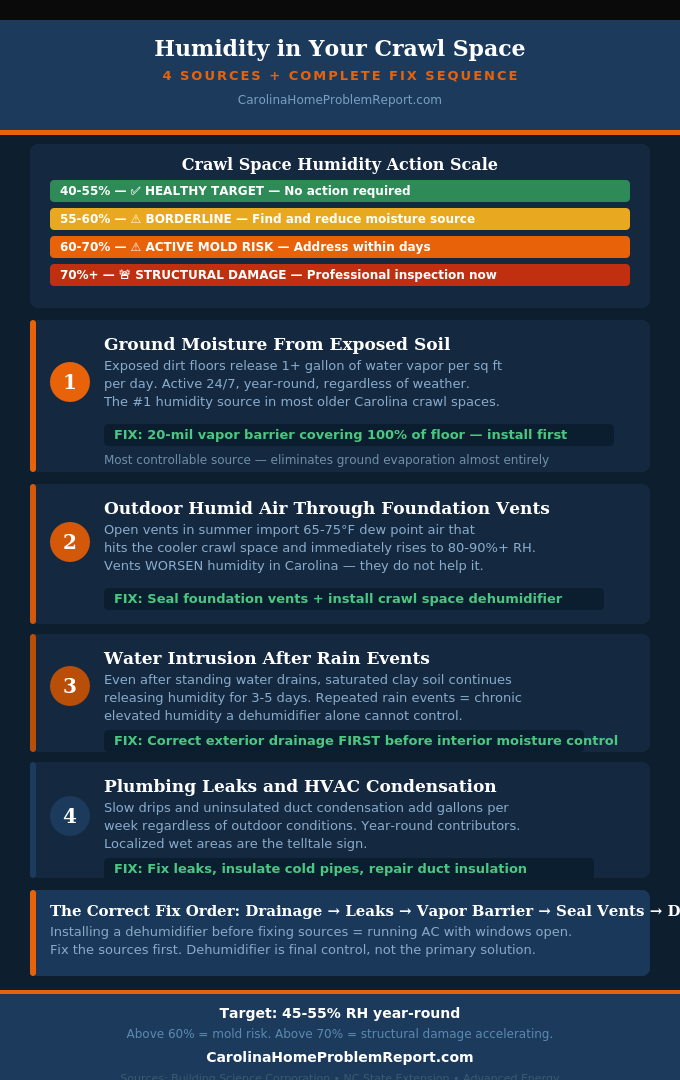
This is the target zone for a Carolina crawl space. Mold cannot colonize at this humidity level. Wood surfaces remain stable. Maintain this range year-round through sealed vents, vapor barrier, and a properly sized dehumidifier if needed.
Below the mold threshold but trending in the wrong direction. Consistently in this range during summer means moisture sources are active. Find and reduce the source. Consider a dehumidifier if not already installed.
Above 60% consistently, mold can actively colonize wood surfaces. Inspect immediately. Install a dehumidifier if not present. Identify and eliminate moisture sources. This is not a monitor-and-wait situation.
At this level mold is likely already established on wood surfaces and wood rot may have begun. Inspect carefully for soft wood, discoloration, and mold growth. Professional inspection may be needed before encapsulation work proceeds.
Above 80% RH, condensation is forming on multiple surfaces, mold is actively growing, and structural components are likely already affected. Schedule a professional inspection immediately. Do not encapsulate without first remediating any existing mold.
The Stack Effect — How Crawl Space Humidity Enters Your Home
Understanding why crawl space humidity matters beyond the crawl space itself requires understanding the stack effect. According to Building Science Corporation, up to 50% of the air inside a home with a crawl space foundation comes from that crawl space. Here is why.
How the Stack Effect Works
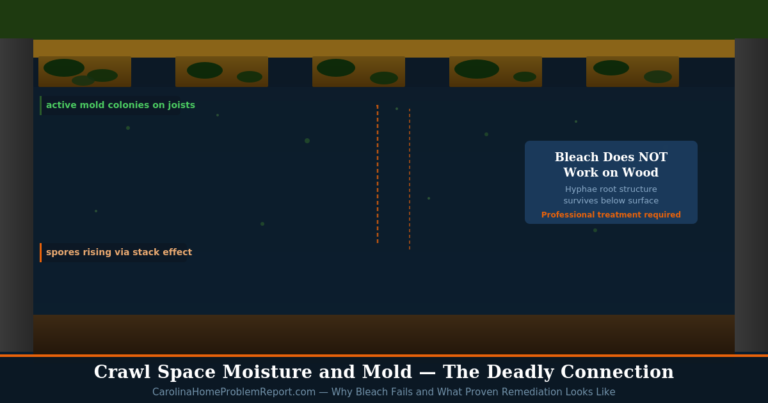
Warm air rises. As warm air inside your home rises and escapes through the upper floors and attic, it creates a low-pressure zone in the lower levels of the house. That low pressure pulls replacement air upward from the crawl space through gaps in the subfloor — around pipes, wires, ductwork penetrations, and any other opening between the crawl space and the living space above. If the crawl space has humidity at 75%, mold spores, and musty odors, that is what gets pulled into your living space.
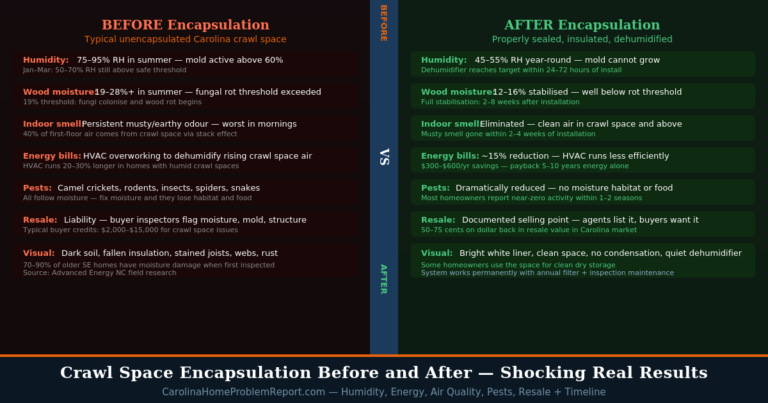
The stack effect also explains why high crawl space humidity drives up your energy bills. When humid air is pulled from the crawl space into the living area, your air conditioning system has to remove that moisture from the air — which requires significant energy. Research from Advanced Energy and NC State Climate Office shows sealed crawl spaces use 15–18% less energy for heating and cooling than vented ones.
4 Sources of High Humidity in Carolina Crawl Spaces
Warning Signs Your Crawl Space Humidity Is Too High
Signals Inside the Living Space
- Musty smell on the first floor, especially in the morning
- Floors that feel softer, springier, or creak differently
- Elevated indoor humidity even when the AC is running
- Increased allergy or respiratory symptoms
- Higher-than-expected HVAC energy bills
Signals Inside the Crawl Space
- Black, white, or grey mold on floor joists
- Insulation hanging down or visibly wet
- Wood that feels soft or spongy when pressed
- White chalky deposits on foundation walls
- Hygrometer reading consistently above 60%
How to Measure Crawl Space Humidity — Hygrometer Placement Guide
A hygrometer is the only reliable way to know what your crawl space humidity actually is. They cost $15–$30 at most hardware stores. Here is how to use one correctly:
Place the hygrometer in the center of the crawl space — not near a vent, not near the access hatch, not on the ground. Hang it from a joist at mid-height.
Leave it for at least 24 hours before recording a reading. Most hygrometers have a MIN/MAX feature — record the maximum reading over 24 hours, not the reading at the moment you enter.
In large crawl spaces, place two hygrometers — one in each half. Humidity can be significantly higher near a specific moisture source. The higher reading is the one that matters.
Check readings during peak season. A reading taken in January tells you very little about summer conditions. Readings taken in July and August capture peak humidity when damage is occurring fastest.
Consider a WiFi-enabled hygrometer for ongoing monitoring. Several models allow you to monitor crawl space humidity remotely from your phone — a worthwhile investment that lets you catch rising humidity before damage occurs.
The Complete Fix Sequence — In the Right Order
The order of these steps matters. Installing a dehumidifier before addressing moisture sources is like bailing a boat without plugging the leak. Here is the correct sequence for a Carolina home with high crawl space humidity:
Fix exterior drainage first. Clean gutters, extend downspouts, correct negative grading. If water is entering from outside, eliminate that source before doing anything inside.
Fix any plumbing leaks and repair duct insulation. Eliminate any active water sources inside the crawl space before installing moisture control systems.
Install a 20-mil vapor barrier covering 100% of the floor. Seal all seams, extend up the walls, and secure it. Do not leave any exposed soil.
Seal foundation vents. Use rigid foam cut to fit each vent opening or purpose-made vent covers. After sealing, the crawl space is now a closed system that requires active humidity management.
Install a properly sized crawl space dehumidifier. Size the dehumidifier for your crawl space square footage — do not use a standard room dehumidifier. Set the target to 50–55% RH and connect to a drain or condensate pump.

Monitor with a hygrometer and verify the system is working. Check readings at 30 and 60 days after installation. Target: 45–55% RH consistently. If the dehumidifier is running continuously and struggling to reach target, a moisture source was missed in the earlier steps.
Frequently Asked Questions
What is a dangerous humidity level in a crawl space?
Above 60% consistently is dangerous because mold can actively colonize wood surfaces at this level. Above 70% means structural damage is likely accelerating. Above 80% is a critical situation requiring immediate professional attention. The target for a Carolina crawl space is 45–55% year-round.
Will a dehumidifier alone fix high crawl space humidity?
Not if the moisture sources are uncorrected. Fix the sources first — vapor barrier, sealed vents, drainage — then the dehumidifier becomes an effective final layer of control that maintains your target humidity automatically.
Is high crawl space humidity normal in the Carolinas?
High outdoor humidity is normal. High crawl space humidity is common but not normal — and not inevitable. Properly managed crawl spaces in NC and SC consistently maintain 45–55% RH year-round even in the hottest, most humid summers. The difference is having the right combination of vapor barrier, sealed vents, and active dehumidification in place.
How does crawl space humidity affect my energy bills?
Through the stack effect, humid crawl space air is continuously pulled into your living space. Your air conditioning system has to remove that moisture — a process that requires significant energy. Advanced Energy and NC State Extension research found that sealed crawl spaces use 15–18% less energy for heating and cooling than vented crawl spaces.
How do I know if my crawl space humidity is causing mold?
Visually inspect floor joists and rim joists for black, white, or grey fuzzy growth. A musty smell inside the first floor is a strong indicator. Press a screwdriver tip firmly against joist locations — soft or crumbly wood indicates rot has begun. A hygrometer reading consistently above 60% in summer means mold conditions are active even if visible growth has not yet appeared. Understanding why your crawl space is damp is the first step in solving the root cause.
💡 Ready for Step 5? Choose the Right Dehumidifier for Your Crawl Space
Once you have sealed vents and installed a vapor barrier, a properly sized commercial crawl space dehumidifier is the final piece that holds humidity at 50–55% year-round. Argendon’s range is sized by square footage for every Carolina home. Use code CHPR3 for 3% off.
Shop Argendon Dehumidifiers → Code CHPR3 saves 3% at checkout- High crawl space humidity is the defining moisture challenge for Carolina homeowners — the region’s climate creates conditions where unmanaged crawl spaces routinely exceed the 60% RH mold threshold.
- A dehumidifier does not work reliably against uncorrected moisture sources — the fix sequence is drainage first, then vapor barrier, then sealed vents, then dehumidifier as the final active control layer.
- The stack effect means up to 50% of the air inside your home comes from the crawl space — high crawl space humidity directly raises indoor humidity and energy costs.
- A $20 hygrometer placed in your crawl space for 24 hours tells you more about the health of your home than almost any other single action you can take — readings above 60% require immediate action.
- Sealed crawl spaces with proper dehumidification use 15–18% less energy for heating and cooling than vented crawl spaces, according to Advanced Energy’s 5-year NC field study.
The Carolina Home Problem Report editorial team researches and writes guides for homeowners across North and South Carolina. Our research draws on NC State Extension Service publications, Clemson Extension resources, EPA guidelines, Building Science Corporation data, and insights from licensed Carolina contractors. We are not contractors — we are a research team dedicated to giving Carolina homeowners clear, locally specific, unbiased answers.
📚 Key Concepts — Reference Sources
- Relative Humidity (Wikipedia) — The percentage of moisture in air that determines mold risk; above 60% enables active mold growth on wood
- Stack Effect (Wikipedia) — The air movement mechanism that carries crawl space humidity into your home's living areas
- Wood-Decay Fungus (Wikipedia) — The fungi that colonise floor joists and subfloor when crawl space humidity remains above 60% RH
Carolina Home Problem Report is an informational resource for homeowners. We are not licensed contractors or mold assessors. Always consult a qualified professional before making home repair decisions. See our Disclaimer and Affiliate Disclosure.