Crawl Space Dehumidifier [The Ultimate Carolina Sizing Guide — Why Consumer Units Fail + What to Buy]
A crawl space dehumidifier is the active moisture control component that makes a sealed crawl space work year-round. In North Carolina, where average summer humidity regularly runs 70–90%, a passive vapor barrier alone is not sufficient — you need a commercial-grade unit sized to your specific crawl space square footage. Consumer dehumidifiers sold at big-box stores typically fail in crawl space conditions within 12–18 months. This guide shows you exactly which unit to buy for your space size and why the sizing decision matters more than the brand.
⭐ Key Takeaways
- ✓NC Building Code R409 requires a permanently installed dehumidifier capable of removing at least 15 pints per day in every closed crawl space — consumer units often fail to maintain this in real Carolina conditions
- ✓Sizing is the most important decision — an undersized unit runs continuously, burns out early, and never achieves the 55% humidity target that prevents mold growth
- ✓Commercial-grade units rated at 33–105°F operating range handle Carolina winters; consumer units rated for 65°F+ ice over and fail in crawl space temperatures
- ✓A built-in condensate pump is non-negotiable for most Carolina crawl spaces — gravity drainage only works if your drain point is lower than the unit; a pump gives you installation flexibility
- ✓Advanced Energy's 5-year NC field study found sealed crawl spaces use 15–18% less energy for heating and cooling — a properly sized dehumidifier is the component that makes the sealed system deliver those savings
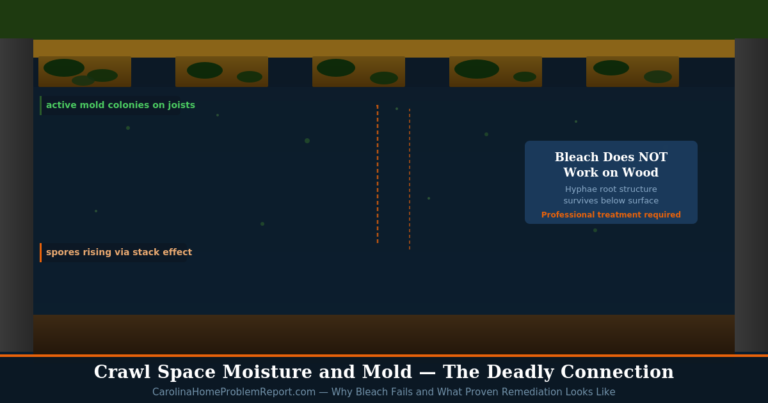
A crawl space dehumidifier is not optional in North Carolina. It is the active component that makes everything else in a sealed crawl space work. Without it, a vapor barrier installation simply traps moisture instead of removing it — rebuilding humidity under the barrier and creating the same mold conditions the encapsulation was meant to prevent.
The single biggest mistake Carolina homeowners make with crawl space dehumidifiers is buying the wrong type. Consumer dehumidifiers designed for living spaces perform poorly in the temperature range, humidity levels, and continuous-run demands of a Carolina crawl space. This guide explains exactly what to look for, how to size the unit correctly for your specific space, and which commercial-grade units are appropriate for NC and SC conditions — with current pricing so you know what to budget.
In This Article
- Why a Crawl Space Dehumidifier Is Not Optional in Carolina
- Commercial vs Consumer Units — Why It Matters in NC
- How to Size a Crawl Space Dehumidifier for Your Home
- Recommended Units for Carolina Crawl Spaces — By Size
- Key Features to Look For
- Drainage Options — Gravity vs Pump
- Placement Guide for Maximum Coverage
- Maintenance Schedule
- Frequently Asked Questions
Why a Crawl Space Dehumidifier Is Not Optional in Carolina
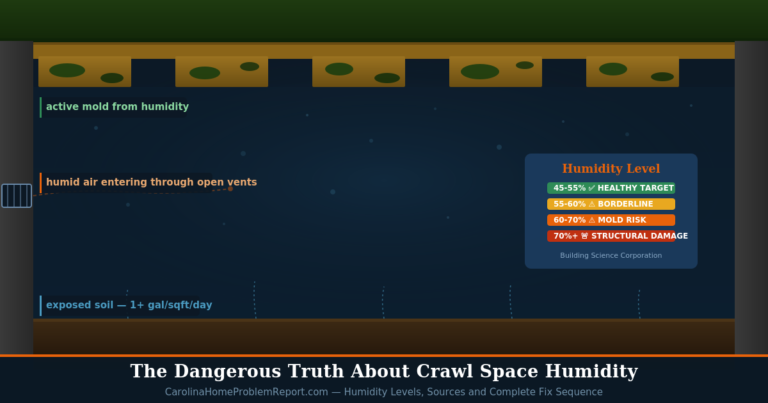
North Carolina's summer dew points consistently reach 65–72°F from May through September. When humid outdoor air enters a vented crawl space and contacts the cooler surfaces of floor joists, the subfloor, and exposed soil, moisture condenses directly onto wood. This is the physical mechanism behind the majority of crawl space mold, rot, and structural damage in the state — and it operates regardless of whether you have a vapor barrier.
NC Building Code Section R409 requires that closed crawl spaces include a permanently installed mechanical drying system capable of removing at least 15 pints per day, or a conditioned air supply from the HVAC system. The code minimum is a floor, not a target. A 15-pint unit is the minimum that passes inspection — it is not the unit that actually maintains the 55% relative humidity target that prevents mold growth in a Carolina summer.
The Vapor Barrier Alone Is Not Enough
A vapor barrier stops ground moisture from evaporating upward. It does not remove the moisture that enters through foundation walls, rim joists, and minor air infiltration. Without a dehumidifier, a sealed crawl space accumulates this residual moisture over the course of a Carolina summer until humidity levels inside the sealed space are actually higher than in a vented one. Encapsulation without dehumidification is an incomplete system.
Commercial vs Consumer Units — Why It Matters in NC
Consumer dehumidifiers sold at big-box stores are tested and rated at 80°F and 60% relative humidity — comfortable living room conditions. A Carolina crawl space in January operates at 45–55°F. In those conditions a consumer unit ices over, cycles off, and removes almost no moisture. In summer the unit runs continuously at maximum load, burning out the compressor within 12–18 months.
| Feature | Consumer Unit | Commercial Grade |
|---|---|---|
| Operating temp range | 65°F+ only | 33–105°F ✓ |
| Real-world pint rating | 30–40% below label | AHAM-rated accurately ✓ |
| Auto defrost | Limited or none | Full auto defrost system ✓ |
| Continuous drain | Manual bucket emptying | Auto-drain with pump ✓ |
| Typical lifespan in crawl space | 12–18 months | 5+ years with maintenance ✓ |
| Warranty | 1 year typical | 5-year limited ✓ |
How to Size a Crawl Space Dehumidifier for Your Home
Dehumidifier pint ratings appear on product listings in two forms. Saturation capacity is the number in the product title — measured at 90°F and 90% RH, the most favorable possible test conditions. AHAM capacity (Association of Home Appliance Manufacturers) is measured at 80°F and 60% RH, which is closer to real crawl space conditions. A unit titled "70-Pint" typically has an AHAM capacity of approximately 35 pints per day in actual use. Size your selection on AHAM capacity, not the saturation figure in the product title.
| Crawl Space Size | Min AHAM (Encapsulated) | Min AHAM (Vented) | NC Adjustment Factor |
|---|---|---|---|
| Under 800 sq ft | 25–35 pints/day | 35–50 pints/day | Add 15% for coastal NC |
| 800–1,300 sq ft | 35–55 pints/day | 55–70 pints/day | Add 15% for coastal NC |
| 1,300–1,800 sq ft | 55–70 pints/day | 70–90 pints/day | Add 20% for clay soil sites |
| 1,800–2,300 sq ft | 70+ pints/day minimum | 90+ pints/day | Consider 2 units for irregular shapes |
| Over 2,300 sq ft | Two units recommended | Two units required | Place units at opposite ends |
🔎 NC-Specific Sizing Notes:
- Coastal NC (Wilmington, Jacksonville, Outer Banks): add 15% to the minimum AHAM rating due to sustained higher dew points
- Eastern NC clay soil sites: add 20% due to higher ground moisture evaporation through even a good vapor barrier
- Homes with previous flooding or standing water history: size up one bracket regardless of square footage
- Crawl spaces with low clearance (under 24 inches): airflow is restricted — size up one bracket to compensate
Recommended Units for Carolina Crawl Spaces — By Size
The units below are commercial-grade crawl space dehumidifiers from Argendon, a specialist brand in basement and crawl space moisture control. All units operate down to 33°F, include auto defrost systems, and carry a 5-year limited warranty — the minimum standard for a Carolina crawl space installation. Use code CHPR3 at checkout on argendon.com for 3% off any unit.


Key Features to Look For in Any Crawl Space Dehumidifier
Operating Temperature Range — 33°F Minimum
The single most important specification for a Carolina crawl space. Consumer units rated to 65°F ice over in winter and shut down. Look for a minimum operating temperature of 33–36°F and a built-in auto defrost system.
Built-In Condensate Pump
A pump with at least 15 feet of lift removes the dependency on a floor-level gravity drain. Without a pump, you are constrained to install the unit near a drain lower than the unit itself, which is often not possible in a crawl space.
Adjustable Humidistat With Display
Set the target humidity and the unit cycles on and off automatically to maintain it. Without a humidistat the unit runs continuously regardless of conditions, wasting energy and accelerating compressor wear. Target setting for a Carolina crawl space: 50–55% RH.
Power-Off Memory Restart
When power cuts out during a storm and returns, the unit restarts automatically at its previous settings without manual intervention. Critical for a crawl space where you may not notice a power interruption for days.
ETL or cETL Safety Certification
ETL or cETL certification confirms the unit has been tested to UL safety standards by an accredited laboratory. This matters in a crawl space where the unit operates unattended in a confined space.
Drainage Options — Gravity vs Pump
Every crawl space dehumidifier must drain continuously. A unit with a collection bucket that fills and triggers an automatic shutoff is not appropriate for a crawl space — once the bucket fills the unit stops removing moisture and you may not discover this for days.
Gravity Drain
Water flows by gravity through a 6.5 ft drain hose to a floor drain, sump pit, or outdoor exit point lower than the unit.
✓ Lower cost — no pump mechanism to fail
✗ Requires drain point below the unit — not always available
Built-In Pump
Pump lifts water up to 19.6 ft vertically, routing drain line to any accessible exit point regardless of height.
✓ Installation flexibility — drain line routes anywhere
✗ Pump is an additional failure point — inspect annually
Placement Guide for Maximum Coverage
Where you place the unit significantly affects its efficiency. A correctly sized dehumidifier placed in a corner with blocked airflow performs like an undersized one. Follow these placement principles for Carolina crawl spaces:
Centre placement is ideal — never in a corner
A centre position allows air to circulate from all directions across the unit. A corner position restricts air intake from two sides and reduces effective coverage by 20–30%.
Hang the unit when possible
Hanging kits suspend the unit from floor joists, keeping it off the ground and improving air circulation on all sides. This is particularly important in low-clearance crawl spaces. Argendon hanging kits are available as an accessory and are compatible with all Shield and Guardian models.
For irregular layouts, consider two smaller units
Carolina homes often have crawl spaces that are not rectangular — additions, wing sections, and obstacles like HVAC units create zones that a single centrally placed dehumidifier cannot reach effectively. Two Shield 35P units at opposite ends of a complex layout often outperform one larger unit in the centre.
Keep at least 12 inches of clearance on all sides
Minimum 12-inch clearance between the unit and any wall, pipe, or obstruction on the air intake and exhaust sides. Less clearance than this causes the unit to recirculate partially dried air rather than drawing in humid unconditioned air from the crawl space.
Maintenance Schedule
| Frequency | Task |
|---|---|
| Monthly | Check MERV-1 filter — rinse under running water if dusty. Confirm drain line is flowing freely. Check humidistat reading vs target. |
| Every 3 months | Inspect drain hose for kinks, algae, or blockage. Wipe down exterior with damp cloth. Verify pump operation (listen for pump activation). |
| Annually | Full crawl space inspection during annual termite inspection visit. Check for condensation on pipes indicating the unit is undersized or settings are too high. Replace filter if cleaning no longer restores airflow. |
| Before summer | Confirm target humidity is set to 50–55% and unit is cycling normally before peak humidity season begins in May. This is the highest-stakes period for crawl space moisture in NC. |
Frequently Asked Questions
Can I use a regular portable dehumidifier in my crawl space?
You can, but in North Carolina it will typically fail within 12–18 months. Consumer portable dehumidifiers are not designed for the continuous-run demands and temperature range of a Carolina crawl space. They ice over in cooler months, cannot maintain target humidity in peak summer conditions, and require manual bucket emptying which means they shut off when no one is available to empty them. A commercial crawl space unit with auto drain costs more initially but typically lasts 5+ years and performs reliably year-round.
What humidity level should I set my crawl space dehumidifier to?
Set the target to 50–55% relative humidity. At 55% or below, mold growth cannot be sustained on wood surfaces. Setting lower than 50% causes the unit to run more than necessary and may cause wood framing to dry and shrink excessively over time. For the first 30 days after installation, check the actual reading weekly to confirm the unit is achieving and maintaining the target. Understanding what humidity level a crawl space should be explains the science behind this target in more detail.
Do I need a dehumidifier if I already have crawl space encapsulation?
Yes. NC Building Code R409 requires it for closed crawl spaces, and the physics of a sealed space demand it. A vapor barrier stops ground moisture evaporation but does not remove moisture that enters through foundation walls, rim joists, and minor penetrations. Without active dehumidification, humidity builds inside a sealed crawl space until conditions are worse than in a vented space. Crawl space encapsulation and a dehumidifier are two parts of one system — neither works correctly without the other.
How much does it cost to run a crawl space dehumidifier in NC?
A commercial crawl space dehumidifier typically draws 300–500 watts. At North Carolina's average residential electricity rate of approximately 11–13 cents per kWh, a unit running 8–12 hours per day in peak summer months costs roughly $8–$20 per month to operate. In winter with lower humidity loads, the unit cycles on less frequently and operating costs are typically $3–$8 per month. Annual operating cost for most Carolina homes falls in the $80–$150 range — a small fraction of the structural damage cost it prevents.
Where exactly should I drain the condensate from my crawl space dehumidifier?
The three practical options for Carolina crawl spaces are: (1) a condensate drain line routed to an existing floor drain or sump pit inside the crawl space; (2) a line pumped up and out through the foundation wall to a downspout or soil area at least 6 feet from the foundation; (3) connection to the home's HVAC condensate drain line. Option 2 is most common and requires a unit with a built-in pump or an external pump. Never route condensate drainage toward the foundation — draining within 6 feet of the foundation reintroduces moisture to the soil immediately adjacent to your crawl space walls.
- NC Building Code R409 requires a permanently installed dehumidifier in every closed crawl space, rated for at least 15 pints per day — commercial-grade units are necessary to meet this requirement reliably.
- Consumer dehumidifiers typically fail in crawl space conditions within 12–18 months; commercial units with a 33°F minimum operating temperature handle Carolina winters without icing over.
- Sizing correctly is more important than brand — an undersized unit runs continuously, burns out early, and never achieves the 55% RH target that prevents mold growth.
- A built-in condensate pump is recommended for most Carolina crawl space installations where a floor-level gravity drain is not conveniently located.
- Advanced Energy's 5-year NC field study found sealed crawl spaces save 15–18% on heating and cooling costs — a properly sized dehumidifier is the active component that makes those savings possible.
Ready to Choose the Right Unit?
Browse the full Argendon crawl space dehumidifier range, sized by square footage. Use code CHPR3 at checkout for 3% off your order.
Shop Argendon Crawl Space Dehumidifiers →The Carolina Home Problem Report editorial team researches and writes guides for homeowners across North and South Carolina. Our research draws on NC Building Code publications, Advanced Energy field studies, EPA guidelines, and insights from licensed Carolina crawl space contractors. We are not contractors — we are a research team dedicated to giving Carolina homeowners clear, locally specific, unbiased answers.
📚 Key Concepts — Reference Sources
- Dehumidifier (Wikipedia) — How dehumidifiers remove moisture from air using refrigeration cycles and why commercial-grade units are rated differently from consumer units
- Relative Humidity (Wikipedia) — The measure of moisture in air that crawl space dehumidifiers are designed to control below the 55% mold-prevention threshold
- Stack Effect (Wikipedia) — The mechanism that makes crawl space humidity a whole-home problem and why a dehumidifier protects indoor air quality not just the crawl space
Carolina Home Problem Report is an informational resource for homeowners. We are not licensed contractors. Always consult a qualified professional before making home repair decisions. Product prices shown are subject to change — verify current pricing at argendon.com. See our Disclaimer and Affiliate Disclosure.