Best Dehumidifier NC: 5 Top Picks for a Humid Home
The best dehumidifier NC and SC homeowners actually need depends on square footage, where it's going, and something most national buying guides never mention: how long it'll actually have to run here. In a humid subtropical climate, a dehumidifier isn't an occasional appliance — it's closer to a second AC unit that needs to work through most of a 5-6 month stretch. That changes which features actually matter (drainage method, noise at night, real running cost) more than a generic "best dehumidifiers of 2026" list written for a national audience will tell you. Below is a Carolina-specific breakdown, with verified specs on five real options and what actually differs between them.
⭐ Key Takeaways
- ✓Most buying guides size a dehumidifier for occasional use — but in a Carolina home, expect a unit to run for 5-6 months a year, which makes drainage method and running cost far more important than they'd be elsewhere
- ✓Only 2 of the 5 units compared below actually have a built-in pump (hOmeLabs and Yaufey) — the other 3 rely on gravity-drain hose or manual bucket emptying, which matters if there's no nearby floor drain
- ✓At Duke Energy's current NC/SC residential rate (~13.9-14¢/kWh), a 50-pint unit running through a Carolina summer costs meaningfully more than the vague "pennies a day" most guides quote — see the real numbers below
- ✓A living-space dehumidifier is a different product from a crawl space unit — and if your crawl space is feeding humidity upstairs, buying either one alone won't fully fix it
- ✓Manufacturer coverage claims (like "4,500 sq ft") are tested under lab conditions far more humid than a typical room — treat them as a ceiling, not a target
If your humidity problem is in the crawl space rather than a living area, our dedicated guide on the best crawl space dehumidifiers for NC and SC covers that different category of unit. If your crawl space might be part of why the upstairs feels humid too, see why upstairs runs more humid than downstairs. For background on why your living space runs humid in the first place, see why houses run humid in NC and SC and why indoor humidity spikes in NC summers.
In This Article
Why a Carolina Home Needs a Different Buying Approach
Most national "best dehumidifier" guides are written for a reader who might run a dehumidifier occasionally — a damp week in spring, a musty smell after rain. That's not really the Carolina situation. North and South Carolina sit in a humid subtropical climate, which means a living-space dehumidifier here is realistically going to run for a stretch of roughly 5-6 months a year (later spring through early fall, longer in a wet year), not occasionally. That single fact changes which specs actually matter:
- Drainage method stops being a minor convenience and becomes a real maintenance question. A 50-pint unit removing water for 5-6 months means the bucket fills fast — emptying a bucket daily for half the year is a very different commitment than doing it a few times each spring.
- Running cost adds up to real money, not "pennies a day." Most guides quote wattage in the abstract; over a genuine Carolina season, at the region's actual electricity rate, that's a number worth knowing before you buy — see the running cost section below.
- Manufacturer coverage numbers (like "4,500 sq ft") are tested at high humidity and a specific temperature — closer to what a Carolina summer actually delivers than what a drier-climate reader would see, but still a best-case ceiling, not a guarantee for your specific room.
How to Size a Dehumidifier for Your Space
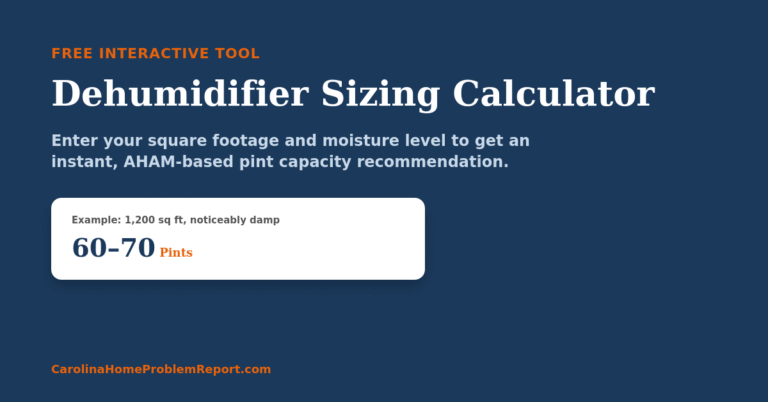
A dehumidifier's capacity is measured in pints removed per 24 hours. The standard sizing rule most manufacturers use starts around 10 pints for a 500 sq ft space and adds roughly 4 pints for every additional 500 sq ft under normal dampness — but for a space that's noticeably damp, musty, or has visible moisture (not just uncomfortable humidity), most manufacturer guidance bumps that up to roughly 12 pints per 500 sq ft with a larger per-500-sq-ft increment. In practice, for a Carolina home dealing with year-round relative humidity rather than occasional dampness, it's worth sizing toward the higher end of these ranges rather than the minimum:
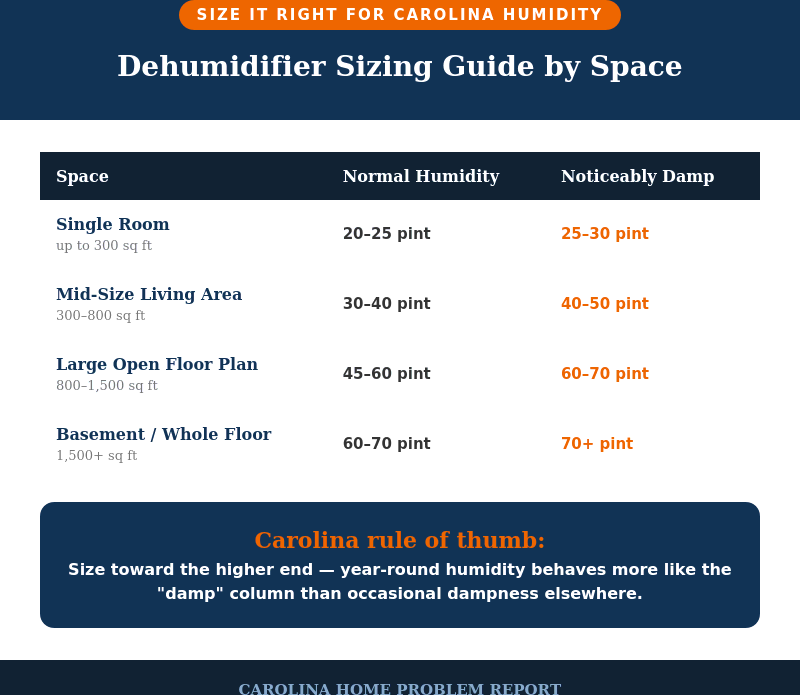
If you're not sure which column applies, a $15-25 hygrometer settles it in a few minutes — a reading consistently above 55-60% means you're in "noticeably damp" territory even if nothing looks visibly wet.
4 Things That Matter More Than Capacity
Once you know roughly what capacity you need, several units at that capacity will look nearly identical on paper. These are the differences that actually decide which one you'll be happy with after a full Carolina season:
5 Dehumidifiers Compared (Verified Specs)
Before you buy: both hOmeLabs and Yaufey sell multiple SKUs of similar-looking units at the same "4,500 sq ft" rating, and pump inclusion isn't always consistent between them — confirm the specific listing you're buying explicitly states a built-in pump before paying extra for one. Whirlpool's own retailer listings list slightly different coverage figures (1,500 and 3,000 sq ft appear on different pages for what looks like the same unit) — treat coverage claims as approximate, not exact.
Which One Fits Your Specific Situation?
Rather than a single "best overall" pick, here's how to match the situation you actually have:
- One sticky bedroom, nothing else: The Whirlpool 30-pint — right-sized, and you won't be running a 50-pint unit's compressor overnight for no reason.
- Basement with no floor drain: hOmeLabs (pump SKU) or Yaufey — a pump is the deciding feature here, not capacity or price.
- Living area with a floor drain or low point nearby: Frigidaire or Vremi — both work fine with gravity drainage, so the pump isn't worth paying extra for.
- Tightest budget, drain available: Vremi is typically the least expensive of the 50-pint options.
- Home with a crawl space that's likely contributing: A living-space unit alone may not be enough — see why upstairs runs more humid than downstairs and consider whether the crawl space itself needs its own crawl space dehumidifier as well.
What It Actually Costs to Run One Here
A 50-pint ENERGY STAR dehumidifier typically draws somewhere around 400-500 watts while actively removing moisture, though it cycles on and off rather than running continuously once it reaches its humidity target. Duke Energy's current residential rate across its Carolinas territory runs roughly 13.9-14¢ per kWh. Running at 450 watts for an average of 8 hours a day (a reasonable estimate for a unit cycling to hold humidity in a Carolina summer) works out to:
That's a rough estimate, not a guarantee — actual cycling time depends on how humid your specific space runs and how tight the building envelope is. But it's a meaningfully more useful number than the generic "300-700 watts" most national buying guides quote without ever converting it to an actual dollar figure for a real climate and a real electricity rate.
Frequently Asked Questions
Can I use a crawl space dehumidifier in my living room instead?
Not recommended. Crawl space units are built for cramped, low-clearance spaces with different venting and durability needs, and they're usually not designed with the noise level or appearance in mind for a living space.
Do I actually need a pump if my basement has a floor drain?
No — if there's a floor drain at or below the unit's outlet height, a gravity hose does the same job for less money. A pump only earns its cost when there's nowhere for water to drain to by gravity alone, or you need to push it up and out (say, through a window or up to a utility sink).
How long will a dehumidifier need to run in a Carolina summer?
Realistically, expect it to cycle on and off for most of a 5-6 month stretch from late spring through early fall, not just occasionally. It won't run 24/7 once it reaches its target humidity, but budget for near-daily use through that period rather than "a few times a month."
Can I drink the water a dehumidifier collects?
No. The water sits in an open tank or hose and can pick up contaminants from dust, the coils, and standing time — it's fine for watering non-edible plants but shouldn't be treated as drinking water.
How much does it cost to run a dehumidifier all summer?
At Duke Energy's current NC/SC residential rate, a 50-pint ENERGY STAR unit cycling through a typical Carolina humid season runs roughly $75-120 in electricity, or about $15-20 a month during the most active stretch. See the full breakdown above.
Will a dehumidifier fix a musty smell?
It can help significantly if the smell is caused by ambient humidity, but it won't fix an active mold problem or a hidden leak. If the smell persists after a few weeks of consistent use, the source is likely something a dehumidifier alone can't solve.
Key Facts on Choosing a Dehumidifier for a Carolina Home:
- Expect near-daily use for 5-6 months a year here, not occasional use — size and drainage decisions should reflect that.
- Only 2 of the 5 units compared (hOmeLabs, Yaufey) include a built-in pump — essential if there's no nearby floor drain.
- At Duke Energy's current NC/SC rate, a 50-pint unit costs roughly $75-120 to run across a full humid season.
- Living-space dehumidifiers are a different product from crawl space units — don't try to use one for the other.
- If a crawl space is contributing to upstairs humidity, a living-space unit alone may not fully solve it.
If humidity or a musty smell persists after running a properly sized dehumidifier for a few weeks, an HVAC or moisture-control professional can check for an underlying cause.
Find an HVAC Professional Near You →The Carolina Home Problem Report editorial team researches and writes guides for homeowners across North and South Carolina. Product specifications were independently verified against manufacturer listings and third-party testing where available, cross-referenced with ENERGY STAR certification data, with regional electricity costs based on published Duke Energy residential rate schedules. We are not contractors or HVAC technicians — we are a research team dedicated to giving Carolina homeowners clear, unbiased answers.
Carolina Home Problem Report is an informational resource for homeowners. We are not licensed contractors or HVAC technicians. Always consult a qualified professional before making home repair decisions. See our Disclaimer and Affiliate Disclosure.