Mold in Crawl Space: What to Do First — The Correct Action Sequence for NC and SC Homeowners
⚡ QUICK ANSWERIf you have found mold in your crawl space, the correct sequence is: stop panicking, identify the scale of the problem, fix the moisture source that caused it, then remediate — in that exact order. Do not encapsulate over mold. Do not apply bleach to wood surfaces. In NC and SC, crawl space mold specialists at Dry Pro and Carolina Encapsulation Company report finding active mold growth in 7 out of 10 homes inspected — you are not alone, and the problem is fixable. Speed matters: mold establishes on wood within 48–72 hours of a moisture event in Carolina summer temperatures.
Discovering mold in your crawl space is alarming — but acting on the wrong advice in the next 24 hours can make the problem significantly worse. Applying bleach to moldy wood joists, disturbing active mold colonies without containment, or encapsulating a crawl space without remediating first are the three most common and most expensive mistakes NC and SC homeowners make after finding mold below their floor. This guide gives you the correct action sequence, the identification framework, and the honest cost picture for crawl space mold remediation in North Carolina and South Carolina.
📋 IN THIS GUIDE
- First — How Serious Is Mold in a Crawl Space?
- How to Identify Mold in Your Crawl Space
- The Correct Action Sequence — What to Do First
- DIY vs Professional Mold Remediation — The Honest Answer for NC and SC
- What Professional Crawl Space Mold Remediation Involves
- Crawl Space Mold Remediation Cost in NC and SC
- After Remediation — Preventing Recurrence
First — How Serious Is Mold in a Crawl Space?
The answer depends on the scale, the species, and how long it has been growing. Not all crawl space mold is equally dangerous or equally expensive to address — but all crawl space mold indicates a moisture problem that will worsen without intervention.
The stack effect means that 40–50% of the air in your home's ground floor originates in the crawl space. Mold spores, mycotoxins, and volatile organic compounds produced by fungal growth in the crawl space migrate upward continuously through gaps in the subfloor, around plumbing penetrations, and through any opening between the crawl space and the living area. If there is mold in your crawl space, there are mold spores in your living space — the only question is how many.
At the structural level, mold growth on wood joists and subfloor sheathing indicates wood moisture content above 19% — the threshold at which fungal growth begins. Wood above 28% moisture content is entering active structural decay. The longer mold has been present, the more likely it is that the underlying wood has lost structural capacity.
How to Identify Mold in Your Crawl Space
Crawl space mold appears in several forms that homeowners commonly misidentify. Understanding what you are looking at determines the urgency and the response.
White mold on wood joists. White, powdery, or fuzzy growth on floor joists and subfloor sheathing is one of the most common presentations of crawl space mold in NC and SC. It is frequently dismissed by homeowners as efflorescence (mineral deposits from concrete) or as harmless discolouration. It is neither. White mold is most commonly Penicillium or Aspergillus species — both produce mycotoxins and both indicate wood moisture content above 19%. White mold on wood is an active fungal colony, not a cosmetic issue.
Black or dark green mold on wood. Dark staining — black, grey-green, or deep brown — on floor joists, sill plates, and subfloor sheathing indicates more advanced mold growth. The most concerning species is Stachybotrys chartarum (commonly called black mold), which requires sustained very high moisture levels to establish and produces mycotoxins associated with serious respiratory effects. However, many dark mold presentations in crawl spaces are Cladosporium — equally requiring professional removal but less acutely toxic than Stachybotrys. Visual identification alone cannot distinguish species — testing is required for definitive identification.
Mold on crawl space insulation. Fibreglass batt insulation that has absorbed moisture becomes a mold substrate. Sagging, discoloured, or visibly deteriorated insulation batts in the crawl space almost certainly have mold growth within the material. Insulation with mold contamination cannot be cleaned — it must be removed and replaced.
🔍 WHITE MOLD VS EFFLORESCENCE — HOW TO TELL THE DIFFERENCE: Efflorescence is white mineral deposit from water moving through concrete — it appears on concrete block foundation walls, not on wood surfaces. If the white material is on wood joists or subfloor sheathing, it is mold, not efflorescence. Wipe a small area with a damp cloth — efflorescence smears and dissolves; mold wipes off but the surface beneath shows staining. When in doubt, treat it as mold.
The Correct Action Sequence — What to Do First
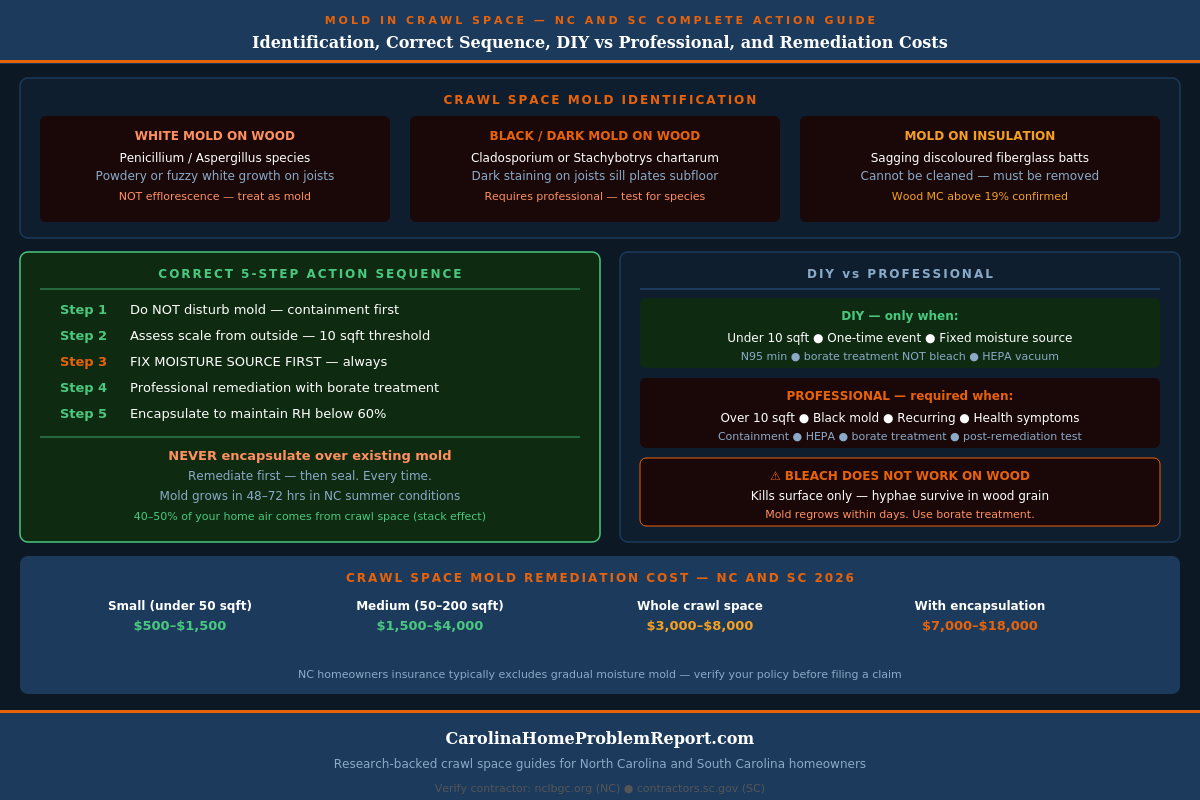
Step 1 — Do not disturb the mold. Your first instinct may be to go in and start cleaning. Resist it. Disturbing active mold colonies without proper containment and personal protective equipment releases millions of spores into the crawl space air — and via the stack effect, directly into your living space. Before any physical contact with mold, you need a plan, proper PPE, and ideally a professional assessment of the scale.
Step 2 — Assess the scale from outside. Using a torch, look into the crawl space access without entering. Estimate roughly how much surface area shows visible mold growth. This determines whether you are in DIY territory or professional territory. The EPA guideline is 10 square feet — anything smaller may be manageable by a careful homeowner with proper PPE. In NC and SC's climate conditions, however, visible mold on wood surfaces almost always indicates a larger hidden infestation than what is visible — professional assessment is strongly recommended before deciding to DIY.
Step 3 — Identify and fix the moisture source. This is the step most homeowners skip — and skipping it is why mold returns. Mold is a symptom. The moisture condition that produced it is the disease. If you remediate without fixing the moisture source, mold regrows. Common moisture sources in NC and SC crawl spaces are foundation vents bringing in humid summer air, active surface water entry from negative yard grading, duct condensation, plumbing leaks, and groundwater seepage. See our What Causes Crawl Space Moisture guide for the full diagnostic framework. Fix the moisture first — every time, without exception.
Step 4 — Remediate the mold. Only after the moisture source is controlled does remediation make sense. Cleaning mold out of an actively damp crawl space is an exercise in futility — it regrows within weeks.
Step 5 — Encapsulate to prevent recurrence. Encapsulation is the permanent prevention step — not the remediation step. A properly sealed crawl space to NC R409 standard maintains relative humidity below 60% consistently, which prevents mold from growing on wood surfaces. But encapsulating over existing mold without remediating first seals a contaminated environment, concentrates the spore load, and makes future remediation more difficult and expensive.
DIY vs Professional Mold Remediation — The Honest Answer for NC and SC
The EPA guideline allows homeowners to remediate mold areas of 10 square feet or less. In practice, crawl space mold in NC and SC almost never meets this threshold by the time it is discovered. Mold in a crawl space is typically not found until it is already visible across multiple joist bays — which represents significantly more than 10 square feet of affected surface area even when it appears localised.
There is also a critical technical reason why DIY mold remediation on crawl space wood is ineffective: bleach does not work on porous wood surfaces. Bleach kills mold on the surface of non-porous materials like tile and glass — it does not penetrate wood grain. The mold hyphae (root structures) that penetrate 1–3mm into wood fibres survive bleach application and re-establish on the surface within days. Professional mold remediation on wood uses borate-based treatments such as BoraCare with Mold-Care — penetrating fungicides that kill mold through the full depth of affected wood and provide a lasting barrier against regrowth. This is the single most important reason to use a professional for crawl space mold: the treatment chemistry that works on wood is not available to consumers in effective concentrations.
⚠️ THE BLEACH MYTH: Spraying bleach on mouldy wood joists kills surface mould but leaves the fungal root structures (hyphae) alive within the wood fibres. The mould regrows within days. Bleach also adds moisture to an already damp environment. Do not use bleach on crawl space wood surfaces.
When DIY is reasonable: A genuinely small area — less than 10 square feet, isolated to one or two joist sections — that resulted from a one-time event (a burst pipe that has been repaired, for example) and that has been present for less than two weeks. You will need: N95 respirator minimum (P100 preferred), disposable coveralls, nitrile gloves, safety goggles, and a HEPA vacuum. Treat with a borate-based wood preservative after physical removal, not bleach.
When professional remediation is required: Any mold covering more than 10 square feet, any dark or black mold of unknown species, any mold that has been present for more than a few weeks, any mold associated with ongoing moisture problems rather than a single isolated event, and any situation where occupants are experiencing unexplained respiratory symptoms or allergy flare-ups.
What Professional Crawl Space Mold Remediation Involves
A professional crawl space mold remediation in NC and SC follows a documented sequence that goes beyond simply spraying the visible mold:
- Containment setup — plastic sheeting seals the crawl space access and any HVAC penetrations to prevent cross-contamination during work
- HEPA air filtration — commercial air scrubbers with HEPA filters run continuously throughout the project, capturing airborne spores
- Physical removal — mouldy insulation is removed and bagged for disposal. Wire brushing and sanding of heavily affected wood surfaces before treatment
- Antimicrobial treatment — application of penetrating borate-based fungicide to all affected wood surfaces and a preventive perimeter treatment to adjacent areas
- Structural assessment — evaluation of wood moisture content and structural capacity of affected members to determine whether any require sistering or replacement
- Post-remediation verification — visual inspection and, in cases involving possible Stachybotrys, air quality testing to confirm spore counts have returned to background levels
Crawl Space Mold Remediation Cost in NC and SC
| Scope | Typical Cost NC SC 2026 | Notes |
|---|---|---|
| Small area — under 50 sqft | $500–$1,500 | Isolated joists, no insulation removal |
| Medium — 50–200 sqft | $1,500–$4,000 | Multiple joist bays, insulation removal included |
| Whole crawl space | $3,000–$8,000 | Full treatment, insulation, structural assessment |
| With structural repair | $5,000–$15,000+ | Joist sistering or subfloor replacement included |
| Remediation + encapsulation | $7,000–$18,000 | Complete solution — remediate then seal |
Will homeowners insurance cover crawl space mold remediation? Almost certainly not if the mold resulted from gradual moisture accumulation — which is the cause of the vast majority of NC and SC crawl space mold cases. Most NC homeowners insurance policies cover mold remediation only when it results from a sudden and accidental covered event, such as a burst pipe. Mold from chronic humidity, poor drainage, or condensation is typically excluded as gradual damage. Check your specific policy and document the cause carefully before filing any claim.
After Remediation — Preventing Recurrence
Mold remediation without addressing the underlying moisture condition is a temporary fix. The recurrence prevention plan for NC and SC homes has three components:
Fix the moisture source first — as discussed in Step 3 above. No prevention measure is effective if the moisture condition that produced the mold is still operating. See our Crawl Space Drainage Problems guide if surface water or groundwater was the cause.
Encapsulate to maintain humidity control — crawl space encapsulation to NC R409 standard maintains relative humidity below 60% RH consistently, which is below the threshold for mold growth on wood. This is the most effective long-term mold prevention available for NC and SC crawl spaces. See our Is Crawl Space Encapsulation Worth It guide for the full ROI case.
Annual inspections — a crawl space inspection by a qualified contractor once per year catches early-stage mold growth before it becomes a full remediation project. Early intervention costs hundreds of dollars. Delayed intervention costs thousands.
Related Guides
- Crawl Space Moisture and Mold — How Humidity Leads to Mold
- What Causes Crawl Space Moisture? — Full Diagnostic Guide
- Is Crawl Space Encapsulation Worth It in NC and SC?
- Crawl Space Encapsulation Cost Guide — NC and SC
- Crawl Space Drainage Problems and Solutions
- Crawl Space Structural Damage Signs — 4-Stage Model
- Complete Crawl Space Guide — NC and SC
Carolina Home Problem Report provides general educational information for NC and SC homeowners. We are not licensed mold remediation professionals or medical professionals. For mold testing and professional remediation use a licensed contractor. For mold species identification contact a certified industrial hygienist. Verify contractor licences at nclbgc.org (NC) or contractors.sc.gov (SC). See our Disclaimer.