Why Is My Crawl Space Damp? 7 Causes Carolina Homeowners Find (And What to Do First)
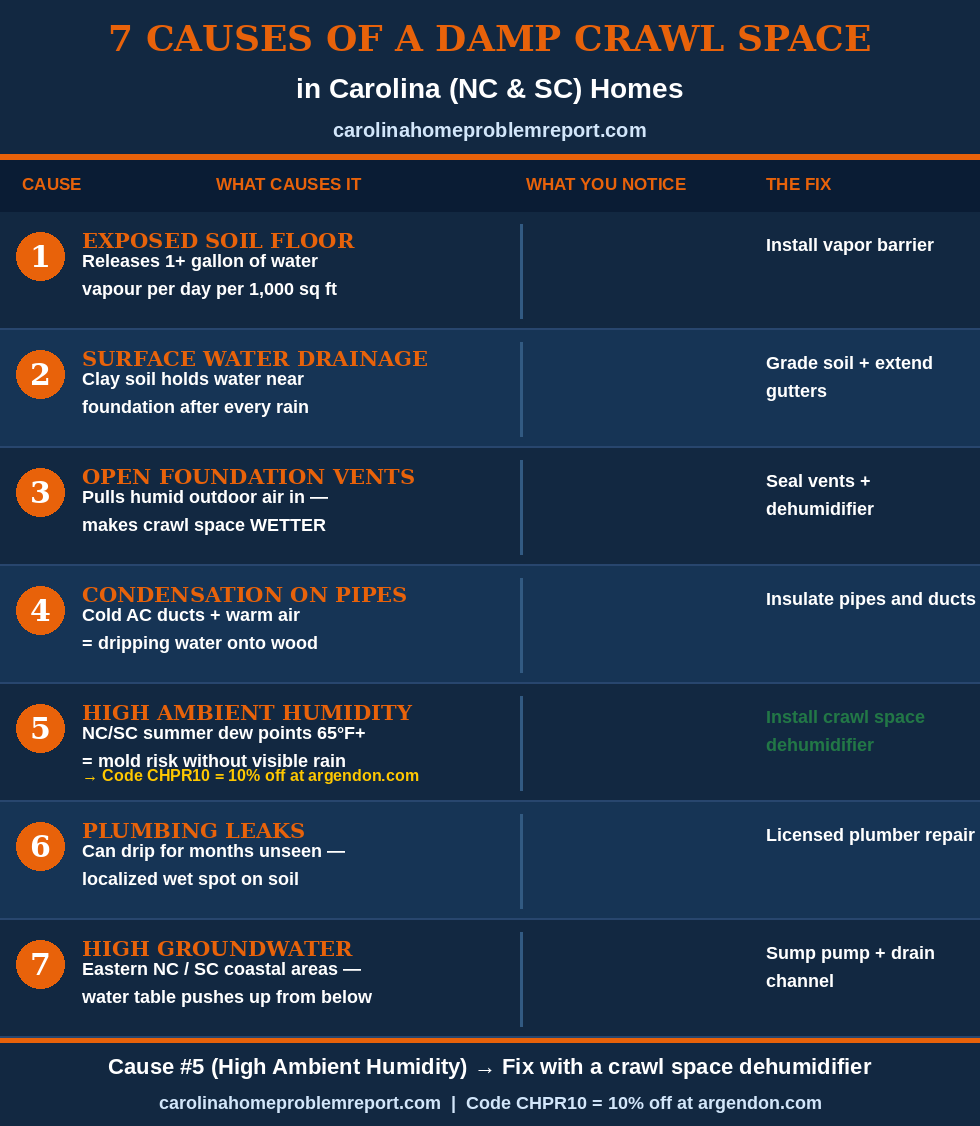
Crawl space dampness in a Carolina home is almost always caused by a combination of these factors: ground moisture from exposed soil, surface water draining toward the foundation, open foundation vents pulling humid air in, condensation on cold pipes and ductwork, plumbing leaks, and high groundwater. The Carolinas’ average summer relative humidity regularly exceeds 70%, meaning crawl spaces here face more moisture pressure than homes in drier climates. A damp crawl space will not dry out on its own.
⭐ Key Takeaways
- ✓A damp crawl space will not dry out on its own in the Carolinas
- ✓Most Carolina crawl space dampness has more than one cause happening simultaneously
- ✓Identify the source before spending money — the wrong fix wastes thousands of dollars
- ✓Relative humidity above 60% in a crawl space leads to mold growth on wood surfaces
- ✓Open foundation vents in older Carolina homes are making humidity worse not better
A damp crawl space in a Carolina home is one of the most common — and most misunderstood — home problems homeowners face. If you have been down there and noticed wet soil, condensation dripping from pipes, musty air, or just a general sense that something is wrong, you are already ahead of most homeowners.
The good news is that a damp crawl space is a solvable problem. But the solution depends entirely on understanding what is causing the moisture in the first place. Getting that wrong is how homeowners waste thousands of dollars on repairs that do not address the actual source.
This guide covers the seven most common reasons crawl spaces stay damp under Carolina homes, what to look for when you inspect yours, and which fixes match which causes.
In This Article
Why Carolina Homes Are Especially Vulnerable
North and South Carolina sit in a climate zone characterized by high year-round relative humidity, frequent summer thunderstorms, a long wet season, and soil conditions — particularly the red clay found throughout the Piedmont — that retain water and release it slowly toward anything in contact with the ground.
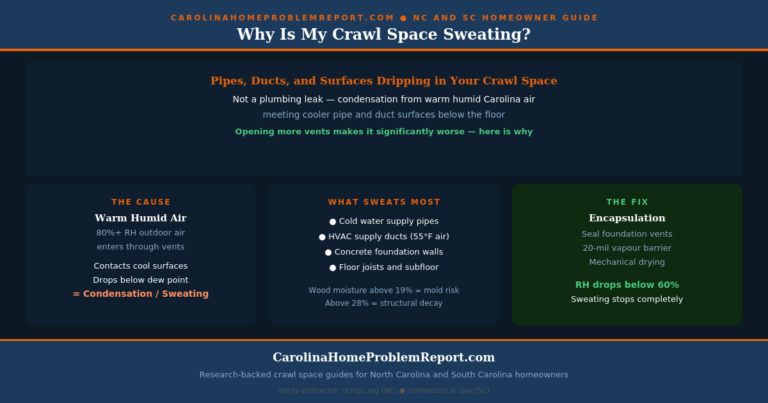
A large proportion of homes in both states — particularly those built before 1990 — have crawl space foundations rather than basements or slabs. Building science research has confirmed that up to 50% of the air inside a home with a crawl space comes from that crawl space via the stack effect — carrying moisture, mold spores, and pest activity directly into the rooms where you live.
That is why a damp crawl space is never just a crawl space problem. It becomes an indoor air quality problem, a mold problem, a pest problem, and eventually a structural problem — all starting from the same source beneath your feet.
The 7 Most Common Causes of a Damp Crawl Space

How to Check Your Crawl Space for Moisture
If you have not been in your crawl space recently, here is what to check. Bring a flashlight, wear old clothes, knee pads, and a dust mask.
- Visible water or puddles on the soil floor
- Mold on floor joists — black, white, or grey fuzzy growth
- Condensation on pipes — water droplets on cold surfaces
- Soft or spongy wood — press joists, they should feel firm
- White chalky deposits on foundation walls
- Sagging insulation — fallen or wet insulation between joists
Measure humidity: A hygrometer placed in the crawl space for 24 hours gives you an accurate reading. Above 60% consistently is a problem. Above 70% is urgent.
Does a Crawl Space Dry Out On Its Own?
The short answer: No. Not in the Carolinas.
In a dry climate a damp crawl space might naturally dry out between rain events. In the Southeast where humidity rarely drops low enough for passive drying and where rain is frequent, a damp crawl space only gets damper over time without active intervention.
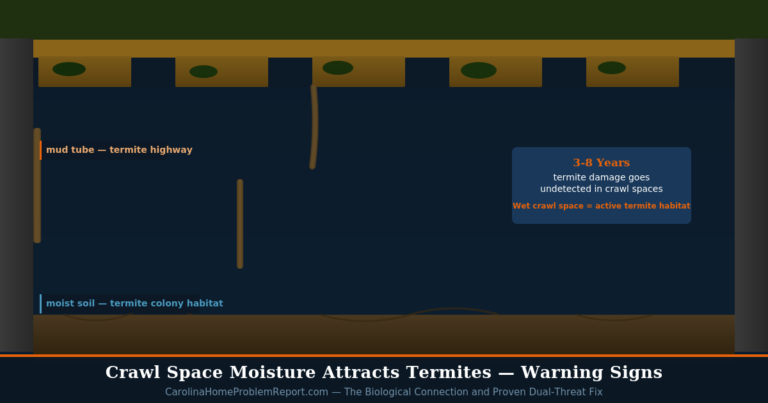
In the Carolinas waiting makes the problem worse and the eventual repair more expensive. Every month of inaction gives mold more surface area, gives termites more reason to investigate, and gives wood rot more time to advance.
What to Do First — The Right Order
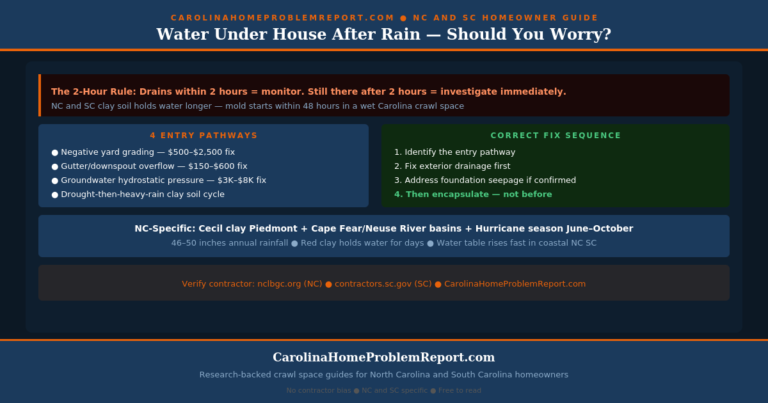
Identify the source first. Walk the perimeter after rain, check gutters and downspouts, check soil grading, then inspect the crawl space. Never spend money until you know what you are paying to fix.
Fix obvious drainage issues outside first. Clogged gutters, downspouts emptying against the foundation, and soil graded toward the house are free or low-cost fixes that often dramatically reduce water intrusion.
Install a vapor barrier if you have exposed soil. A 20-mil liner across the entire floor dramatically reduces ground moisture evaporation within days.
Seal foundation vents and add a crawl space dehumidifier. This is the next most effective step. See Cause 5 above for the right unit for your crawl space size — or browse the complete sizing guide.
Get a professional inspection if the problem persists or if you see mold, structural damage, or standing water.
Frequently Asked Questions
Is it normal for a crawl space to be damp?
Some humidity is unavoidable in Carolina crawl spaces but a persistently damp crawl space is not normal. Humidity above 60% consistently indicates a problem that will lead to mold, wood rot, and pest attraction over time.
Will a damp crawl space dry out on its own?
No. Without active intervention — a vapor barrier, improved drainage, or a dehumidifier — a damp crawl space gets worse over time in the Carolinas, not better.
What humidity level is too high for a crawl space?
Above 60% consistently creates conditions for mold growth. Above 70% causes active mold colonization on wood surfaces. Target: below 55% relative humidity year-round.
How do I know if my crawl space has a moisture problem?
A musty smell inside the house especially after rain, condensation on pipes and ductwork, visible mold on floor joists, soft or springy floors, increased pest activity, and higher-than-normal indoor humidity even when the AC is running.
Is a damp crawl space dangerous?
Yes, over time. A damp crawl space promotes mold growth, accelerates wood rot and structural decay, attracts subterranean termites, raises indoor humidity through the stack effect, and increases energy costs.
💡 If Cause 5 Applies — Choose the Right Dehumidifier
High ambient humidity is the most common cause of crawl space dampness in Carolina homes that already have a vapor barrier in place. A commercial-grade crawl space dehumidifier set to 50–55% RH is the correct permanent fix. Argendon’s range covers every crawl space size from 1,000 sq ft to 2,300+ sq ft. Use code CHPR3 for 3% off.
Shop Argendon Dehumidifiers → Code CHPR3 saves 3% at checkout- A damp crawl space will not dry out on its own in the Carolinas — without active intervention, humidity builds higher over time, not lower.
- Most Carolina crawl space dampness has more than one cause happening simultaneously — identify all of them before spending money on a fix.
- Open foundation vents make crawl space humidity significantly worse during summer by importing warm, high-dew-point outdoor air directly into the space.
- Relative humidity above 60% consistently causes mold growth on wood surfaces; the target for a healthy Carolina crawl space is 45–55% RH year-round.
- Up to 50% of the air inside your home comes from the crawl space via the stack effect — a damp crawl space is an indoor air quality problem as much as a structural one.
The Carolina Home Problem Report editorial team researches and writes guides for homeowners across North and South Carolina. Our research draws on NC State Extension Service publications, Clemson Extension resources, EPA guidelines, Building Science Corporation data, and insights from licensed Carolina contractors. We are not contractors — we are a research team dedicated to giving Carolina homeowners clear, locally specific, unbiased answers.
📚 Key Concepts — Reference Sources
- Stack Effect (Wikipedia) — The mechanism that pulls crawl space air into your living space through pressure differences
- Relative Humidity (Wikipedia) — The measure of moisture in air that determines mold risk thresholds
- Wood-Decay Fungus (Wikipedia) — The fungi responsible for rot in crawl space floor joists when humidity exceeds 19% wood moisture content
Carolina Home Problem Report is an informational resource for homeowners. We are not licensed contractors or mold assessors. Always consult a qualified professional before making home repair decisions. See our Disclaimer and Affiliate Disclosure.