Crawl Space Vents Open or Closed [Warning: Why Closing Them Wrong Makes Things Worse + Proven Answer for Carolina]
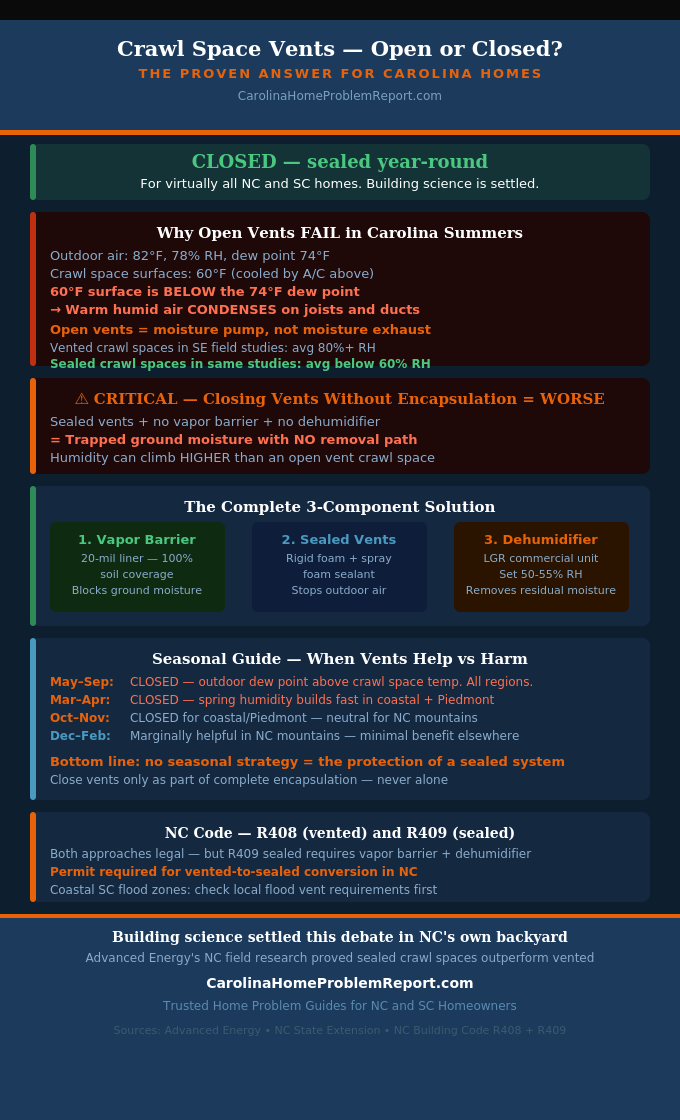
The short answer to the crawl space vents open or close question: for the vast majority of Carolina homes, crawl space vents should be closed and sealed year-round — not seasonally adjusted, not opened in summer to "air things out," and not left to a manual damper schedule. The building science is settled: in North Carolina's and South Carolina's humid subtropical climate, open foundation vents actively import moisture into the crawl space during the months when moisture problems are worst. However, closing vents without proper encapsulation makes things worse — sealing moisture in without a way to remove it. The vent decision and the encapsulation decision must be made together.
⭐ Key Takeaways
- ✓In Carolina's humid summers, open vents add moisture to the crawl space — they do not remove it. The physics of dew point condensation makes venting counterproductive in this climate.
- ✓Closing vents without encapsulation can make conditions worse — you trap existing moisture with no removal mechanism
- ✓NC code changed in 2004 and significantly updated in 2018 — Section R409 now explicitly endorses sealed crawl spaces with specific requirements
- ✓The only situation where open vents are not clearly harmful in Carolina is dry winter months in the NC mountain counties — everywhere else, year-round sealing is correct
- ✓A complete sealed crawl space requires vapor barrier + sealed vents + mechanical dehumidification — three components working together, not just blocking the vent openings
Should crawl space vents be open or closed? The crawl space vents open or close debate is one of the most argued questions in Carolina home improvement circles — and it is one where a generation of conventional wisdom turned out to be wrong. For most of the twentieth century, building codes required open foundation vents. The logic seemed sound: move air through the space, let the moisture out. For decades, contractors, building inspectors, and home inspectors all recommended the same thing — open the vents in spring, close them in fall, keep air moving through.
Building science research — including a landmark multi-year study in the Southeast and Advanced Energy's field research in North Carolina specifically — revealed that the conventional wisdom was backwards for humid climates. In a climate like Carolina's, where outdoor summer humidity regularly reaches 75–90% relative humidity, open foundation vents do not dry the crawl space. They actively inject moisture into it. The same physics that make a cold drink sweat on a humid day cause warm humid outdoor air to condense on the cooler surfaces of the crawl space — floor joists, ductwork, pipes — the moment it enters through those open vents.
This guide explains the dew point science behind why venting fails in Carolina, what NC and SC code says about both vented and sealed approaches, the specific warning about closing vents without proper encapsulation, and the correct complete solution for Carolina homeowners who want to resolve the vent debate permanently.
In This Article
- Why Open Vents Fail in Carolina — The Dew Point Explanation
- Why Vents Were Ever Required — and When Building Science Changed
- Warning — Closing Vents Without Encapsulation Makes Things Worse
- What NC and SC Building Code Actually Says
- Seasonal Vent Management — Does Opening in Winter Ever Help?
- How to Properly Seal Foundation Vents
- The Complete Solution — What Needs to Happen After You Seal the Vents
- Frequently Asked Questions
Why Open Vents Fail in Carolina — The Dew Point Explanation
The failure of foundation vents in Carolina is not a matter of opinion — it is basic physics. Understanding the dew point mechanism explains everything.
Dew point is the temperature at which air becomes saturated and water vapour begins to condense into liquid water. Think of a cold glass of iced tea on a humid Carolina afternoon — the glass sweats because the warm humid air comes into contact with the cold glass surface, the air temperature drops below its dew point, and moisture precipitates out as liquid water droplets. That same process happens inside your crawl space every time warm humid outdoor air enters through open foundation vents.
A typical Carolina summer morning — what actually happens when your vents are open
Outdoor conditions at 8am on a July morning in Raleigh: 82°F, 78% relative humidity. Dew point: approximately 74°F.
Inside the crawl space, the ground temperature stays close to the annual mean air temperature — in most of Carolina that is 55–65°F. The floor joists, pipes, and ductwork are cooled by the air conditioning running above.
When that 82°F/78% RH outdoor air enters through the open vent, it meets 60°F surfaces in the crawl space. Those surfaces are below the outdoor dew point of 74°F. Condensation begins immediately. Water droplets form on floor joists, ductwork, pipes, and the soil surface. The open vent has not dried the crawl space. It has deposited liquid water on every cool surface inside it. Multiply this by every humid morning and afternoon from April through October and you have the mechanism that produces the mold colonies, wood rot, and termite conditions that Carolina homeowners find when they first look inside their crawl spaces.
The ventilation strategy works in reverse — the same vent openings that were supposed to dry the crawl space are pumping moisture in. This is not a marginal effect. According to Advanced Energy's multi-year field research on NC homes, vented crawl spaces in the Southeast averaged relative humidity above 80% — well into the range where mold growth and wood rot are active. Sealed crawl spaces in the same study averaged below 60% — safely below the mold threshold.
The only time open vents actually help dry a Carolina crawl space is during winter months when outdoor air is cold and dry — lower dew point than the crawl space interior. In most of NC and all of SC, this condition applies for perhaps 2–4 months of the year. For the other 8–10 months the physics runs in the wrong direction and open vents are actively harmful. A seasonal management strategy — open in winter, closed in summer — does reduce the damage compared to leaving vents open year-round, but it does not solve the problem and requires active management that most homeowners do not consistently maintain.
Why Vents Were Ever Required — and When Building Science Changed
Understanding how we got here matters — because many Carolina homeowners still receive advice from contractors, inspectors, and family members based on the old conventional wisdom, and understanding why that advice was once reasonable but is no longer correct helps you evaluate what you hear.
Pre-1990s logic — why venting seemed correct: Before widespread air conditioning and before building scientists had field data from humid climates, the ventilation logic made intuitive sense. Moving air removes moisture in dry climates. Code writers in Washington DC applying national standards to homes in Arizona, North Carolina, and Maine used the same approach. The 1 sq ft of vent area per 150 sq ft of crawl space floor area rule that appeared in codes was based on theory, not field measurement in humid climates.
The research that changed everything: In the late 1990s and early 2000s, building scientists including Advanced Energy's team in North Carolina began instrumenting crawl spaces in the Southeast and measuring what actually happened to humidity levels in vented versus sealed spaces. The data was unambiguous: in humid climates, vented crawl spaces were consistently wetter than sealed ones. The ventilation strategy was producing the opposite of its intended effect.
How NC code evolved: North Carolina was one of the first states to respond to this research. NC adopted closed crawl space code language in 2004 — one of the earliest states to do so. The code was significantly updated in 2018 and again with the 2024 NC Residential Code (mandatory July 1, 2025), which now includes Section R409 providing explicit requirements for closed crawl spaces and Section R408 for vented crawl spaces. North Carolina currently allows both approaches but the code framework for closed crawl spaces is well-developed, reflecting building science consensus on the superior performance of sealed systems in this climate.
Warning — Closing Vents Without Encapsulation Makes Things Worse
This is the most critical point in this entire article — and the most common expensive mistake homeowners make when they learn that open vents are harmful.
⚠️ Do NOT simply block your foundation vents and walk away
A crawl space with closed vents but no vapor barrier, no air sealing, and no dehumidifier is not a sealed crawl space. It is a sealed box with a moisture source inside — the exposed soil floor — and no way for that moisture to escape. Moisture from ground evaporation accumulates continuously with no ventilation pathway out and no mechanical removal system. Humidity levels can rise higher than in a vented crawl space within weeks of closing the vents.
This is confirmed in NC Building code Section R409 itself — a code-compliant closed crawl space requires mechanical drying as a mandatory component, precisely because sealing the space without active humidity removal does not work. The code does not allow vent sealing without a dehumidification method.
What closing vents without encapsulation looks like in practice: A homeowner reads or hears that open vents are bad. They purchase foam vent covers from a hardware store and block all their foundation vents. The crawl space now has no fresh air entry and no active moisture removal. Ground evaporation from the exposed dirt floor now has nowhere to go. Within 2–3 weeks the humidity inside the sealed-but-unencapsulated space climbs toward 90% or higher. Mold establishes on floor joists faster than it would have in the vented crawl space. Wood moisture content rises. The homeowner has taken a moisture problem and made it significantly worse.
✅ The correct sequence when closing vents
Seal the vents only as part of a complete encapsulation. The complete system — vapor barrier covering 100% of the soil floor, sealed foundation walls, dehumidifier with auto-drain operating year-round — must be in place before the vents are blocked. When all three components are in place, sealing the vents removes the outdoor humidity import pathway and the dehumidifier manages the residual interior moisture load. This is what produces the sub-60% RH that prevents mold growth.
What NC and SC Building Code Actually Says
NC building code now provides two parallel frameworks — one for vented crawl spaces (Section R408) and one for closed crawl spaces (Section R409). Understanding both helps you know what your options are and what is required for each.
🏭 Section R408 — Wall-Vented Crawl Spaces (the traditional approach)
- Foundation vents required — minimum 1 sq ft of vent area per 150 sq ft of crawl space floor area
- Can be reduced to 1 sq ft per 1,500 sq ft of floor area if an approved vapor retarder covers the ground
- At least one vent within 3 feet of each corner of the building
- Insulation placed in floor system — wall insulation is not allowed as the only insulation in a vented space
- A minimum 6-mil vapor retarder on the ground is still required even in a vented space
- Homeowners with vented crawl spaces are not required to convert — this path remains code-compliant
🏭 Section R409 — Closed Crawl Spaces (the modern approach)
- Foundation vents specifically prohibited — "Closed crawl spaces shall be built to minimize entry of outdoor air. Specifically prohibited are foundation wall vents."
- Minimum 6-mil Class I vapor retarder covering all exposed earth — sealed at seams, extending up walls
- Mechanical drying required — permanently installed dehumidifier (minimum 15 pints/day) or conditioned air supply
- Air sealing required — caulk or sealant at foundation wall/floor assembly joints, around penetrations
- Wall insulation required where floor above is not insulated — R-10 continuous minimum (Zone 3A)
- 3-inch termite inspection gap at top of wall insulation and vapor barrier
- Permit required for converting from vented to closed crawl space
⚠️ South Carolina note
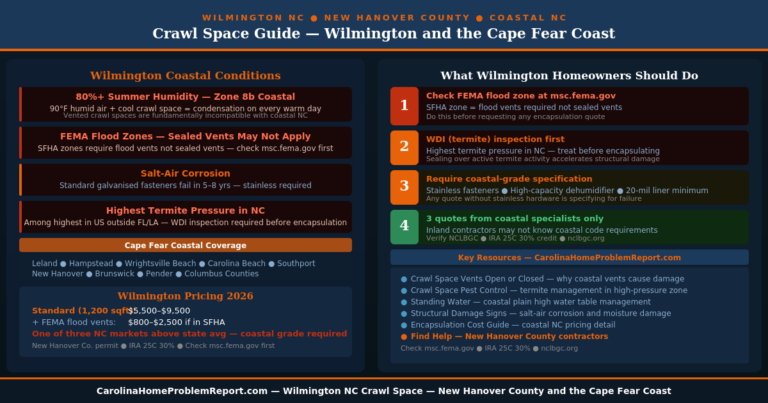
South Carolina follows similar provisions for closed crawl spaces. Coastal SC building departments in flood zones may impose additional requirements including flood vents that must remain operational. If your home is in a FEMA Special Flood Hazard Area, confirm local requirements with your building department before sealing all vents — flood vent requirements may limit or modify vent sealing options.
Seasonal Vent Management — Does Opening in Winter Ever Help?
The traditional advice — close vents in summer, open in winter — is a significant improvement over leaving vents open year-round, but it is not the optimum strategy even for those who choose to maintain a vented rather than sealed crawl space. Here is an honest assessment by location and season:
| Season/Period | Coastal SC and Eastern NC | NC/SC Piedmont | NC Mountains (Zone 4A) |
|---|---|---|---|
| May–September | CLOSED — outdoor air actively adds moisture | CLOSED — same reason | CLOSED — humid summers still apply |
| October–November | CLOSED — humidity still elevated | CLOSED — transition months, variable | Neutral — may open cautiously |
| December–February | Marginally beneficial — cold dry air | Marginally beneficial in dry cold spells | OPEN — cold dry air genuinely dries space |
| March–April | CLOSED — spring humidity arrives early | CLOSED — spring humidity builds | Neutral — transition period |
The honest conclusion: even the optimal seasonal vent management strategy requires constant attention, leaves vents open during the 2–3 months of winter when they provide marginal benefit, and does not protect the crawl space during the 8–10 months of the year when humidity is the actual problem. NC State Extension's Healthy Homes program consistently recommends sealed crawl spaces with proper moisture control as the correct long-term approach for Carolina homes — not seasonal vent management.
How to Properly Seal Foundation Vents
Vent sealing is one component of encapsulation — not a standalone fix. With that clearly understood, here is how vent sealing should be done correctly as part of a complete encapsulation project:
Measure each vent opening precisely
Vent openings vary in size. Standard sizes are approximately 8 inches x 16 inches but older homes often have non-standard openings. Measure every vent before purchasing materials — custom cuts from rigid foam board are needed for non-standard sizes.
Cut rigid foam inserts to fit
Cut 2-inch XPS rigid foam board to fit snugly inside each vent opening. The insert should fit flush with or slightly behind the vent frame opening. Rigid foam provides both an air seal and thermal insulation at the vent location — a plain piece of wood or plywood blocks airflow but creates a thermal bridge and is not code-compliant for a closed crawl space.
Seal all edges with spray foam
Run a bead of one-component expanding spray foam around all four edges of each rigid foam insert. This seals any air gaps between the insert and the vent frame. Allow the foam to fully cure and trim any excess. This creates the airtight seal that prevents outdoor air infiltration.
Seal the access door separately
NC code requires the crawl space access door to be insulated to minimum R-2 and fitted with a latch mechanism to minimize air entry. An uninsulated wooden hatch undercuts the sealed environment created by blocking the foundation vents. If the existing hatch is not insulated and latched, replace or upgrade it as part of the sealing project.
Address other penetrations
NC code requires air sealing at penetrations for plumbing, mechanical, electrical, and gas lines. Every pipe or wire that exits through the foundation wall or sill plate is a potential air infiltration point. Seal all penetrations with appropriate caulk or spray foam rated for the gap size — caulk for gaps under 1/4 inch, spray foam for larger gaps.
The Complete Solution — What Needs to Happen After You Seal the Vents
Sealing foundation vents is one step in a three-part system. All three must be in place for the system to work:
These three components form a system. Remove any one and the system fails. The dehumidifier without sealed vents runs continuously fighting incoming outdoor air. The sealed vents without a dehumidifier trap ground moisture with no removal path. The vapor barrier without sealed vents reduces but does not control summer humidity because outdoor air through the vents continues contributing moisture. All three together produce the sub-60% RH that protects the crawl space year-round.
Frequently Asked Questions
Should I open or close my crawl space vents in summer in NC?
Close them. In North Carolina's summer humidity — typical outdoor conditions from May through September exceed the dew point of crawl space surfaces — open vents actively condense moisture onto floor joists, ductwork, and pipes. This is the opposite of their intended function. For a lasting solution rather than just closing the vents, a complete encapsulation with vapor barrier, sealed vents, and dehumidifier is the correct approach.
Can I just cover my crawl space vents myself?
You can physically block the vents with rigid foam and spray foam sealant — the vent sealing step itself is DIY-accessible. However, closing vents without a vapor barrier and dehumidifier already in place will make moisture conditions worse, not better. Only close vents as part of a complete encapsulation. If you complete a full encapsulation project, vent sealing is a straightforward DIY component. If you are only able to do the vent sealing step and not the full system, leave the vents open until you can complete all three components.
Does NC code require me to seal my crawl space vents?
No — NC code does not require existing homes with vented crawl spaces to convert to sealed crawl spaces. Both approaches are permitted under current NC code (Section R408 for vented, Section R409 for closed). However, if you choose to convert from vented to sealed, the conversion must meet Section R409 requirements — including vapor barrier, mechanical drying, and air sealing — and requires a permit.
What about flood vents in coastal SC and NC areas?
Homes in FEMA Special Flood Hazard Areas may have engineered flood vents that are required by local flood ordinance to remain functional. These are different from standard foundation vents and cannot simply be sealed. If your home is in a designated flood zone, consult your local building department before sealing any foundation openings — flood vent requirements may limit your encapsulation options or require special flood-rated encapsulation approaches.
What temperature should I close my crawl space vents in NC?
In North Carolina, the correct answer is not a temperature threshold — it is a dew point threshold. The standard guidance is to close foundation vents whenever the outdoor dew point exceeds approximately 55°F, which in NC typically means keeping vents closed from April through October at a minimum. A practical temperature-based rule used by many Carolina contractors is: close vents when outdoor temperatures consistently exceed 65°F and keep them closed until overnight lows reliably drop below 50°F in autumn. However, the most reliable trigger is outdoor relative humidity above 60% — at that point, regardless of temperature, outdoor air entering the crawl space will raise interior humidity toward mold-risk levels. For a properly encapsulated crawl space, this question is moot — the vents are permanently sealed and a dehumidifier maintains target humidity year-round with no seasonal management required.
My home inspector said to open the vents in summer. Are they wrong?
This is older advice based on building practices and codes that pre-date current building science research. Many home inspectors trained before the shift to sealed crawl space standards still repeat conventional wisdom from that era. The building science research on this question is clear and has been confirmed by multiple field studies including Advanced Energy's North Carolina research — in humid climates like Carolina's, open foundation vents increase rather than decrease crawl space moisture during summer months. The current NC building code's endorsement of sealed crawl spaces reflects this research consensus.
💡 Sealing Your Vents? Get Component 3 Sorted First.
A dehumidifier sized to your crawl space is what stops a sealed vent project from turning into a sealed box. Argendon's range covers every Carolina crawl space size, with a 5-year warranty. Use code CHPR3 for an extra 3% off.
Shop Argendon Dehumidifiers → Code CHPR3 saves 3% at checkout- Crawl space vents in NC and SC should be closed and sealed year-round, not seasonally adjusted — the dew point physics that make open vents harmful hold for 8–10 months of the year across the Coastal Plain and Piedmont.
- Closing vents without a vapor barrier and dehumidifier already in place makes conditions worse, not better — humidity inside a sealed-but-unencapsulated crawl space can climb past 90% within 2–3 weeks.
- NC code does not require existing homes to convert from vented to sealed — but any conversion must meet Section R409's vapor barrier, mechanical drying, and air sealing requirements, and requires a permit.
- The only Carolina exception is the NC mountain counties in December–February, where cold dry outdoor air can genuinely help dry a vented crawl space — everywhere else, year-round sealing is correct.
- The three-component system — vapor barrier, sealed vents, dehumidifier — only works as a set. The dehumidifier is the component most homeowners skip or undersize, and it's the one that determines whether a sealed vent project actually stays dry.
The Carolina Home Problem Report editorial team researches and writes guides for homeowners across North and South Carolina. Our research draws on Advanced Energy field studies, NC State Extension Healthy Homes publications, NC Building Code research, and insights from licensed Carolina contractors. We are not contractors — we are a research team dedicated to giving Carolina homeowners clear, locally specific, unbiased answers.
📚 Key Concepts — Reference Sources
- Dew Point (Wikipedia) — the temperature threshold behind every condensation mechanism explained in this article, and why open vents fail in Carolina's climate
- Relative Humidity (Wikipedia) — the 60% RH threshold referenced throughout this guide as the line between a healthy and at-risk crawl space
- Mold (Wikipedia) — what establishes on floor joists within weeks when a sealed-but-unencapsulated crawl space is left without a dehumidifier
Carolina Home Problem Report is an informational resource for homeowners. We are not licensed contractors. Always consult a qualified professional before making home repair decisions. See our Disclaimer and Affiliate Disclosure.