Crawl Space Moisture and Mold [The Deadly Connection + Proven Remediation Guide for Carolina Homes]
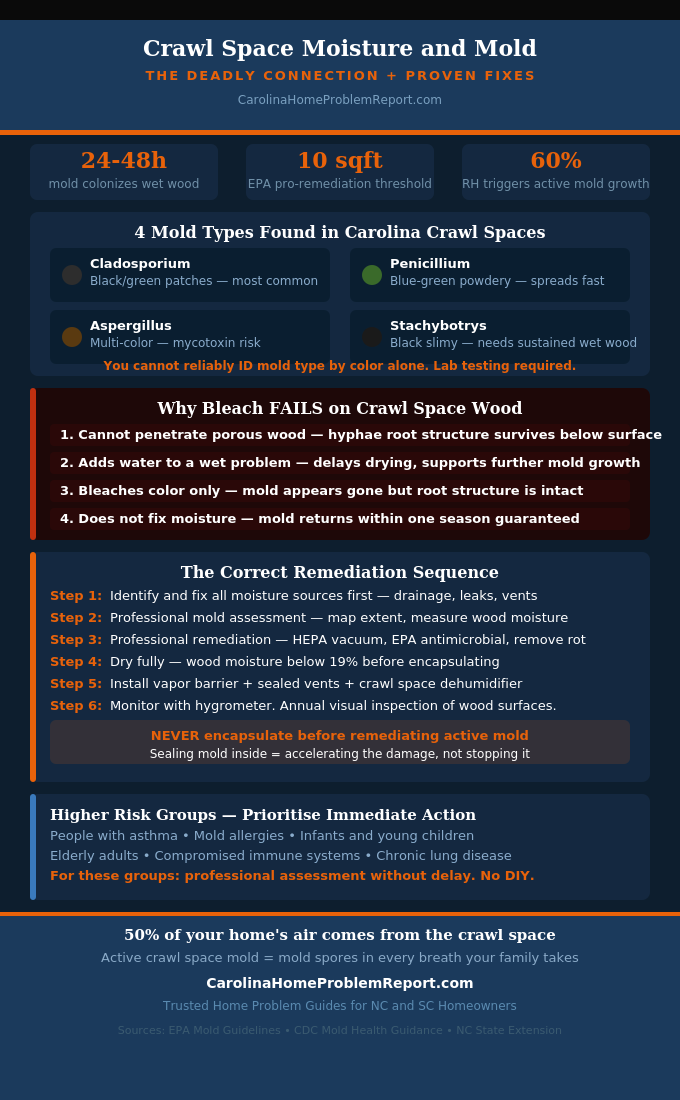
Crawl space moisture and mold are directly connected — moisture is what mold needs to grow, and Carolina crawl spaces provide it in abundance. Mold begins colonizing wood surfaces within 24-48 hours of reaching sustained humidity above 60% and requires three things: moisture, organic material (wood), and temperatures above 40°F. All three are present in a Carolina crawl space for months at a time. The only way to stop mold permanently is to eliminate the moisture that feeds it — remediation without moisture control guarantees the mold will return.
⭐ Key Takeaways
- ✓Crawl space moisture and mold are a cause-and-effect relationship — mold is a symptom, moisture is the disease
- ✓Bleach does not kill mold on wood — it bleaches the color away but leaves the root structure (hyphae) alive and active
- ✓The EPA recommends professional remediation for any mold area larger than 10 square feet — crawl space mold almost always exceeds this threshold
- ✓Up to 50% of the air in your home comes from the crawl space — mold spores growing below your floor are in the air your family breathes daily
- ✓Mold remediation without fixing the moisture source first is money wasted — the mold will be back within one season
Crawl space moisture and mold go together the way humidity and Carolina summers do — one reliably produces the other. Most Carolina homeowners who find mold on their floor joists are surprised by it. They had no idea it was there. The crawl space is out of sight and rarely inspected, which is precisely why mold can colonize its surfaces for a full season or longer before anyone notices the musty smell drifting up through the floorboards.
What makes crawl space mold particularly dangerous is not just the structural damage it causes to floor joists, rim joists, and subflooring — though that damage is real and expensive. It is that the same stack effect that pulls crawl space air upward into your living spaces also carries mold spores. Every breath your family takes inside a home with an active mold colony in the crawl space contains those spores. For people with asthma, allergies, or compromised immune systems, this is a genuine and ongoing health threat.
This guide explains the relationship between crawl space moisture and mold specifically for Carolina homes — the conditions that allow mold to establish, the types you are most likely to find, the health effects you need to understand, why common DIY approaches fail, and the correct sequence for permanent resolution.
In This Article
- How Moisture Causes Mold in a Crawl Space
- Types of Mold Found in Carolina Crawl Spaces
- Health Effects of Crawl Space Mold
- Warning Signs of Mold in Your Crawl Space
- Why Bleach Does Not Work on Crawl Space Mold
- DIY vs Professional Remediation — Where the Line Is
- The Correct Remediation and Prevention Sequence
- Frequently Asked Questions
How Moisture Causes Mold in a Crawl Space
Understanding the moisture-mold relationship in a crawl space starts with understanding what mold actually needs to grow. Mold is a fungus that reproduces through microscopic spores. Those spores are present everywhere — in the soil, in the outdoor air, and on every surface in your crawl space. They cannot be eliminated. What can be controlled is whether they have the conditions to germinate and colonize.
Mold requires three things simultaneously: an organic food source, moisture, and temperatures above roughly 40°F. A crawl space provides all three. The wood framing — floor joists, rim joists, sill plates, blocking, and subflooring — is the organic food source. Temperatures stay above 40°F for ten or more months of the year in most of the Carolinas. Moisture is the only variable the homeowner can influence.
The moisture threshold that triggers mold colonization
According to the EPA's mold guidance, mold growth is effectively prevented when materials are kept dry — specifically when relative humidity is maintained below 60% and building materials are not allowed to remain wet for more than 24-48 hours. In a Carolina crawl space during summer, where outdoor humidity alone can push crawl space RH above 75-80%, those conditions are routinely exceeded for weeks or months at a time without any active intervention. This is why the overwhelming majority of older vented Carolina crawl spaces have some degree of mold growth by the time they are professionally inspected.
Wood moisture content is the more precise measurement that matters for structural mold risk. When wood absorbs enough moisture from the air to reach a moisture content of 19% or higher, fungal growth can begin on its surface. This is not a theoretical threshold — it is the level at which the fungi responsible for wood rot gain the foothold needed to begin breaking down cellulose. In a persistently humid Carolina crawl space, floor joists can reach and sustain this moisture content for the entire summer season.
The result, over one to two seasons, is what crawl space professionals find in the overwhelming majority of older, vented Carolina homes they inspect: active or dormant mold colonies covering varying percentages of the exposed wood framing beneath the floor.
Types of Mold Found in Carolina Crawl Spaces
Knowing what you are looking at matters for both health and remediation decisions. Here are the four most common mold types found in Carolina crawl spaces:
Cladosporium — Black, green, or olive patches
The most common mold found in Carolina crawl spaces. Appears as dark spots or patches on wood surfaces. One of the most common indoor molds in the country. Can trigger allergic reactions and respiratory irritation in sensitive individuals. Not typically considered toxic but its presence confirms that moisture conditions are supporting mold growth.
Penicillium — Blue-green, powdery appearance
Blue-green or teal-colored colonies with a powdery texture. Spreads rapidly in humid conditions. Can damage building materials and produce mycotoxins in some species. A strong musty odor is a common indicator. Penicillium spreads easily through air movement, making it a common contaminant in HVAC systems in homes with crawl space mold.
Aspergillus — White, yellow, green, or brown colonies
One of the most widespread mold genera in the world. Appears in many colors. Some Aspergillus species produce aflatoxins and other mycotoxins that present health risks particularly to people with compromised immune systems. Very common in Carolina crawl spaces with persistent moisture. Associated with respiratory symptoms and allergic reactions.
Stachybotrys chartarum — The black mold
The most talked-about mold and the most misidentified. True Stachybotrys is greenish-black, slimy in texture, and grows specifically on materials with high cellulose content that have been continuously wet for a sustained period — not just high humidity. It is less common than the other types but presents the most significant health concerns. Requires professional testing to confirm identification. Never attempt DIY remediation of suspected Stachybotrys.
⚠️ Important about mold identification
You cannot reliably identify mold type by looking at it. Color is not a reliable indicator of species or toxicity. White mold is not automatically safe. Black mold is not automatically Stachybotrys. If you need to know the specific species for health or insurance reasons, have a certified mold inspector collect samples for laboratory analysis. For most homeowners the species is less important than the size of the colonized area and what surfaces are affected.
Health Effects of Crawl Space Mold
The health effects of crawl space mold exposure depend on the mold species, the extent of colonization, the airflow between the crawl space and living areas, and the individual sensitivity of people in the household. According to the CDC's mold health guidance, mold exposure can cause the following health effects:
For most healthy adults — allergic and irritant symptoms:
- Nasal and sinus congestion, runny nose
- Eye irritation — itching, redness, watering
- Skin irritation and rashes
- Coughing, wheezing, or throat irritation
- Headaches that improve when away from home
- Fatigue that has no obvious other cause
⚠ Higher risk for these groups:
- People with asthma — mold spores are a known asthma trigger; exposures can precipitate acute attacks
- People with mold allergies — more severe allergic reactions including respiratory distress
- Infants and young children — developing respiratory systems are more sensitive to airborne irritants
- Elderly individuals — may have reduced immune response
- People with compromised immune systems — cancer patients, those on immunosuppressive medications, HIV-positive individuals — risk of serious lung infections from mold exposure
- People with chronic lung disease — COPD, chronic bronchitis — may develop mold infections in lung tissue
If anyone in your household falls into a higher-risk group and your home has a musty smell or you suspect crawl space mold, treat this as a higher-priority health situation and pursue professional assessment and remediation without delay.
Warning Signs of Mold in Your Crawl Space
Many Carolina homeowners detect crawl space mold first through symptoms inside the living space rather than through direct inspection. Here is what to watch for both above and below:
SIGNALS YOU MAY NOTICE INSIDE YOUR HOME:
- A persistent musty or earthy smell, particularly on the first floor and strongest in the morning before the house has aired out
- Allergy or asthma symptoms that are worse at home and improve when away for a day or more
- Household members experiencing unexplained respiratory symptoms during summer months
- A smell that worsens after the HVAC system turns on — indicating mold spores may have entered the duct system
- Floors that feel slightly soft or bouncy in areas — advanced wood rot may have already begun
WHAT TO LOOK FOR INSIDE THE CRAWL SPACE:
- Visible growth on floor joists, rim joists, blocking, or subflooring — any color: black, white, grey, green, or brown
- Fuzzy, powdery, or slimy patches on wood surfaces — any texture indicates active or recently active mold
- Dark staining on wood that does not wipe off — may be established mold colony or post-mold staining
- Wood that feels soft, spongy, or crumbles when pressed with a screwdriver tip
- Insulation that is wet, discolored, or has fallen from between joists
- Hygrometer reading consistently above 60% in summer
Why Bleach Does Not Work on Crawl Space Mold
Bleach is the most commonly attempted DIY mold treatment — and on crawl space wood, it is almost completely ineffective. This is one of the most important things a Carolina homeowner can understand about crawl space moisture and mold before spending time or money on remediation.
Here is why bleach fails on wood:
Bleach cannot penetrate porous wood surfaces. The active ingredient in bleach (sodium hypochlorite) is water-based. Water does not penetrate deeply into wood grain. The bleach kills mold on the surface but the root structure — called hyphae — extends into the wood where bleach cannot reach. Surface mold dies. The root structure survives. The colony regrows within weeks.
Bleach adds water to an already wet problem. Mold grows because of moisture. Applying a water-based solution to a damp wood surface in a humid environment adds moisture to the equation. Even after the bleach evaporates, the added surface moisture delays drying and can support further mold growth.
Bleach masks the problem without solving it. The bleaching action removes the visible color from mold growth, making the wood look clean when it is not. Homeowners who bleach their crawl space often believe the problem is solved. It is not. The mold is still there, now invisible, with its root structure intact and the moisture conditions unchanged.
Bleach does not address the moisture source. Even if bleach killed every mold spore on every surface in the crawl space — which it cannot — the mold would return within one season because the moisture conditions that allowed it to grow have not changed. Mold remediation without moisture control is maintenance, not resolution.
What actually works on wood: Professional mold remediation for crawl space wood uses EPA-registered antimicrobial treatments specifically formulated to penetrate porous wood, encapsulation with mold-resistant coatings after treatment, physical removal of heavily colonized wood where necessary, and in some cases borate treatments that prevent re-colonization. These are not available at hardware stores and require professional application for full effectiveness.
DIY vs Professional Remediation — Where the Line Is
The EPA's guidance provides a practical starting point: homeowners can manage mold areas smaller than 10 square feet using proper protective equipment and EPA-approved cleaning products. Beyond 10 square feet, professional remediation is recommended.
In practice, crawl space mold almost always exceeds this threshold by the time it is discovered. Mold that has had one summer season to grow on floor joists with sustained humidity above 70% rarely affects just 10 square feet. The dark, undisturbed, humid crawl space is an ideal mold habitat — growth that would be noticed and addressed on a visible wall surface can spread across dozens of linear feet of floor joists undetected for a full year.
The Correct Remediation and Prevention Sequence
This sequence is non-negotiable. Steps done out of order produce incomplete results or create new problems. Encapsulating a crawl space with active mold and uncorrected moisture, for example, seals the mold inside a controlled environment and can accelerate the damage it causes.
Identify and fix all moisture sources first. No remediation should begin until you know what is producing the moisture and have a plan to stop it. Fix exterior drainage, repair plumbing leaks, and confirm which moisture sources are active. Remediating mold before fixing moisture is like painting over rust — cosmetic and temporary.
Assess the extent of mold growth professionally. Before spending money on remediation, have a certified mold inspector assess the crawl space. They can map the extent of colonization, identify what surfaces are affected, measure wood moisture content, and determine whether any structural repair is needed before encapsulation work proceeds.
Conduct professional mold remediation. Professional remediation for crawl space wood includes HEPA vacuuming of loose spores, application of EPA-registered antimicrobial treatment, physical removal of heavily colonized or structurally compromised wood material, and post-treatment inspection. Cost in the Carolina market typically runs $500-$2,000 for the crawl space alone, before any moisture control improvements.
Allow the crawl space to dry fully before encapsulating. After remediation, the wood needs to reach a safe moisture content (below 19%) before any encapsulation work seals the space. Encapsulating wet wood traps moisture inside the sealed environment. A wood moisture meter reading confirms when conditions are safe to proceed.
Install permanent moisture control systems. Vapor barrier, sealed foundation vents, and a properly sized crawl space dehumidifier create the environment in which mold cannot re-establish. This step is what converts a remediation from a temporary fix into a permanent solution. Without it the mold will be back within one to two seasons.
Monitor with a hygrometer and annual inspection. Place a hygrometer in the crawl space and check readings quarterly. Target: 50-55% RH consistently. Schedule an annual visual inspection of the wood surfaces. Catching any moisture breakthrough or early mold return early costs a fraction of what full remediation costs.

Frequently Asked Questions
Can crawl space mold make you sick even if you never go in the crawl space?
Yes. The stack effect pulls crawl space air upward through gaps in the subfloor and into living areas continuously. You do not need to enter the crawl space for airborne mold spores to enter your breathing environment. Homes with active crawl space mold consistently show elevated mold spore counts in indoor air samples even when the crawl space is not recently entered or disturbed.
How long does mold remediation take in a crawl space?
Most professional crawl space mold remediation projects are completed in one to three days. This includes HEPA vacuuming, antimicrobial treatment application, and any necessary material removal. The full sequence including moisture source correction, drying time, and encapsulation typically spans two to six weeks total when all phases are included.
Will encapsulation stop mold from growing in my crawl space?
Encapsulation combined with a crawl space dehumidifier maintains conditions below the mold growth threshold, effectively preventing re-establishment once active mold has been remediated. However encapsulation alone — without a dehumidifier — is not sufficient in a Carolina climate. And encapsulation without prior remediation of existing mold is counterproductive. The sequence matters.
How much does crawl space mold remediation cost in North or South Carolina?
Mold remediation in a crawl space typically costs $500-$2,000 in the NC and SC market depending on the extent of colonization and the access difficulty of the crawl space. This is the cost of the remediation work itself. The complete solution — fixing moisture sources, vapor barrier, dehumidifier, and encapsulation — typically adds $2,000-$8,000 on top of remediation costs. Always get at least three quotes from licensed remediation contractors.
Does homeowners insurance cover crawl space mold remediation?
It depends on the cause. Mold resulting from a sudden, accidental water event such as a burst pipe may be covered under your homeowners policy if the water damage itself was covered. Mold resulting from long-term moisture, gradual seepage, groundwater, or lack of maintenance is typically excluded. Always document the situation thoroughly and contact your insurer before beginning remediation work to preserve any potential claim.
💡 Already Remediated? Don't Skip Step 5.
Remediation without permanent humidity control is the single most common reason mold returns within a season. Argendon's crawl space dehumidifier range covers every Carolina crawl space size, with a 5-year warranty. Many models are already on sale — apply code CHPR3 at checkout for an extra 3% off the listed sale price.
Shop Argendon Dehumidifiers → Code CHPR3 = extra 3% off at checkout- Crawl space moisture and mold are a direct cause-and-effect relationship — mold is a symptom, moisture is the disease, and treating the symptom without fixing the disease guarantees the mold returns within one season.
- Bleach does not work on crawl space wood — it kills surface mold but leaves the root structure (hyphae) alive inside the wood grain, and it adds moisture to an already wet problem.
- Crawl space mold almost always exceeds the EPA's 10 sq ft DIY threshold by the time it's discovered — professional remediation is the realistic path for most Carolina crawl spaces.
- Up to 50% of the air on your home's ground floor comes from the crawl space — mold spores growing below the floor are in the air your family breathes daily, whether or not anyone ever enters the crawl space.
- Step 5 — a properly sized commercial dehumidifier — is what converts a remediation from a temporary fix into a permanent one. Skipping it is the most common reason Carolina homeowners pay for mold removal twice.
The Carolina Home Problem Report editorial team researches and writes guides for homeowners across North and South Carolina. Our research draws on NC State Extension Service publications, Clemson Extension resources, EPA guidelines, Building Science Corporation data, and insights from licensed Carolina contractors. We are not contractors — we are a research team dedicated to giving Carolina homeowners clear, locally specific, unbiased answers.
📚 Key Concepts — Reference Sources
- Mold (Wikipedia) — the fungus species that colonise crawl space wood, and the moisture conditions that let it establish
- Relative Humidity (Wikipedia) — the 60% RH threshold referenced throughout this guide as the trigger point for mold colonization
- Dehumidifier (Wikipedia) — how mechanical dehumidification maintains the sub-60% humidity that prevents mold from returning after remediation
Carolina Home Problem Report is an informational resource for homeowners. We are not licensed contractors or mold assessors. Always consult a qualified professional before making home repair decisions. See our Disclaimer and Affiliate Disclosure.