Crawl Space Smell in House [What Each Odour Is Telling You — Complete Root Cause Guide for Carolina Homeowners]
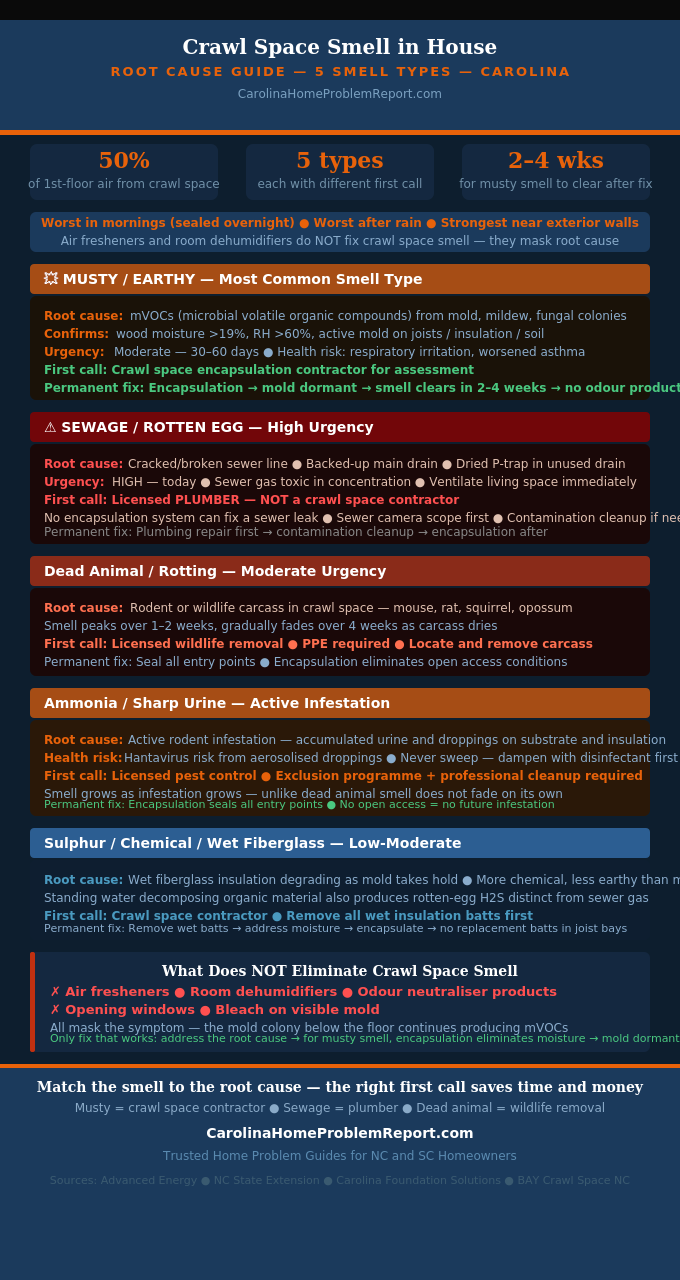
A crawl space smell in the house tells you something specific — if you know how to read it. Musty or earthy means moisture and mold. Sewage or rotten egg means a broken drain line — call a plumber first. Dead animal or rotting means a carcass below the floor. Ammonia or sharp urine means active rodent infestation. Each smell has a specific root cause, a specific first call, and a specific permanent fix. The smell reaching your living space is proof of the stack effect — up to 50% of first-floor air in a crawl space home comes from below the floor.
⭐ Key Takeaways
- ✓The smell is strongest in the morning — when the house has been sealed overnight and crawl space air has risen undiluted through the floor. This is the best time to diagnose which smell type you have.
- ✓A musty crawl space smell is caused by microbial volatile organic compounds (mVOCs) released by mold, mildew, and fungal colonies — not by "dampness" itself. The mold is there; the smell is its byproduct.
- ✓A sewage smell from a crawl space requires a licensed plumber as the first call — not a crawl space contractor. The root cause is a broken or backed-up drain line and no encapsulation can fix a sewage leak.
- ✓Air fresheners, dehumidifiers placed in the living space, and crawl space odour products do not eliminate the smell — they mask it temporarily while the root cause continues
- ✓After the root cause is fixed, the musty smell typically clears within 2–4 weeks as encapsulation and dehumidification process the contaminated air — without any odour product needed
A crawl space smell in the house is one of the most diagnostic signals a home can give. Most Carolina homeowners who notice it spend months attempting to address it in the wrong place — buying air fresheners, running room dehumidifiers, checking the kitchen bins — before discovering the source is six inches below the floor they are standing on. The musty, earthy odour that is strongest first thing in the morning, worst after rain, and noticeable mostly near exterior walls or in rooms on the lowest floor is almost always originating from the crawl space.
The mechanism that delivers this smell from below the floor to your nose is the stack effect documented in Advanced Energy's crawl space research — warm air rises through the home and exits at the top, pulling replacement air from the lowest available source: the crawl space. Up to 50% of the first-floor air in a crawl space home comes from below the floor. What is in that air — mold spores, mVOCs, rodent contamination particles, or sewer gases — determines both the smell and the health risk.
This article maps every distinct crawl space smell type to its root cause, urgency level, the correct first call, and the permanent fix. Identifying which smell you have converts a confusing and alarming problem into a specific diagnosis with a specific action plan.
In This Article
- How Crawl Space Smell Enters Your Living Space
- Musty or Earthy Smell — Root Cause and Fix
- Sewage or Rotten Egg Smell — Root Cause and Fix
- Dead Animal or Rotting Smell — Root Cause and Fix
- Ammonia or Sharp Urine Smell — Root Cause and Fix
- Sulphur or Wet Fiberglass Smell — Root Cause and Fix
- What Does Not Eliminate Crawl Space Smell
- The Permanent Fix — Why Encapsulation Eliminates Musty Smell
- Frequently Asked Questions
How Crawl Space Smell Enters Your Living Space
Understanding the delivery mechanism explains why the smell is worst in the morning and near exterior walls — and why addressing it in the living space never works permanently.
The Stack Effect — How air moves from crawl space to your nose
Warm air rises through your home and exits at the top through gaps around windows, attic hatches, and ceiling penetrations. This creates a low-pressure zone at the bottom of the home that pulls replacement air in from the lowest available source — the crawl space below. Air from the crawl space enters the living space through gaps around plumbing pipes, electrical wires, HVAC ducts, and joints in the subfloor.
WHY WORST IN MORNINGS
House sealed overnight — crawl space air rises undiluted through the floor for hours
WHY WORST AFTER RAIN
Rain raises crawl space humidity, accelerates mold activity, increases mVOC production
WHY NEAR EXTERIOR WALLS
Highest gap density around perimeter — most air infiltration from below occurs here
Musty or Earthy Smell — Root Cause and Fix
Sewage or Rotten Egg Smell — Root Cause and Fix
Dead Animal or Rotting Smell — Root Cause and Fix
Ammonia or Sharp Urine Smell — Root Cause and Fix
Sulphur or Wet Fiberglass Smell — Root Cause and Fix
What Does Not Eliminate Crawl Space Smell
These are the most common approaches Carolina homeowners try before discovering the root cause is below the floor:
✗ Air fresheners and odour absorbers in the living space
Mask the smell at the point where it has already entered the living space. The source continues producing mVOCs below the floor and the smell returns immediately when the freshener is exhausted. The crawl space never stops generating odour.
✗ Room dehumidifier placed in the living space
Reduces humidity in the room — does nothing for the humidity in the crawl space 6 inches below the floor. The mold colony generating mVOCs is in the crawl space, not in the living room.
✗ Crawl space odour neutraliser products
Various products claim to neutralise crawl space odours by chemical reaction in the air. None address the mold colony producing the mVOCs. Some may temporarily reduce odour intensity inside the crawl space but cannot prevent the ongoing mVOC production from active mold on wood surfaces.
✗ Opening windows and increasing ventilation in the home
Dilutes the smell by introducing outdoor air — reduces perceived intensity. Does nothing for the crawl space. The smell returns when windows are closed. In summer, increasing ventilation to the living space actually increases the stack effect draw from the crawl space below.
✗ Bleach application to visible mold on the crawl space ceiling
Bleach kills surface mold on non-porous surfaces — it does not penetrate wood grain where mold colonises. It adds moisture to an already humid space. It does not address the humidity that causes the mold to regrow within weeks. NC State Extension and most remediation professionals do not recommend bleach for wood mold remediation.
The Permanent Fix — Why Encapsulation Eliminates Musty Smell
For the musty/mVOC smell — the most common crawl space smell in Carolina homes — encapsulation is the permanent solution because it addresses the moisture that sustains the mold producing the smell.
The chain from root cause to smell to fix:
Moisture enters
via open vents, soil
Humidity >60% RH
mold threshold exceeded
Mold colonies grow
on wood and soil
mVOCs released
musty smell produced
Stack effect
carries smell indoors
Encapsulation breaks the chain at step 1: sealed vents prevent moisture entry, vapour barrier eliminates ground evaporation, dehumidifier maintains RH below 60%. Mold cannot grow in RH below 60%. Existing colonies become dormant and stop producing mVOCs. The smell clears within 2–4 weeks as the processed air inside the sealed space becomes clean.
According to NC State Extension's house inspection guidance, the musty smell in a crawl space home is one of the most reliable indicators of an active moisture problem requiring professional assessment — and one of the most reliably eliminated by proper moisture control.
Frequently Asked Questions
Why does my house smell musty in the morning?
The stack effect operates overnight while the house is sealed. Crawl space air rises through gaps around pipes and wires and enters the living space continuously. By morning, this air has accumulated undiluted for hours — the smell is at its strongest before windows are opened and outdoor air begins diluting it. If the smell is strongest in the morning and decreases when you open windows, the source is almost certainly the crawl space below.
Can crawl space smell make you sick?
Yes — the specific compounds depend on the smell type. Mold mVOCs from a musty crawl space are associated with respiratory irritation, worsened asthma, allergic reactions, and headaches — particularly in children, the elderly, and those with respiratory conditions. Sewer gas (hydrogen sulfide) is toxic in sufficient concentrations. Rodent droppings aerosolised from a crawl space carry hantavirus risk. If family members experience symptoms (chronic nasal congestion, coughing, headaches) that improve when away from home, crawl space air quality is a likely contributor.
How do I find where the crawl space smell is coming in?
The smell enters through gaps around plumbing pipes, electrical cables, HVAC duct penetrations, and joints in the subfloor. The highest concentration is typically found by placing your nose near the floor or close to exterior walls where the most penetrations occur. On a cold morning before the house has aired, use a lit stick of incense held near floor-level penetrations — smoke drawn downward through gaps confirms crawl space air entry points. These entry points cannot be permanently sealed from above — the moisture source below must be addressed first.
Will crawl space encapsulation get rid of the musty smell?
Yes — for musty smell caused by mold and moisture, encapsulation is the permanent solution. It eliminates the moisture that sustains the mold. Active mold becomes dormant within 2–4 weeks as humidity drops below 60% RH. mVOC production stops. The musty smell clears within 2–4 weeks of a completed installation in most cases. Many Carolina homeowners specifically report the morning smell test as the clearest before/after indicator they notice.
What does crawl space mold smell like?
Crawl space mold produces a musty, earthy odour — commonly described as damp cardboard, wet leaves, or an old basement. The smell is produced by mVOCs (microbial volatile organic compounds) released by the mold's metabolic activity. Different mold species produce slightly different mVOC profiles, which is why some mold smells earthy and others smell more chemical or medicinal. All of them indicate active mold growth driven by moisture above 60% RH. The smell intensity is not a reliable indicator of the extent of mold coverage — a small mold colony in a concentrated area can produce a strong smell while extensive mold on remote joists may be less noticeable from the living space.
A crawl space smell in a Carolina home is a diagnostic signal, not just an inconvenience. The musty morning smell is mold mVOCs rising via the stack effect — the permanent fix is encapsulation. The sewage smell is a broken drain line — the first call is a licensed plumber. The rotting smell is a dead animal — the first call is wildlife removal. Match the smell to its root cause and you know exactly who to call and what the permanent fix looks like.
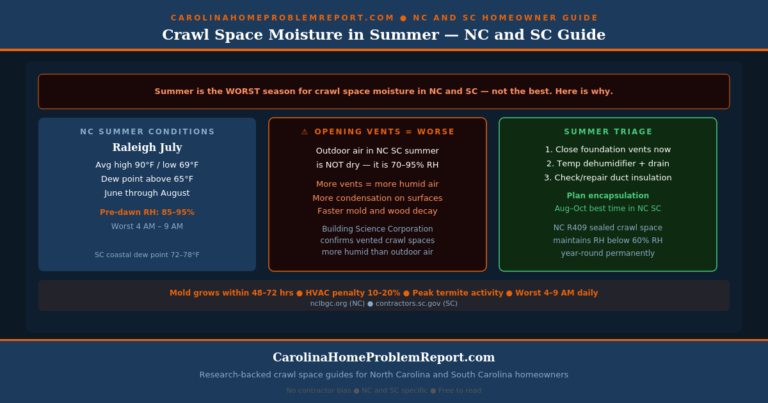
In North and South Carolina, where humidity is consistently high, the musty crawl space smell is nearly universal in homes with unencapsulated crawl spaces — it is not a sign that something unusual has happened to your home. It is a sign that the standard conditions under your home have exceeded the threshold where mold is inactive. The fix is straightforward, it is documented, and it works permanently.
Get a Free Crawl Space Assessment →The Carolina Home Problem Report editorial team researches and writes guides for homeowners across North and South Carolina. Our research draws on Advanced Energy field studies, NC State Extension publications, Carolina Foundation Solutions NC, JES Foundation Repair, BAY Crawl Space NC research, and Angi expert guidance. We are not licensed contractors — we are a research team dedicated to giving Carolina homeowners clear, locally specific, unbiased answers.
Carolina Home Problem Report is an informational resource for homeowners. We are not licensed contractors. If you smell sewer gas or detect symptoms of gas exposure, ventilate immediately and call professionals. See our Disclaimer.