Crawl Space Radon NC — North Carolina Radon Risk Zones, How Crawl Spaces Increase Exposure, and Mitigation Options
⚡ QUICK ANSWER
Radon is a radioactive gas that forms naturally from uranium decay in soil and rock. Crawl space homes provide a large, enclosed entry zone directly below the floor. NC has significant radon risk zones, particularly in the western mountains and Piedmont regions. The EPA action level is 4 pCi/L. Test your home first — if levels are elevated, a sub-membrane depressurisation system under the crawl space vapour barrier is the standard mitigation method.
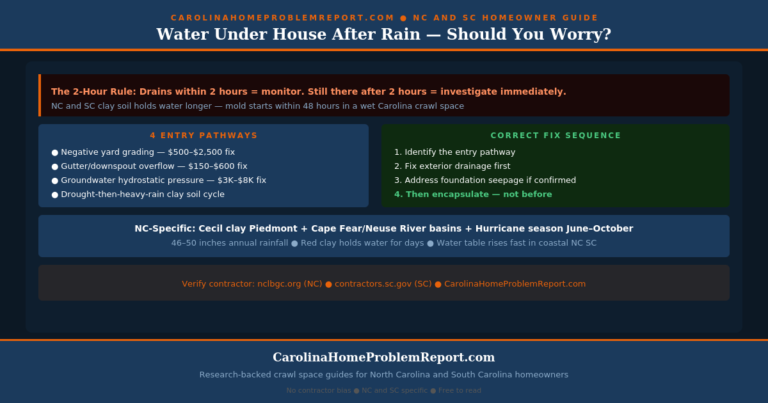
Crawl space radon NC is a significant health concern that many North Carolina homeowners overlook entirely, partly because radon is invisible and odourless and partly because NC's radon risk is not evenly distributed — it is concentrated in specific geological zones that run through the western and Piedmont regions of the state. Crawl space homes in these zones face higher radon risk than slab homes because the crawl space creates a large, enclosed collection zone beneath the floor where radon can accumulate before entering the living space.
Radon and Crawl Spaces — How the Risk Works
Radon is produced continuously from the natural radioactive decay of uranium in soil, rock, and groundwater. It is present everywhere at low levels but concentrates to harmful levels when it accumulates in enclosed spaces — particularly the ground floor of homes built over soil with elevated uranium content.
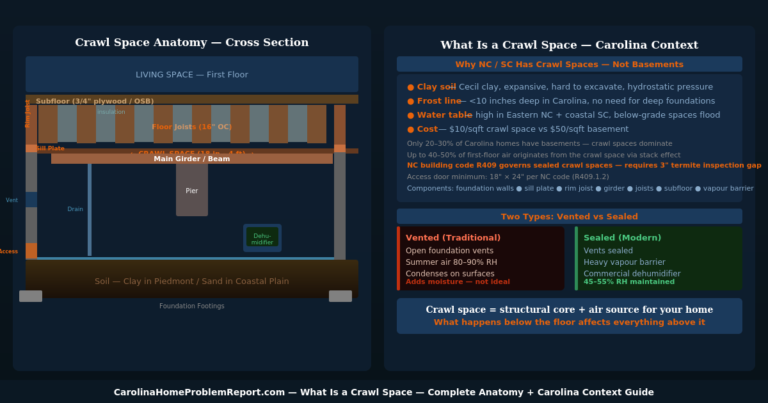
In a slab home, the slab provides a partial barrier between the soil and the living space. In a crawl space home, the crawl space sits directly on or close to the soil, with a large surface area of exposed earth, and is separated from the living space only by the subfloor — which has numerous gaps around joists, plumbing, wiring, and HVAC penetrations. Radon that accumulates in the crawl space migrates upward through these gaps continuously.
North Carolina Radon Risk Zones
⚠️ NC RADON RISK ZONES BY EPA CLASSIFICATION
- Zone 1 — Highest potential (above 4 pCi/L average): Western NC mountain counties — Buncombe, Henderson, Madison, Yancey, Mitchell, Avery, Watauga, Ashe, Alleghany, and Piedmont counties including Lincoln and Gaston. Test as a priority.
- Zone 2 — Moderate potential (2–4 pCi/L average): Much of the NC Piedmont including Mecklenburg (Charlotte), Forsyth (Winston-Salem), Guilford (Greensboro), Rowan, Cabarrus (Concord), Iredell. Zone 2 homes should still be tested — elevated levels are common even if zone average is below action threshold.
- Zone 3 — Lower potential (below 2 pCi/L average): Much of the NC coastal plain. Lower risk but not zero — testing still recommended.
South Carolina has a different distribution — most of SC is Zone 2 or Zone 3, with lower overall radon risk than western NC. However, SC homes in the Piedmont Upstate region (Greenville, Spartanburg) are in moderate-risk zones and should be tested.
How to Test for Radon in Your NC Home
Short-term test (2–7 days): A charcoal canister test kit placed in the lowest liveable area of the home. Available at hardware stores for $15–$30 or through the NC Radon Program. Provides a quick initial screening.
Long-term test (90+ days): An alpha track detector that measures radon over a full season or longer. Provides a more accurate average that accounts for seasonal variation. Recommended for confirmation if a short-term test shows elevated levels.
Professional testing: A certified radon measurement professional can conduct continuous electronic monitoring that provides the most accurate and defensible result. Required for real estate transactions in some situations.
The EPA action level is 4 pCi/L — mitigation is recommended at this level and above. The EPA also recommends considering mitigation at 2–4 pCi/L given that no level of radon is completely safe.
Crawl Space Radon Mitigation
If testing confirms elevated radon levels in a crawl space home, the standard mitigation method is sub-membrane depressurisation — a system that creates negative pressure beneath the crawl space vapour barrier to draw radon away from the living space before it can accumulate.
The system consists of a continuous vapour barrier laid over the entire crawl space floor, with a suction pipe routed from beneath the barrier through the crawl space and up through the house to vent outdoors above the roofline. A fan maintains negative pressure beneath the barrier continuously, drawing radon-laden soil gases out and away from the home.
This system is compatible with — and often incorporated into — a full crawl space encapsulation. Radon mitigation should be performed by a certified radon mitigation contractor. In NC, look for contractors certified through the National Radon Proficiency Program (NRPP) or the National Radon Safety Board (NRSB).
Related Guides
- Crawl Space Vapor Barrier Guide
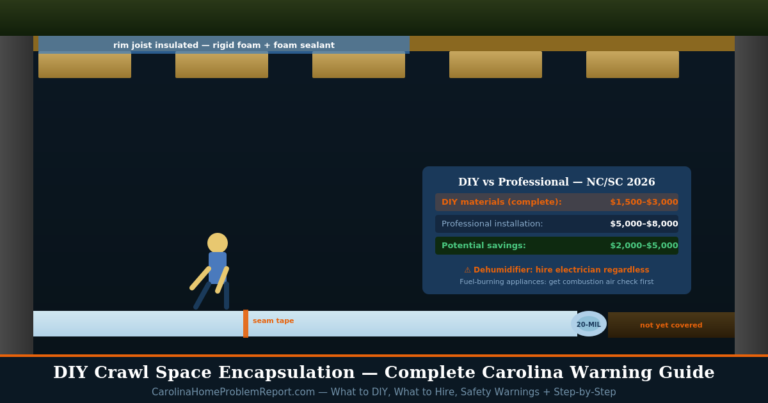
- DIY Crawl Space Encapsulation
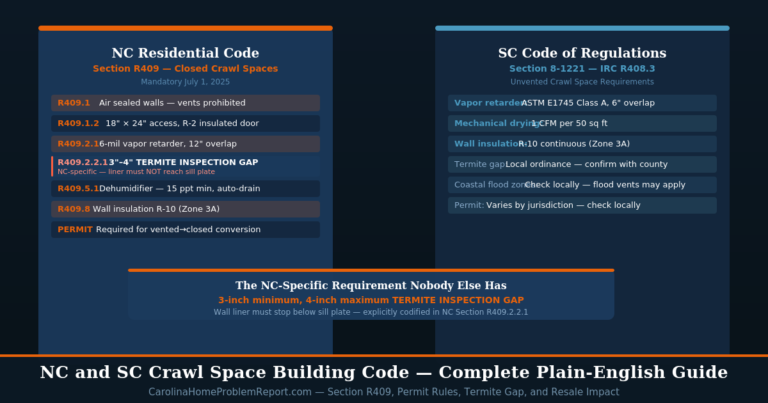
- NC and SC Crawl Space Building Code
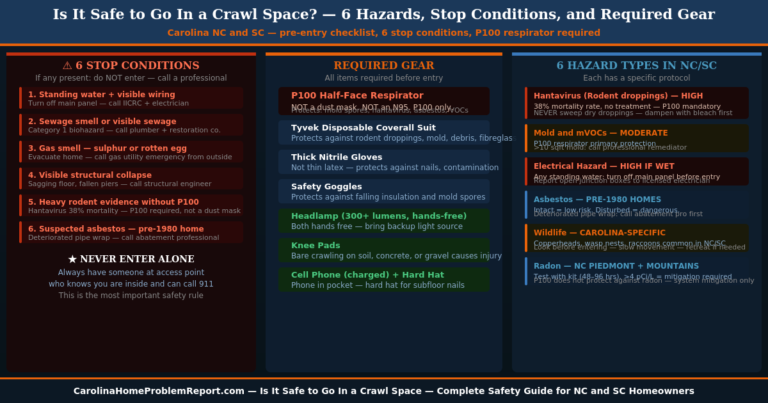
- Is It Safe to Go in a Crawl Space?
- Complete Crawl Space Guide
Carolina Home Problem Report provides general educational information for NC and SC homeowners. We are not licensed radon professionals. For radon testing and mitigation use a certified NRPP or NRSB contractor. For NC radon programme information visit ncdhhs.gov. See our Disclaimer.