Is Crawl Space Encapsulation Worth It in NC and SC? The Complete ROI Analysis
⚡ QUICK ANSWERFor most NC and SC homeowners, crawl space encapsulation is worth it — the combination of 15–20% HVAC energy savings, $8,000–$15,000 in avoided repair costs over a 10-year period, and documented resale value uplift in the Charlotte and Raleigh markets produces a payback period of 5–8 years on a typical project. There are specific situations where it is not worth it — we cover those honestly below. The honest answer depends on your home's current condition, how long you plan to stay, and whether active damage has already occurred.
Whether crawl space encapsulation is worth it in North Carolina and South Carolina is the question every homeowner asks before committing to a $4,200–$13,500 project. It is a fair question that deserves a direct answer — not a contractor sales pitch. This guide breaks down the actual ROI data, the NC-specific payback calculation using real energy costs, the resale value evidence, and the specific situations where encapsulation genuinely does not make financial sense. If you are deciding whether to encapsulate, this is the complete picture.📋 IN THIS GUIDE
- The Short Answer — Is Crawl Space Encapsulation Worth It in NC and SC?
- The ROI Case — What the Numbers Actually Show
- The NC-Specific Payback Calculation
- What Encapsulation Actually Does — The Five Benefits
- When Is Crawl Space Encapsulation NOT Worth It
- What About the 25C Tax Credit?
- Pros and Cons of Crawl Space Encapsulation in NC and SC
- How to Make Sure Encapsulation Is Worth It — Contractor Checklist
The Short Answer — Is Crawl Space Encapsulation Worth It in NC and SC?
For the majority of NC and SC homeowners with a vented crawl space, yes — crawl space encapsulation is worth it. The Carolinas sit in one of the worst climate zones in the country for unprotected crawl spaces. Charlotte averages 70% relative humidity in July according to NOAA climate normals. Summer humidity across NC and SC regularly exceeds 80%. The Cecil clay Piedmont soil holds moisture against foundations persistently. These are not conditions where an unencapsulated crawl space stays dry — it is a question of how much damage accumulates before it is addressed. The more useful question is not whether it is worth it in general — it is whether it is worth it for your specific home and situation. That answer depends on four factors: the current condition of your crawl space, your HVAC energy costs, how long you plan to stay in the home, and whether you are approaching a sale. We address each below.The ROI Case — What the Numbers Actually Show
The financial case for encapsulation in NC and SC rests on three measurable benefits: energy savings, avoided repair costs, and resale value. Each has documented evidence specific to the Carolina climate. Energy savings. A Building America study tracked two identical homes in North Carolina — one vented, one encapsulated — and found 15% lower heating and cooling energy consumption in the sealed home. Advanced Energy's NC field research confirms 15–20% HVAC energy savings consistently in mixed-humid Climate Zone 3A, which covers all of NC and most of SC. Duke Energy reports an average NC residential energy bill of approximately $1,900 per year. At 15% savings, that is $285 annually in the first year — compounding over time as energy costs increase. Over a 10-year period, cumulative energy savings on a typical NC home range from $3,000–$4,500 at current rates. Avoided repair costs. This is the most underestimated element of the encapsulation ROI calculation. Homeowners insurance covers sudden damage — a burst pipe, a storm. It does not cover gradual moisture damage, wood rot, or mold caused by a chronically damp crawl space. These costs come entirely out of pocket. A single floor joist sistering repair costs $300–$500 per joist. Full joist replacement runs $800–$1,500 per joist. A crawl space mold remediation in NC costs $2,500–$8,000. A structural subfloor replacement costs $5,000–$15,000. Encapsulation — by controlling humidity below 60% RH consistently — prevents these failure modes from developing. Over a 10-year period in NC climate conditions, a homeowner with an unencapsulated crawl space can conservatively expect $8,000–$15,000 in repairs that a properly encapsulated home avoids entirely. Resale value. In the Charlotte and Raleigh markets, a properly encapsulated crawl space with documentation adds an estimated $8,000–$15,000 to appraised value and significantly reduces the risk of a sale falling through. Home inspectors flag crawl space moisture problems on virtually every pre-sale inspection of an older NC home — buyers either renegotiate price or walk. An encapsulated crawl space eliminates this risk entirely. In the Triangle market, buyers are increasingly aware of crawl space conditions and encapsulated properties move faster and at higher prices than comparable unencapsulated homes.The NC-Specific Payback Calculation
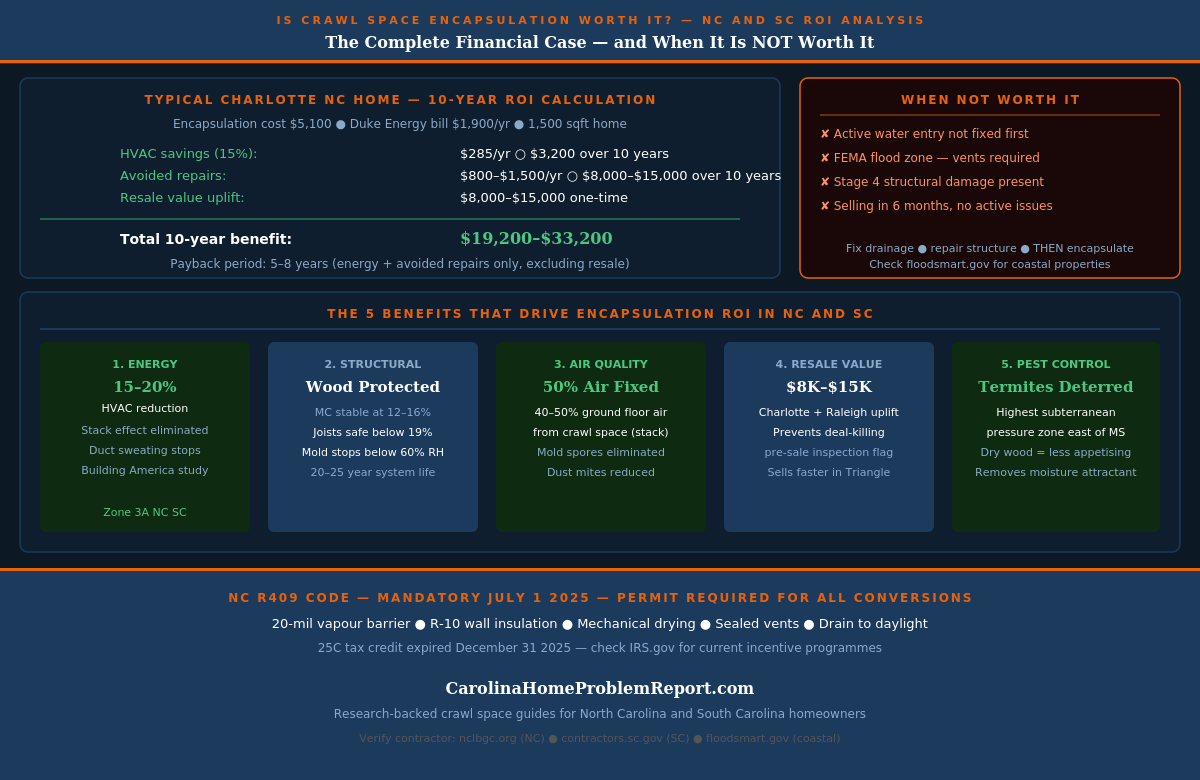
Taking a typical Charlotte NC home — 1,500 sqft, encapsulation cost $5,100, Duke Energy bill $1,900/year — here is the realistic payback calculation:| Benefit Category | Annual Value | 10-Year Value |
|---|---|---|
| HVAC energy savings (15%) | $285 | $3,200 |
| Avoided moisture repairs | $800–$1,500 | $8,000–$15,000 |
| Resale value uplift | One-time | $8,000–$15,000 |
| Total 10-year benefit | $19,200–$33,200 | |
| Encapsulation cost | $5,100 |
What Encapsulation Actually Does — The Five Benefits
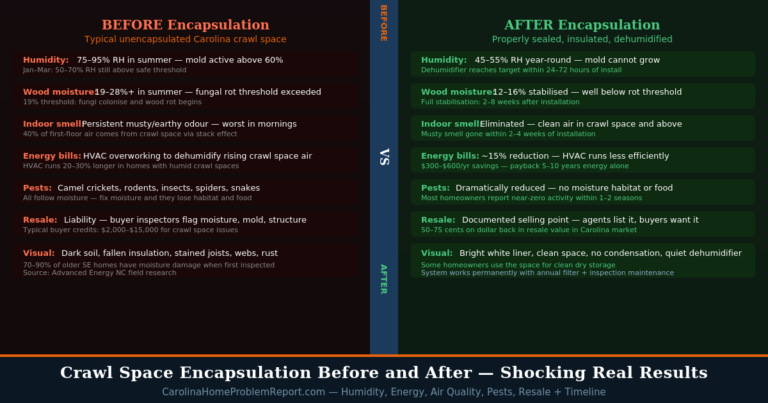
1. Controls humidity and stops mold. A sealed, conditioned crawl space maintains relative humidity below 60% consistently — the threshold below which mold cannot grow on wood surfaces. This is the primary structural protection benefit. In NC and SC's summer conditions, an unencapsulated crawl space regularly exceeds 80% RH from April through October. 2. Reduces HVAC load and energy bills. The stack effect draws 40–50% of a home's ground floor air from the crawl space. A conditioned crawl space means the HVAC system is not fighting against a constantly humid air source below the floor. Supply ducts in a sealed crawl space no longer sweat and lose efficiency. The compressor runs fewer hours annually — extending equipment life alongside reducing energy costs. 3. Protects structural integrity. Wood moisture content above 19% enables mold growth. Above 28%, structural decay accelerates. In a properly encapsulated crawl space, wood moisture content stabilises at 12–16% — well within the safe range. Floor joists, sill plates, and subfloor sheathing that would otherwise degrade over 10–15 years in a vented NC crawl space remain structurally sound for the life of the encapsulation system. 4. Improves indoor air quality. The stack effect means crawl space air becomes living space air. Mold spores, dust mite droppings, mycotoxins, radon, and soil gases that accumulate in a damp, unencapsulated crawl space migrate upward continuously. Encapsulation seals the primary pathway for these pollutants to enter the home. 5. Deters termites and pests. Subterranean termites establish colonies within 18 inches of a consistent moisture source. A dry crawl space removes the moisture attractant that draws termites, rodents, and wood-destroying insects. In NC and SC — which sit in the highest subterranean termite pressure zone east of the Mississippi — this is not a minor benefit.When Is Crawl Space Encapsulation NOT Worth It
⚠️ HONEST ANSWER — these are the specific situations where encapsulation may not be the right immediate investment:
You are selling within 6 months and the crawl space has no active issues. If a pre-sale inspection shows no moisture problems, mold, or structural concerns, the cost of encapsulation may not be fully recovered in that specific transaction timeline. A clean crawl space inspection report may be sufficient for the sale without full encapsulation. Active water entry has not been resolved. Encapsulating over an active surface water entry pathway or groundwater seepage problem is the single most common expensive crawl space mistake in NC and SC. Encapsulation does not waterproof a foundation — it seals a dry space. If water is actively entering, drainage must be fixed first. Installing a vapour barrier over active water entry traps moisture inside and accelerates the damage it was meant to prevent. See our Crawl Space Drainage Problems guide before encapsulating. Your home is in a FEMA Special Flood Hazard Area. Properties in coastal NC and SC flood zones require flood-compliant foundation vents, not sealed vents. Standard encapsulation on a flood-zone property is non-compliant and may affect flood insurance. Check at floodsmart.gov before encapsulating any coastal property. Stage 4 structural damage is already present. If floor joists, sill plates, or subfloor sections have already failed, encapsulation must wait until structural repairs are complete. Sealing a structurally compromised crawl space does not reverse existing damage — it only prevents further deterioration. At Stage 4, the structural repair cost is the priority investment, not encapsulation.What About the 25C Tax Credit?
The IRA Section 25C energy efficiency tax credit — which covered air sealing and insulation improvements including crawl space encapsulation at 30% of cost up to $1,200 per year — expired on December 31, 2025 under the One Big Beautiful Bill. As of 2026, there is no federal tax credit available for crawl space encapsulation. Check with your tax professional and monitor IRS.gov for any replacement incentive programmes that may be introduced. NC Energy Saver rebates launched in 2025 may offer some partial offset — check with your utility provider for current availability.Pros and Cons of Crawl Space Encapsulation in NC and SC
Pros:- 15–20% HVAC energy savings — documented by Building America NC field research
- Prevents mold, wood rot, structural decay — the primary avoided-repair benefit
- Increases home resale value — $8,000–$15,000 uplift in Charlotte and Raleigh markets
- Improves indoor air quality — reduces mold spores, dust mites, and soil gases entering living space
- Deters termites and pests — removes moisture attractant in highest-pressure termite zone in the US
- NC R409 compliant — mandatory code standard for sealed crawl spaces since July 1 2025
- Lasts 20–25 years — with annual dehumidifier maintenance and bi-annual inspections
- Upfront cost — $4,200–$13,500 depending on city, crawl space size, and condition
- Requires ongoing maintenance — dehumidifier servicing annually, bi-annual inspections
- Not a waterproofing solution — drainage problems must be fixed before encapsulating
- Permit required in NC — adds $100–$300 and inspection time but provides compliance verification
- Not appropriate for all flood zone properties — coastal NC SC flood zone homes may need flood vents
How to Make Sure Encapsulation Is Worth It — Contractor Checklist
Encapsulation delivers its full ROI only when it is correctly installed to NC R409 standard. A poorly installed system — wrong vapour barrier mil rating, incomplete vent sealing, undersized dehumidifier — will not deliver the energy savings or the structural protection that justifies the cost. Before signing any contract:- Verify NC contractor licence at nclbgc.org or SC licence at contractors.sc.gov
- Confirm the contractor will pull a building permit — NC requires this for all vented-to-sealed conversions
- Specify 20-mil minimum vapour barrier — not 6-mil basic poly sheeting
- Confirm wall insulation R-value — R-10 minimum in NC and SC Climate Zone 3A
- Confirm mechanical drying method — dehumidifier minimum 70-pint capacity or conditioned air supply
- Get the scope in writing — vapour barrier mil, R-value, dehumidifier capacity, vent sealing method
Related Guides
- Crawl Space Encapsulation Cost Guide — NC and SC Markets
- NC and SC Crawl Space Building Code — R409 Requirements
- Crawl Space Drainage Problems — Fix Before Encapsulating
- Crawl Space Encapsulation Before and After
- DIY Crawl Space Encapsulation — When It Is and Is Not Viable
- Crawl Space Structural Damage Signs — 4-Stage Cost Model
- Complete Crawl Space Guide — NC and SC
Carolina Home Problem Report provides general educational information for NC and SC homeowners. We are not licensed contractors or financial advisors. ROI estimates are based on published building science research and regional market data — actual results vary by home, contractor, installation quality, and market conditions. Verify contractor licences at nclbgc.org (NC) or contractors.sc.gov (SC). See our Disclaimer.