Best Crawl Space Dehumidifier for NC & SC Homes [2027 Honest Rankings]
The best crawl space dehumidifier for most NC and SC homes is the Argendon Shield 60P. It covers up to 1,800 sq ft, has a built-in pump, and costs roughly a third of the premium brands. If your crawl space is very low (about 12 inches of clearance) or you want the most energy-efficient unit money can buy, the Santa Fe Compact70 is the premium pick. For small crawl spaces under 1,300 sq ft, look at the AlorAir Sentinel HD55P. For ducted, whole-house setups, the Aprilaire E070.
⭐ Key Takeaways
- ✓A crawl space dehumidifier is not the same as a household one. You need a unit built for continuous drainage, auto defrost, and cool, damp air — bedroom units ice up and need bucket emptying.
- ✓Compare units on their AHAM rating (pints per day at 80°F and 60% humidity). The bigger "saturation" number looks impressive but is measured in near-impossible conditions.
- ✓A built-in pump matters in most Carolina crawl spaces, because there is rarely a floor drain lower than the unit.
- ✓Premium brands (Santa Fe, Aprilaire) remove more water per day and carry longer brand histories — but cost two to three times more and usually need a pump bought separately.
- ✓Any dehumidifier only works properly once vents are sealed and a vapor barrier is down. Buy the unit as part of the system, not instead of it.
Choosing the best crawl space dehumidifier for a North or South Carolina home is harder than it should be. Search results are full of bedroom dehumidifiers that were never built to sit under a house, and the real crawl space units range from under $400 to over $1,700.
This guide ranks the units that actually belong in a Carolina crawl space. We compare them on the things that matter in this climate: how much water they remove, whether they drain themselves, how they handle cool winter crawl spaces, warranty, and price.
If you are not sure what size you need yet, read our complete crawl space dehumidifier sizing guide first. If you want to know why humidity under the house matters so much, start with what humidity level a crawl space should be.
📄 In This Guide
- Side-by-Side Comparison Table
- Best Overall: Argendon Shield 60P
- Best Premium: Santa Fe Compact70
- Best for Small Crawl Spaces: AlorAir Sentinel HD55P
- Best for Ducted Systems: Aprilaire E070
- Best for Large Crawl Spaces: Argendon Guardian 85P
- How to Choose — 5 Things That Matter in Carolina
- Buying Mistakes to Avoid
- Quick Picks by Situation
- People Also Ask
- Frequently Asked Questions
Side-by-Side Comparison
All capacity figures are the manufacturers' AHAM ratings (80°F, 60% humidity), so they can be compared fairly. Prices change often — the figures below were checked in September 2026.
| Unit | Pints/day (AHAM) | Coverage | Built-in pump | Warranty | Approx. price |
|---|---|---|---|---|---|
| Argendon Shield 60P ★ | 60 | 1,800 sq ft | Yes | 5-year limited | $594 $576.33 w/ code CHPR3 |
| Santa Fe Compact70 | 70 | ~2,200 sq ft | Optional add-on | Up to 6 years | ~$1,500–$1,600 |
| AlorAir Sentinel HD55P | 55 | 1,300 sq ft | Yes | 6-year limited | Check current price |
| Aprilaire E070 | 70 | 2,200 sq ft | No (standard model) | 5-year replacement | ~$1,700 |
| Argendon Guardian 85P | See Argendon | 2,300 sq ft | Yes | 5-year limited | $719 $697.43 w/ code CHPR3 |
1. Best Overall for Carolina Homes: Argendon Shield 60P

What owners say: one Argendon customer wrote that his unit "pulled the moisture out of my 2,000 square foot crawl space and has been maintaining it at the level I set it to." Another, who replaced a Santa Fe that failed after 8 years, said the Argendon was "doing the job well."
For the full story behind the brand and a deeper look at this unit, read our Argendon crawl space dehumidifier review.
2. Best Premium Pick: Santa Fe Compact70
Specs: 70 pints/day at AHAM · rated for spaces around 2,200 sq ft · only about 12 inches tall · ENERGY STAR Most Efficient 2024 · condensate pump sold separately · minimum operating temperature 49°F · warranty up to 6 years · made in Wisconsin.
Why it's here: It is the long-standing professional favourite. The very low height fits crawl spaces where almost nothing else will, its efficiency rating is among the best available, and the warranty is the longest in this list.
Where it falls short: It typically costs $1,500 or more before you add a pump, and its 49°F minimum operating temperature means it can pause in a cold winter crawl space in the NC mountains.
3. Best for Small Crawl Spaces: AlorAir Sentinel HD55P
Specs: 55 pints/day at AHAM · up to 1,300 sq ft · pump and gravity drain options · hot-gas defrost rated down to 36°F · 6-year limited warranty · optional remote monitoring.
Why it's here: A well-established crawl space brand with strong cold-weather operation and a longer warranty than Argendon, in a compact body for smaller homes.
Where it falls short: 1,300 sq ft is its ceiling. Many Carolina ranch homes are larger, and an undersized unit runs non-stop.
4. Best for Ducted, Whole-House Setups: Aprilaire E070
Specs: 70 pints/day at AHAM · up to 2,200 sq ft · ductable · washable MERV 8 filter · operates as low as about 41°F · no internal pump on the standard model · 5-year replacement warranty · Wi-Fi version available.
Why it's here: Best choice if an HVAC contractor is ducting dehumidification into the house as well as the crawl space. The better filter is a plus for allergy sufferers.
Where it falls short: Around $1,700, and Aprilaire recommends professional installation, which adds to the cost.
5. Best for Large Crawl Spaces: Argendon Guardian 85P

Why it's here: If your crawl space is bigger than 1,800 sq ft — common under two-story Carolina homes — the Guardian 85P covers up to 2,300 sq ft with a built-in pump for about $719 (as low as $697.43 with code CHPR3). That is still less than half the price of the premium brands.
One Guardian 85P owner said he's "looking forward to buying another down the road for my daughter's home."
See the Guardian 85P at Argendon → Code CHPR3 = extra 3% offBudget option for small spaces: for crawl spaces up to about 1,000 sq ft, the Argendon Shield 35P (with pump) is around $373 — apply code CHPR3 for an extra 3% off (roughly $361.81) — the lowest-cost unit we'd trust under a Carolina home.
How to Choose — 5 Things That Matter in Carolina
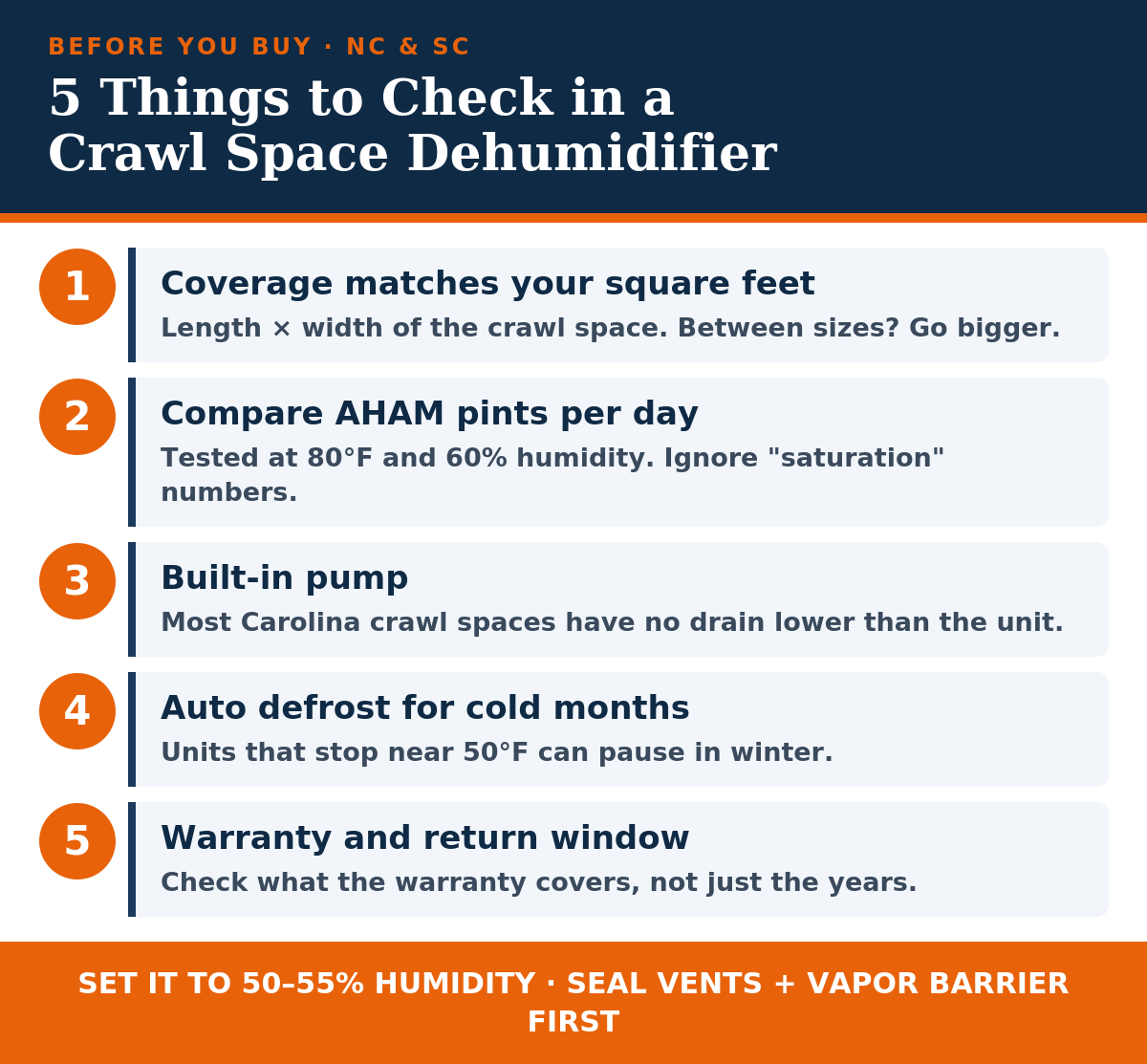
- Size to your square footage — and size up if unsure. Measure the length and width of the crawl space and multiply. If you land between two sizes, choose the larger unit; Carolina summers are hard on undersized machines.
- Compare AHAM pints, not saturation pints. AHAM is measured at 80°F and 60% humidity, which is close to real crawl space conditions. Saturation numbers are measured in far wetter air, so they look bigger than what you will actually see.
- Get a built-in pump unless you have a low floor drain. Most Carolina crawl spaces sit below the nearest drain point. A pump pushes water up and out to the exterior; without one you need a separately bought pump.
- Check the low-temperature rating. Crawl spaces cool down in winter. Units with automatic defrost keep working; units rated only down to about 50°F may pause, especially in the NC mountains.
- Read the warranty terms, not just the number of years. Some warranties cover the whole unit, some only the sealed refrigeration system. Also check the return window in case the unit doesn't suit your space.
Buying Mistakes to Avoid
Buying a bedroom dehumidifier for the crawl space. Household units need their bucket emptied, stop when the bucket is full, and often ice up in cool air. They are the most common wasted purchase we see.
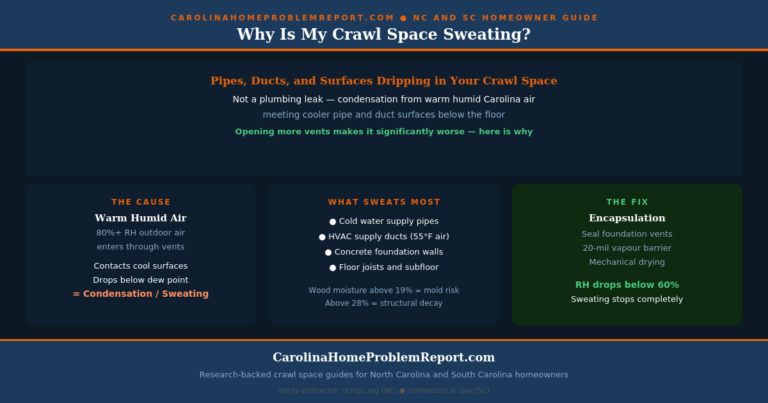
Running the dehumidifier with the vents open. In a Carolina summer, open vents let in a constant stream of humid air, so the unit runs non-stop and still can't keep up. See our guide to whether crawl space vents should be open or closed.
Draining the water back into the crawl space. The drain line must run outside or into a sump. Letting it empty onto the crawl space floor just recycles the moisture.
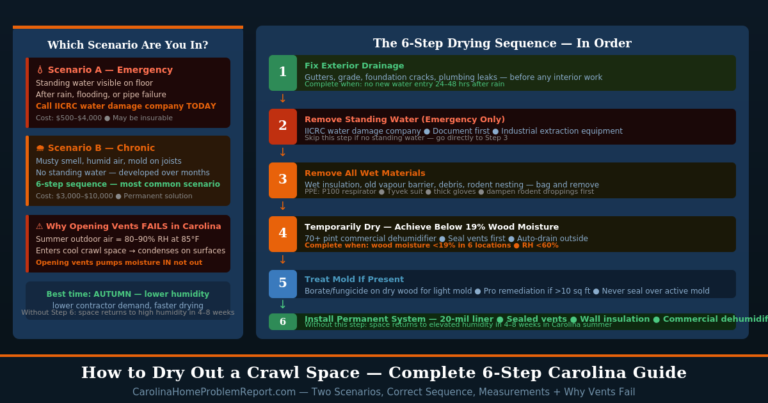
Building science backs this up. Advanced Energy's North Carolina crawl space research found that closed crawl spaces stay far drier than vented ones, and Building Science Corporation publishes extensive guidance on why humid-climate crawl spaces need mechanical drying. If your space is already wet, follow our 6-step guide to drying out a crawl space before installing the permanent unit.
Which One Should You Buy? Quick Picks by Situation
If you've read this far and still aren't sure, find the line below that describes your home.
- Single-story home, crawl space up to 1,800 sq ft, normal clearance: Argendon Shield 60P. It covers the space, drains itself, and leaves budget for the vapor barrier and vent sealing that make it work.
- Two-story home or crawl space over 1,800 sq ft: Argendon Guardian 85P, or the Santa Fe Compact70 if you prefer the premium brand and don't mind adding a pump.
- Very low crawl space where you can barely fit a unit: Santa Fe Compact70. Its roughly 12-inch height is its biggest advantage.
- Small crawl space under 1,300 sq ft: AlorAir Sentinel HD55P, or the Argendon Shield 35P if the space is under about 1,000 sq ft and budget matters most.
- NC mountain home with cold winter crawl spaces: choose a unit with automatic defrost and a low operating temperature. Avoid units that stop working around 50°F.
- HVAC contractor is ducting dehumidification into the whole house: Aprilaire E070, installed professionally.
- Crawl space still has open vents and bare dirt: don't buy any dehumidifier yet. Seal the vents and put down a vapor barrier first, or the unit will run constantly and wear out early.
Whichever you choose, check it at 30 days with a cheap hygrometer hung from a joist. If it holds 50–55% humidity through a humid week, the unit is doing its job. If it can't get below 60%, look for open vents, gaps in the vapor barrier, or a drain line emptying back into the crawl space before blaming the machine.
People Also Ask
Is a crawl space dehumidifier really worth it?
Yes, in Carolina's climate. Owners who've made the switch report real, measurable results — one buyer saw crawl space humidity drop about 40% within 3–4 months of installing a properly sized unit. The cost is small next to the alternative: mold remediation alone runs $1,500–$5,000, and structural repair from long-term wood rot costs far more.
Can I use a regular household dehumidifier in a crawl space?
You can, but it usually disappoints. Household units are built for a bedroom, not a cold, damp space under a house — they tend to ice up below 65°F and need their bucket emptied by hand every day or two. A purpose-built crawl space unit with auto defrost and continuous drainage is what actually keeps up.
How long do crawl space dehumidifiers last?
A commercial-grade unit typically lasts 8–10+ years with basic upkeep — mainly rinsing or replacing the filter. One buyer we found had run a premium Santa Fe unit for 8 years before it needed replacing, which is a realistic ballpark for a well-built unit in continuous use.
Do I need to seal my crawl space vents before installing a dehumidifier?
Yes — this is the step most homeowners skip, and it's why some end up disappointed with an otherwise good unit. Open vents keep pulling in humid outdoor air, so the dehumidifier runs constantly and never quite catches up. See our guide on whether crawl space vents should be open or closed.
Can I manage my crawl space dehumidifier without going back under the house?
With the right unit, yes. Owners with a wired remote or app-connected model report checking and adjusting settings from inside the house — one described managing his unit "from upstairs without going in my crawl space all the time." Look for this feature if crawl space access is difficult for you.
Frequently Asked Questions
What is the best crawl space dehumidifier for a Carolina home?
For most NC and SC homes, the Argendon Shield 60P offers the best balance of coverage (1,800 sq ft), a built-in pump, and price. If budget is not a concern and your crawl space is very low, the Santa Fe Compact70 is the premium alternative.
What size dehumidifier do I need for my crawl space?
Match the unit's coverage rating to your crawl space's square footage and size up if you're between two units. Our crawl space dehumidifier sizing guide walks through it step by step.
Do I need a dehumidifier with a pump?
Usually yes. Unless there is a floor drain or sump lower than the unit, water has to be pumped up and out of the crawl space. A built-in pump saves buying and fitting a separate one.
What humidity should I set my crawl space dehumidifier to?
Set it to 50–55% relative humidity. That keeps conditions below the level where mold grows without running the unit harder than necessary.
Is a cheaper crawl space dehumidifier worth it compared to Santa Fe or Aprilaire?
It depends on your space. Premium units remove more water per day and have longer track records. But a correctly sized, purpose-built unit with a pump and a solid warranty will hold a sealed Carolina crawl space at target humidity for far less money. What matters most is choosing a real crawl space unit, not a household one. For full project pricing, see how much it costs to dry out a crawl space.
💡 Ready to Choose Your Unit?
Argendon's range covers crawl spaces from 1,000 to 2,300+ sq ft, every unit ships free, and there's a 30-day return window. Use code CHPR3 for an extra 3% off.
Shop Argendon Crawl Space Dehumidifiers →- The best crawl space dehumidifier for most NC and SC homes is a purpose-built unit with continuous drainage, auto defrost, and coverage matched to the crawl space's square footage.
- The Argendon Shield 60P is the best-value pick for crawl spaces up to 1,800 sq ft; the Santa Fe Compact70 is the premium pick for very low crawl spaces.
- Compare dehumidifiers on AHAM pints per day, measured at 80°F and 60% humidity, not on saturation figures.
- A built-in pump is needed in most Carolina crawl spaces because there is rarely a drain lower than the unit.
- A crawl space dehumidifier works properly only after the vents are sealed and a vapor barrier covers the floor; set it to 50–55% relative humidity.
The Carolina Home Problem Report editorial team researches and writes guides for homeowners across North and South Carolina. For this guide we compared manufacturer specifications, retailer listings, and verified owner reviews, and drew on Advanced Energy and Building Science Corporation research. We are not contractors — we are a research team giving Carolina homeowners clear, locally specific answers.
📚 Key Concepts — Reference Sources
- Dehumidifier (Wikipedia) — how refrigerant dehumidifiers pull water from the air
- Relative Humidity (Wikipedia) — the measurement behind the 50–55% target setting
- Dew Point (Wikipedia) — why humid summer air condenses inside cooler crawl spaces
Carolina Home Problem Report is an informational resource for homeowners. We are not licensed contractors. Specifications and prices come from manufacturers and retailers and can change; confirm details before buying. See our Disclaimer and Affiliate Disclosure.