Is a Crawl Space Bad? [The Honest Answer for Carolina Homeowners — Myths Debunked, Real Problems Named, and What Proper Management Actually Delivers]
A crawl space is not inherently bad — but an unmanaged vented crawl space in Carolina is genuinely problematic. The distinction matters enormously. The crawl space as a foundation type has real advantages: utility access, elevation off the ground, cheaper construction than a basement. The problems people associate with crawl spaces are almost entirely problems of moisture management failure — and those problems are solvable. A properly sealed and maintained crawl space is not bad. It is one of the best-performing foundation types available in the Carolina climate.
⭐ Key Takeaways
- ✓The problems most people associate with crawl spaces — mold, moisture, pests, musty smell — are problems of an unmanaged vented crawl space, not problems of the crawl space concept itself
- ✓A properly sealed and dehumidified crawl space delivers lower energy bills, better indoor air quality, reduced pest activity, structural protection, and a selling point at resale — none of which are "bad"
- ✓The Inflation Reduction Act 25C tax credit — which expired December 31, 2025 — previously allowed homeowners to claim 30% of encapsulation costs up to $1,200 per year for qualifying air sealing and insulation work — reducing the net cost of the fix
- ✓The real question is not "is a crawl space bad" but "is my crawl space currently managed correctly" — and that is answered by a moisture meter, a hygrometer, and a 30-minute inspection
- ✓Homes with sealed, well-maintained crawl spaces sell faster and for more in the Carolina market than comparable homes with neglected vented crawl spaces — it is now a documented buyer preference
The question "is a crawl space bad" is one of the most commonly searched crawl space questions — and it deserves a more honest answer than most articles provide. The typical response is either a contractor-motivated "yes, very bad, here is what to buy" or a dismissive "no, it is fine" that ignores the very real problems that unmanaged crawl spaces create in Carolina homes. Both answers miss the point.
The more accurate answer requires separating two distinct things: the crawl space as a foundation concept, and the crawl space as it actually exists under most older Carolina homes. As a concept, the crawl space has genuine advantages that explain why it dominated Carolina construction for generations. As it actually exists — vented, uninsulated, with a torn or absent vapour barrier — it creates real problems that progressively damage the home above it.
According to Advanced Energy's North Carolina crawl space research, 70–90% of older Southeast homes already have moisture-damaged insulation or mold when first professionally inspected. That is not a condemnation of the crawl space — it is a condemnation of decades of inadequate moisture management guidance. The fix is available, it is cost-effective, and it converts the "bad" crawl space into a performing asset. This article separates the myths from the truths so Carolina homeowners can make clear-headed decisions.
In This Article
- The Real Question — Crawl Space vs Unmanaged Crawl Space
- Genuine Problems — What Is Actually Bad About Most Carolina Crawl Spaces
- Genuine Advantages — What Is Actually Good About a Well-Managed Crawl Space
- 8 Crawl Space Myths — Debunked
- Buying or Selling a Carolina Home With a Crawl Space
- Frequently Asked Questions
The Real Question — Crawl Space vs Unmanaged Crawl Space
The question "is a crawl space bad" conflates two different things. Getting clear on the distinction resolves most of the confusion:
The vast majority of questions, complaints, and horror stories about crawl spaces describe the second scenario — not the first. Almost all the crawl space problems documented in older Carolina homes are problems of the unmanaged vented crawl space, which describes most of the pre-2000s housing stock in NC and SC. That is a management problem, not a structural concept problem.
Genuine Problems — What Is Actually Bad About Most Carolina Crawl Spaces
Being clear-eyed about what is genuinely problematic is important. These are real issues — not myths — in unmanaged vented crawl spaces:
⚠ Moisture and mold — the primary problem
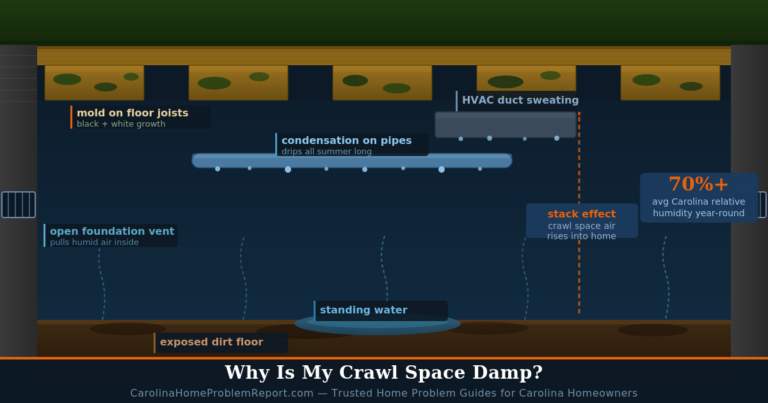
In an unvented or poorly managed vented crawl space, summer humidity routinely exceeds 70–90% RH in Carolina. This sustains mold growth on wood framing, produces mVOCs that rise into the living space, and drives the progressive wood rot that makes structural repairs necessary. This is the real problem with most Carolina crawl spaces and it is the problem that encapsulation solves.
⚠ Air quality impact — 40–50% of first-floor air
The stack effect means up to 40–50% of first-floor indoor air originates from the crawl space. In an unmanaged crawl space with active mold and rodent activity, that air carries mold spores, mVOCs, and contamination particles. For families with asthma, allergies, or respiratory conditions, this is a genuine health concern — not a theoretical one.
⚠ Energy waste
An unmanaged crawl space in Carolina forces the HVAC system to dehumidify and condition crawl space air that rises into the living space. This adds 15–20% to HVAC costs in documented Advanced Energy studies. Over 20 years on a $2,400/year HVAC bill, that is $7,200–$9,600 in unnecessary energy spending.
⚠ Pest habitat
Open foundation vents and moist soil create an ideal environment for rodents, insects, and wildlife. Termites are attracted to moisture-softened wood. A vented crawl space with no moisture management is actively inviting the pests that cause the most expensive damage to Carolina homes.
Genuine Advantages — What Is Actually Good About a Well-Managed Crawl Space
These are the legitimate advantages of a crawl space foundation when properly managed — and they are real:
✅ Full utility access
Every plumbing line, electrical run, HVAC duct, and gas pipe is accessible without demolition. A slab home requires cutting concrete to reach buried pipes. A crawl space home has a crawlable access channel under the entire floor — making repairs and upgrades dramatically cheaper.
✅ Elevation advantage
The first floor is elevated above grade — reducing flood intrusion risk in the event of surface water events, slowing the rate of moisture entry from the soil, and in coastal NC meeting FEMA elevation requirements that slabs in flood zones cannot.
✅ Warmer floors in winter
A properly insulated and encapsulated crawl space — with R-10 wall insulation decoupling the crawl space from outdoor temperature extremes — produces noticeably warmer floors in winter. This is one of the most commonly reported homeowner benefits after encapsulation. Slab homes with inadequate insulation have cold floors by design.
✅ Energy performance when sealed
Advanced Energy documents 15–20% HVAC energy cost reductions in NC homes after encapsulation. The Inflation Reduction Act 25C tax credit — expired December 31, 2025 — previously allowed 30% of qualifying encapsulation costs as a federal tax credit, up to $1,200 per year. The investment has documented, measurable returns.
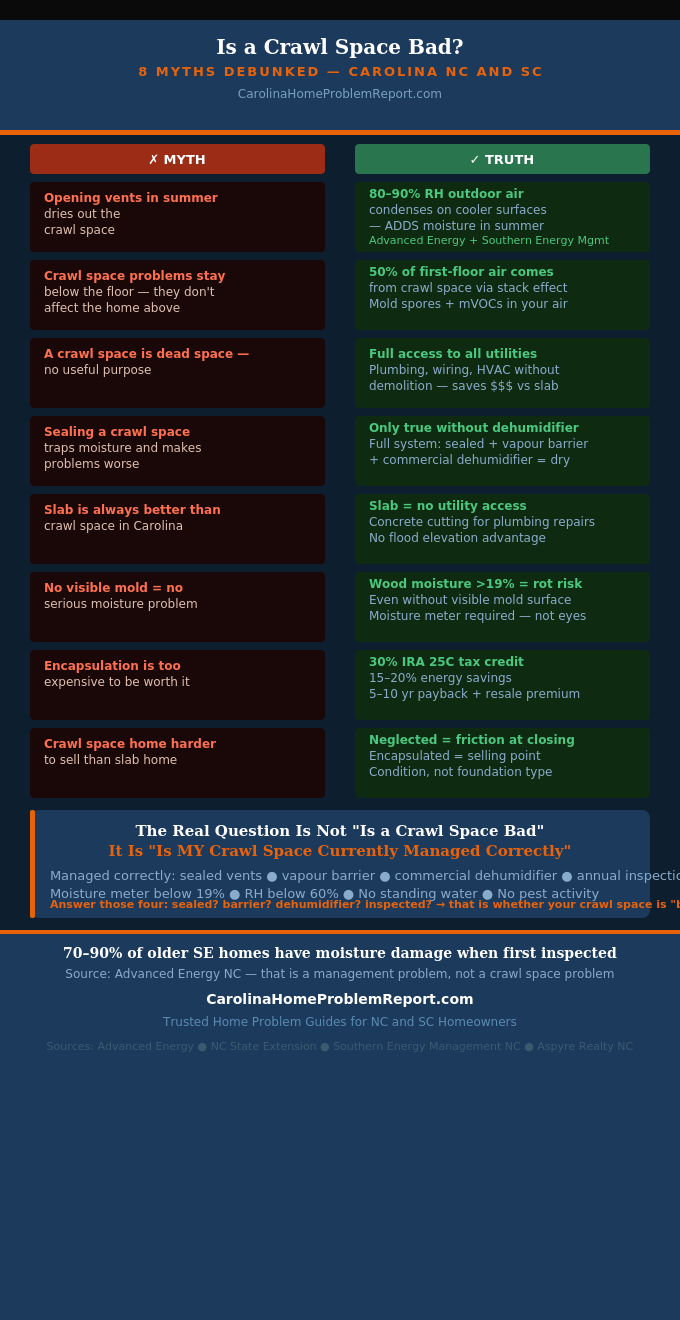
8 Crawl Space Myths — Debunked
These are the most common beliefs about crawl spaces that are either wrong, oversimplified, or only partly true:
Buying or Selling a Carolina Home With a Crawl Space
The crawl space has become a more significant factor in Carolina real estate transactions over the past five years as buyer awareness has grown. Here is what to know on both sides of the transaction:
Frequently Asked Questions
Is a crawl space bad for a house?
An unmanaged vented crawl space in Carolina is genuinely problematic — it sustains mold, drives moisture damage, adds to energy costs, and attracts pests. A properly sealed and maintained crawl space is not bad for a house — it is a performing asset that protects the structure, improves indoor air quality, reduces energy costs, and adds resale value. The foundation type is not the issue. The management is.
Is it bad to buy a house with a crawl space?
Not inherently — but you need to know the condition of the crawl space before you complete the purchase, not after. Request a specific crawl space inspection with moisture meter readings. A well-managed crawl space home is an excellent purchase in the Carolina market. A home with significant moisture damage, mold, or structural issues in the crawl space is negotiable — get contractor quotes and factor the cost of remediation into your offer.
What are the disadvantages of a crawl space foundation?
The real disadvantages are moisture management complexity (requiring annual inspection and a sealed system in Carolina), limited headroom for mechanical work, and the cost of encapsulation if not already done. The perceived disadvantages — mold, pests, structural damage — are consequences of neglect rather than inherent features of the foundation type. Every foundation type has trade-offs: slabs lack utility access and cannot be elevated; basements are expensive in clay-soil areas and flood-prone.
Is crawl space encapsulation worth it in NC or SC?
According to NC State Extension's guidance and Advanced Energy field research, yes — particularly for homes with any history of moisture issues, musty smells, pest activity, or soft floors. The 15–20% documented energy savings, the IRA 25C tax credit (expired December 31, 2025) on qualifying costs, the avoided structural repair costs, and the resale premium in active Carolina markets make a compelling financial case. The question is more accurately: "can I afford not to encapsulate" — especially in a home that will be sold within 10 years.
Does a crawl space affect home value?
Yes — in both directions. A crawl space with documented problems (mold, structural damage, pest evidence) found at inspection reduces sale price through buyer credits and can kill deals at the inspection contingency stage. A crawl space with permitted, documented encapsulation is a positive selling point in the Carolina market — listing agents in Charlotte, Raleigh, and Greenville SC now routinely include encapsulation status in marketing. The net effect of a well-managed crawl space on home value in Carolina is positive.
Is a crawl space bad? The honest answer for Carolina homeowners is: it depends entirely on what is happening under your home right now. The crawl space as a foundation type is practical, cost-effective, and accessible — advantages that explain its prevalence across NC and SC. The unmanaged vented crawl space that describes most of the pre-2000s housing stock in the region is genuinely problematic and progressively damaging.
The good news is that the gap between "bad" and "performing asset" is bridgeable with a one-time investment in encapsulation — partially offset by the IRA 25C tax credit (expired December 31, 2025), partially paid back by energy savings, and substantially paid back at resale. The question is not whether crawl spaces are bad. The question is whether yours is currently managed correctly.
Get a Free Crawl Space Assessment →The Carolina Home Problem Report editorial team researches and writes guides for homeowners across North and South Carolina. Research draws on Advanced Energy field studies, NC State Extension publications, Aspyre Realty Group NC encapsulation analysis, Southern Energy Management NC, and Carolina Foundation Solutions.
Carolina Home Problem Report is an informational resource for homeowners. We are not licensed contractors or financial advisors. Tax credit eligibility should be confirmed with a qualified tax professional. See our Disclaimer.