Why Is My Crawl Space Sweating? Pipes, Ducts, and Surfaces Explained for NC and SC Homeowners
Crawl space sweating is condensation — not a plumbing leak. Warm, humid outdoor air entering through foundation vents contacts cooler pipe, duct, and wood surfaces inside the crawl space and deposits liquid water when those surfaces drop below the air’s dew point. In NC and SC, where summer relative humidity regularly exceeds 80%, this is extremely common in vented crawl spaces from April through October. Opening more vents makes it significantly worse. The permanent fix is sealing the vents, installing a vapor barrier, and adding a crawl space dehumidifier.
⭐ Key Takeaways
- ✓Crawl space sweating is condensation physics — not a plumbing failure and not a sign your home was built badly
- ✓Opening more foundation vents makes sweating dramatically worse by pumping more humid outdoor air onto cooler crawl space surfaces
- ✓Wood moisture content above 19% enables mold growth — sustained summer sweating drives Carolina crawl spaces well past this threshold
- ✓Pipe insulation stops dripping from supply pipes but does not address duct sweating, wood moisture, or the root cause
- ✓The permanent fix is sealed vents + vapor barrier + crawl space dehumidifier — all three working together
Crawl space sweating is one of the most commonly misdiagnosed moisture problems in NC and SC homes. When homeowners see water droplets forming on pipes, ducts, or wood surfaces in the crawl space, the immediate assumption is often a plumbing leak. A plumber is called. No leak is found. The dripping continues.
The real cause is condensation — warm, humid outdoor air meeting cooler surfaces below the floor and depositing its moisture on contact. Understanding what is actually happening is the first step to fixing it permanently, because the fix for condensation is completely different from the fix for a plumbing leak. Getting this wrong costs thousands in unnecessary work.
This guide explains exactly what crawl space sweating is, why NC and SC homes are especially vulnerable, how to confirm it is condensation rather than a leak, and what the permanent fix looks like.
In This Article
- What Crawl Space Sweating Actually Is
- Why NC and SC Crawl Spaces Are Especially Prone
- What Surfaces Sweat Most in a Carolina Crawl Space
- How to Confirm Condensation vs a Plumbing Leak
- Why Opening More Vents Makes It Worse
- The Permanent Fix — Crawl Space Encapsulation
- Interim Measures While Waiting for Encapsulation
- Frequently Asked Questions
What Crawl Space Sweating Actually Is
The term “sweating” is accurate — it describes the same process that makes a cold glass of water bead with moisture on a humid summer day. The glass is not leaking. Water vapour in the warm surrounding air is condensing on the cold surface because that surface is below the dew point temperature of the air.
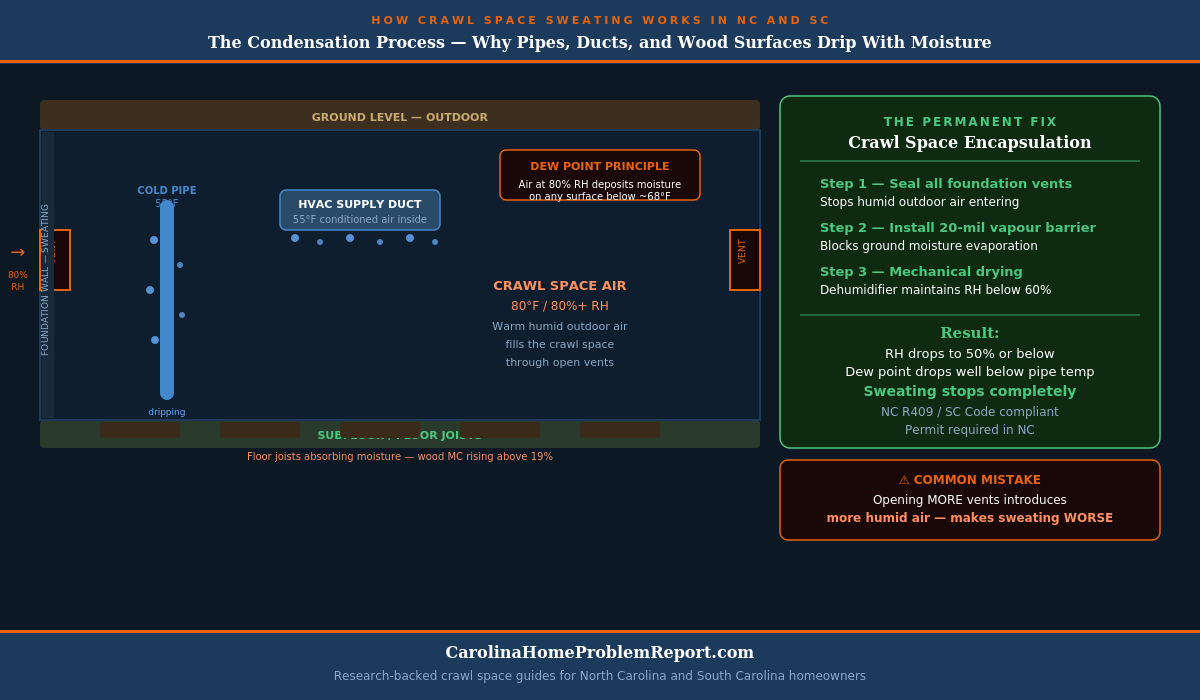
The same process happens continuously in a vented crawl space during NC and SC summers. Foundation vents bring in outdoor air that — in the Carolinas during summer — is not just warm but saturated with moisture. When that warm, humid air enters the crawl space and contacts cooler surfaces inside — steel pipes, aluminium ductwork, concrete foundation walls, and the cooler wood of floor joists — it drops below its dew point and deposits liquid water on those surfaces.
Key Distinction
This is not a plumbing failure. It is not a sign your home was built badly. It is a physics problem created by the interaction between humid Carolina air and the cooler environment below your floor — and it requires a physics-based solution, not a plumber.
Why NC and SC Crawl Spaces Are Especially Prone to Sweating
Extreme Summer Humidity
NC and SC summer relative humidity regularly reaches 85–95% in the morning hours and stays above 70% through much of the day. The higher the relative humidity of the incoming air, the lower the temperature needs to be before condensation occurs — and the more water deposits per cubic foot of air that passes through.
Temperature Differential
The crawl space sits below grade, shaded from solar heating by the earth around it. Even on days when outdoor temperatures reach 95°F, the crawl space may remain at 68–75°F — creating exactly the temperature differential that causes condensation. The cooler the crawl space relative to the incoming air, the more severe the sweating.
Red Piedmont Clay Soil
Clay holds moisture against foundations far longer than sandy soils. In the Piedmont regions of both states — covering Charlotte, Greensboro, Raleigh, Durham, Winston-Salem, Greenville SC, and Rock Hill — clay soil maintains high moisture content through dry spells, providing a persistent ground evaporation source directly under the floor.
What Surfaces Sweat Most in a Carolina Crawl Space
Cold Water Supply Pipes
The most visible sweating in most crawl spaces. Copper or PVC pipes carrying cold water maintain a constant temperature well below the summer dew point. Condensation forms continuously and drips onto the vapor barrier or soil below. In a severe case, a single cold water pipe can add several gallons of water to the crawl space floor over a summer week.
HVAC Supply Ducts
Supply ducts carry conditioned air — typically 50–55°F — through a crawl space that may be at 80°F with 80% humidity. The temperature differential is extreme and condensation is severe. Duct insulation reduces but does not eliminate this sweating, particularly when the insulation becomes wet and compresses.
Foundation Walls and Piers
Concrete and block foundation walls absorb ground temperature and remain consistently cooler than summer air. Condensation forms on wall surfaces, runs down to the footing, and contributes to overall moisture accumulation — and is frequently misdiagnosed as a leaking foundation wall.
Floor Joists and Subfloor
Wood is hygroscopic — it absorbs and releases moisture from the surrounding air. Wood moisture content above 19% is the threshold for mold growth. Above 28%, structural decay accelerates. In a vented Carolina crawl space during summer, floor joists routinely exceed both thresholds.
How to Confirm Condensation vs a Plumbing Leak
Before calling a plumber, use this simple test to confirm whether the water is condensation or an actual leak. Getting this right saves an unnecessary service call and points you toward the correct fix.
🔎 The Dry Wipe Test
Dry the suspect surface completely with a clean cloth.
Wait 30–60 minutes without touching the surface.
Inspect the surface and the location of any new moisture.
✓ CONDENSATION
Moisture reappears uniformly across the entire pipe or duct surface — not at any specific joint or fitting. This is condensation. You need humidity control, not a plumber.
⚠ PLUMBING LEAK
Moisture reappears specifically at a joint, fitting, or connection point. This is a plumbing leak requiring repair by a licensed plumber.
Why Opening More Vents Makes It Worse
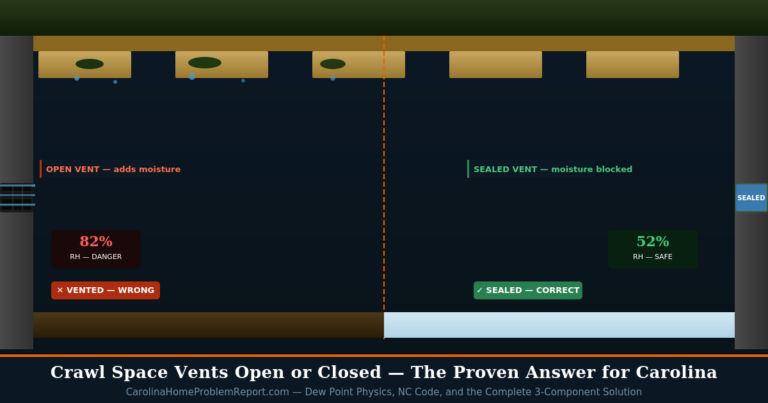
The most common incorrect response to crawl space sweating is to open more foundation vents. In NC and SC this produces the opposite result — more ventilation means more warm, humid outdoor air entering the crawl space, more condensation, and higher overall humidity.
Research from Building Science Corporation confirmed this counterintuitive result: in humid climate zones, ventilated crawl spaces are consistently more humid than the outdoor air they are ventilated with. The solution is to stop ventilating with outdoor air entirely. This is why the NC Building Code moved to the closed crawl space standard — research by Advanced Energy in North Carolina was central to that shift.
Every home built before 2004 in NC — and most homes in SC — was built with vented foundation systems that were standard practice at the time. Those vents were not a mistake when they were installed. They are a mistake in the context of what building science has since confirmed about humid-climate crawl spaces. Sealing them is the correct response.
The Permanent Fix — Crawl Space Encapsulation
Crawl space encapsulation eliminates the sweating problem at its source by removing the supply of humid outdoor air that causes it. A properly encapsulated crawl space to NC R409 standard includes four components working together:
Sealed foundation vents — stopping the entry of humid outdoor air that drives sweating on every surface.
20-mil vapor barrier covering the entire crawl space floor and extending up foundation walls — blocking ground moisture evaporation.
Dedicated crawl space dehumidifier maintaining relative humidity below 60% year-round. After sealing vents, the crawl space is a closed system that requires active humidity management. A correctly sized crawl space dehumidifier holds humidity at 50–55% RH automatically, eliminating the conditions that cause pipe, duct, and wood sweating.
Wall insulation reducing the temperature differential on foundation surfaces, further reducing condensation potential even when humidity is well controlled.

Interim Measures While Waiting for Encapsulation
If full encapsulation is not immediately possible, these steps reduce damage while you plan the permanent fix. None of them are a substitute for encapsulation — they slow the problem, not solve it.
Pipe Insulation — $50–$200 DIY
Foam pipe insulation sleeves on cold water supply pipes raise the pipe surface temperature above the dew point, stopping condensation on pipes specifically. Does not address duct sweating, wood moisture, or the broader humidity problem — but eliminates the most visible dripping quickly.
Duct Insulation Repair
Wet or compressed duct insulation accelerates sweating on ductwork. Re-wrapping damaged duct insulation with new material reduces — though does not eliminate — duct condensation. Have an HVAC contractor assess if insulation is beyond simple repair.
Temporary Dehumidifier
A portable dehumidifier placed in the crawl space with vents partially closed reduces humidity during peak summer months. This is a temporary measure only — it does not provide the consistent performance of a dedicated sealed-space unit and does not address the root cause. See our dehumidifier sizing guide for what unit specifications to look for.
Frequently Asked Questions
Why is my crawl space sweating?
Your crawl space is sweating because warm, humid outdoor air is entering through foundation vents and contacting cooler surfaces — pipes, ducts, foundation walls, and wood — that are below the air’s dew point. In NC and SC summers, this happens consistently in vented crawl spaces from April through October. It is condensation physics, not a plumbing failure.
Is crawl space sweating dangerous?
Yes, over time. Sustained crawl space sweating drives wood moisture content above 19%, enabling mold growth on floor joists and subfloor. Above 28%, structural decay accelerates. It also increases indoor humidity through the stack effect and can damage duct insulation. Left unaddressed for multiple summers, the repair costs — mold remediation, joist sistering, subfloor replacement — far exceed the cost of encapsulation.
Will pipe insulation fix crawl space sweating?
Pipe insulation stops dripping from cold water supply pipes specifically — and it is worth doing as an interim measure. But it does not address duct sweating, wood moisture absorption, foundation wall condensation, or the underlying humidity problem. The crawl space will continue building moisture even if the visible pipe dripping stops.
Should I open or close my crawl space vents in summer?
Close them — or better, seal them permanently. In NC and SC, open foundation vents during summer pull high-dew-point outdoor air directly onto cooler crawl space surfaces, dramatically increasing condensation and humidity. Building Science Corporation research confirmed that vented crawl spaces in humid climates are consistently more humid than the outdoor air, not less. See our full guide on crawl space vents open or closed.
What is the permanent fix for crawl space sweating?
Crawl space encapsulation: sealed foundation vents, 20-mil vapor barrier covering 100% of the floor and walls, and a properly sized crawl space dehumidifier maintaining 50–55% relative humidity year-round. After encapsulation, the conditions that cause sweating — warm humid air contacting cold surfaces — no longer exist inside the crawl space.
💡 Ready to Stop the Sweating Permanently?
Once your vents are sealed and vapor barrier is installed, a properly sized crawl space dehumidifier is what keeps humidity at 50–55% and stops all surface sweating year-round. Argendon’s range is sized by crawl space square footage for every Carolina home. Use code CHPR3 for 3% off.
Shop Argendon Dehumidifiers → Code CHPR3 saves 3% at checkout- Crawl space sweating is condensation physics — warm humid outdoor air contacting cooler surfaces — not a plumbing leak and not a sign of structural failure. The dry wipe test confirms which you have before any money is spent.
- In NC and SC, summer morning humidity regularly exceeds 80% — meaning every vented crawl space is continuously exposed to high-dew-point air that condenses the moment it contacts cooler pipes, ducts, and wood surfaces.
- Opening more foundation vents in summer makes sweating dramatically worse by importing more humid outdoor air onto cooler surfaces — the NC Building Code moved to closed crawl spaces in 2004 precisely because ventilation increases humidity in the Southeast.
- Wood moisture content above 19% enables mold growth on floor joists; above 28%, structural decay accelerates. Sustained summer sweating in a vented crawl space drives wood well past both thresholds across multiple summers.
- The permanent fix is encapsulation: sealed vents + 20-mil vapor barrier + crawl space dehumidifier holding 50–55% RH. After encapsulation, pipe sweating stops because the air surrounding the pipes is no longer at 80% RH — it is at 50% or below.
📚 Related Guides — Continue Reading
The Carolina Home Problem Report editorial team researches and writes guides for homeowners across North and South Carolina. Our research draws on NC State Extension Service publications, Clemson Extension resources, EPA guidelines, Building Science Corporation data, and insights from licensed Carolina contractors. We are not contractors — we are a research team dedicated to giving Carolina homeowners clear, locally specific, unbiased answers.
📚 Key Concepts — Reference Sources
- Condensation (Wikipedia) — The physics process by which water vapor in humid air converts to liquid water when it contacts surfaces below the dew point temperature
- Dew Point (Wikipedia) — The temperature at which air becomes saturated and condensation begins to form on cooler surfaces — the core concept behind crawl space sweating
- Wood-Decay Fungus (Wikipedia) — The fungi that colonise floor joists and subfloor when sustained moisture drives wood moisture content above 19%
Carolina Home Problem Report provides general educational information for NC and SC homeowners. We are not licensed contractors. If you suspect a plumbing leak rather than condensation, contact a licensed plumber. Verify contractor licences at nclbgc.org (NC) or contractors.sc.gov (SC). See our Disclaimer and Affiliate Disclosure.