The Complete Crawl Space Guide for NC and SC Homeowners
The Complete Crawl Space Guide for NC and SC Homeowners
Crawl space NC SC conditions are unlike anywhere else in the country — the combination of red Piedmont clay, 60–90% summer humidity, 48 inches of annual rainfall, long warm seasons, and the highest subterranean termite pressure east of the Mississippi creates a near-perfect environment for moisture damage, mold, structural deterioration, and pest infestation to develop silently below your floor.
This is the complete resource for Carolina homeowners — covering why crawl spaces get wet, what the damage costs at every stage, how to fix it correctly, what your city's specific conditions mean for your project, and how to find and vet a licensed contractor before signing anything.
Carolina Homeowner's Crawl Space Action Plan
One-page checklist covering warning signs, contractor vetting questions, the correct fix sequence, and 2026 city pricing for every major NC and SC market. Print it and take it to every contractor meeting.
⬇ Download Free ChecklistNo sign-up required — instant PDF download
Why Crawl Space Problems Are Worse in NC and SC Than Almost Anywhere Else
Most national crawl space advice is written for the Pacific Northwest or the Midwest. It does not account for what makes the Carolinas fundamentally different — and that difference is why homeowners in Charlotte, Raleigh, Wilmington, and Charleston face crawl space problems at rates far higher than the national average.
The Carolinas sit in a climate zone where summer humidity regularly exceeds 80%, where red Piedmont clay holds moisture against foundations persistently, and where the warm temperatures that persist from April through October create ideal conditions for mold growth, wood rot, and termite activity to run simultaneously rather than seasonally. In most of the country, a homeowner deals with one problem at a time. In NC and SC, moisture, mold, structural damage, and pest pressure all compound each other year-round.
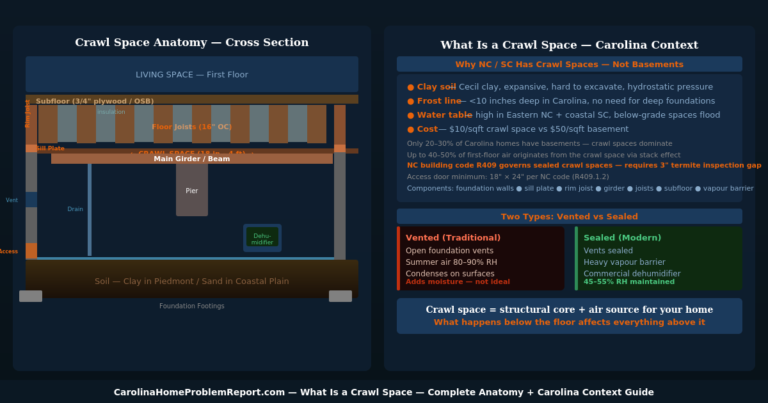
The stack effect makes this worse. Because warm air rises through a home and escapes at the top, it pulls replacement air in from the bottom — meaning 40–50% of the air you breathe in your living space originates in your crawl space. In a damp, moldy crawl space, that is not just a structural problem. It is an air quality problem that affects every person in the home, particularly those with allergies, asthma, or respiratory conditions.
Add to this the fact that NC and SC have more crawl space homes per capita than almost anywhere else in the country — because the regional geology, building traditions, and flood risk management all favour crawl space construction — and you have a large, vulnerable housing stock in a high-risk moisture environment. Understanding this is the starting point for every decision a Carolina homeowner makes about what is happening under their floor.
The 4-Stage Crawl Space Damage Model — What Stage Are You At?
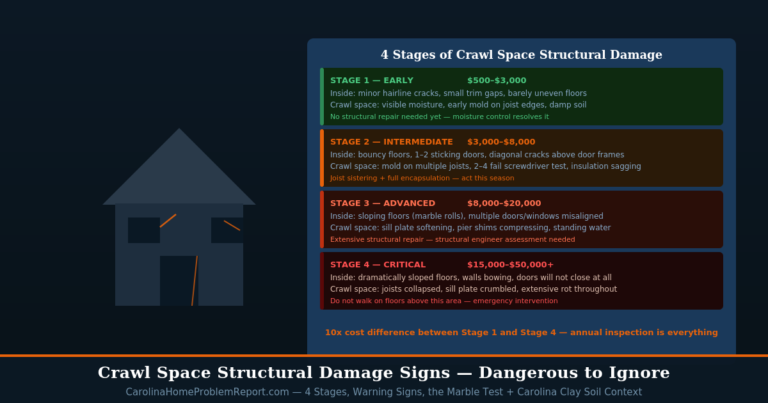
Crawl space damage in NC and SC follows a predictable four-stage progression. Knowing your stage determines your budget, your urgency, and your sequence of repairs. Most homeowners who discover a crawl space problem are at Stage 2 or 3 — which is the most important window to act, because Stage 4 costs are three to five times higher than Stage 2.
STAGE 1 — Elevated Humidity Relative humidity above 60% consistently. No visible mold or damage yet. Musty smell may be present. Cost to fix: $3,000–$6,000 — encapsulation and dehumidification. This is the cheapest and fastest stage to resolve.
STAGE 2 — Surface Mold Visible mold on joists and subfloor. Insulation sagging. Wood moisture readings 18–25%. Cost to fix: $5,000–$10,000 — remediation plus encapsulation. Act now — mold spreads rapidly in warm Carolina summers.
STAGE 3 — Wood Rot and Structural Softening Soft joists, spongy sill plates, sagging floors. Moisture readings above 28%. Cost to fix: $8,000–$18,000 — structural repair plus remediation plus encapsulation. Floors may feel springy or uneven.
STAGE 4 — Structural Failure Failed joists, collapsed subfloor sections, pier damage. Cost to fix: $15,000–$40,000+. At this stage the structural repair cost dwarfs the encapsulation cost. Termite damage often present alongside moisture damage.
Understanding Crawl Space Moisture — Start Here
If you are noticing a musty smell, cold floors, or a home inspector flagging your crawl space — start with these guides. They explain why the problem exists in the Carolinas specifically and what is actually happening under your home. Reading the diagnosis guides before calling any contractor puts you in a far stronger position when comparing quotes.
Common symptoms include musty smells that worsen in summer, cold or uneven floors in winter, sticking doors and windows as wood expands from absorbed moisture, higher-than-expected energy bills, and visible condensation on ductwork or pipes. Any one of these warrants a crawl space inspection.
Why Is My Crawl Space Damp? The NC-specific diagnosis guide — clay soil, groundwater, humidity, and what to check first.
What Causes Crawl Space Moisture? The five moisture sources ranked by frequency in Carolina homes — with what to fix first.
Crawl Space Moisture and Mold How moisture becomes mold in Carolina crawl spaces — and what to do about it.
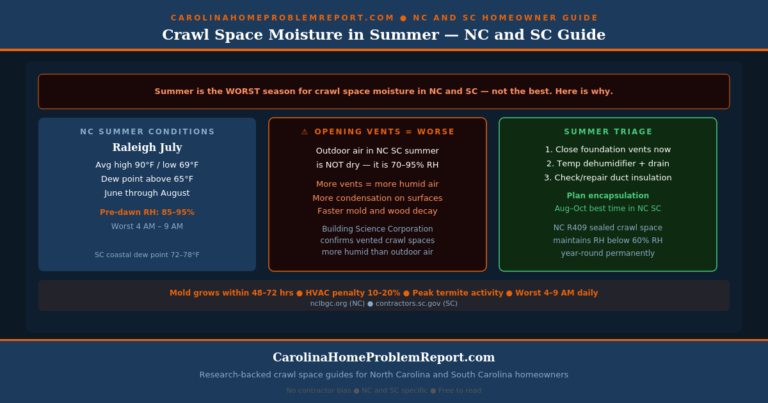
Crawl Space Condensation Why warm humid air condenses in your crawl space — and why open vents make it worse.
Humidity in Crawl Space Target humidity levels, how to measure them, and what the numbers mean for your home.
Wet Crawl Space After Rain Why heavy NC rainfall floods crawl spaces — grading, drainage, and the permanent fix.
Standing Water in Crawl Space ★ What to do when there is actual standing water — step by step, safely.
Crawl Space Smell in House Why crawl space air reaches your living space — and how to trace the source of the smell.
What Is a Crawl Space? Why NC and SC homes are built on crawl spaces — and what that means for maintenance.
Is a Crawl Space Bad? The honest answer — crawl spaces are not inherently bad, but unmanaged ones become bad quickly.
Crawl Space Moisture and Allergies How crawl space mold spores enter living areas and trigger allergy and asthma symptoms.
Crawl Space Moisture and HVAC How a wet crawl space overloads your HVAC system and raises energy bills year-round.
Fixing the Problem — Encapsulation, Drainage, and Drying
Crawl space encapsulation is the standard solution for moisture problems in NC and SC — but it is not the first step. The correct sequence matters enormously. Encapsulating over active structural damage seals in the problem. Encapsulating over active water entry creates a pool behind the liner. The right order is always: assess the structure first, address drainage second, then encapsulate, then maintain.
Encapsulation costs vary significantly across the Carolinas — from $4,200 in Greenville SC to $13,500 in Cary NC for the same square footage. The difference is driven by local labour rates, contractor pool depth, soil conditions requiring additional drainage work, and the premium markets where full-specification work is the standard.
Crawl Space Encapsulation Cost Guide ★ Per-city pricing for every NC and SC market — what drives the cost difference between Charlotte and Asheville.
DIY Crawl Space Encapsulation When DIY is viable, when it is not, and a step-by-step guide for homeowners who qualify.
Crawl Space Vapor Barrier 6-mil vs 20-mil, how to choose, and what the NC/SC code requires for compliant installation.
Crawl Space Vents Open or Closed? The settled science on crawl space vents in the Carolinas — and why open vents make moisture worse.
Crawl Space Insulation Fiberglass batts vs rigid foam vs spray foam — which works in NC and SC humidity conditions.
Crawl Space Dehumidifier Choosing the right capacity dehumidifier for your Carolina crawl space — what the numbers mean.
How to Dry Out a Crawl Space The 6-step sequence — what order to tackle drainage, drying, and encapsulation.
Cost to Dry Out a Crawl Space What drying and remediation costs in NC and SC — before, during, and after encapsulation.
Crawl Space Encapsulation Before and After What changes after a proper encapsulation — humidity levels, energy bills, smell, and structure.
NC and SC Crawl Space Building Code ★ NC R409 and SC code requirements — what is legally required for sealed crawl space installation. Free PDF download.
Structural Damage — Wood Rot, Joists, and What to Look For
Moisture that goes unaddressed eventually becomes structural damage — and in the Carolina climate, that transition can happen faster than homeowners expect. A crawl space that goes from Stage 1 to Stage 3 in two to three wet seasons is not unusual in areas with high clay content and poor drainage, particularly in older homes.
A wood moisture meter reading above 19% anywhere in the crawl space framing indicates active moisture damage. Above 28% means structural assessment is urgent before any other work proceeds.
Crawl Space Structural Damage Signs ★ The 4-stage cost model for crawl space structural damage — what stage you are at and what it will cost.
Crawl Space Wood Rot How to identify dry rot vs wet rot, what the moisture meter numbers mean, and repair vs replace.
Crawl Space Floor Joist Repair Sistering, full replacement, and what the 2026 cost range looks like per joist in NC and SC.
Crawl Space Inspection Checklist What a proper inspection covers — and what to measure yourself before calling any contractor.
Is It Safe to Go in a Crawl Space? Personal protective equipment, hazards to look for, and when to call a professional instead.
What to Do With a Crawl Space ★ The full decision tree — assess, sequence, budget, hire, and maintain your crawl space correctly.
Pests in the Crawl Space — Termites, Rodents, and Wildlife
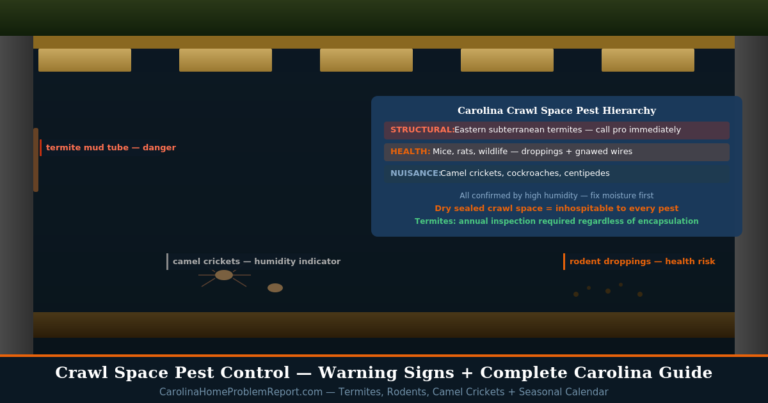
The Carolinas sit in the highest subterranean termite pressure zone east of the Mississippi. Subterranean termites require moisture to survive and thrive. A damp crawl space is not just a moisture problem — it is an active termite attractant operating 24 hours a day, 12 months a year.
Encapsulation removes the moisture attractant and is the most effective long-term termite deterrent available to Carolina homeowners — more effective than chemical treatment alone because it addresses the root cause rather than the symptom.
Crawl Space Moisture Attracts Termites ★ Why damp crawl spaces are the primary termite entry point — and how encapsulation removes the attractant.
Crawl Space Pest Control Termites, rodents, and insects in Carolina crawl spaces — treatment options and what they cost.
Snakes in Crawl Space NC Which NC snakes enter crawl spaces, how to identify them, and how to seal them out permanently.
Spiders in Crawl Space Brown recluse and black widow habitat in Carolina crawl spaces — what the presence means and what to do.
Crawl Space Radon NC NC radon risk zones, how crawl spaces allow radon entry, and mitigation options.
Context and Decisions — Foundation Type, Resale Value, and Is It Worth It?
Crawl space encapsulation is one of the few home improvement projects with a documented return on investment at resale. In Charlotte and Raleigh, a properly encapsulated crawl space with documentation adds an estimated $8,000–$15,000 to resale value. A properly encapsulated crawl space also typically reduces heating and cooling costs by 15–20% annually — representing $300–$600 in annual savings on a typical NC home.
Slab vs Crawl Space NC SC Why NC and SC still build on crawl spaces — and the honest comparison of long-term costs and maintenance.
Crawl Space Fire Safety NC SC Fire safety requirements for encapsulated crawl spaces — foam insulation, vapour barriers, and code compliance.
How to Choose a Crawl Space Contractor in NC and SC
Choosing the wrong contractor for a crawl space project in the Carolinas is one of the most expensive home improvement mistakes a homeowner can make. Unlike a roof replacement or kitchen renovation, poor crawl space work is invisible until it fails.
1. Verify the licence before any conversation about price. In North Carolina verify the General Contractor licence at nclbgc.org. In South Carolina verify the Residential Builder licence at contractors.sc.gov — required for all SC projects over $5,000.
2. Get three quotes minimum — and compare scope, not just price. Ask each contractor to specify vapour barrier thickness, wall insulation R-value, mechanical drying method, and whether a permit will be pulled. A quote that does not include these details is an estimate for undefined work.
3. Require the permit to be pulled — do not waive it for a discount. Vented-to-sealed conversion requires a building permit in North Carolina statewide. The permit triggers an inspection that verifies the work meets code. A contractor who offers a discount to skip the permit is offering to do uninspected work.
4. Assess structural condition before accepting any encapsulation quote. Request moisture meter readings on the floor joists and sill plates as part of any inspection. Any reading above 19% means structural assessment must precede encapsulation.
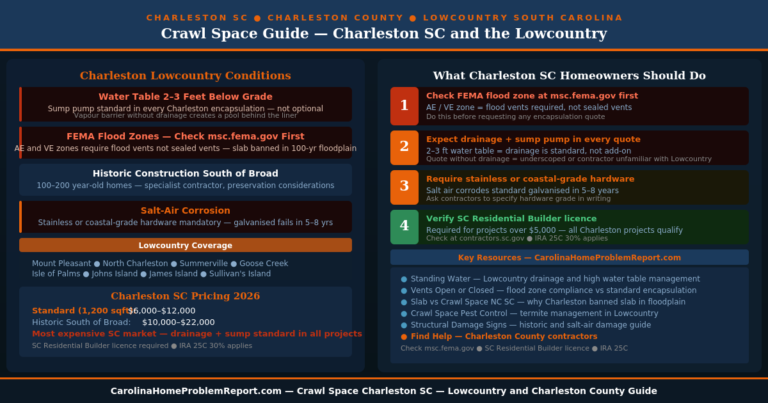
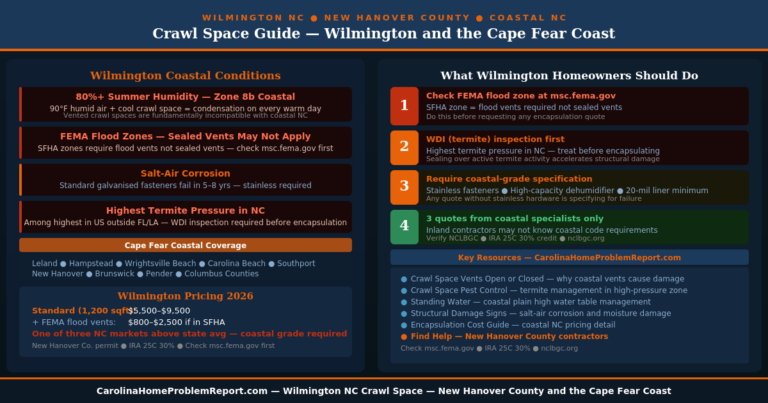
5. Check coastal flood zone status before any work on coastal NC or SC properties. Properties in FEMA Special Flood Hazard Areas require flood-compliant vents, not sealed vents. Check flood zone status at floodsmart.gov before requesting any coastal encapsulation quote.
Local Guides — What Your City's Conditions Mean for Your Crawl Space
Soil type, water table depth, contractor pool size, local building code interpretation, and encapsulation pricing all vary significantly across the Carolinas. These city guides explain what is specific to your market — the conditions, the typical costs, and what to look for in a local contractor.
North Carolina
Charlotte NC Mecklenburg County — Red clay, 67% humidity, $5,100 avg — 40+ specialists, deepest NC contractor pool
Raleigh NC Wake County — Mixed soils, Neuse River water table, $5,000–$8,500 — Triangle resale implications
Greensboro NC Guilford County — Cecil clay, 3-lake humidity, $4,500–$8,000 — best $/sqft value in NC
Durham NC Durham County — Pre-1960s historic housing, clay soil, $5,000–$12,000 — structural assessment first
Winston-Salem NC Forsyth County — Tobacco-era housing, Forsyth clay, $4,500–$8,000 — oldest major Triad housing stock
Fayetteville NC Cumberland County — Fort Liberty VA market, Cape Fear floods, $4,200–$7,800
Wilmington NC New Hanover County — 80%+ humidity, flood zones, salt air, $5,500–$9,500 — coastal specialist required
Asheville NC Buncombe County — Mountain terrain, freeze-thaw, post-Helene, $5,500–$10,500 — highest costs in NC
Cary NC Wake County — Triangle premium market, $6,000–$13,500 — full-spec standard, $500K+ resale stakes
Concord NC Cabarrus County — Charlotte metro satellite, red clay, $4,800–$8,500 — 40+ Charlotte specialists
South Carolina
Greenville SC Greenville County — Upstate Piedmont clay, I-85 competitive pricing, $4,200–$5,500 — best-value Carolinas
Columbia SC Richland County — Fall Line soils, 60–90% year-round humidity, $4,500–$5,500 — know your zone first
Charleston SC Charleston County — 2–3 ft water table, flood zones, historic construction, $6,000–$22,000
Myrtle Beach SC Horry County — Vacation homes, salt air, seasonal pricing, $5,000–$7,000 — book fall/winter
Rock Hill SC York County — Same clay as Charlotte NC, Charlotte contractor pool, $4,300–$5,500 — SC licence required
Ready to Talk to a Contractor?
Use the guides above to understand the problem and know what a fair price looks like in your city — then connect with a licensed specialist who covers your area. Knowing your stage, your soil conditions, and what the code requires puts you in a far stronger negotiating position before anyone sets foot in your home.
Find a Crawl Space Contractor in Your City →Crawl Space NC SC — Frequently Asked Questions
How much does crawl space encapsulation cost in NC and SC?Crawl space encapsulation in North Carolina averages $5,100 for a standard 1,200 sqft space, with a range of $4,200–$13,500 depending on city, condition, and scope. Greenville SC is the most affordable market at $4,200–$5,500. Cary NC and Asheville NC are the most expensive at $6,000–$13,500. Charleston SC is the most expensive SC market at $6,000–$22,000 due to its extreme water table, historic construction, and flood zone complexity.
Does crawl space encapsulation require a permit in NC and SC?In North Carolina, a building permit is required statewide for vented-to-sealed crawl space conversion — confirmed by the NC Office of State Fire Marshal. The permit triggers an inspection verifying R409 code compliance. In South Carolina the requirement varies by jurisdiction. Always ask your contractor whether they will pull the permit as part of the project.
Should crawl space vents be open or closed in NC and SC?Closed — and sealed permanently, not just during winter months. The building science consensus is clear: open foundation vents in high-humidity climates like the Carolinas introduce warm humid air that condenses on cooler surfaces inside the crawl space, raising moisture levels rather than reducing them. NC R409 and SC building codes both recognise sealed crawl spaces as the correct approach. The only exception is flood zone properties where FEMA requires flood vents to remain functional.
How do I verify a crawl space contractor's licence in NC and SC?In North Carolina verify the General Contractor licence at nclbgc.org — search by company name or licence number. In South Carolina verify the Residential Builder licence at contractors.sc.gov — required for all projects over $5,000. Verification takes less than two minutes and confirms the contractor is currently licensed and in good standing.
What is the difference between a vapour barrier and full encapsulation?A vapour barrier is a single component — a polyethylene liner placed on the crawl space floor to block ground moisture. Full encapsulation includes the vapour barrier plus sealed foundation vents, wall insulation, mechanical drying via dehumidifier or conditioned air, and in many cases interior drainage. A vapour barrier alone costs $1,500–$3,000 and provides partial protection. Full encapsulation to NC R409 standard costs $4,200–$13,500 and provides complete moisture control.
How long does crawl space encapsulation last in NC and SC?A properly installed encapsulation system with a 20-mil vapour barrier, sealed vents, wall insulation, and a maintained dehumidifier typically lasts 20–25 years in Carolina conditions. The dehumidifier requires annual servicing and replacement every 8–12 years. Bi-annual inspections in February and September catch developing problems before they become costly repairs.
Authoritative Resources
The following government and regulatory sources underpin the guidance throughout this site:
US EPA — Mold and Moisture in Crawl Spaces EPA guidance on crawl space moisture, mold growth conditions, and health implications of high humidity.
ENERGY STAR / DOE — Crawl Space Sealing and Insulation Department of Energy guidance on sealed crawl space design, insulation placement, and moisture control.
IRS — Energy Efficient Home Improvement Credit (25C) The IRA 25C credit expired December 31, 2025. Check IRS.gov for current home improvement incentive programmes.
NC Licensing Board for General Contractors Verify North Carolina contractor licences before hiring for any crawl space project in NC.
SC Contractors Licensing Board Verify SC Residential Builder licences — required for any SC crawl space project over $5,000.
FloodSmart — FEMA National Flood Insurance Program Check flood insurance requirements and flood risk by address — essential before any coastal NC or SC project.
Carolina Home Problem Report provides research-based educational information for North Carolina and South Carolina homeowners. We are not licensed contractors, home inspectors, or mold assessors. Verify contractor licensing at nclbgc.org (NC) or contractors.sc.gov (SC) before hiring. Check floodsmart.gov before any coastal crawl space project. Always consult a qualified professional before making home repair decisions. See our Disclaimer and About pages.