Crawl Space Moisture in Winter: Is It Normal? What Causes It and What NC and SC Homeowners Should Do
Crawl space moisture in winter in NC and SC is normal — but that does not mean it is harmless. Charlotte receives more annual rainfall than Seattle, and winter ground moisture, cold-air condensation on masonry walls, and freeze-thaw soil movement all contribute to crawl space moisture year-round. The most important thing to understand: most crawl space mold and structural damage discovered in spring inspections started developing during the previous winter. Winter is when the problems begin. Summer is when people finally notice them.
⭐ Key Takeaways
- ✓Some winter crawl space moisture is normal in NC and SC — but persistent humidity above 60% RH, wall condensation, or standing water is not acceptable
- ✓Winter moisture comes from upward ground vapor drive and cold-air condensation on masonry — different from summer but equally damaging
- ✓Cold floors and a musty smell getting worse in winter are both direct crawl space moisture symptoms — not drafts, not coincidence
- ✓Running a dehumidifier at summer settings in winter can over-dry wood — causing hardwood floor cracking and drywall damage at door frames
- ✓Schedule crawl space inspection in March or April — you see winter’s full damage and have maximum planning time before summer moisture season
Crawl space moisture in winter is something every NC and SC homeowner with a vented crawl space should understand. Is it something you should worry about? Homeowners across NC and SC ask this every year — usually after noticing cold floors, a musty smell coming through the floorboards, or windows that fog up for no clear reason. The honest answer: yes, winter crawl space moisture in the Carolinas is worth your attention — not because it is as visually dramatic as summer condensation, but because it is the season when damage quietly starts accumulating beneath your feet.
This guide covers what causes winter crawl space moisture in NC and SC, how it differs from summer moisture, what symptoms to watch for, and what the correct management approach looks like — including the important winter dehumidifier mistake many homeowners make.
In This Article
- Is Crawl Space Moisture Normal in Winter?
- What Causes Crawl Space Moisture in Winter in NC and SC
- Cold Floors and Musty Smell — How Winter Moisture Affects Your Home
- The Over-Drying Danger — A Winter Dehumidifier Mistake to Avoid
- Pipe Freeze Risk in NC and SC Crawl Spaces
- The Spring Reveal — Why Winter Damage Appears in Spring
- Frequently Asked Questions
Is Crawl Space Moisture Normal in Winter?
Some degree of crawl space moisture in winter is normal in NC and SC — the Carolinas are not a dry climate. Charlotte averages 43 inches of annual rainfall, more than Seattle’s 38 inches, spread relatively evenly across the year. January and February bring cold rainfall, saturated clay soil that holds water against foundations, and temperature swings that create freeze-thaw cycles along foundation walls. Expecting a completely dry crawl space in a Carolina winter without active moisture control is unrealistic.
✓ NORMAL IN WINTER
- Some humidity from ground vapor drive
- Light condensation on masonry during cold spells
- Soil moisture against foundation after rain
⚠ NOT ACCEPTABLE IN WINTER
- Persistent RH above 60% on hygrometer
- Visible condensation running down block walls
- Wet or sagging insulation between joists
- Standing water on floor
What Causes Crawl Space Moisture in Winter in NC and SC
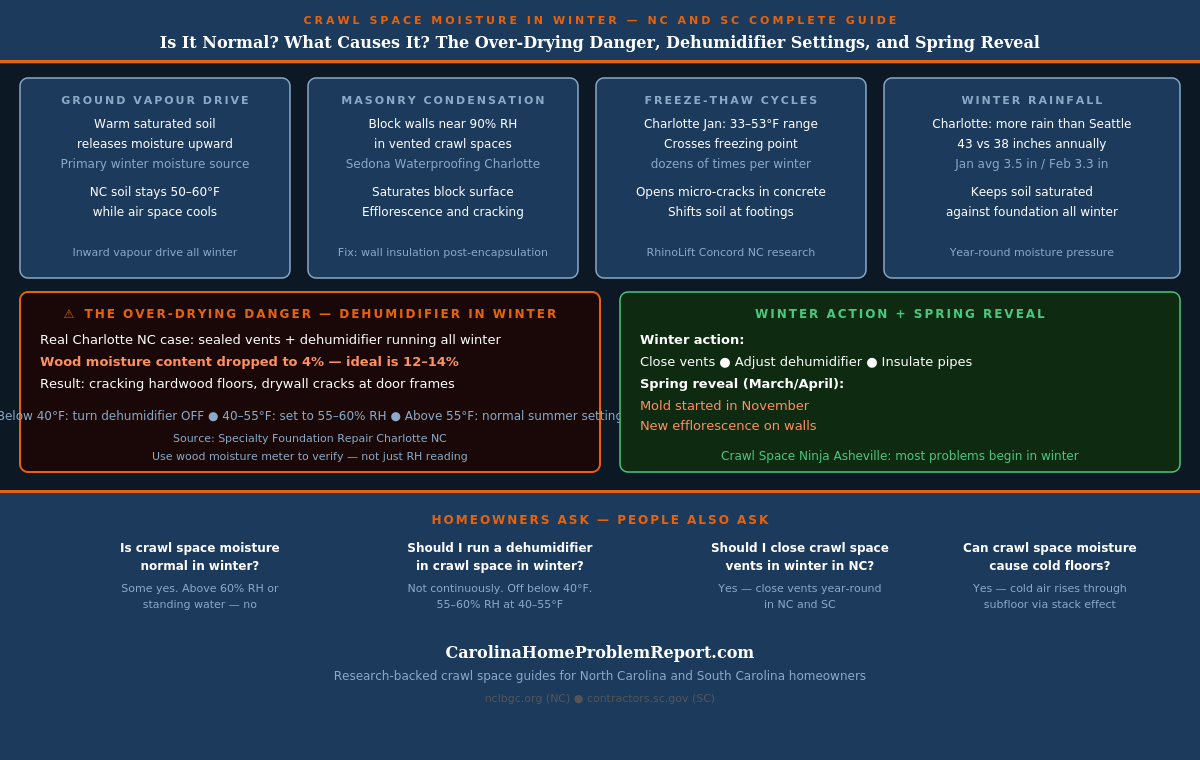
Ground Moisture Vapour Drive
In winter, the moisture gradient in a Carolina crawl space reverses compared to summer. Rather than warm humid outdoor air condensing on cool surfaces, winter moisture is driven primarily upward from the soil. Cold winter air holds less moisture than warm summer air — but the ground beneath a crawl space stays relatively warm (50–60°F) and saturated with accumulated rainfall. This creates an upward vapour drive from soil to air space all winter long.
Cold Air Condensation on Masonry
Masonry surfaces in vented crawl spaces — concrete block foundation walls, piers, and footings — regularly reach near 90% relative humidity in Carolina winters. When damp cold air contacts these surfaces through foundation vents, condensation forms on the block faces. This is often dismissed as normal winter dampness but it represents sustained moisture loading of foundation wall surfaces that leaches mortar and contributes to long-term structural deterioration.
Winter Rainfall and Groundwater
NC and SC receive consistent winter rainfall — January averages 3.5 inches in Charlotte, February averages 3.3 inches. This keeps soil saturated against foundations and raises groundwater levels in low-lying areas throughout winter. Homes with negative yard grading or insufficient drainage experience water entry during winter storms that would be less severe in drier conditions.
Freeze-Thaw Cycles
Charlotte’s average January temperature ranges from 33°F overnight to 53°F during the day — a range that crosses the freezing point frequently through December, January, and February. This repeated freeze-thaw cycling causes soil expansion and contraction that stresses foundation walls, creates micro-cracks in concrete, and shifts soil away from footings in ways that gradually open new water entry pathways. Unlike northern climates where ground freezes solidly for months, NC and SC experience dozens of short freeze-thaw cycles each winter — potentially more damaging to foundation integrity than sustained deep freeze.
Cold Floors and Musty Smell — How Winter Crawl Space Moisture Affects Your Home
Two winter symptoms homeowners describe constantly — cold floors and a musty smell that seems worse in winter — are both directly connected to crawl space moisture conditions.
🏠 Cold Floors in Winter
Homeowners often attribute cold floors to drafts or poor insulation. The actual mechanism is the stack effect working in reverse. Cold crawl space air rises through gaps in the subfloor, around plumbing penetrations, and through any opening between the crawl space and the living space. An unencapsulated crawl space at 45°F is continuously supplying cold air to your ground floor. Encapsulation brings the crawl space into the conditioned zone — stopping the cold air supply and allowing crawl space temperature to stabilise closer to indoor temperatures.
🎒 Musty Smell Worse in Winter
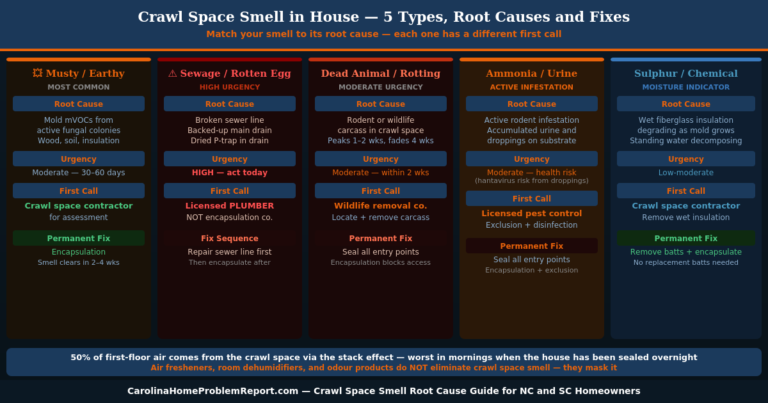
Many NC and SC homeowners report that the musty smell from their crawl space is more noticeable in winter than summer. In winter, windows and doors are sealed and the home is more airtight. The stack effect still draws crawl space air upward continuously, but there is nowhere for it to escape. Mold volatile organic compounds (MVOCs) concentrate in a sealed winter home in a way they cannot in a ventilated summer home. The smell getting worse in winter is often a sign that mold established during the previous summer is still present and active.
The Over-Drying Danger — A Winter Dehumidifier Mistake to Avoid
⚠️ CRITICAL WINTER DEHUMIDIFIER WARNING
A Charlotte NC inspection found a homeowner who had sealed all foundation vents and was running a commercial dehumidifier year-round at summer settings. Winter crawl space wood moisture content was measured at 4% — severely below the healthy range of 12–14%. The result: cracking hardwood floors and drywall cracks at door frames and stairwells — all caused by over-dried wood shrinking. A dehumidifier set to control summer humidity of 50% RH will over-dry a sealed crawl space in winter when outdoor absolute humidity is low.
The correct approach for dehumidifier management in winter in NC and SC:
Below 40°F crawl space temperature: Turn the dehumidifier off. Most residential units lose accuracy and efficiency below this temperature and risk compressor damage.
40–55°F crawl space temperature: Set to 55–60% RH maximum — not 45–50% as in summer. The lower outdoor humidity requires a higher crawl space target.
Above 55°F crawl space temperature: Normal summer settings apply — target 50–55% RH.
Monitor wood moisture content, not just RH. Use a wood moisture meter on crawl space joists. Target: 12–14% year-round. Below 10%: dehumidifier settings need to be relaxed. Above 19%: active moisture control is needed.
Pipe Freeze Risk in NC and SC Crawl Spaces
Frozen pipes are a less common but real winter risk in NC and SC crawl spaces — particularly in western NC mountain counties, the Triad, and Triangle areas where overnight temperatures regularly fall below 20°F during cold snaps. Pipes in unencapsulated vented crawl spaces are exposed to outdoor air temperatures when outdoor air enters through foundation vents during cold spells.
Immediate Steps Before a Hard Freeze Warning
- Close foundation vents immediately
- Wrap exposed cold water pipes with foam pipe insulation or heat tape
- Allow indoor faucets fed by crawl space pipes to drip slowly during the coldest nights
- Confirm the dehumidifier is off if crawl space temperature is approaching 40°F
Encapsulation eliminates this risk by bringing the crawl space into the conditioned zone. Crawl space temperatures in an encapsulated space with a small heat supply or conditioned air connection rarely fall below 40°F even during hard freezes — making pipe freeze in an encapsulated Carolina crawl space an extremely rare event.
The Spring Reveal — Why Winter Damage Appears in Spring
Most crawl space problems begin in winter. Winter moisture conditions — sustained humidity from ground vapour drive, repeated freeze-thaw crack cycles, cold air condensation on masonry — create the conditions for mold growth and structural deterioration that become visible in spring as temperatures warm and conditions worsen.
What a March/April Inspection Typically Reveals After a Carolina Winter:
- New efflorescence on block walls from winter water movement
- Early-stage mold growth on joists that started in November
- Sagging insulation batts that absorbed winter moisture
- New micro-cracks in foundation walls from freeze-thaw movement
- Higher wood moisture content readings than were present in autumn
Homeowners who inspect only in summer miss the causal chain entirely — they see summer damage that winter created. The practical implication: schedule your annual crawl space inspection in March or April. This gives you the best picture of accumulated winter damage and the maximum lead time to plan encapsulation before the next moisture season.

Frequently Asked Questions
Is crawl space moisture normal in winter in NC and SC?
Some moisture is normal due to consistent rainfall and ground vapor drive. What is not normal — and not acceptable — is persistent humidity above 60% RH, visible condensation on wall surfaces, or standing water. These indicate a moisture management problem that will worsen through winter and produce visible mold and structural damage by spring.
Should I run a dehumidifier in my crawl space in winter?
In an encapsulated crawl space in NC and SC, you typically do not need to run the dehumidifier continuously in winter. When crawl space temperatures fall below 40°F, turn it off. Between 40–55°F, set it to 55–60% RH rather than the summer setting. Over-running a dehumidifier in winter at summer settings can dry wood below 12% moisture content, causing hardwood floor cracking and drywall damage.
Should I open or close my crawl space vents in winter in NC?
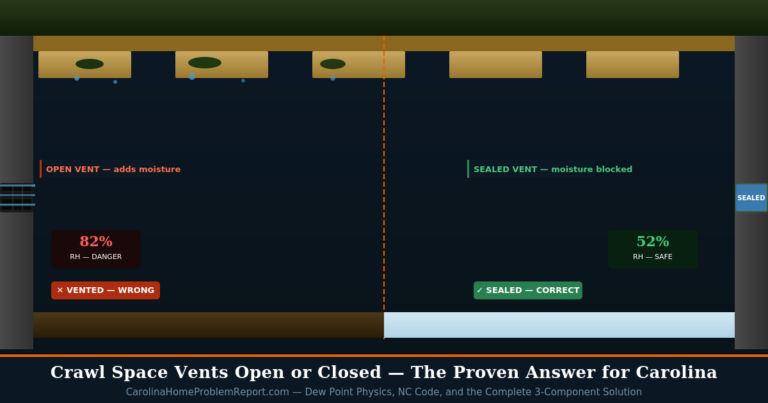
Close them — in winter and in summer. In winter, open vents bring in cold air that drops crawl space temperature toward pipe-freeze risk, increases cold floor symptoms, and adds outdoor humidity to the crawl space environment. NC R409 requires sealed vents in encapsulated crawl spaces. If you are not yet encapsulated, closing vents in winter is still the correct approach. See our full guide on crawl space vents open or closed.
Can crawl space moisture cause cold floors in winter?
Yes — through the reverse winter stack effect. Cold crawl space air rises through gaps in the subfloor and around plumbing penetrations into the living space. An unencapsulated crawl space at 45°F is continuously supplying cold air to your ground floor. Encapsulation brings the crawl space temperature closer to indoor temperature, which noticeably reduces cold floor symptoms without adding insulation.
Why is my crawl space musty smell worse in winter?
Because windows and doors are sealed in winter, making the home more airtight. Mold volatile organic compounds from the crawl space rise through the stack effect into a sealed interior with nowhere to escape. The smell getting worse in winter is often a sign that mold established during the previous summer is still present. It will worsen in the next summer season without intervention.
When is the best time to encapsulate a crawl space in NC?
Late August through October. You end the current summer moisture season with a permanent solution in place before winter. Contractors are less busy, scheduling is more flexible, and you go into winter with a sealed, controlled space rather than another vulnerable season adding to cumulative moisture damage. Get quotes in July, schedule for September, inspect in spring to confirm performance.
💡 Planning Encapsulation for This August–October?
The dehumidifier is the active control layer in a sealed crawl space. Argendon’s range is sized by square footage for every Carolina home and operates correctly at both summer and winter settings. Use code CHPR3 for 3% off.
Shop Argendon Dehumidifiers → Code CHPR3 saves 3% at checkout- Some winter crawl space moisture is normal in NC and SC — Charlotte gets more rain than Seattle and Carolina winters are not dry. What is not normal is persistent RH above 60%, wall condensation, or standing water.
- Most spring crawl space damage started developing in winter — efflorescence, early mold, sagging insulation, and freeze-thaw cracks all accumulate while most homeowners are not inspecting. Schedule your annual inspection in March or April.
- Cold floors and a musty smell getting worse in winter are both direct crawl space moisture symptoms — not drafts or coincidence. Both improve significantly after encapsulation brings the crawl space into the conditioned zone.
- Running a dehumidifier at summer settings in winter can over-dry wood below 12% moisture content, causing hardwood floor cracking and drywall damage. In winter, set to 55–60% RH and turn it off if crawl space temperature falls below 40°F.
- The optimal encapsulation window is August–October — after summer peak humidity and before winter, when contractors are available. Get quotes in July, schedule for September, and enter next winter with a permanently controlled crawl space.
📚 Key Concepts — Reference Sources
- Stack Effect (Wikipedia) — How cold crawl space air rises into NC and SC homes in winter, causing cold floors and concentrating musty odours in sealed winter homes
- Relative Humidity (Wikipedia) — How moisture in air changes with temperature — explains why masonry surfaces near 90% RH in winter NC conditions produce persistent condensation
- Wood-Decay Fungi (Wikipedia) — The fungi responsible for brown rot and white rot in structural wood — explains why sustained winter moisture above 19% wood moisture content produces the decay found in spring inspections
Verified external authorities:
- NOAA NC State Climate Summary — North Carolina climate normals and precipitation data
- NC Licensing Board for General Contractors — Verify contractor licences for crawl space work in NC
- SC Contractors’ Licensing Board — Verify contractor licences for crawl space work in SC
📖 Related Guides
The Carolina Home Problem Report editorial team researches and writes guides for homeowners across North and South Carolina. Our research draws on NC State Extension Service publications, Clemson Extension resources, EPA guidelines, Building Science Corporation data, and insights from licensed Carolina contractors. We are not contractors — we are a research team dedicated to giving Carolina homeowners clear, locally specific, unbiased answers.
Carolina Home Problem Report provides general educational information for NC and SC homeowners. We are not licensed contractors. For crawl space moisture assessment and encapsulation verify contractor licences at nclbgc.org (NC) or contractors.sc.gov (SC). See our Disclaimer and Affiliate Disclosure.