Is It Safe to Go In a Crawl Space? [The Honest Safety Guide for Carolina Homeowners — 6 Stop Conditions, Required Gear, and What to Do With Each Hazard]
It can be — but only with the right gear, never alone, and only after checking for six conditions that mean you should not enter at all. The hazards in a Carolina crawl space are not hypothetical — hantavirus carries a 38% mortality rate, sewage contamination is a Category 1 biohazard, wet wiring is an electrocution risk, and asbestos in older homes becomes dangerous the moment it is disturbed. The gear list is short, the pre-entry checks take five minutes, and the rule is simple: if any stop condition is present, call a professional.
⭐ Key Takeaways
- ✓Never enter a crawl space alone. Always have someone stationed at the access point who knows you are inside and can call for help if you do not emerge. This is the single most important crawl space safety rule.
- ✓A paper dust mask does not protect you from mold spores, hantavirus particles, or chemical fumes in a crawl space. Only a P100 half-face respirator provides adequate protection for crawl space entry.
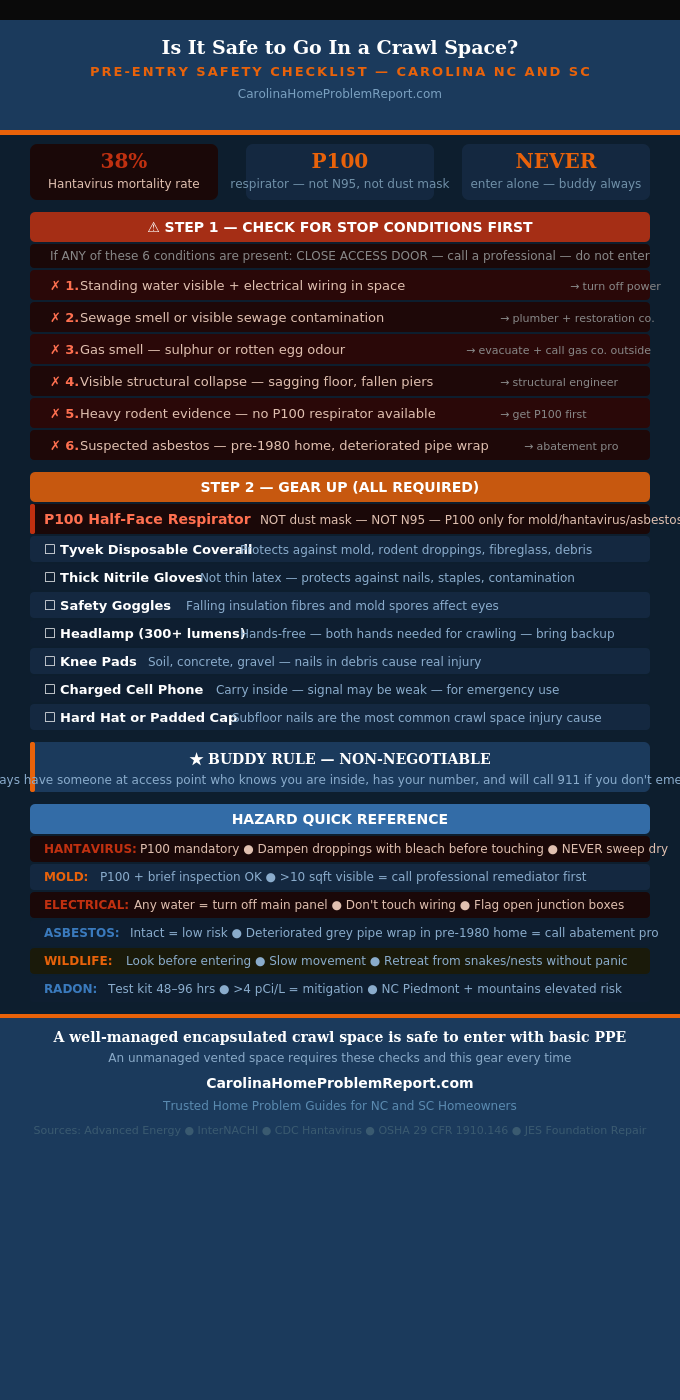
- ✓Six conditions mean do not enter at all — call a professional. Standing water with visible wiring, sewage smell or visible sewage, gas smell, visible structural collapse risk, heavy rodent evidence without proper respirator, and suspected asbestos.
- ✓Hantavirus Pulmonary Syndrome has a 38% mortality rate and no specific treatment — it is transmitted by breathing aerosolised particles from rodent urine and droppings. Never sweep or vacuum dry rodent droppings in a crawl space. Dampen with disinfectant spray first.
- ✓A well-maintained encapsulated crawl space with no rodent activity, no standing water, and no asbestos is a relatively safe space to enter with standard PPE — it is not inherently dangerous
Whether it is safe to go in a crawl space depends on what is in that crawl space and whether you have the right gear before you enter. A dry, well-maintained encapsulated crawl space with no rodent activity, no asbestos, and no standing water is a relatively straightforward space to enter with basic PPE. An unmanaged vented Carolina crawl space that has not been inspected in years is a genuinely hazardous environment that requires specific preparation before entry — and in some conditions should not be entered at all until a professional has assessed it.
According to Advanced Energy's North Carolina crawl space research, most homeowners underestimate what is in their crawl space — particularly in the Carolina climate where warmth and humidity create conditions that actively encourage rodent nesting, mold growth, and pest activity. The hazards are real, they are specific, and they each have a specific mitigation protocol. This article gives Carolina homeowners the complete pre-entry checklist, the required gear, the six stop conditions, and the specific protocol for each hazard type.
The goal is not to discourage homeowners from going into their crawl spaces — annual inspection is strongly encouraged and most healthy crawl spaces are accessible with basic preparation. The goal is to make sure the preparation matches the actual conditions you are about to enter.
In This Article
⚠ Six Conditions That Mean Do Not Enter — Call a Professional
Before any pre-entry check, look through the access opening first. If you see any of the following, close the access door and call a professional:
Standing water visible + electrical wiring in the space
Water conducts electricity. Frayed or fallen wiring in a wet crawl space is an electrocution hazard. Turn off power at the main panel and call an IICRC water damage company and an electrician before anyone enters. Do not step in standing water with unknown wiring conditions.
Sewage smell or visible sewage contamination
Sewage in a crawl space is a Category 1 biohazard. Contact with bare skin or inhalation of fumes can cause serious illness. Do not enter. Call a licensed plumber to address the source and an IICRC-certified disaster restoration company for cleanup. This is not a DIY scenario under any circumstances.
Gas smell — any sulphur or rotten egg odour
Leave the area immediately. Do not create sparks — do not flip light switches or use your phone near the access point. Ventilate the home by opening windows and doors. Call your gas utility company's emergency line from outside the home. Do not re-enter until cleared by the gas company.
Visible structural compromise — sagging floor system, collapsed piers, fallen beams
A structurally compromised crawl space presents a crush and entrapment hazard. If the floor system above the crawl space has significantly sagged, or if piers or beams have visibly failed, the home above may be unstable. Call a licensed structural engineer or foundation contractor for assessment before anyone enters.
Heavy rodent evidence without a P100 respirator available
Rodent droppings, urine stains, or nesting material in quantity indicate potential hantavirus contamination. Never enter a space with heavy rodent evidence without a P100 half-face respirator — not a dust mask, not an N95. If you do not have a P100 respirator available, do not enter. The risk is not hypothetical: Hantavirus Pulmonary Syndrome has a 38% mortality rate and no specific treatment.
Suspected asbestos — pre-1980 home with disturbed pipe wrap or duct insulation
Homes built before 1980 may have asbestos pipe insulation, duct wrap, or floor tile adhesive in the crawl space. Asbestos is harmless when intact and undisturbed — it becomes dangerous when fibers are airborne. If you see deteriorating grey wrap on pipes or ducts in an older home and you do not know if asbestos testing has been done, do not disturb anything. Call a licensed asbestos abatement professional for testing before any work proceeds.
Required Gear Before You Enter
If none of the six stop conditions are present, the following gear is required before crawl space entry:
The buddy rule — never enter alone
Always have another person stationed at the access opening before you enter. This person should know you are inside, how long you expect to be in there, and what to do if you do not emerge. Crawl spaces are confined spaces — if you become injured, trapped by a falling beam, overcome by fumes, or simply become disoriented, you cannot reliably exit or call for help without the buddy standing by. This is the most important crawl space safety rule and the one most commonly skipped.
The Six Crawl Space Hazards — What Each One Is and How to Handle It
Pre-Entry Checklist — 10 Checks Before You Go In
Complete this checklist before entering. The first section confirms you have not missed a stop condition. The second confirms your gear is ready.
Stop Conditions — 6 checks
No standing water visible — if water present and wiring is in the space, turn off power at main panel or do not enter
No sewage smell or visible sewage contamination — if present, call plumber and restoration company, do not enter
No gas smell — any rotten egg or sulphur odour means evacuate home and call gas company emergency line from outside
No visible structural collapse — sagging floor system, fallen piers, collapsed beams visible through access opening means call structural engineer
P100 respirator available if rodent evidence present — heavy droppings, urine stains, or nesting without P100 means do not enter
No suspected asbestos visible in pre-1980 home — deteriorated pipe wrap or duct insulation means call abatement professional
Gear Checks — 4 checks
P100 respirator fitted and sealed — check seal by covering filters and inhaling — mask should collapse slightly if sealed correctly
Tyvek suit, thick gloves, and knee pads on — boots over suit legs, gloves over suit cuffs
Headlamp charged and working — test before entering, carry backup light source if possible
Buddy confirmed at access point — person outside knows you are entering, has your phone number, knows to call 911 if you do not emerge in the expected time
When to Call a Professional Inspector Instead
Beyond the six immediate stop conditions, call a professional crawl space inspector rather than entering yourself when:
- →The crawl space has not been inspected in more than 3 years — unknown conditions may have developed
- →You are physically unable to safely crawl through the access opening or move through the space — confined space entry requires the ability to reverse direction and exit quickly
- →You have respiratory conditions, allergies, or immune compromise — even with PPE, exposure to mold spores and mVOCs carries higher risk for vulnerable individuals
- →You are buying a home and this is a pre-purchase inspection — you need a documented professional report, not a homeowner assessment
- →You noticed symptoms — musty smell, soft floors, increased energy bills, worsening respiratory symptoms — that suggest active problems requiring diagnosis, not just visual observation
A professional crawl space inspection typically costs $150–$400 in NC and SC. According to NC State Extension's house inspection guidance, a crawl space assessment by a trained professional is recommended at least once at purchase and every 3–5 years thereafter for most Carolina homes.
Frequently Asked Questions
Is it dangerous to go in a crawl space?
It can be, depending on the condition of the crawl space. A well-maintained encapsulated crawl space with no rodent activity, no standing water, and no asbestos is relatively safe to enter with standard PPE. An unmanaged vented Carolina crawl space that has not been inspected in years may harbour hantavirus-contaminated rodent droppings, mold, wet wiring, and wildlife. The key is checking for the six stop conditions before entry and having appropriate PPE for the conditions present. Never enter any crawl space alone.
What do I need to wear in a crawl space?
The minimum gear for any Carolina crawl space entry: P100 half-face respirator (not a dust mask or N95), Tyvek disposable coverall, thick nitrile gloves, safety goggles, headlamp, knee pads, and a hard hat or padded cap. The P100 respirator is the most critical item — a paper dust mask does not protect against mold spores, hantavirus particles, asbestos fibres, or chemical vapours. Carry a charged cell phone inside the space and have someone standing by at the access opening at all times.
Can you get hantavirus from going in a crawl space?
Yes — crawl spaces are identified by the CDC as one of the highest-risk locations for hantavirus exposure. The virus is transmitted by inhaling aerosolised particles from rodent urine, droppings, or nesting material disturbed in an enclosed space. Hantavirus Pulmonary Syndrome has a 38% mortality rate with no specific treatment. In a Carolina crawl space with evidence of rodent activity, a P100 respirator is mandatory before entry. Never sweep or vacuum dry rodent droppings — always dampen with bleach solution first.
What are the dangers in a crawl space?
Six categories of hazard in a Carolina crawl space: hantavirus from rodent droppings (38% mortality rate), mold and mVOCs from high humidity, electrical hazard from wet wiring or exposed conductors, asbestos in pre-1980 homes, wildlife including copperheads and wasp nests, and radon gas particularly in NC Piedmont and mountain counties. Each has a specific protocol. The most dangerous conditions require professional attention before any homeowner entry.
Can I go in my crawl space by myself?
No — never enter a crawl space alone. Always have another person stationed at the access point who knows you are inside, how long you expect to be in there, and what to do if you do not emerge in the expected time. A crawl space is a confined space — if you become injured, overcome by fumes, trapped by a structural failure, or encounter an unexpected hazard, you cannot reliably exit or call for help without someone outside aware of your presence. This is the single most important crawl space safety rule.
A Carolina crawl space can be entered safely — the hazards are manageable with the right preparation. The six stop conditions are clear. The gear list is short and inexpensive. The buddy rule is non-negotiable. And when a well-maintained encapsulated crawl space is what is under your home, entry is straightforward. The problem is the large percentage of Carolina homes with unmanaged vented crawl spaces that have not been inspected in years — those spaces require respect before entry and professional assessment when conditions are unclear.
Find a Crawl Space Inspector Near You →Research draws on Advanced Energy NC field studies, InterNACHI crawl space hazard guidance, JES Foundation Repair safety protocols, Jackson & Sons Eastern NC crawl space safety, OSHA confined space standards 29 CFR 1910.146, CDC hantavirus guidance, and NC State Extension publications.
Carolina Home Problem Report is an informational resource for homeowners. We are not licensed contractors or safety professionals. Always exercise appropriate caution before entering any confined space. See our Disclaimer.