Crawl Space Moisture Problems in Summer: Why NC and SC Humidity Makes It the Worst Season of the Year
Crawl space moisture in summer is worse in NC and SC than at any other time of year — not better. From April through October, outdoor relative humidity regularly exceeds 80% in the Carolinas, and summer dew points in Raleigh and Charlotte regularly climb above 65°F. When this warm, moisture-saturated air enters a vented crawl space, it contacts cooler surfaces and releases its moisture as condensation. Opening foundation vents in summer makes the problem significantly worse, not better. The permanent solution is encapsulation — sealing the vents, installing a vapor barrier, and controlling humidity mechanically with a crawl space dehumidifier.
⭐ Key Takeaways
- ✓Summer is the worst season for crawl space moisture in NC and SC — the warm humid air logic that applies in dry climates works in reverse here
- ✓The worst damage window is 4–9 AM when pre-dawn humidity hits 85–95% RH — most homeowners are asleep while peak condensation occurs
- ✓Opening more foundation vents in summer makes moisture significantly worse by pumping peak-humidity outdoor air directly onto cooler crawl space surfaces
- ✓Summer crawl space moisture forces your AC to work 10–20% harder — directly increasing summer energy bills through the stack effect
- ✓The permanent fix is encapsulation: sealed vents + vapor barrier + crawl space dehumidifier holding below 60% RH year-round
Crawl space moisture in summer surprises many NC and SC homeowners who assume the warm, dry-feeling summer air outside means conditions below their floor are improving. The opposite is true. Summer in the Carolinas is the worst season for crawl space moisture — not the best. Understanding why requires understanding dew point, the stack effect, and why the ventilation advice written for dry climates actively damages humid-climate crawl spaces.
The good news is that summer crawl space moisture in NC and SC is entirely predictable and entirely controllable. The bad news is that every summer you delay the permanent solution is another season of mold growth, wood moisture accumulation, and structural damage operating beneath your floors.
In This Article
- Why Summer Is the Worst Season for Crawl Space Moisture in NC and SC
- The Overnight Humidity Spike — The Peak Moisture Window
- Why Opening Foundation Vents in Summer Makes It Worse
- What Summer Crawl Space Moisture Actually Looks Like
- How Summer Crawl Space Moisture Affects Your Home
- What to Do Right Now — Summer Triage Sequence
- The Permanent Solution — Encapsulation to NC R409 Standard
- Frequently Asked Questions
Why Summer Is the Worst Season for Crawl Space Moisture in NC and SC
The common assumption is that summer heat dries things out. That logic holds in Phoenix. It does not hold in Raleigh, Charlotte, or Greenville SC. The difference is dew point — the temperature at which air releases its moisture as liquid water.
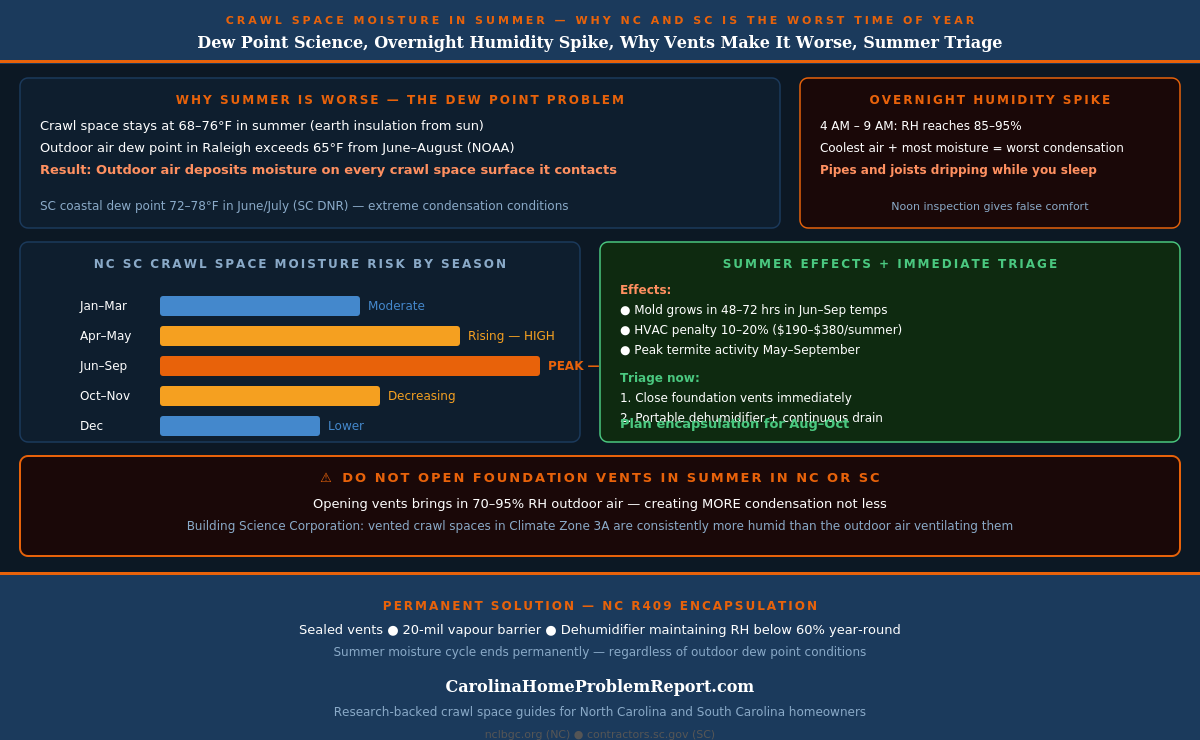
According to NOAA NC climate normals, Raleigh summers have average high temperatures of 90°F in July with average lows of 69°F. Summer dew point temperatures in Raleigh regularly exceed 65°F from June through August — meaning the air feels uncomfortably muggy and will deposit moisture on any surface below 65°F.
The crawl space, insulated from the sun by the soil around it, typically maintains temperatures of 68–76°F through summer — often below the outdoor dew point. The result: warm humid air enters through foundation vents and immediately begins condensing on every cooler surface it contacts.
In coastal SC, the situation is even more extreme. SC DNR climate records show coastal dew point readings of 72–78°F in June and July — among the highest in the continental US outside the Gulf Coast. At these dew point levels, condensation forms on any surface below 72°F, which includes virtually every surface in a Carolina crawl space throughout summer.
The Overnight Humidity Spike — The Peak Moisture Window
The single most damaging moisture period in a Carolina crawl space occurs not during the heat of the day but during the early morning hours of summer — typically between 4 AM and 9 AM. Here is why.
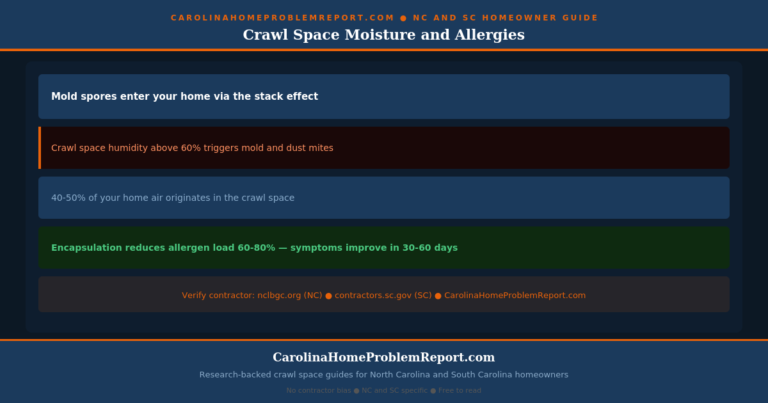
During summer nights, temperatures fall while absolute moisture content in the air stays high. As temperatures drop, relative humidity rises — often reaching 85–95% RH in the pre-dawn hours across NC and SC. This is the period when outdoor air is simultaneously at its coolest and its most moisture-saturated.
Foundation vents draw peak-humidity pre-dawn air into your crawl space continuously. By the time you inspect at noon, the worst damage of the day has already occurred.
Why Opening Foundation Vents in Summer Makes It Worse
The ventilation advice printed on most pre-2000 home construction guides was written for climates where summer outdoor air is drier than interior spaces — typically the arid West and Midwest. The logic was sound in those conditions: bring in dry outdoor air to dilute and remove interior moisture. In humid climates like NC and SC, this logic reverses completely.
In a Carolina summer, outdoor air is not dry — it is at 70–95% relative humidity. Opening foundation vents does not bring dry air into the crawl space. It brings the most humid air in the surrounding environment directly into contact with the coolest surfaces in your home. More ventilation means more condensation, higher average humidity, faster wood moisture absorption, and faster mold growth.
⚠️ DO NOT OPEN FOUNDATION VENTS IN SUMMER IN NC OR SC
Building Science Corporation research confirms that in mixed-humid Climate Zone 3A — which covers all of NC and most of SC — vented crawl spaces are consistently more humid than the outdoor air that ventilates them. Opening additional vents in summer is one of the most common and most costly crawl space mistakes Carolina homeowners make.
What Summer Crawl Space Moisture Actually Looks Like
Understanding what you are looking at when you inspect a Carolina crawl space in summer helps distinguish normal conditions from active damage:
Condensation on Cold Water Supply Pipes
Some surface moisture on cold water supply pipes in summer is common in vented crawl spaces and does not represent acute structural risk — though it confirms that moisture conditions are high and contributing to the overall humidity load in the space. See our Crawl Space Sweating guide for the full condensation explanation.
Condensation on HVAC Ducts
Summer HVAC supply ducts carry 52–55°F conditioned air through a crawl space where air may be at 80°F and 80% RH. Condensation on duct surfaces is severe, soaks duct insulation, and raises the overall moisture load significantly. Wet duct insulation also reduces the R-value of the duct system, increasing cooling energy costs.
⚠ Dark Staining Beginning on Floor Joists
If you see dark staining developing on floor joist surfaces during summer inspections, wood moisture content is elevated above normal. This is the early stage of the mold and decay sequence. Staining that was not present in spring indicates active moisture accumulation during the current summer season. Act immediately — do not wait until autumn.
⚠ Hygrometer Reading Above 70% RH
A hygrometer reading above 70% RH in the crawl space during summer indicates active condensation conditions on most surfaces. Readings above 80% RH indicate severe moisture loading that is producing measurable condensation and mold conditions. The target is below 60% RH — at which point mold growth on wood stops and condensation is greatly reduced.
How Summer Crawl Space Moisture Affects Your Home
HVAC Performance and Energy Bills
The stack effect draws 40–50% of your ground floor air from the crawl space. When the crawl space is at 80% RH in summer, that moisture enters your living space continuously, forcing the AC to run longer to control indoor humidity. Duke Energy data for average NC homes suggests a 10–20% HVAC energy penalty from crawl space moisture — translating to $190–$380 additional cooling cost per summer season.
Mold Growth Window
Mold requires three conditions: a food source (wood), moisture above 19% wood moisture content or air above 60% RH, and temperatures above 40°F. From June through September in NC and SC, temperatures and humidity in unencapsulated crawl spaces satisfy all three conditions simultaneously for months at a stretch. This is why the overwhelming majority of crawl space mold found at inspection in NC and SC developed during summer seasons.
Termite Activity Peak
Summer is peak termite activity season across NC and SC. Subterranean termite swarmers emerge in spring, colonies are most active from May through September, and the moisture conditions of a humid crawl space provide the sustained damp wood environment that sustains large colonies. Summer crawl space moisture and termite pressure are directly linked.
What to Do Right Now — Summer Triage Sequence
If you are discovering crawl space moisture conditions in summer and encapsulation is not immediately possible, this triage sequence limits damage while you plan the permanent solution:
Close Foundation Vents Immediately
This is counterintuitive but correct for NC and SC summers. Partially closing vents reduces the volume of humid outdoor air entering the space. Blocking them completely with foam inserts is even more effective as a temporary measure.
Install a Dehumidifier
A portable dehumidifier rated for your crawl space square footage, with a continuous drain hose routed to the outside, will mechanically remove moisture from the air while you arrange the permanent solution. However, portable units are not as effective as dedicated sealed-space units and do not address the entry pathway.
Check and Repair Duct Insulation
Wet or compressed duct insulation accelerates condensation and moisture loading. Re-wrapping damaged sections reduces the moisture contribution from duct sweating and improves HVAC efficiency immediately.
Plan Encapsulation for Late Summer or Autumn
The best time to encapsulate a crawl space in NC and SC is late August through October — after peak humidity season and before winter. Contractors are typically less busy in autumn and material costs are stable. Getting quotes in July and scheduling for September allows you to end the current moisture season with a permanent solution in place before the next one begins.
The Permanent Solution — Encapsulation to NC R409 Standard
Temporary measures reduce summer crawl space moisture. They do not eliminate it. The permanent solution is crawl space encapsulation — sealing foundation vents, installing a 20-mil vapor barrier, and adding mechanical drying that maintains relative humidity below 60% RH consistently through summer and year-round.
After encapsulation, the summer moisture cycle that damages an unencapsulated Carolina crawl space does not occur. The sealed space is no longer supplied with outdoor humid air. The vapor barrier blocks ground evaporation. The dehumidifier maintains a controlled environment that stays below 60% RH regardless of what outdoor dew points are doing at 6 AM in July.

See our Is Crawl Space Encapsulation Worth It guide for the full NC-specific ROI analysis and our Crawl Space Encapsulation Cost Guide for current NC and SC pricing.
Frequently Asked Questions
Why is my crawl space wetter in summer than in winter in NC or SC?
Because summer outdoor air in the Carolinas carries far more moisture than winter air. When this warm, humid outdoor air enters a vented crawl space and contacts cooler surfaces, it deposits liquid water through condensation. In winter, outdoor air is drier and the temperature differential between indoor and outdoor is less extreme — both factors reduce condensation. Summer is always the worst moisture season in Carolina crawl spaces.
Should I open my crawl space vents in summer in the Carolinas?
No. Opening foundation vents in summer in NC and SC makes crawl space moisture significantly worse. The 70–95% humidity outdoor air enters the crawl space and condenses on every cooler surface inside — pipes, ducts, joists, walls. More venting equals more moisture, not less. Close the vents, or better, seal them permanently as part of encapsulation. See our full crawl space vents guide for the complete explanation.
What time of day is crawl space moisture worst in Carolina summers?
Between 4 AM and 9 AM. Pre-dawn hours are when outdoor temperatures are lowest while absolute humidity remains high — pushing relative humidity to 85–95% RH. Foundation vents draw this peak-humidity air into the crawl space continuously during this window. Most homeowners who inspect at midday think conditions are acceptable. A check at 6 AM would reveal pipes and joists dripping with condensation and puddles on the vapor barrier.
Is summer crawl space moisture dangerous?
Yes, over time. Summer crawl space moisture drives wood moisture content above the 19% mold threshold for months at a stretch, provides peak-season conditions for termite colony growth, increases indoor humidity and forces your AC to work 10–20% harder, and deposits moisture on duct insulation reducing its effectiveness. Left unaddressed across multiple summers, the cumulative damage — mold remediation, joist sistering, duct replacement — far exceeds the cost of encapsulation.
What is the fastest way to reduce crawl space moisture in summer?
Fastest immediate reduction: close or block foundation vents and place a dehumidifier with a continuous drain in the crawl space. This reduces peak humidity within days. The permanent solution is full encapsulation — sealed vents, 20-mil vapor barrier, and a properly sized crawl space dehumidifier holding 50–55% RH year-round. Schedule encapsulation for late summer or autumn so you start the following summer with the problem fully solved.
💡 Ready to Stop Summer Moisture Permanently?
The dehumidifier is the active control layer that holds humidity at 50–55% year-round regardless of outdoor dew points. Argendon’s crawl space range is sized for every Carolina home from 1,000 to 2,300+ sq ft. Use code CHPR3 for 3% off.
Shop Argendon Dehumidifiers → Code CHPR3 saves 3% at checkout- Summer is the worst season for crawl space moisture in NC and SC — outdoor relative humidity of 85–95% in the pre-dawn hours means every vented crawl space faces peak-intensity condensation from June through August.
- The worst damage occurs while most homeowners are asleep — between 4 AM and 9 AM when pre-dawn humidity is at its highest and foundation vents are continuously pulling saturated outdoor air onto cooler crawl space surfaces.
- Opening more foundation vents in summer makes the problem dramatically worse by importing more humid outdoor air — Building Science Corporation research confirms vented crawl spaces in humid Climate Zone 3A are consistently more humid than the outdoor air that ventilates them.
- Summer crawl space moisture costs NC homeowners $190–$380 in additional cooling energy per season by forcing the AC to dehumidify the 40–50% of ground floor air that rises from the crawl space through the stack effect.
- The permanent fix is encapsulation: sealed vents + 20-mil vapor barrier + crawl space dehumidifier holding 50–55% RH year-round. Best time to schedule encapsulation is late August through October — after peak season, before winter, when contractors are available.
📚 Key Concepts — Reference Sources
- Dew Point (Wikipedia) — The temperature at which air releases its moisture as liquid water — the core physics behind summer crawl space condensation in NC and SC
- Stack Effect (Wikipedia) — How summer crawl space humidity enters NC and SC living spaces and why 40–50% of ground floor air originates in the crawl space
- Relative Humidity (Wikipedia) — How water vapour concentration in air changes with temperature — explains why NC and SC overnight summer humidity reaches 85–95% RH
Verified external authorities referenced in this guide:
- NOAA NC State Climate Summary — North Carolina climate normals and summer temperature data
- SC DNR Climate Data — South Carolina climate normals including summer dew point data
- Building Science Corporation — Research confirming vented crawl spaces in humid climates are more humid than the outdoor air that ventilates them
- NC Licensing Board for General Contractors — Verify contractor licences for crawl space work in NC
- SC Contractors’ Licensing Board — Verify contractor licences for crawl space work in SC
📖 Related Guides
- Crawl Space Humidity — Target Levels and What They Mean
- Why Is My Crawl Space Sweating? Pipes and Surfaces Explained
- Crawl Space Condensation — Why It Happens and What to Do
- Crawl Space Vents — Open or Closed?
- Crawl Space Moisture in Winter — Is It Normal?
- Crawl Space Encapsulation Cost Guide — NC and SC
The Carolina Home Problem Report editorial team researches and writes guides for homeowners across North and South Carolina. Our research draws on NC State Extension Service publications, Clemson Extension resources, EPA guidelines, Building Science Corporation data, and insights from licensed Carolina contractors. We are not contractors — we are a research team dedicated to giving Carolina homeowners clear, locally specific, unbiased answers.
Carolina Home Problem Report provides general educational information for NC and SC homeowners. We are not licensed contractors. For crawl space encapsulation and moisture control verify contractor licences at nclbgc.org (NC) or contractors.sc.gov (SC). See our Disclaimer and Affiliate Disclosure.