Wet Crawl Space After Rain? [5 Alarming Causes + Proven Fixes for Carolina Homeowners]
A wet crawl space after rain is never normal even though it is common in Carolina homes. The diagnostic rule used by home inspectors is clear: any visible water that remains longer than 24 to 48 hours after rain stops is a drainage problem that will recur and worsen. The cause is almost always one of five things — poor yard grading, clogged gutters, foundation cracks, a rising water table, or failed drainage systems — and each requires a different fix. Treating them as the same problem is how homeowners waste thousands of dollars on solutions that do not match the actual source.
⭐ Key Takeaways
- ✓A wet crawl space after rain is common but never normal — it signals a drainage failure that will repeat
- ✓The 24-48 hour rule — water remaining longer than 48 hours after rain stops always indicates a problem requiring action
- ✓Carolina clay soils hold water against foundations longer than sandy soils — making drainage problems more severe and longer-lasting than in other regions
- ✓One rain event is a warning. Two or more is a chronic drainage problem requiring a permanent solution
- ✓The cheapest fix is always exterior — grading and gutters first, then interior drainage only if needed
A wet crawl space after rain is one of the most common calls Carolina crawl space contractors receive. You go down to inspect after a heavy storm and find wet soil, standing water, or that unmistakable damp smell that tells you something got in. Your immediate question is always the same: is this normal, or is this a problem?
The answer home inspectors give consistently is this: it is common, but it is never normal. A crawl space is designed to stay dry in all weather. When it gets wet after rain, it is telling you that the drainage and moisture management systems around your home are not doing their job. And in the Carolinas, where heavy clay soils hold water against foundations for days after a storm and where rainfall events can dump several inches in a matter of hours, a crawl space that gets wet after rain almost always gets wet again — and worse each time.
This guide gives Carolina homeowners the framework to diagnose why their crawl space is wet after rain, distinguish between a one-time event and a chronic failure, and choose the right fix at the right price for their specific situation.
In This Article
- Is a Wet Crawl Space After Rain Normal? The 24-48 Hour Rule
- Why Carolina Homes Get Wetter Than Most After Rain
- 5 Reasons Your Crawl Space Gets Wet After Rain
- One-Time Event or Chronic Problem? How to Tell the Difference
- Post-Storm Inspection Checklist for Carolina Homeowners
- Proven Fixes — From Cheapest to Most Comprehensive
- Frequently Asked Questions
Is a Wet Crawl Space After Rain Normal? The 24-48 Hour Rule
A wet crawl space after rain is the single most common crawl space complaint from Carolina homeowners — particularly in spring and early summer when the ground is already saturated from winter and early spring rains and additional rainfall has nowhere to go. Common does not mean normal.
The 24-48 Hour Inspector Rule
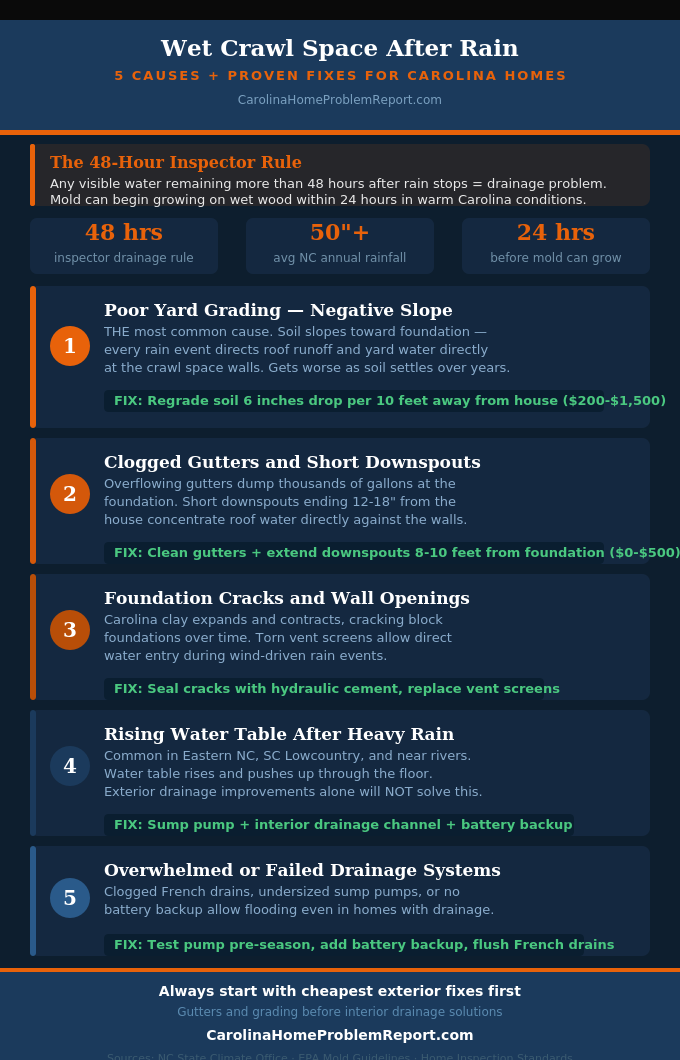
Home inspectors and crawl space professionals across the Carolinas use a consistent rule of thumb: any visible water that remains in a crawl space longer than 24 to 48 hours after rain stops is a drainage problem. Brief surface dampness immediately after an extreme rain event may not indicate a chronic issue. Puddles that persist for days do. This distinction matters because it separates a home that had a one-time event from a home with an ongoing drainage failure that will recur every time it rains significantly.
According to the NC State Climate Office, North Carolina receives over 50 inches of rainfall annually on average, with the heaviest events concentrated in the spring and tropical storm season running from June through November. This means Carolina crawl spaces are tested by significant rain events repeatedly throughout the year. A home that gets wet after every major rain is a home with a chronic drainage failure — not a home that is simply unlucky with weather.
The other critical number is 24 hours. The EPA's mold guidance states that mold can begin growing on wet building materials within 24 to 48 hours under warm, humid conditions. A crawl space that gets wet after rain in a Carolina summer — where temperatures regularly stay above 70°F even at night — is a crawl space where mold can establish a foothold before the water even fully drains. This is not a theoretical risk. It is why repeat flooding events compound in severity rather than staying constant.
Why Carolina Homes Get Wetter Than Most After Rain
A wet crawl space after rain is a problem in homes across the country, but Carolina homes experience it with particular frequency and severity for reasons specific to this region.
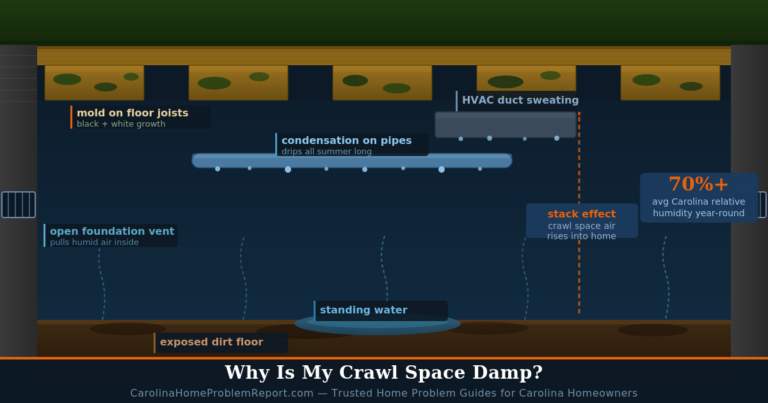
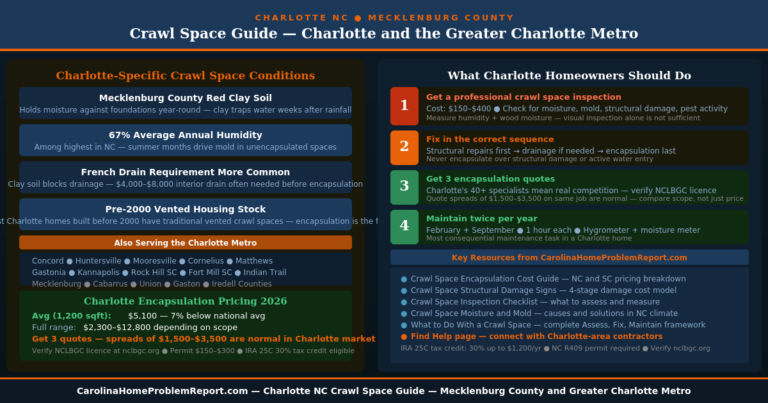
Clay soils hold water far longer than other soil types. The red clay soils that characterize the Carolina Piedmont — running from Charlotte through Raleigh and across the central portions of both states — have extremely low permeability. When these soils saturate during a rain event, they do not drain quickly. Water sits near the surface and pushes laterally against anything below grade — including crawl space foundations. A home in the Piedmont can have water pressing against its foundation for three to five days after a heavy rain event that would produce no lingering saturation in a sandier coastal soil.
Tropical weather systems produce extreme rainfall events. Carolina homeowners in both NC and SC live within reach of Atlantic hurricane season from June through November. Tropical systems — hurricanes, tropical storms, and their remnants — can drop 5 to 15 inches of rain in 24 to 48 hours. These events overwhelm drainage systems that function adequately during normal rain. A home with marginal drainage that barely manages typical storms can experience significant flooding after a tropical event.
Many Carolina homes were built before modern drainage standards. Homes built before the 1990s frequently lack gutters of adequate capacity, have downspouts that discharge close to the foundation, and were graded at initial construction but have since settled or eroded into configurations that direct water toward rather than away from the house. The combination of aging drainage infrastructure and Carolina's aggressive rainfall patterns is a reliable recipe for a wet crawl space after rain.
The coastal plain water table sits close to the surface. In Eastern North Carolina and the South Carolina Lowcountry, the water table sits only a few feet below grade in many areas. Heavy rain events raise the water table further, creating hydrostatic pressure that pushes water through the crawl space floor from below regardless of what drainage improvements have been made at grade level.
5 Reasons Your Crawl Space Gets Wet After Rain
One-Time Event or Chronic Problem? How to Tell the Difference
Not every wet crawl space after rain represents an equal level of urgency. Here is how to read your specific situation:
✓ Likely a one-time or low-priority event if:
- This is the first time you have noticed wetness after a genuinely extreme rain event (3+ inches in a few hours)
- The soil is damp but no standing water is visible
- The dampness resolves completely within 24-48 hours of the rain stopping
- You have not noticed this after previous normal rain events
⚠ Chronic drainage problem requiring action if:
- This has happened after more than one rain event — even different-sized ones
- Water remains visible for more than 48 hours after rain stops
- You see water staining, white efflorescence, or tide marks on foundation walls from previous events
- The crawl space smells musty even between rain events
- You can see mold on any wood surfaces
- The soil remains wet for days after the surrounding yard dries out
Post-Storm Inspection Checklist for Carolina Homeowners
After any significant rain event — particularly events of 1 inch or more — do this inspection within 24-48 hours while the evidence is fresh.
OUTSIDE THE HOME — Check these first, before entering the crawl space:
- Walk the foundation perimeter — is water pooling against the house anywhere?
- Check downspouts — are they clear and extending water away from the foundation?
- Look for erosion or splash damage on soil near the foundation
- Check yard grade — does the ground slope toward or away from the house?
- Look for saturated soil that has not drained 24+ hours after rain
INSIDE THE CRAWL SPACE — Bring a flashlight, wear old clothes and a dust mask:
- Is there visible standing water or wet soil anywhere on the floor?
- Where is the water located — near a specific wall, near a vent, in a low corner?
- Are foundation walls showing active moisture or fresh staining?
- Check vent screens for damage — torn or missing screens allow direct water entry
- Is the vapor barrier (if present) wet on top or underneath?
- Is the sump pump running? Did it run during the event? Is the pit empty now?
- Check floor joists for staining or soft spots near water entry points
Document with photos or video during the wet period — the evidence will be gone by the time a contractor comes for an estimate and the documentation helps with insurance claims.
Proven Fixes — From Cheapest to Most Comprehensive
Always start with the cheapest exterior fixes first. Interior drainage solutions are necessary for groundwater problems but should not be the first line of defense against surface water that proper exterior management would solve.
Clean gutters and extend downspouts (Free — $500). The lowest-cost intervention with the highest return for most homes. Clean gutters, add gutter guards, extend all downspouts to 6-10 feet from the foundation. Do this before anything else.
Regrade soil around the foundation ($200 — $1,500). Correct negative grade by adding and shaping topsoil to slope away from the house. This is DIY-accessible with a wheelbarrow and topsoil for smaller areas. For large or complex grading issues, a landscaper or contractor is needed.
Install a vapor barrier ($1,200 — $4,000). A 20-mil vapor barrier across the entire crawl space floor prevents ground moisture from evaporating into the space after rain saturates the soil. Even if surface water enters temporarily, a vapor barrier prevents the secondary moisture problem of soil evaporation continuing to raise humidity after the water drains.
Install or upgrade a sump pump ($800 — $3,000). Essential for groundwater intrusion and high water table situations. Add a battery backup system. Test the pump twice a year — once before storm season and once before hurricane season if you are in a coastal or Eastern NC location.
Install a French drain or exterior perimeter drainage ($1,500 — $8,000). For homes where surface and groundwater combine to overwhelm simpler solutions. A perforated pipe in a gravel-filled trench around the foundation perimeter collects water before it can push through foundation walls. This is the gold standard for chronic surface water problems on sites with poor natural drainage.
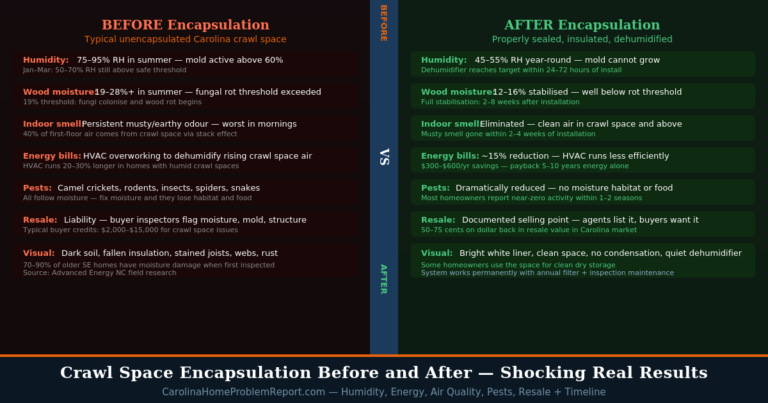
Full crawl space encapsulation ($1,500 — $15,000, avg $5,500). The most comprehensive solution for chronic moisture problems combining vapor barrier, sealed vents, interior drainage, and dehumidification into one system. Appropriate for homes with repeated flooding, visible mold or structural damage, or any situation where simpler fixes have not resolved the problem.
Frequently Asked Questions
Is it normal to have water in a crawl space after heavy rain?
Common, but not normal. A crawl space is designed to stay dry in all weather. Water after rain indicates a drainage, grading, or groundwater problem. Brief surface dampness that fully resolves within 24-48 hours after an extreme event may be a low-priority concern. Standing water that persists or recurs after multiple rain events is a problem requiring attention.
How long should a crawl space stay wet after rain?
No longer than 24-48 hours in a properly draining home. If water remains visible beyond 48 hours after rain stops, you have a drainage problem. In the Carolinas where mold can begin growing within 24-48 hours on wet wood under warm, humid conditions, this is not a wait-and-see situation.
Will fixing my gutters and grading stop my crawl space from getting wet after rain?
For most homes it will significantly improve the situation and may solve it completely. Surface water intrusion from roof runoff and yard drainage accounts for the majority of wet crawl space after rain problems in Carolina homes. Fix the exterior first before investing in interior drainage. If water persists after proper gutter and grading improvements the source is likely groundwater requiring a sump pump solution.
Should I be worried if my crawl space gets wet during tropical storms?
Yes. Tropical systems can overwhelm drainage that handles normal rain adequately — but a single tropical event that produces flooding does not mean your drainage is chronically inadequate for normal conditions. After any tropical event, do a thorough inspection for water damage, mold, and structural effects. If your crawl space flooded during a tropical event it needs to be dried out within 48 hours to prevent mold establishment.
How much does it cost to fix a wet crawl space after rain?
Costs range from free (cleaning clogged gutters yourself) to $15,000+ for full encapsulation with interior drainage. The right starting point is always the cheapest exterior intervention — gutters and grading — before considering interior solutions. Most homes with surface water intrusion problems see significant improvement from $200-$1,500 in exterior drainage corrections. Only if those do not solve the problem should interior drainage systems be considered.
A wet crawl space after rain is one of the most common calls crawl space contractors receive across North and South Carolina — and one of the most preventable. Carolina clay soils, aggressive tropical storm seasons, aging drainage infrastructure, and a naturally high water table in coastal and Eastern NC regions create conditions that make crawl space water intrusion frequent and sometimes severe. The homeowners who avoid expensive structural repairs are the ones who address it early, start with the cheapest exterior fixes first, and do not wait for a second or third wet crawl space event before acting.
If your crawl space has been wet after more than one rain event, or if water has remained for longer than 48 hours after rain stops, a professional inspection is the right next step. A qualified contractor can identify the entry points, assess any existing damage, and recommend the right system — starting with the least expensive exterior correction and adding interior drainage only where genuinely needed.
Find a Crawl Space Professional Near You →The Carolina Home Problem Report editorial team researches and writes guides for homeowners across North and South Carolina. Our research draws on NC State Extension Service publications, Clemson Extension resources, EPA guidelines, Building Science Corporation data, and insights from licensed Carolina contractors. We are not contractors — we are a research team dedicated to giving Carolina homeowners clear, locally specific, unbiased answers.
Carolina Home Problem Report is an informational resource for homeowners. We are not licensed contractors or mold assessors. Always consult a qualified professional before making home repair decisions. See our Disclaimer and Affiliate Disclosure.