Water Under House After Rain: Should You Worry? The 4 Entry Pathways NC and SC Homeowners Need to Know
⚡ QUICK ANSWERA small amount of surface moisture that drains within 1–2 hours after heavy rain is within normal range. Standing water that persists beyond 2 hours, returns after every moderate rain, or covers more than a small area is a drainage problem that needs to be identified and fixed. Left unaddressed, persistent water under the house in NC and SC leads to mold within 48–72 hours, wood rot within weeks, and structural damage within months.
Water under house after rain is one of the most common and most anxiety-inducing discoveries a Carolina homeowner can make — and the question every homeowner asks first is the right one: should I worry? The honest answer depends on how much water, how long it stays, and which of the four entry pathways brought it in. In NC and SC, where annual rainfall averages 46–50 inches and where red Piedmont clay soil holds water against foundations far longer than most soil types, finding moisture under the floor after heavy rain is common. Persistent standing water that does not drain within two hours is not.
The 2-Hour Rule — When Water Under the House Becomes a Problem
The 2-hour rule is a practical diagnostic: after a heavy rain event, check the crawl space. If you see moisture on the soil surface or a light dampness on the vapour barrier but the space is visibly draining and drying, monitor it. If you see standing water — actual pooling water that has not moved or reduced after two hours — that is a drainage failure requiring investigation. If you see standing water every time it rains moderately, not just after a tropical storm or hurricane, that is a persistent entry pathway that will not resolve without active intervention.
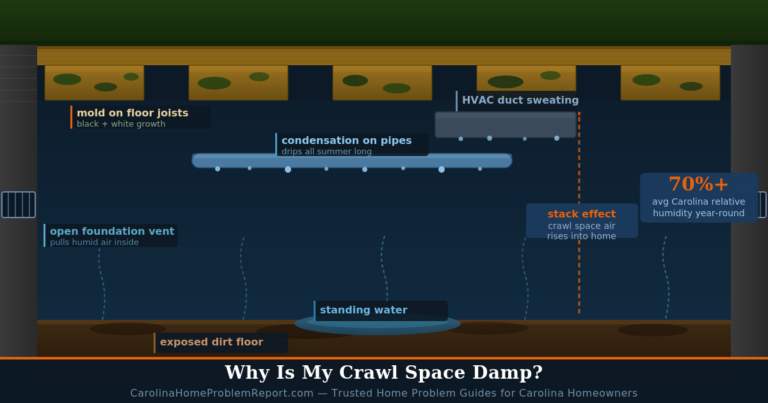
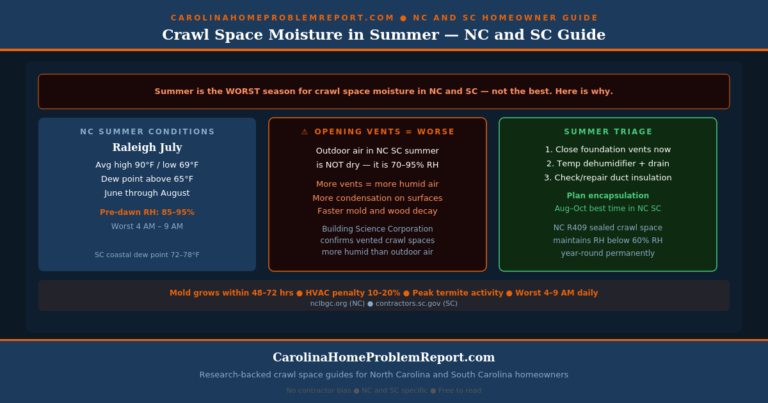
In the Carolinas, the stakes are higher than in dry climates because mold begins growing on wood surfaces within 48–72 hours in a wet crawl space during Carolina summer temperatures. What is a temporary inconvenience in Seattle can become structural damage in Charlotte or Raleigh within a single season.
The Four Entry Pathways
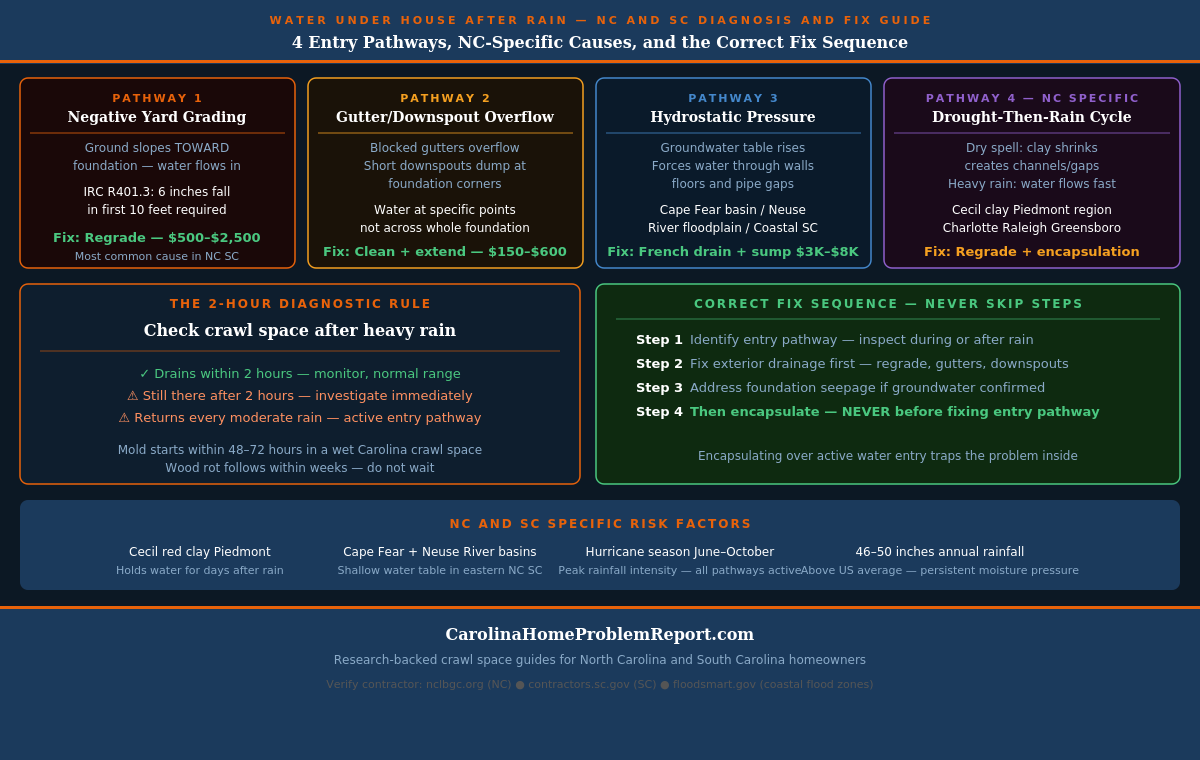
Pathway 1 — Surface water intrusion from negative yard grading. The most common cause of water under NC and SC homes after rain. Negative yard grading means the ground around the foundation slopes toward the house rather than away from it. The IRC 2021 Section R401.3 requires a minimum fall of 6 inches in the first 10 feet. The diagnostic signature is water that enters broadly at the base of foundation walls. The fix is regrading. Cost in NC: $500–$2,500.
Pathway 2 — Gutter and downspout overflow. Clogged gutters and short or missing downspout extensions are the second most common cause. The diagnostic signature is water that enters at specific corners of the house where downspouts terminate. The fix is cleaning gutters and extending downspouts a minimum of 6 feet from the foundation. Cost: $150–$600.
Pathway 3 — Groundwater table rise and hydrostatic pressure. After extended heavy rainfall during tropical storm systems and multi-day frontal events, the water table rises. When groundwater approaches footing level, it exerts hydrostatic pressure outward against the foundation. This is most common in the Cape Fear River basin around Fayetteville and Wilmington, the Neuse River floodplain around Raleigh and Clayton, and low-lying areas of the SC Coastal Plain. The fix is an interior perimeter drainage system with a sump pump. Cost in NC: $3,000–$8,000.
Pathway 4 — The drought-then-heavy-rain cycle. This is the most NC-specific and least understood entry pathway. During drought, red Piedmont clay soil contracts and shrinks, creating gaps and channels in the soil around the foundation. When heavy rain follows, water flows rapidly through these newly created channels directly to the foundation before the soil has time to re-expand. Homes that have never had water problems before can suddenly flood heavily after their first major rainfall following a dry period.
NC and SC Soil Conditions That Amplify the Problem
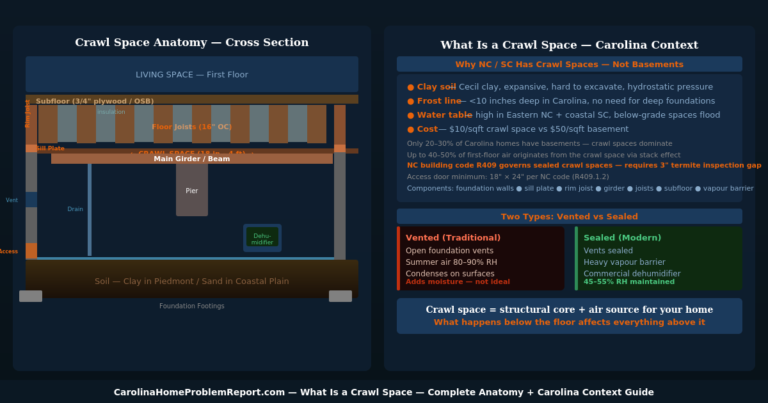
Piedmont red clay (Cecil clay series). The dominant soil across Charlotte, Raleigh, Greensboro, Durham, Winston-Salem, Greenville SC, Rock Hill, and Concord. Cecil clay has extremely low permeability when wet — it holds water against foundations for days after rain stops. It also swells significantly when wet and shrinks when dry, creating the drought-then-rain cycle vulnerability described above.
Coastal plain with high water table. The dominant soil across Wilmington, Fayetteville, Jacksonville, and much of eastern NC and SC. In many parts of coastal NC and SC, the water table sits only 2–4 feet below grade. After heavy rainfall during hurricane season, the water table can rise to crawl space floor level within hours of a major storm event.
The Correct Fix Sequence
✅ CORRECT SEQUENCE — NEVER SKIP STEPS: Step 1 — Identify the entry pathway. Step 2 — Fix exterior drainage first (regrade, gutters, downspouts). Step 3 — Address foundation seepage if groundwater is confirmed. Step 4 — Encapsulate only after active water entry is resolved. Encapsulating over active water entry traps the problem inside a clean-looking liner.
Cost Summary — Water Under House After Rain Fixes in NC and SC
| Entry Pathway | Fix | Cost Range NC SC |
|---|---|---|
| Negative yard grading | Regrade exterior soil | $500–$2,500 |
| Gutter/downspout overflow | Clean gutters, extend downspouts | $150–$600 |
| Groundwater/hydrostatic pressure | Interior French drain + sump pump | $3,000–$8,000 |
| Foundation wall cracks | Crack injection + waterproofing | $400–$2,000 per crack |
| Full solution — all pathways | Drainage + encapsulation | $5,000–$15,000 |
Related Guides
- Standing Water in Crawl Space — What to Do Step by Step
- Wet Crawl Space After Rain — Causes and Fixes
- Crawl Space Drainage Problems and Solutions
- Crawl Space Encapsulation Cost Guide NC SC
- What Causes Crawl Space Moisture?
- Complete Crawl Space Guide — NC and SC
Carolina Home Problem Report provides general educational information for NC and SC homeowners. We are not licensed contractors. Check flood zone status at floodsmart.gov before any coastal property work. Verify contractor licences at nclbgc.org (NC) or contractors.sc.gov (SC). See our Disclaimer.