The Complete Humidity & Air Quality Glossary: 35 Terms, 4 Pillar Hubs, and All 42 Articles
This humidity and air quality glossary defines the 35 terms Carolina homeowners run into most often — from relative humidity and short-cycling to ERV, MERV rating, and Manual J calculation — and links each one straight to the in-depth article on this site that covers it.
Below the glossary, you'll find our 4 pillar hub guides, and then a complete index of all 42 Humidity & Air Quality articles currently live on Carolina Home Problem Report, organized by pillar, so nothing gets missed.
- ✓35 core humidity and air quality terms are defined here in plain language, each linked to the full article that covers it in depth
- ✓4 pillar hub guides cover the full category: House Humidity, Indoor Air Quality, Home Humidity Control Systems, and HVAC Moisture & Comfort
- ✓This page indexes all 42 Humidity & Air Quality articles currently published on the site, grouped by pillar
- ✓Definitions and links were compiled against our own verified article production records on October 3, 2026, not from memory
- ✓Use this page as a starting point when you don't yet know the term for what you're dealing with, or as a directory when you already know the topic
How to Use This Glossary
This page is organized in three layers, from general to specific. Start with the glossary if you're not yet sure what to call the problem you're looking at — each definition is short, plain-language, and points you to the one article that goes deep on that specific topic. If you already know you want the full picture on a broader topic — humidity, indoor air quality, dehumidifiers and ventilation, or HVAC moisture and comfort — skip to the pillar hub guides. And if you want to see everything at once, organized by pillar instead of alphabetically, the complete article index at the bottom lists all 42 articles in four groups.Glossary: A–Z
These are the 35 terms that come up most often across our humidity and air quality coverage — moisture, ventilation, HVAC, and indoor-air terminology a Carolina homeowner is likely to hit while researching a problem or reading a technician's diagnosis.The actual mass of water vapor in a given volume of air, regardless of temperature — different from relative humidity, which is a percentage that changes as temperature changes. Read more: why your house is humid in the first place.
A measure of how many times the entire volume of air in a space is replaced with outside air in one hour — the standard metric ASHRAE uses to define adequate ventilation. Read more: how ventilation rate determines indoor air quality.
The indoor component of a split HVAC system that houses the blower fan and evaporator coil and circulates conditioned air through the ductwork — a common hidden source of condensate and refrigerant issues. Read more: where HVAC moisture and comfort problems actually hide.
Dust mite debris, pet dander, mold spores, and pollen that accumulate indoors and trigger allergy or asthma symptoms — often worsened by excess humidity or poor ventilation. Read more: the most common indoor allergy triggers and how to reduce them.
Soffit and ridge vents, or powered attic fans, that keep humid air from accumulating under the roof deck where it can condense and feed mold. Read more: attic ventilation requirements for NC and SC homes.
Elevated indoor CO2, mostly from human breathing in a poorly ventilated room, linked to drowsiness and reduced concentration well before it becomes a safety concern. Read more: what CO2 levels in your home actually mean.
The line that carries moisture an AC pulls from the air away from the unit — one of the most common, most overlooked causes of both reduced dehumidification and water damage when it clogs. Read more: what to do about a condensate drain line clog.
The ongoing electricity cost of operating a dehumidifier, which varies dramatically with unit size, run time, and whether it's correctly sized for the space. Read more: real-world dehumidifier running costs.
The rated moisture-removal capacity of a dehumidifier, measured in pints per day, which must match square footage and current humidity load — guessing from a box label is the single most common costly mistake. Read more: how to size a dehumidifier correctly.
The temperature at which air becomes fully saturated and releases its moisture as condensation — what actually causes window and duct sweating. Read more: why condensation forms on windows and what it means.
Conditioned air escaping into an attic or crawl space before reaching its intended room, wasting capacity and creating the room-to-room comfort imbalance homeowners notice. Read more: how duct leaks drive humidity and comfort problems.
A balanced ventilation system that exchanges stale indoor air for fresh outdoor air while recovering energy and transferring some humidity between the two air streams. Read more: ERV vs. HRV ventilation compared.
Bathroom and kitchen fans that remove moisture at the source before it spreads through the house — genuine humidity-control equipment, not just odor control. Read more: bathroom ventilation fans explained.
A high-efficiency particulate air filter capable of capturing at least 99.97% of particles down to 0.3 microns — used in standalone air purifiers rather than typical HVAC return filters. Read more: choosing an air purifier for mold spores.
A balanced ventilation system similar to an ERV, but one that transfers only heat between air streams, not humidity — the better choice in some climates and seasons. Read more: when an HRV beats an ERV.
A control that lets a dehumidifier run independently of the thermostat, based on a target relative humidity rather than temperature. Read more: how whole-home dehumidifiers use a humidistat.
The energy an AC removes by condensing moisture out of the air, separate from the sensible heat it removes by lowering temperature — why a system can cool a room without actually drying it. Read more: why your house stays humid even with the AC running.
The industry-standard method for sizing HVAC equipment to a home's actual heating and cooling load — the correct alternative to a rule-of-thumb estimate, which the Department of Energy flags as the root cause of most oversizing problems. Read more: HVAC sizing problems and why Manual J matters.
A 1-20 scale rating how effectively an HVAC air filter captures particles — a higher number isn't automatically better, since a filter rated beyond what your system was designed for can restrict airflow. Read more: how your HVAC system affects indoor air quality.
The relative humidity level — generally sustained humidity above roughly 60% — at which mold growth on indoor surfaces and wood framing becomes a realistic risk. Read more: exactly what humidity level causes mold.
Microscopic mold reproductive particles (spores) and the compounds (mycotoxins) some molds produce, both of which can become airborne and affect indoor air quality. Read more: how mold affects your indoor air quality.
A condition where exhaust fans or a leaky envelope pull more air out of a house than enters it, which can pull combustion gases from fuel-burning appliances back into the living space. Read more: how crawl space air pressure affects indoor air quality.
A system with more cooling capacity than the home actually needs, which satisfies the thermostat too quickly to run long enough to dehumidify the air properly — one of the single biggest causes of a cold, clammy house. Read more: oversized AC humidity problems.
Airborne solid and liquid particles classified by size (PM2.5, PM10) that can come from dust, pollen, smoke, or combustion sources and affect respiratory health indoors. Read more: what's actually causing dust in your house.
A standalone unit that dehumidifies a single room or zone, lower in upfront cost than a whole-home system but limited in coverage — the right call for an isolated problem room rather than the whole house. Read more: portable vs. whole-home dehumidifiers compared.
The amount of moisture in the air expressed as a percentage of the maximum the air could hold at that temperature — the number most humidity targets and problems are actually measured in. Read more: what counts as high indoor humidity.
The predictable rise and fall of indoor humidity levels across the year, driven by outdoor temperature and moisture — summer in the Carolinas is the single hardest season for most homes' systems to keep up with. Read more: why summer humidity inside the house is worse.
An HVAC system turning on and off far more frequently than it should, usually from oversizing — the Department of Energy identifies this as a leading cause of comfort and efficiency problems. Read more: what causes HVAC short-cycling and how to fix it.
A cluster of symptoms — headaches, fatigue, irritated eyes or throat — that occupants experience while inside a specific building and that improve after leaving it, pointing toward an indoor air quality cause. Read more: poor indoor air quality symptoms to watch for.
The tendency of warm, moist air to rise through a house and escape at the top, pulling replacement air (often humid crawl space air) up from below — a major reason upstairs rooms run hotter and more humid. Read more: why upstairs is hotter and more humid than downstairs.
The resistance air meets as it moves through ductwork — when leaks or poor duct design push it outside the range equipment was designed for, both airflow and dehumidification suffer across the whole house. Read more: how duct problems affect static pressure and humidity.
The feeling of a house that's "at temperature" on the thermostat but still feels damp or sticky — almost always a dehumidification problem, not a temperature problem. Read more: why your house feels sticky even when it's cool.
Gases emitted from paints, furniture, cleaning products, and building materials that contribute to stale, chemical-smelling indoor air and can affect health at sustained exposure. Read more: what's actually causing stale air in your home.
A unit installed directly into HVAC ductwork that dehumidifies the entire house automatically, running independently of the thermostat on its own humidistat — the right call when humidity is a whole-house problem. Read more: how whole-home dehumidifiers work.
The percentage of water weight in wood relative to its dry weight — elevated levels cause flooring to cup, gap, or warp, and sustained high levels invite rot and mold. Read more: how humidity affects wood floors.
The 4 Pillar Hub Guides
Each pillar of this category has its own comprehensive hub guide (2,800+ words) that covers the full breadth of that topic and links down to every cluster article underneath it:| Pillar Hub | What It Covers |
|---|---|
| House Humidity Problems | Causes, signs, and fixes for high indoor humidity — 12 cluster articles. |
| Indoor Air Quality Problems | Dust, allergens, VOCs, mold, and ventilation's role in indoor air — 11 cluster articles. |
| Home Humidity Control Systems | Dehumidifiers and ventilation equipment compared — 10 cluster articles. |
| HVAC Moisture and Comfort Problems | Short-cycling, sizing, drainage, and airflow problems — 9 cluster articles. |
Complete Article Index (All 42 Articles)
Every Humidity & Air Quality article currently published on Carolina Home Problem Report, grouped by pillar. This list was built from our own verified article production and delivery records as of October 3, 2026, cross-checked against the original site silo architecture so nothing is missed or duplicated.
- Why Is My House So Humid
- High Indoor Humidity
- Humidity Even With AC
- Condensation on Windows
- Humidity Upstairs Hotter
- Summer Humidity Inside House
- What Humidity Level Causes Mold
- Humidity and Wood Floors
- How to Reduce Home Humidity
- Signs House Is Too Humid
- Humidity and Allergies
- Crawl Space Affecting Upstairs Humidity
Key Facts for Carolina Homeowners:
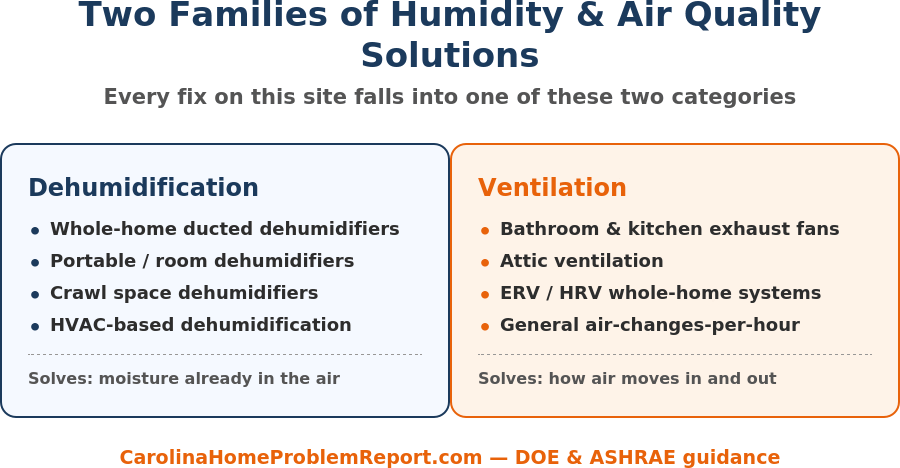
- The Carolinas' humid subtropical climate makes dehumidification, not just cooling, a genuine year-round concern — see our home humidity control systems guide for the full equipment landscape
- If you don't know where to start, the House Humidity Problems and Indoor Air Quality Problems hubs are the two most useful entry points
- This index reflects every Humidity & Air Quality article published on the site as of October 3, 2026 — bookmark this page, as it's the most complete single map of our humidity and air quality coverage
Methodology & Sources
The article count and links on this page were compiled against our own verified production and delivery records for the Humidity & Air Quality category, cross-referenced against the original site silo architecture to confirm nothing was missed and nothing was duplicated. That gave a verified total of 42 cluster articles across 4 pillars, plus the 4 pillar hub guides themselves. Term definitions reflect standard building-science, HVAC, and indoor-air-quality terminology, adapted to plain language, and each links to the specific article on this site that treats that topic in the most depth.Frequently Asked Questions
No. Each pillar hub (like House Humidity Problems) is a standalone, comprehensive guide to that pillar's topic. This glossary page is a reference tool — it defines terms and indexes every article in the category, including the hub guides themselves, so you can jump directly to the specific topic you need.
Crawl space moisture is one of the most common root causes of upstairs humidity and indoor air quality problems, so a few cluster articles (like Crawl Space Affecting Upstairs Humidity) genuinely bridge both categories. They're included here because the humidity or air-quality angle is the article's primary focus.
Yes — this page is designed to be the living index for the category, so new Humidity & Air Quality articles should be added to the relevant pillar group here going forward.
Use the glossary above to find the term closest to your situation, click through to that article, and start there. If you're not sure which pillar your problem belongs to, start with whichever pillar hub guide sounds closest and its own navigation will point you the rest of the way.
We research and verify home-problem solutions specific to Carolina homes and climate, so you can fix issues right the first time — or know exactly what to ask a pro before you hire one.
This glossary is for general informational purposes. Term definitions reflect common building-science, HVAC, and indoor-air-quality usage; always confirm specific equipment sizing or diagnosis with a licensed HVAC contractor before work begins.