AC Short Cycling:11 Causes, and How to Tell Which One You Have
AC short cycling means your system turns on, runs for only a few minutes, and shuts off again — repeatedly — instead of completing a normal 10-20 minute cooling cycle. An oversized system is one cause, but it's far from the only one: a dirty air filter, a failing capacitor, low refrigerant, a frozen evaporator coil, or a misplaced thermostat can all produce the identical symptom. The fix depends entirely on which cause is behind it, which is why "just replace the unit" is often the wrong first answer.
- ✓Normal AC cycles run 10-20 minutes; short cycling means 3-5 minutes or less, repeated over and over
- ✓At least 8 distinct mechanical and electrical causes can produce short cycling, from a $20 air filter to a failing $200 capacitor to a genuinely oversized system
- ✓A humming outdoor unit that won't start is a specific signature of a failing capacitor — not the same problem as an oversized system that starts fine but stops too soon
- ✓Homeowners on HVAC forums consistently worry short cycling means a huge electric bill — but the more immediate risk is compressor wear, since most starts draw far more current than steady running
- ✓Several causes are homeowner-checkable in under 5 minutes before you call anyone
A real homeowner thread on this exact problem describes the system running "for about 10 minutes then cuts off for about 15 minutes and repeats that cycle" — and the immediate worry was a "$300 light bill." That instinct (short cycling = expensive) is common, but it points at the wrong risk first. We've already covered one specific cause of AC short cycling in detail — oversized AC and humidity problems, where an oversized system cools too fast and shuts off before pulling enough moisture out of the air. That article treats short cycling as a symptom of one specific cause. This one is different: it's the full diagnostic guide to short cycling as its own problem, covering every mechanical and electrical cause behind the same symptom, so you know which one you're actually dealing with before you call anyone or spend anything.
What Counts as Short Cycling
A healthy central AC system typically runs a full cooling cycle of 10 to 20 minutes before shutting off, then stays off for a stretch before starting again — the exact timing depends on outdoor temperature, humidity, and how well the house holds its cooling. Short cycling means that pattern breaks down: the system starts, runs for roughly 3 to 5 minutes, shuts off, and starts again shortly after — over and over, sometimes dozens of times a day. If your system is doing that, something specific is interrupting a normal cycle before it finishes, and the rest of this guide is about figuring out what.
It's worth being precise here because "my AC cycles a lot" isn't automatically a problem. A system that runs a full 10-20 minute cycle and then rests for a while, repeated several times over a hot afternoon, is working exactly as designed. The distinction that matters is cycle length, not cycle frequency — a system that's genuinely short cycling is cutting cycles short, not just running several full-length ones.
Every Cause of Short Cycling, Ranked by How Often It's the Answer
Short cycling is a symptom, not a diagnosis — the same on/off pattern can come from a $20 fix or a $4,000 one. Here's the full list, starting with what's most likely to be the actual cause in a typical home:
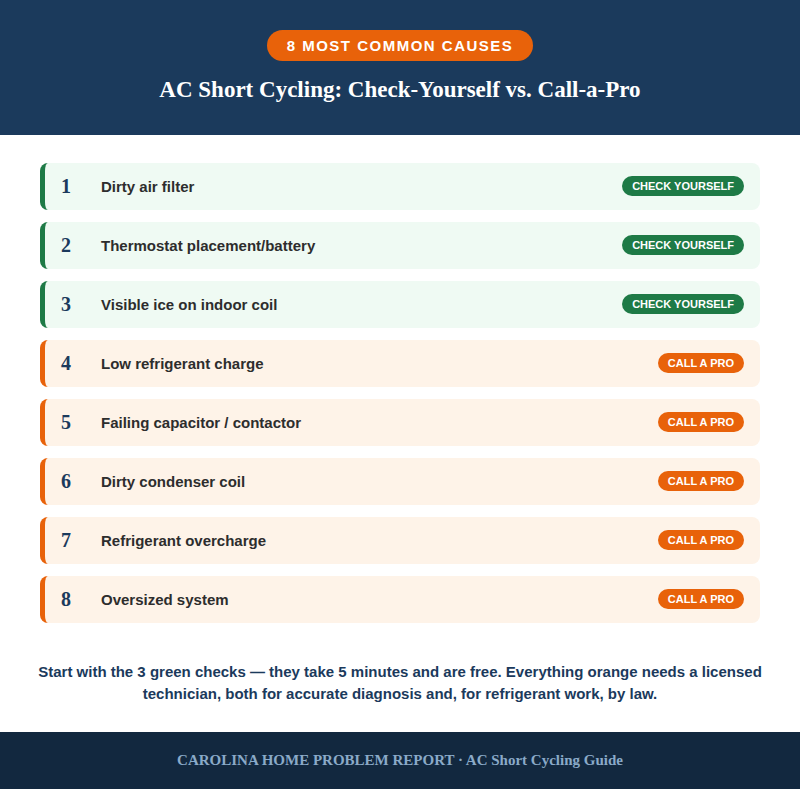
- Dirty or clogged air filter. A loaded filter restricts return airflow across the evaporator coil. Airflow drops, the coil gets colder than it should, and in more severe cases it can ice over — which itself trips a safety shutdown. This is the single most common, and most homeowner-fixable, cause.
- Frozen evaporator coil. Often the downstream result of a dirty filter or low airflow elsewhere, but it can also follow from low refrigerant. Once ice forms on the coil, both airflow and refrigerant flow get blocked, and the system shuts down on a protective switch before completing a cycle.
- Low refrigerant charge. Refrigerant that's leaked out over time reduces the system's ability to absorb heat, which creates abnormal pressure readings. The system's own safety controls cut it off early rather than let it run in that state — this one requires a licensed technician, both to find the leak and to legally handle refrigerant.
- Faulty or misplaced thermostat. A thermostat near a sunny window, a supply vent, or another heat source reads the wrong temperature and tells the system it's satisfied long before the room actually is — or the reverse. Relocating it, or replacing an old mechanical unit with an electronic one, is often a same-day, homeowner-level fix.
- Dirty condenser coil (outdoor unit). Dirt, grass clippings, and pollen on the outdoor coil reduce how well the system can reject heat. Discharge pressure climbs, and a high-pressure safety switch shuts the compressor down before the cycle finishes.
- Failing capacitor or contactor. An electrical component issue, not a refrigerant or airflow one — covered in detail in the next section, because its symptoms are distinct enough to be worth calling out separately.
- Refrigerant overcharge. Less common than being low, but too much refrigerant elevates both suction and discharge pressure and can trip the same high-pressure safety switch as a dirty condenser coil — another technician-only diagnosis.
- Oversized system. Covered in full in our oversized AC humidity problems guide: a system with more cooling capacity than the house needs satisfies the thermostat too quickly, before it's run long enough to remove much humidity. The fix here isn't a repair — it's a correctly-sized replacement, which is also the subject of our HVAC sizing problems guide if you're facing that decision.
A pressure switch malfunction, compressor overheating, and a failed metering device (the thermostatic expansion valve or fixed orifice that meters refrigerant flow) round out the full technical list, but all three are technician-diagnosis-only and comparatively rare in a residential system that's had regular maintenance.
The Electrical Causes: Capacitors and Contactors
A failing capacitor deserves its own section because its symptoms are genuinely different from a refrigerant or airflow problem, and it's a common enough failure that it's worth knowing the signature. A capacitor's job is to deliver a steady jolt of power to start the compressor and fan motor, then keep their power supply stable through the run. A weakening capacitor can't do that reliably — the compressor struggles to start, or starts and then loses stable power partway through, and the system cycles off rather than run through a normal cycle.
The specific signs that point to a capacitor rather than another cause: a humming noise from the outdoor unit when it tries to start (the motor is getting some power but can't turn), a noticeably slow or delayed start, and — if you can safely see the unit — visible damage on the capacitor itself, such as a swollen or bulging top, oil residue, or burn marks. By contrast, a thermostat problem tends to produce consistent, predictable cycling regardless of the outdoor unit's condition, and an airflow restriction (like a dirty filter) usually shows up as reduced cooling output rather than a startup struggle. A technician can confirm a capacitor failure definitively with a multimeter in a few minutes.
A failing contactor — the electrical switch that actually applies power to the compressor and outdoor fan — produces a related but distinct problem: pitted or worn contactor points create an unreliable connection, which can cause the same kind of on/off instability. Neither the capacitor nor the contactor is something to test or replace yourself; both carry a real electrical shock and arc-flash risk, which is why every source on this topic treats them as technician-only repairs even though the parts themselves are inexpensive.
What You Can Check in 5 Minutes
Before calling anyone, three things are safe and quick to check yourself:
- Pull the air filter and hold it up to a light. If you can't see light through it clearly, replace it. This alone resolves a meaningful share of short-cycling complaints.
- Check the thermostat's location and settings. Is it on an interior wall, away from windows, supply vents, lamps, or the TV? Are the batteries fresh (if it's battery-powered)? A misreading thermostat is one of the easiest fixes on this whole list.
- Look at the indoor unit for ice. If you can see frost or ice on the refrigerant lines or the coil itself, turn the system off completely (not just down) and let it thaw fully before running it again — running a frozen system can damage the compressor. Ice is a sign of either an airflow problem (check the filter first) or a refrigerant problem, and if it comes back after a fresh filter, it's time to call a technician.
Everything past this point — refrigerant level, capacitor and contactor condition, pressure switch calibration, condenser coil cleaning, and a genuine sizing evaluation — needs a licensed HVAC technician, both for accurate diagnosis and, in the case of refrigerant work, because it's legally required.
Why Short Cycling Costs More Than the Electric Bill
The instinct homeowners have — that short cycling means a scary electric bill — isn't wrong, but it's not the main risk. A compressor draws significantly more current in the moment it starts than it does during steady running, which is exactly why a system that's constantly stopping and restarting puts more mechanical and electrical stress on the compressor than one running normal, complete cycles. Over time, that's the more expensive consequence: accelerated wear on the single most expensive component in the system, not just a marginally higher utility bill from one summer of short cycling. If your system also runs through a crawl space, a short-cycling AC that never completes a full dehumidification cycle can compound directly with the moisture issues we cover in crawl space moisture and HVAC.
Key Facts for Carolina Homeowners:
- Check the air filter and thermostat placement first — both are free, safe, 5-minute checks
- A humming outdoor unit that won't start points to a capacitor, not oversizing or refrigerant
- Ice on the indoor coil means turn the system off and let it thaw before running it again
- If short cycling started right after a new system was installed, oversizing is worth checking first — see our dedicated guide
Frequently Asked Questions
No — oversizing is one of at least 11 documented causes, and it's really only the likely answer if the short cycling started right after a new system was installed and every basic check (filter, thermostat, visible ice) comes back clean. See our oversized AC humidity problems guide for that specific diagnosis.
Left unaddressed, yes — the repeated high-current starts put more wear on the compressor than normal, complete cycles do, and the compressor is the most expensive single component to replace. The sooner the actual cause is identified and fixed, the less cumulative wear it causes.
That specific symptom — humming without starting — is a fairly reliable sign of a failing capacitor. The motor is receiving some power but can't get enough of a starting jolt to actually turn. This isn't a DIY repair; call a licensed technician, who can confirm it with a multimeter in a few minutes.
Yes. Turn the system off completely (not just adjust the thermostat) and let the ice fully thaw — that can take several hours — before running it again. Running a system with a frozen coil can push liquid refrigerant into the compressor and cause serious damage. Check the air filter while it thaws, since a dirty filter is the single most common cause of a frozen coil.
We research and verify home-problem solutions specific to Carolina homes and climate, so you can fix issues right the first time — or know exactly what to ask a pro before you hire one.
This article is for general informational purposes and is not a substitute for an on-site HVAC evaluation. Refrigerant, electrical, and pressure-switch diagnostics require a licensed HVAC technician.