Why Is My House Humid Even With the AC Running?
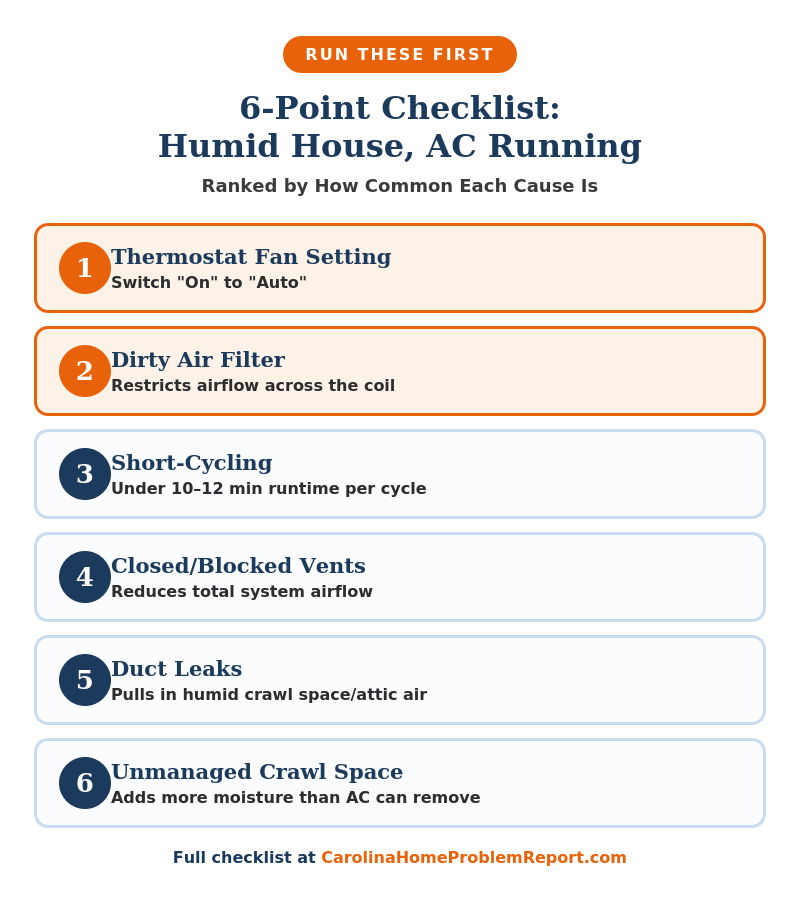
Getting humidity even with AC running? The most common cause by far is your thermostat fan setting — set to "On" instead of "Auto," it blows air across a wet, moisture-laden coil even when the compressor isn't cooling, pushing that moisture right back into your home. Beyond that, a dirty filter, an oversized system that short-cycles, or an unmanaged crawl space are the next most likely culprits. Work through the checklist below before assuming you need a new AC.
⭐ Key Takeaways
- ✓Setting the thermostat fan to "On" instead of "Auto" is the single most common, and most fixable, cause of this exact complaint — it costs nothing to check
- ✓A system that reaches your set temperature in under 10–12 minutes and shuts off is likely short-cycling — too little runtime to remove meaningful moisture
- ✓A clogged air filter restricts airflow across the coil, reducing how much moisture the system can pull from the air per cycle
- ✓An AC that is cooling correctly can still leave a house humid — temperature and humidity are related but separate jobs the system has to do
- ✓If every check below comes back clean, an unmanaged crawl space is the next place to look — it can add more moisture than a properly running AC can remove
This is a specific and common complaint: the AC is on, it's cooling the house to the right temperature, and the house still feels sticky and humid. It's a different problem from a house that's humid because the AC isn't running enough or is too small — here the system is clearly working, just not on the humidity side. This guide is a step-by-step checklist to run through before assuming the fix is a new or bigger AC unit, which in most cases it isn't.
If you haven't confirmed your actual humidity number yet, or want the full picture of what typically drives humidity in a Carolina home, our guide on why houses run humid in NC and SC is worth reading alongside this one. This guide assumes you've already confirmed the humidity problem and want to know specifically why it persists despite the AC running.
In This Article
The 6-Point Checklist
Work through these in order — they're ranked by how often each one turns out to be the actual cause.
When the Checklist Points to a Professional
✅ You've likely solved it yourself if:
- The fan was set to "On" and switching to "Auto" drops humidity within a day or two
- A new filter noticeably improves airflow and comfort
- Opening blocked vents resolves uneven humidity between rooms
⚠️ Call an HVAC technician if:
- The system consistently short-cycles under 10 minutes even with a clean filter and fan set to Auto
- You suspect duct leaks in the crawl space or attic
- The system is more than 10–12 years old and struggles with both temperature and humidity
- Refrigerant charge is a possibility — low refrigerant reduces both cooling and dehumidification capacity
What a Dehumidifier Adds That AC Alone Can't
An air conditioner is designed primarily to cool, with dehumidification as a side effect of that process. A dedicated dehumidifier is designed to do one job well, and can run independently of the thermostat's temperature setpoint — useful in shoulder-season weather (mild temperatures, still humid) when the AC doesn't need to run much but humidity is still a problem. If your checklist above comes back clean and the AC is functioning correctly, a dedicated dehumidifier — sized to the space, whether that's a single room or the crawl space feeding the whole house — fills that specific gap rather than replacing a working AC system. For consequences of leaving high humidity unaddressed and a full ranked fix guide, see our high indoor humidity guide.
Frequently Asked Questions
Should my thermostat fan be set to "On" or "Auto"?
"Auto" in a humid climate like North or South Carolina. "On" keeps the blower running continuously, which re-evaporates moisture off the coil between cooling cycles and pushes it back into your home — the opposite of what you want when humidity is the concern.
Does a bigger, more powerful AC unit fix this?
Usually not, and it often makes short-cycling worse. A larger unit cools the space faster, meaning shorter run cycles — and dehumidification happens over the course of a run, not in the first few minutes. If short-cycling is already the issue, a bigger unit compounds it.
How do I know if my AC is short-cycling?
Time it. Listen for the compressor (the loud outdoor unit) turning on and off, and note the minutes between. Consistently running under 10–12 minutes per cycle, especially on a hot day, is a strong sign of short-cycling.
Is it normal for a house to feel humid right after the AC turns off?
A brief return to slightly higher humidity right after a cooling cycle ends is normal. A house that feels persistently humid throughout the day despite regular AC cycling is not — that pattern points to one of the six checklist items above rather than normal system behavior.
Key Facts About a Humid House With the AC Running:
- The thermostat fan setting ("On" vs "Auto") is the single most common and most fixable cause of this exact complaint.
- A cooling cycle under 10–12 minutes is a sign of short-cycling — not enough runtime to meaningfully dehumidify.
- A dirty filter or closed vents both reduce airflow across the coil, cutting how much moisture the system removes per cycle.
- An AC that cools correctly can still leave a house humid — the two jobs are related but separate.
- If all six checklist items come back clean, an unmanaged crawl space is the next most likely whole-house source.
Work through the checklist in order before assuming you need a new AC system — in most Carolina homes, the fix is a thermostat setting or a $15 filter, not a new unit.
Find an HVAC Professional Near You →The Carolina Home Problem Report editorial team researches and writes guides for homeowners across North and South Carolina. Our research draws on ACCA HVAC industry guidance, U.S. Department of Energy home energy guidance, and insights from licensed Carolina HVAC contractors. We are not contractors or HVAC technicians — we are a research team dedicated to giving Carolina homeowners clear, locally specific, unbiased answers.
Carolina Home Problem Report is an informational resource for homeowners. We are not licensed contractors or HVAC technicians. Always consult a qualified professional before making home repair decisions. See our Disclaimer and Affiliate Disclosure.