AC Not Removing Humidity? The Airflow Setting Most Homeowners Never Check
If you've already checked the thermostat fan setting, air filter, and vents and your AC is still not removing humidity, the next thing to check is your evaporator airflow-to-tonnage ratio (CFM per ton). The industry baseline is around 400 CFM/ton, but humid climates like the Carolinas deliberately run lower than that to remove more moisture — a system left at a generic, dry-climate default will cool the air fine while leaving far more humidity behind than a properly climate-matched setup. This is a professional calibration, not a DIY setting, and it's distinct from a clogged filter, which reduces airflow in an uncontrolled, worsening way.
⭐ Key Takeaways
- ✓The industry design baseline is around 400 CFM per ton of cooling capacity — a starting point, not a fixed rule
- ✓Humid climates deliberately run below 400 CFM/ton on purpose, to remove more moisture from the air
- ✓This is a controlled, professional calibration — different from a clogged filter, which is an uncontrolled restriction that worsens over time
- ✓Airflow set too low risks coil icing — a visible warning sign that it's gone past the useful range
- ✓Even correctly tuned airflow doesn't eliminate the AC's separate 50-70% dehumidification ceiling — it only narrows the gap
This is the next step after the basic troubleshooting checklist in our humidity even with AC guide (fan setting, filter, short-cycling, vents, duct leaks) — if you've already worked through that list, this article covers a deeper, more technical cause.
For the separate structural limit every AC runs into regardless of airflow tuning, see our guide to HVAC dehumidification and the 50-70% ceiling.
In This Article
- The Airflow-to-Tonnage Ratio Most People Have Never Heard Of
- Why Humid Climates Need Less Airflow, Not More
- Why This Is Different From a Clogged Filter
- How This Gets Adjusted
- What to Ask an HVAC Technician
- A Sign Your Airflow Might Already Be Too Low
- Where the Ceiling Still Applies
- Frequently Asked Questions
The Airflow-to-Tonnage Ratio Most People Have Never Heard Of
If you've already checked the usual culprits — thermostat fan setting, a clean air filter, open supply vents — and your AC not removing humidity problem persists, there's a deeper, more technical cause worth understanding: how much air is actually moving across your evaporator coil per ton of cooling capacity. HVAC trade-education resource HVAC School explains the underlying relationship between airflow and moisture removal directly: "coil temperature decreases because less overall heat is being picked from the air" when airflow across the evaporator coil drops, and that colder coil "drops further below the dewpoint, causing more moisture to be removed from the air, increasing dehumidification." The industry design baseline is around 400 CFM per ton of cooling capacity — but that number is a starting point, not a fixed rule.
Why Humid Climates Need Less Airflow, Not More
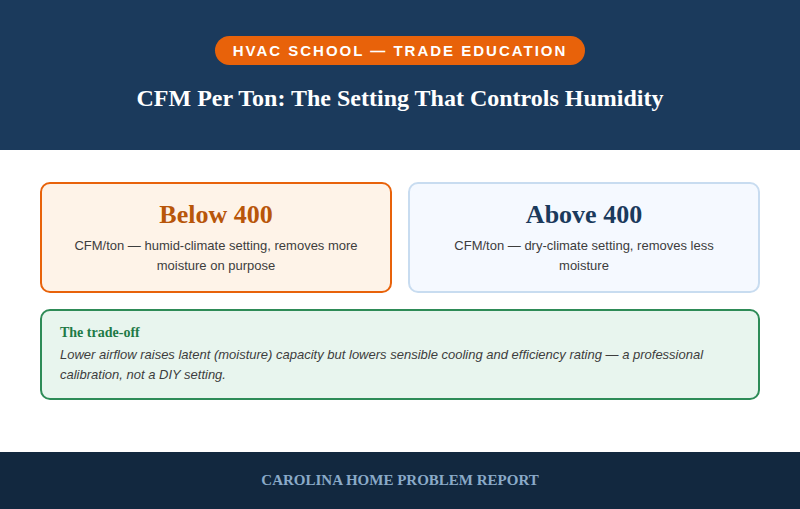
Here's the counter-intuitive part: the fix for poor dehumidification usually isn't more airflow across the coil, it's less. The guidance is explicit that this is a deliberate design choice technicians make for climate: "areas with higher latent (humidity) load will run lower than 400 CFM/ton on purpose to remove more moisture from the air, and areas with arid (dry) climates will often run higher than 400 CFM/ton to remove less or no moisture from the air." A system installed with a generic, dry-climate airflow setting in a humid Carolina home will cool the air just fine while leaving far more moisture behind than a properly climate-matched setup would.
Why This Is Different From a Clogged Filter
This is where the distinction from basic troubleshooting matters. A dirty air filter also reduces airflow across the coil — and by the same physics, it can temporarily seem to improve dehumidification. But an uncontrolled restriction isn't the same as a deliberately engineered one: a clogged filter keeps reducing airflow further over time, eventually dropping coil temperature low enough to freeze the coil entirely, which then blocks airflow completely and can damage the compressor. The airflow setting that actually helps with humidity is a controlled, professionally set blower speed or duct design — not an accident of neglected maintenance.
How This Gets Adjusted
On most residential systems, evaporator airflow is set by blower motor speed taps (on older PSC motors) or programmed blower profiles (on variable-speed electronically commutated motors), along with the duct system's overall static pressure and design. This isn't a DIY adjustment — set it too low and you also reduce sensible cooling capacity and risk coil icing if it's dropped without also accounting for the system's total design. It's a calibration a technician makes deliberately, informed by your specific climate and duct system, not a setting to guess at.
What to Ask an HVAC Technician
If your system is cooling correctly but humidity still lingers after ruling out the causes covered in our humidity-even-with-AC guide (fan setting, filter, short-cycling, vents, duct leaks), ask specifically whether your system's CFM-per-ton was set for a humid climate or left at a generic default. This is a legitimate, answerable question a qualified technician can check with airflow measurement tools — it's not the same as asking them to simply "make the AC dehumidify more."
A Sign Your Airflow Might Already Be Too Low
Airflow tuning for humidity has a real lower limit, and it's worth knowing the warning signs of going past it. If your system's coil ever visibly frosts or ices over — even partially, even briefly — that's not a sign the setting is working well for dehumidification; it's a sign airflow has dropped far enough that the coil temperature fell below freezing rather than just below the dewpoint. A correctly tuned humid-climate airflow setting removes more moisture without ever approaching that point.
⚠️ Call a Technician If You See
Persistent ice on the coil, a system that stops cooling well after running for a while, or unusually high humidity right alongside reduced airflow at the vents — all reasons to call a technician rather than adjust anything yourself.
Where the Ceiling Still Applies
Even a correctly climate-matched airflow setting doesn't eliminate the structural limit covered in our HVAC dehumidification guide — a standard AC system still tops out at roughly 50-70% of a humid climate's total dehumidification need, because sensible and latent cooling loads peak at different times of day. Airflow tuning narrows the gap; it doesn't close it entirely.
Frequently Asked Questions
What is CFM per ton and why does it matter for humidity?
CFM per ton measures how much air moves across your evaporator coil relative to the system's cooling capacity. Lower airflow drops the coil temperature further below the dew point, removing more moisture — which is why humid climates deliberately run below the 400 CFM/ton baseline.
Isn't lower airflow the same problem as a dirty filter?
No. A dirty filter is an uncontrolled restriction that keeps worsening and can eventually freeze the coil. A deliberately tuned low-airflow setting is a controlled, professional calibration that stays within a safe range.
Can I adjust my system's airflow myself?
No — this isn't a DIY setting. Setting airflow too low reduces sensible cooling capacity and risks freezing the coil if it's changed without accounting for the system's full design. It's a calibration for a qualified technician.
Will fixing my airflow setting completely solve my humidity problem?
It narrows the gap but doesn't close it entirely. Even a correctly climate-matched airflow setting still runs into the AC's structural 50-70% dehumidification ceiling caused by the sensible/latent timing mismatch.
Key Facts About AC Not Removing Humidity:
- The industry airflow baseline is around 400 CFM per ton of cooling capacity — humid climates deliberately run below it.
- Lower airflow drops coil temperature further below the dew point, removing more moisture — a deliberate design choice, not a malfunction.
- This differs from a clogged filter, which is an uncontrolled restriction that worsens over time and risks freezing the coil.
- Visible frost or ice on the coil is a warning sign airflow has been reduced too far — call a technician, don't adjust it yourself.
- Even correctly tuned airflow doesn't eliminate the AC's separate 50-70% dehumidification ceiling — it only narrows the gap.
If your AC is cooling correctly but humidity still lingers, an HVAC professional can measure your system's actual CFM per ton and adjust it for your climate.
Find an HVAC Professional Near You →This guide was researched using HVAC School's published trade-education guidance on evaporator airflow and dehumidification, cross-referenced against our existing AC-and-humidity troubleshooting content, to explain a technical airflow-design factor most homeowner guides never mention. We are not contractors or HVAC technicians — we are a research team dedicated to giving Carolina homeowners clear, locally specific, unbiased answers.
Carolina Home Problem Report is an informational resource for homeowners. We are not licensed contractors or HVAC technicians. Always consult a qualified professional before making home repair decisions. See our Disclaimer and Affiliate Disclosure.