CO2 Levels In Home: What ASHRAE Says the 1,000 PPM Number Actually Means
Quick Answer
If you've bought a CO2 monitor, you've probably seen 1,000 ppm treated as a hard health line. Per ASHRAE's own position document, that number traces back to a 19th-century hygienist's ventilation proposal, not a modern health threshold — CO2 levels in home monitoring is "at best an indicator of outdoor air ventilation rate per person," not a direct measure of air quality or danger. For real context: OSHA/NIOSH's occupational limit is 5,000 ppm for an 8-hour shift, far above the 1,200–1,800 ppm range that triggers most consumer monitor alerts overnight. Treat a rising reading as a ventilation prompt, not a health alarm — and never confuse elevated CO2 with carbon monoxide (CO), a completely different and genuinely dangerous gas from fuel-burning appliances.
Key Takeaways
- The 1,000 ppm benchmark traces to Pettenkofer, a 19th-century hygienist — it's a historical ventilation marker, not a modern health limit.
- ASHRAE: CO2 is "at best an indicator of outdoor air ventilation rate per person," not a direct air-quality or health measurement.
- OSHA/NIOSH's actual occupational limit is 5,000 ppm (8-hour shift) — typical home readings sit far below it.
- CO2 and carbon monoxide (CO) are completely different gases — high CO2 means poor ventilation; CO is a genuine poisoning hazard from fuel-burning appliances.
- Monitor placement affects accuracy — too close to a window, door, or vent gives a misleadingly low reading.
- Evidence linking typical indoor CO2 levels directly to cognitive or health effects is, per ASHRAE, still inconsistent.
Table of Contents
- Where the 1,000 PPM Number Actually Comes From
- What ASHRAE Says CO2 Levels In Home Actually Measure
- Do High CO2 Levels In Home Actually Affect You?
- For Context: Where the Real Danger Zone Is
- CO2 vs. Carbon Monoxide: Don't Confuse the Two
- Where to Place Your CO2 Monitor for an Accurate Reading
- What To Actually Do About High CO2 Levels In Home
- Frequently Asked Questions
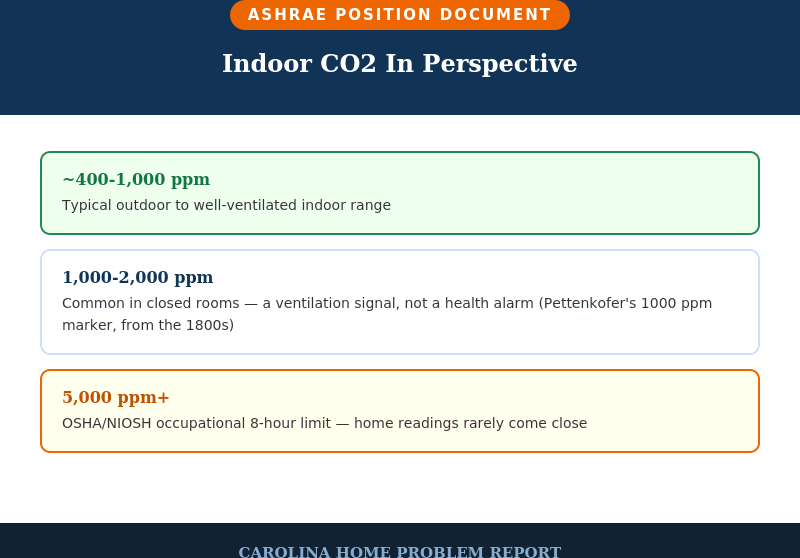
| CO2 Reading | What It Actually Means |
|---|---|
| 400–1,000 ppm | Typical range with adequate outdoor air exchange |
| 1,000–2,000 ppm | Common overnight bedroom range; a ventilation signal, per ASHRAE not a health threshold |
| 5,000 ppm | OSHA/NIOSH's actual occupational limit for an 8-hour shift — well above typical home readings |
| 30,000 ppm | OSHA/NIOSH short-term exposure limit — not a level home monitors are designed to reach |
Where the 1,000 PPM Number Actually Comes From
ASHRAE traces the number to its origin directly: "Pettenkofer proposed 1000 ppmv of CO2 as a marker of inadequate ventilation indoors and 700 ppmv for bedrooms." That's a proposal from Max Joseph von Pettenkofer, a 19th-century hygienist — not a modern health-based safety limit. It became a widely repeated benchmark because it's simple and easy to remember, not because it marks a scientifically established point where indoor air becomes harmful.
What ASHRAE Says CO2 Levels In Home Actually Measure
This is the finding most home CO2-monitor marketing skips entirely. ASHRAE states plainly: "indoor CO2 concentrations are not overall indicators of IAQ, but they can be a useful tool if users understand how they relate to IAQ and the important limitations of their use."
More specifically: "an indoor CO2 concentration below 1000 ppmv has long been considered an indicator of acceptable IAQ, but this concentration is at best an indicator of outdoor air ventilation rate per person." EPA's own guidance echoes the same caution more briefly: "carbon dioxide concentrations indoors can provide information about ventilation but need to be interpreted carefully."
In plain terms: your CO2 reading doesn't directly measure air quality, mold spores, VOCs, or dust — it measures how much outdoor air is reaching you relative to how many people (and how much they're breathing) are in the room. A rising number after a family dinner in a closed dining room reflects breathing and low outdoor air exchange, covered in more depth in our ventilation and IAQ guide — not a pollutant problem in the way a VOC or particulate reading would.
Do High CO2 Levels In Home Actually Affect You?
Here's where ASHRAE's position gets genuinely useful for a homeowner deciding how seriously to take a reading. The document states: "existing evidence for direct impacts of CO2 on health, well-being, learning outcomes, sleep patterns, and work performance at commonly observed indoor concentrations is inconsistent. This evidence does not currently justify changes to ventilation and IAQ standards, regulations, or guidelines."
That's not a dismissal — ASHRAE does note that "six studies reported an association between CO2 and decreased cognitive performance at concentrations in the range of 1000 ppmv," which is exactly why a stuffy, high-CO2 room can genuinely correlate with feeling sluggish or foggy. But the research isn't consistent enough to say CO2 itself, at typical home concentrations, is the direct cause of that feeling rather than a marker riding alongside whatever else builds up in poorly ventilated air (heat, humidity, actual pollutants tied to occupancy).
For Context: Where the Real Danger Zone Is
It helps to know where actual health-hazard thresholds sit, since home monitors rarely put typical readings in context. ASHRAE notes that "OSHA and NIOSH have established a time-weighted average limit value of 5000 ppmv for airborne exposure in any 8-hour work shift during a 40-hour workweek and 30,000 ppmv as a short-term exposure limit."
A home reading of 1,200-1,800 ppm in a closed bedroom overnight — the range that triggers most consumer monitor alerts — sits nowhere near either of those occupational limits. It's a ventilation signal worth acting on for comfort, not a level anywhere close to what produces hypercapnia, the medical term for a genuinely dangerous buildup of CO2 in the body.
CO2 vs. Carbon Monoxide: Don't Confuse the Two
This is a genuinely important distinction most CO2-monitor content never addresses directly, and confusing the two can leave a real hazard unaddressed. Carbon dioxide (CO2) is what everyone in the room exhales — a rising reading means the room needs more outdoor air, not that something is broken.
Carbon monoxide (CO) is a completely different gas, produced by incomplete combustion, and per EPA, "is produced whenever any fuel such as gas, oil, kerosene, wood, or charcoal is burned" — from "oil and gas furnaces, gas water heaters, gas ranges and ovens, gas dryers, gas or kerosene space heaters, fireplaces, and wood stoves." Unlike CO2, CO is genuinely dangerous at low concentrations: EPA notes that even "low levels can cause shortness of breath, mild nausea, and mild headaches," with moderate exposure causing "severe headaches," dizziness, and confusion.
A standard CO2 monitor does not detect carbon monoxide — they require separate sensors, and a home with any fuel-burning appliance needs a dedicated CO detector regardless of whether it also has a CO2 monitor. This distinction connects directly to a mechanism covered in our ventilation and IAQ guide: a strong exhaust fan can create enough negative pressure to backdraft CO-producing combustion gases from a gas appliance back into the home — a genuine safety issue, unlike a rising CO2 number from normal breathing.
Where to Place Your CO2 Monitor for an Accurate Reading
A monitor placed in the wrong spot gives a misleadingly low reading, which defeats the point of having one. General guidance for home use: mount it in the room's "breathing zone" — roughly the same height you'd mount a thermostat, about 4-6 feet from the floor — rather than near the ceiling or floor, since CO2 is denser than air and concentrates lower in a room before it mixes upward.
Avoid placing it directly near a window, door, or HVAC vent, all of which create a localized pocket of fresher or more mixed air that won't represent the room's actual reading, and keep it out of direct sunlight, which can skew some sensor types. For a bedroom specifically, placing it near where you actually sleep — not just somewhere in the room — gives the most relevant reading for the overnight buildup this article is usually consulted about.
What To Actually Do About High CO2 Levels In Home
Treat a rising CO2 number as exactly what ASHRAE says it is — a ventilation-rate proxy, not a direct health alarm. If your monitor climbs consistently in a specific room (a bedroom overnight, a home office during the day), the fix is the same regardless of the exact ppm figure: increase outdoor air exchange in that room specifically, whether that's a cracked window, a bathroom or attic fan run longer, or — for a home that's tightly sealed and runs high numbers everywhere — a dedicated mechanical ventilation system, the option covered in our stale air in home guide.
Frequently Asked Questions
Is 1,000 ppm CO2 dangerous in my home?
No — per ASHRAE, 1,000 ppm traces back to a 19th-century ventilation marker, not a modern health threshold. OSHA/NIOSH's actual occupational limit is 5,000 ppm for an 8-hour shift.
Are CO2 and carbon monoxide (CO) the same thing?
No — they're completely different gases. CO2 comes from normal breathing and signals a ventilation need; CO comes from incomplete combustion in fuel-burning appliances and is genuinely dangerous even at low levels. A CO2 monitor does not detect CO — you need a separate CO detector.
Why does my bedroom CO2 monitor climb overnight?
Normal — a closed bedroom with sleeping occupants and limited outdoor air exchange will accumulate CO2 from breathing. It's a ventilation signal, not a sign anything is wrong with the room.
Where should I place my CO2 monitor?
At roughly thermostat height (4-6 feet), away from windows, doors, and HVAC vents, and near where you actually spend time in that room — placement near an air source gives a misleadingly low reading.
Does high CO2 cause headaches or brain fog?
Possibly correlated, but per ASHRAE the evidence is inconsistent — some studies link CO2 in the 1,000 ppm range to reduced cognitive performance, but it's not conclusively established as the direct cause versus other factors that build up alongside it in poorly ventilated air.
🏠 CAROLINA LOCAL SUMMARY
Key Facts on CO2 Levels In Home:
- 1,000 ppm is a 19th-century ventilation marker, not a modern health limit — ASHRAE calls it at best a proxy for outdoor air exchange per person.
- OSHA/NIOSH's real occupational limit (5,000 ppm) is far above typical home readings.
- CO2 and carbon monoxide are different gases — a CO2 monitor won't catch a CO leak from a gas appliance.
- Monitor placement matters — near a window, door, or vent gives a falsely low reading.
If a high reading is paired with other symptoms — headaches, persistent stuffiness, allergy flare-ups — our poor indoor air quality symptoms guide can help you figure out whether ventilation alone will fix it or something else is contributing.
About the Author
This guide was researched using ASHRAE's official Position Document on Indoor Carbon Dioxide, the EPA's guidance on measuring CO2 indoors and on carbon monoxide poisoning, cross-referenced against Carolina Home Problem Report's own ventilation documentation, to give homeowners an accurate read on what their CO2 monitor is — and isn't — telling them.