Crawl Space Affecting Upstairs Humidity: The Real Reason Your Top Floor Suffers Most
Quick Answer
Yes — a crawl space affecting upstairs humidity is a real and well-documented mechanism, not a coincidence. Through the stack effect, air infiltrating from a damp crawl space rises continuously through the house and exits highest in the building, meaning upper floors sit further along that rising air path than the ground floor does. If your top floor runs noticeably more humid than the rest of the house, a wet or unsealed crawl space below is one of the most overlooked contributing causes.
Table of Contents
Key Takeaways
- The stack effect pulls air in low (crawl space, foundation gaps) and pushes it out high (upper floors, attic) — this is basic building physics, not specific to any one house.
- Upper floors sit closer to the building's exit point for that rising air than the ground floor, so crawl space moisture disproportionately loads onto the top floor in many two-story homes.
- This compounds with a separate, already-documented issue: upper floors tend to run more humid than downstairs anyway, for reasons unrelated to the crawl space (see our humidity upstairs vs downstairs guide).
- Sealing and dehumidifying the crawl space addresses the source; balancing airflow addresses the upstairs symptom — most homes need both, not one or the other.
| Mechanism | What It Means |
| Stack effect (building-wide) | Air enters low, exits high — crawl space air is pulled upward through the house continuously |
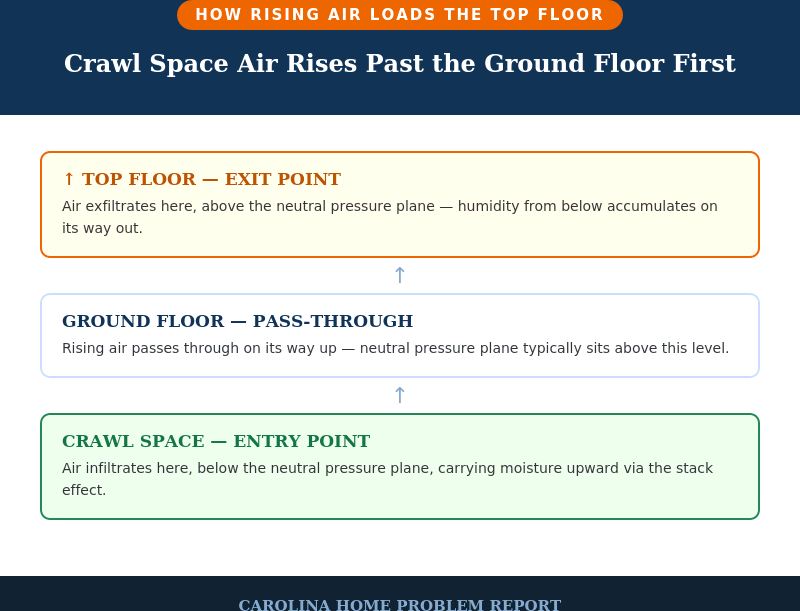
| Neutral pressure plane | The point where the rising air stops being "pulled" and starts being "pushed" — typically above the ground floor in a two-story home |
| Upstairs humidity buildup (separate cause) | Bedroom/bathroom moisture generation, closed doors, unbalanced ductwork — compounds with the above |
How Crawl Space Air Actually Reaches the Top Floor
Our guide on crawl space humidity's whole-house impact already covers the basic stack effect: warm interior air rises and escapes near the top of the house, and that outflow pulls replacement air upward from the crawl space through subfloor gaps. What that article doesn't get into — and what actually determines whether it's your downstairs or your upstairs that feels the effect most — is the building science concept of the neutral pressure plane.
Building science research on multi-story stack effect (via Building Science Corporation) describes it this way: below the neutral pressure plane, outside air infiltrates in; above it, interior air exfiltrates out. In a heated building, air "tends to flow out of the top of the building while inducing air to flow in at the bottom" — and critically, in a multi-floor structure, "the air in lower units ends up in the upper units." That's not a metaphor about cost or comfort; it's a description of where the physical air mass actually travels.
Applied to a typical two-story Carolina home: crawl space air enters below the neutral pressure plane, and that plane usually sits above the ground floor — meaning the rising air has to pass through the ground floor on its way to exiting higher up. The upstairs isn't just "also affected" the same amount as downstairs; it's further along the same rising air path, and in homes with a leakier envelope or a single central HVAC system straining to keep up, that difference becomes noticeable as a real humidity gap between floors.
Why This Compounds With an Existing Upstairs Problem
Our upstairs-vs-downstairs humidity guide covers a separate set of reasons the top floor tends to run more humid regardless of the crawl space: warm, moisture-carrying air rises through convection, bedrooms and bathrooms generate humidity overnight behind closed doors, and a single unbalanced HVAC system in a leaky building envelope often under-conditions the top floor relative to the ground floor.
Neither guide, taken alone, explains a top floor that stays humid even after standard upstairs fixes (adding a return vent, running a bathroom fan longer, cracking bedroom doors) are already in place. That's the sign this is a two-source problem: the crawl space is feeding moisture into the same rising-air path that upstairs humidity generation already strains, and fixing only one source leaves the other to keep the top floor above a comfortable range.
Signs the Crawl Space Is a Real Contributor
- A musty smell noticeable upstairs, especially near return air vents, even though the odor's source traces to the crawl space or first floor.
- Upstairs humidity that stays elevated even after addressing the standard upstairs-specific causes (ductwork balance, bathroom ventilation, closed-door moisture buildup).
- Visible crawl space moisture signs — condensation, damp insulation, a hygrometer reading consistently above 60% down there — combined with a hygrometer reading upstairs that tracks noticeably higher than the ground floor.
- The gap between floors is worse in humid weather and improves somewhat when the crawl space is actively dehumidified or ventilated, which points to it as a real contributing variable rather than coincidence.
A real example from a building-science discussion illustrates how large this gap can get: one homeowner measured their living space at 58% relative humidity while the connected floor cavity carrying their ductwork read 89-90% — a nearly 30-point difference they described as "it seems like it should not be this different." The cause turned out to be a pressure imbalance: leaky return ducts were depressurizing the cavity, actively pulling humid outdoor air in through gaps in the siding and band joist. If your own crawl space-to-upstairs gap seems unusually wide rather than a mild difference, leaky return ducts — not just the general stack effect — are worth checking specifically, since sealing a return leak can close much more of the gap than sealing the crawl space alone.
Addressing Both Sources
Because this is genuinely a two-source problem, a fix aimed at only one side tends to under-deliver:
- At the crawl space: sealing subfloor gaps and vents reduces how much air the stack effect can pull upward in the first place; a dedicated crawl space dehumidifier cuts the moisture content of whatever air does rise.
- At the upstairs level: our full humidity-reduction toolkit covers room-by-room and whole-house fixes; a correctly-sized dehumidifier for the living space itself handles what's already accumulated upstairs regardless of source.
- Track both floors with separate hygrometers for at least a week before and after any crawl space work — that's the only reliable way to confirm how much of the upstairs gap the crawl space was actually responsible for versus the separate upstairs-specific causes.
Frequently Asked Questions
Can a crawl space really affect the top floor of a two-story house?
Yes. Through the stack effect, air infiltrating from the crawl space is part of a continuous flow that moves upward and exits near the top of the building, which places upper floors further along that path than the ground floor.
Should I fix the crawl space or the upstairs humidity first?
Start with the crawl space if it shows visible moisture or a musty smell — it's the source, and fixing a source generally has a bigger effect than treating a symptom. But budget for both if the top floor stays humid after crawl space work; upstairs-specific causes are a separate, additive problem.
How do I know if my crawl space is actually contributing, versus my upstairs humidity being unrelated?
Run hygrometers in both the crawl space and upstairs for a week, then temporarily run a crawl space dehumidifier and track whether the upstairs reading drops in response. A clear correlation confirms the crawl space is a real contributor, not just a coincidence.
Does sealing crawl space vents alone solve upstairs humidity?
It reduces the crawl space's contribution but rarely solves it alone, since sealed vents without active dehumidification can trap moisture rather than remove it, and upstairs-specific causes (ductwork balance, bathroom moisture, closed doors) remain untouched either way.
My crawl space reads 30+ points higher in humidity than my living space — is that normal?
Some gap is normal, but a gap that wide is more often a sign of leaky return ductwork depressurizing the crawl space and actively pulling humid outdoor air in, rather than the ordinary stack effect alone. That's a fixable, checkable cause — a duct pressure test can confirm it — not just something to accept as unavoidable.
🏠 CAROLINA LOCAL SUMMARY
Key Facts on Crawl Space Affecting Upstairs Humidity:
- The stack effect pulls crawl space air upward through the house continuously — upper floors sit further along that rising air path than the ground floor.
- This combines with separate, already-documented upstairs humidity causes (convection, moisture generation, unbalanced HVAC), making the top floor a compounding problem in many two-story homes.
- Confirm the connection with hygrometers in both locations before and after crawl space work, rather than assuming either source alone explains the whole gap.
- Fixing both the crawl space source and the upstairs-specific causes together resolves the issue faster than treating either alone.
Carolina Home Problem Report Editorial Team RESEARCH TEAM
The Carolina Home Problem Report editorial team researches and writes guides for homeowners across North and South Carolina. The neutral-pressure-plane mechanism in this article is drawn from Building Science Corporation's published building-physics research. We are not building scientists or structural engineers — we are a research team dedicated to giving Carolina homeowners clear, unbiased answers, and always recommend a professional moisture assessment for a diagnosis specific to your home.
Carolina Home Problem Report is an informational resource for homeowners. We are not licensed contractors, physicians, or allergists. Always consult a qualified professional before making home repair or medical decisions. See our Disclaimer and Affiliate Disclosure.