Humidity and Wood Floors: How to Protect Them From Cupping and Gapping
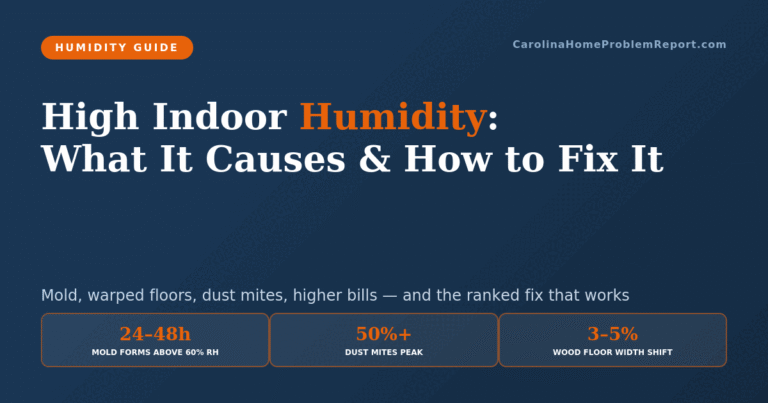
Humidity and wood floors have a well-documented relationship: the National Wood Flooring Association recommends keeping relative humidity between 30-50% to prevent both cupping (boards swelling and rising at the edges from too much moisture) and gapping (boards shrinking apart from too little). Most national guides treat these two failure modes as roughly equal risks. In a Carolina home, they usually aren't — cupping from summer humidity is the more common complaint here, because outdoor moisture pushes indoor levels toward the high end of that range for months at a time, while gapping tends to be a shorter winter-only concern tied to indoor heating.
⭐ Key Takeaways
- ✓NWFA's official range: 30-50% relative humidity, 60-80°F, for solid and engineered hardwood alike
- ✓A 30-point RH swing (30% to 60%) can expand a 5-inch board by roughly 0.09 inches — across a typical room, NWFA's own figures show that can add up to more than 2 inches of total movement, enough to push walls or cause severe gapping
- ✓Cupping (edges higher than centers) means the wood is absorbing moisture — usually from the underside, often tied to a crawl space or slab issue, not just room air
- ✓Some seasonal gapping every winter is normal and expected — NWFA itself says so — the goal is controlling the range, not eliminating all movement
In This Article
The NWFA's Recommended Range
Wood is hygroscopic — it absorbs and releases moisture from the surrounding air, expanding and contracting as it does. The National Wood Flooring Association, the industry's own trade association, recommends keeping indoor conditions at 30-50% relative humidity and 60-80°F for both solid hardwood and engineered wood flooring. That's a narrower and more specific range than the general comfort guidance (30-60%) most people are used to hearing for a home overall — wood floors have less tolerance for the upper end of "comfortable" than most other things in a house.
This isn't a one-time installation concern. Wood keeps responding to humidity for as long as it's in your home, which is why NWFA frames this as an ongoing range to maintain, not a target hit once during acclimation and forgotten.
Cupping vs. Gapping: What Each One Means
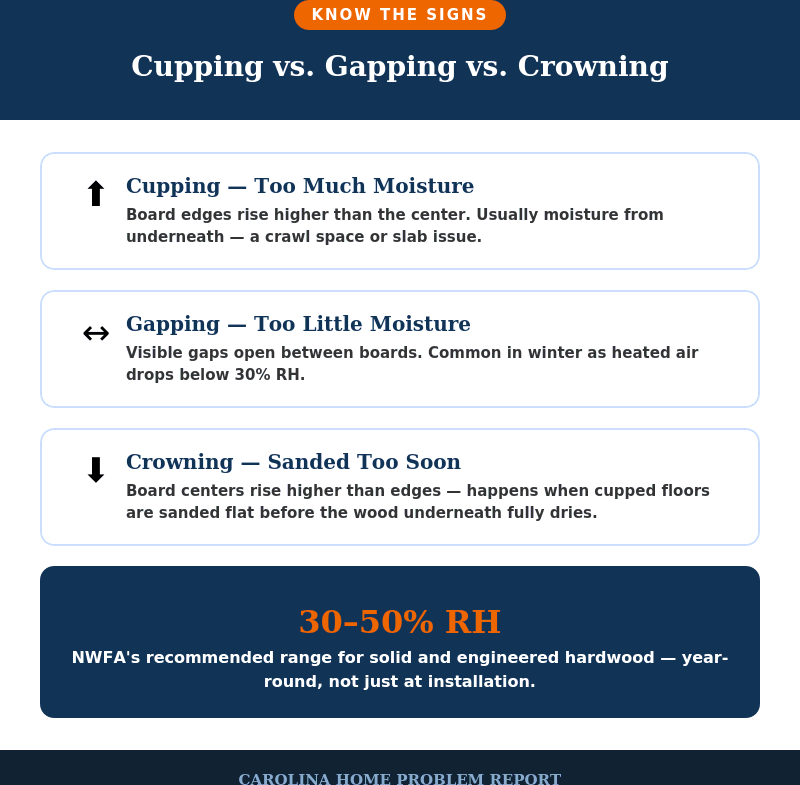
Cupping is the one worth taking seriously fastest, because unlike gapping — which usually self-corrects once spring humidity returns — cupping often points to a moisture source that won't fix itself: a leak, standing water in a crawl space, or a slab without a proper vapor barrier underneath.
A fourth term worth knowing: buckling. This is cupping taken to its most severe extreme — boards actually lift away from the subfloor entirely, sometimes several inches, rather than just curling at the edges. It's uncommon and almost always tied to a major, sudden water event (a burst pipe, significant flooding) rather than ordinary seasonal humidity swings. If a floor is lifting off the subfloor rather than just showing edge-curl, that's a buckling situation needing emergency water extraction and professional assessment, not a humidity-management fix.
Why Carolina Homes Lean Toward Cupping
Most wood-flooring guides written for a national audience treat cupping and gapping as roughly symmetrical risks — one in summer, one in winter, both equally likely. That's a reasonable assumption in a climate with a genuinely dry winter and a moderately humid summer. It holds up less well here:
- The humid season is longer and more intense. Carolina's humid subtropical climate keeps outdoor humidity elevated for 5-6 months, which pushes indoor conditions toward the upper end (or above) NWFA's 50% ceiling for a large share of the year — see our breakdown of why indoor humidity spikes in NC summers.
- Crawl space moisture reaches the floor directly. A vented or poorly sealed crawl space sits right underneath a home's wood flooring, and ground/outdoor moisture moving up through it can push a floor's underside humidity higher than the room's own air — a factor a national guide has no reason to mention.
- Winter gapping is milder here. Winters in most of NC and SC are shorter and less severe than in the northern climates these guidelines were written with in mind, so the low-humidity half of the equation is a smaller, shorter-lived concern by comparison.
The practical result: a Carolina homeowner should weight their attention toward summer humidity control more than the national guidance implies, and should specifically consider whether a damp crawl space is contributing before assuming the cause is only the room's own air.
How Much Movement a Humidity Swing Actually Causes
Most guides tell you humidity swings "cause movement" without saying how much. NWFA has actually run the numbers: a relative humidity swing from 30% to 60% — a 30-point change, well within what a Carolina home can see between a dry winter day and a humid summer one — can expand a 5-inch-wide red oak plank by roughly 0.09 inches. That sounds small until it's added up across a room: NWFA's own figures show that accumulated movement across multiple boards spanning a typical room width can exceed 2 inches total, enough in extreme cases to push against walls or baseboards, or open severe gaps once the humidity reverses.
This is exactly why NWFA frames the 30-50% range as a range to maintain consistently, not just avoid the extremes of occasionally — the damage isn't usually from one humid week, it's from the accumulated swing between a home's driest and most humid conditions over a full year.
How to Protect Your Floors Year-Round
- Keep a hygrometer near the floor, not just on a thermostat. Floor-level humidity can run higher than the room average, especially near exterior walls or over a crawl space.
- Run a dehumidifier through the humid season if readings regularly climb above 50% — see our dehumidifier sizing and buying guide for options sized to a living area.
- Address a damp crawl space directly rather than only treating the symptom upstairs — if the underside of the floor is the moisture source, room-level dehumidification alone won't fully solve cupping.
- Wipe up spills and standing water quickly. A single soaked area can cup locally even when the rest of the home's humidity is well within range.
- Expect and accept some winter gapping. A small seasonal gap that closes again by late spring is normal wood behavior, not a defect — NWFA says so directly, and chasing it with a whole-home humidifier for a minor, self-correcting gap is usually unnecessary.
Frequently Asked Questions
Will cupped floors flatten back out on their own?
Often, yes — mild cupping caused by a temporary humidity spike can flatten as the wood dries back out and humidity returns to normal, sometimes over several weeks. Cupping that doesn't improve once humidity is back in range usually means there's an ongoing moisture source (a leak, a chronically damp crawl space) rather than a one-time event.
Can I sand cupped floors flat right away?
Not right away, and not without finding the moisture source first. Sanding cupped boards flat while they're still holding excess moisture is the classic cause of crowning — once the wood finally dries out and shrinks back, the sanded boards end up higher in the middle than the edges. Let the wood fully re-acclimate to normal humidity before any refinishing.
Does engineered hardwood have the same humidity requirements as solid wood?
NWFA's recommended 30-50% range applies to both. Engineered flooring is generally more dimensionally stable than solid wood due to its cross-layered construction, which can make it somewhat more forgiving of brief excursions outside that range, but it isn't immune to cupping or gapping if conditions stay outside the range for an extended period.
How do I know if it's the crawl space causing my cupped floors?
Cupping that's worst near exterior walls or concentrated over a specific area of the crawl space (rather than spread evenly across the whole floor) points toward a below-floor moisture source. A moisture meter check from the crawl space side, comparing the underside of the subfloor to the room-side reading, is the most direct way to confirm it.
Is a whole-home humidifier necessary in a Carolina winter?
Usually not required the way it might be in a colder, drier climate. NC and SC winters are milder and shorter, so indoor humidity typically doesn't fall as far below 30% or stay there as long. Minor seasonal gapping that closes again by spring is normal and doesn't necessarily justify the cost of a whole-home humidifier system.
If I pay to sand and refinish cupped floors, will they just cup again?
Not if the actual moisture source gets fixed first — but yes, if it doesn't. Refinishing addresses the wood's appearance, not the reason it cupped in the first place. Before paying for sanding and refinishing, confirm and resolve whatever was pushing moisture into the floor (a damp crawl space, a slab without a vapor barrier, a slow leak). Once that source is genuinely fixed and the wood has had time to re-acclimate to normal humidity, there's no reason for the same boards to cup again from the same cause.
🏠 CAROLINA LOCAL SUMMARY
Key Facts on Humidity and Wood Floors in a Carolina Home:
- NWFA recommends 30-50% relative humidity, 60-80°F, for both solid and engineered hardwood.
- A 30-point RH swing can move a 5-inch board roughly 0.09 inches — over 2 inches accumulated across a typical room (NWFA figures).
- Cupping (moisture) is the more common Carolina problem; gapping (dryness) is a milder, shorter winter concern here than in colder climates.
- A damp crawl space can push floor-level humidity above the room average — check it directly if cupping doesn't improve with room dehumidification alone.
- Some winter gapping is normal and usually self-corrects by spring — it doesn't necessarily mean something is wrong.
Carolina Home Problem Report Editorial Team RESEARCH TEAM
The Carolina Home Problem Report editorial team researches and writes guides for homeowners across North and South Carolina. Humidity and movement figures in this article are drawn directly from the National Wood Flooring Association's relative humidity guidance. We are not flooring installers — we are a research team dedicated to giving Carolina homeowners clear, unbiased answers.
Carolina Home Problem Report is an informational resource for homeowners. We are not licensed contractors or flooring professionals. Always consult a qualified professional before making home repair decisions. See our Disclaimer and Affiliate Disclosure.