Indoor Allergies Triggers: The AAFA-Backed Fix That Beats Air Purifiers
Quick Answer
The most common indoor allergies triggers, per AAFA, are dust mites (roughly 8 in 10 Americans are exposed) and pet dander (roughly 6 in 10), followed by mold, pollen that infiltrates despite closed windows, and cockroach allergens. The counterintuitive part most people miss: AAFA's own guidance is that these allergens sit more heavily on surfaces than in the air, and removing them at the source — encased mattresses, decluttered surfaces, regular hot-water bedding washes — outperforms air purifiers for actually reducing symptoms.
Table of Contents
- Why Surfaces Matter More Than Air
- Allergy or Cold? How to Tell the Difference
- Dust Mites and Pet Dander: The Two Biggest Indoor Allergy Triggers
- Mold and Cockroaches: The Indoor Allergy Triggers Most Guides Skip
- Pollen Still Gets In With Windows Closed
- Priority Order for Reducing Indoor Allergy Triggers
- When to See an Allergist Instead of Guessing
- Frequently Asked Questions
Key Takeaways
- AAFA: roughly 8 in 10 people are exposed to dust mites, 6 in 10 to pet dander — the two most common indoor allergen triggers nationally.
- Allergens settle on surfaces more than they stay airborne — dusting, sitting, or disturbing fabric releases them back into the air you breathe.
- Pollen gets indoors even with windows closed, often riding in on pet fur — long-haired pets can carry meaningful pollen loads during high-pollen seasons.
- Source removal (mattress/pillow encasements, decluttering, hot-water washing) works better for symptom reduction than air cleaning alone, per AAFA's own guidance.
| Trigger | Exposure / Notes (AAFA) |
| Dust mites | ~8 in 10 people exposed — the most common indoor allergen nationally |
| Pet dander | ~6 in 10 people exposed to cat or dog dander |
| Mold & pollen | Enter more easily when ventilation is poor; pollen can also ride in on pets |
| Cockroach allergens | More common in inner-city and southern U.S. homes |
Why Surfaces Matter More Than Air
Most people's first move against indoor allergies is an air purifier. According to AAFA, that instinct skips the bigger problem: "there may be more allergens on surfaces than in the air." Dust mite waste, pet dander, and mold fragments settle onto bedding, upholstery, carpet, and clutter, and stay there — mostly inert — until dusting, vacuuming, or simply sitting down disturbs them back into the air you're breathing.
This is why AAFA's own guidance is specific: encasing mattresses and pillows "works better than air cleaners to reduce allergy symptoms." An air purifier addresses what's already airborne; it does nothing about the reservoir sitting on every surface waiting to be disturbed again. Source removal and air cleaning aren't competing strategies, but if a household has to prioritize one, the surface-level fixes come first.
Allergy or Cold? How to Tell the Difference
Before chasing down a trigger, it helps to confirm it's actually an allergy. Per WebMD, a genuine indoor allergy tends to produce a drippy nose with clear, watery secretions, itchy eyes, and symptoms that linger for weeks with no real improvement. A cold, by contrast, usually brings thicker, discolored (yellow or green) mucus, chills, body aches, and resolves within about a week to ten days on its own. If symptoms have been dragging on well past the two-week mark with no fever or body aches, that pattern points toward an indoor trigger rather than a passing virus — and toward the source-removal steps in this article rather than cold medicine.
This distinction matters practically: a household that keeps treating a dust-mite or mold allergy as "just another cold" will keep reaching for decongestants instead of encasing mattresses or dealing with a damp bathroom — the actual fix stays untouched while the symptoms keep coming back every few weeks.
Dust Mites and Pet Dander: The Two Biggest Indoor Allergy Triggers
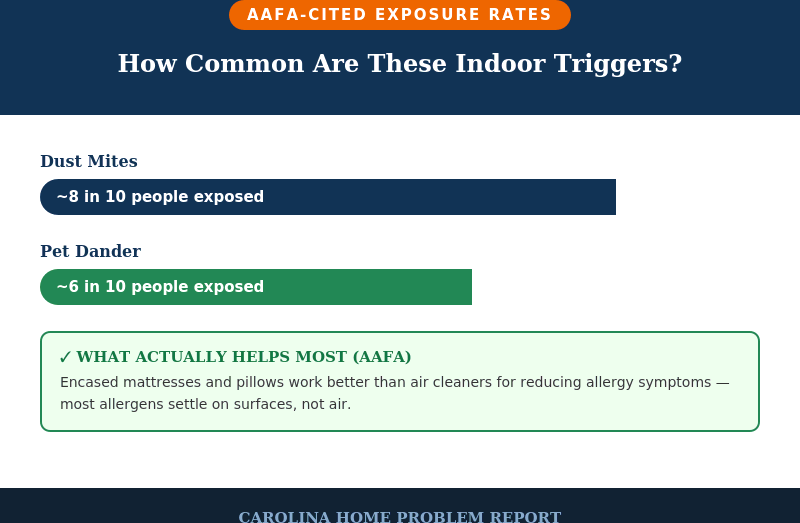
The scale here is easy to underestimate: AAFA cites roughly 8 in 10 people as exposed to dust mites and 6 in 10 to pet dander. Our guide on humidity and allergies covers the specific humidity range (30-50%) that limits dust mite populations — this article focuses on the broader trigger landscape, not the humidity mechanism specifically, since that's already covered in depth there.
For the dust mite side specifically, the American Academy of Allergy, Asthma & Immunology (AAAAI) recommends washing bedding weekly in water of at least 130°F — a specific, checkable number that "hot water" alone doesn't give a reader anything to verify their washing machine against.
Pet dander is harder to fully eliminate than dust mites, since it's continuously produced rather than tied to a controllable environmental condition like humidity. AAFA's specific recommendation — keeping pets out of the bedroom — targets the room where exposure time is highest, rather than trying to eliminate dander from the whole house at once. AAAAI adds a point worth knowing: "there are no 'hypoallergenic' breeds of dogs or cats" — the allergen is in saliva and urine as well as dander, so breed alone doesn't solve the exposure.
Mold and Cockroaches: The Indoor Allergy Triggers Most Guides Skip
Mold and cockroach allergens show up in nearly every list of indoor allergy triggers, but most guides stop at naming them — without saying what to actually do. Both matter more in the Carolinas than in drier climates: mold needs dampness to grow, and AAAAI is specific that it concentrates in basements and bathrooms — the same humid, poorly-ventilated spaces this site covers in its humidity-reduction guide. For hard surfaces, AAAAI's specific guidance is cleaning with water, detergent, and a 5% bleach solution, drying the area completely afterward, and calling in a professional once the affected area is larger than about 10 square feet.
Cockroach allergen is a protein in their droppings, not the insect itself — which is why an empty-looking kitchen can still be a source. AAAAI's concrete steps are sealing entry points (cracks, gaps around pipes, window edges), fixing leaky faucets so there's no standing water to draw them in, storing food and garbage in lidded containers, and washing dishes immediately after meals rather than leaving them overnight. For an infestation that's already established, a professional exterminator — timed for when the family can be out of the house — is the AAAAI-recommended step, since over-the-counter sprays alone rarely resolve an established colony.
Pollen Still Gets In With Windows Closed
Closing windows during high pollen season is standard advice, but it's not a complete seal. AAFA specifically notes that long-haired pets can carry meaningful pollen loads inside during high-pollen periods — a transmission route that has nothing to do with ventilation or window seals, and one most "keep windows closed" advice doesn't account for. Wiping down a pet after outdoor time during pollen season addresses a real gap that closed windows alone can't.
Priority Order for Reducing Indoor Allergy Triggers
- First — source removal: allergen-proof mattress and pillow encasements, hot-water bedding washes, decluttering surfaces that collect dust.
- Second — reduce reservoirs: keep pets out of the bedroom, wipe them down after outdoor time in pollen season, vacuum with a sealed-bag or HEPA-filter vacuum rather than one that recirculates fine particles.
- Third — environmental controls: our humidity-reduction toolkit helps limit dust mite and mold growth specifically; a HEPA air purifier helps with what's already airborne, but per AAFA's own guidance, it's the least effective of the three when used alone.
When to See an Allergist Instead of Guessing
Source removal and reservoir reduction solve most cases, but if symptoms are still lingering after a few weeks of consistently applying them, trial-and-error stops being useful and an allergist visit is the faster path. Per WebMD, a typical workup starts with a medical history and a physical exam (eyes, nose, throat, chest, and sometimes an X-ray of the sinuses or lungs), then narrows down the actual trigger with a skin test — usually the most accurate and least expensive option, with results showing as redness, swelling, or itching in as little as 20 minutes.
Two alternatives exist for cases where skin testing isn't practical: a patch test (an allergen taped to the skin and checked after 48 hours) or a blood test that measures antibody response, typically used when a skin condition or certain medications rule out skin testing directly. The point of testing isn't just curiosity — knowing definitively whether it's dust mites, pet dander, mold, or something else means the household can stop guessing and target the actual source instead of trying every fix on this page at once.
Frequently Asked Questions
What are the most common indoor allergy triggers?
Per AAFA, dust mites (roughly 8 in 10 people exposed) and pet dander (roughly 6 in 10) are the two most common, followed by mold, infiltrating pollen, and — particularly in certain regions — cockroach allergens.
How do I know if it's an indoor allergy and not just a cold?
Allergies typically bring clear, watery nasal discharge, itchy eyes, and symptoms that drag on for weeks. A cold usually brings thicker, discolored mucus, chills, and body aches, and clears up within about 7-10 days. Symptoms lasting well past two weeks with no fever point toward an allergy, not a virus.
Are air purifiers effective against indoor allergens?
They help with what's already airborne, but AAFA's own guidance is that source-removal steps like mattress encasements work better for reducing allergy symptoms, since most allergens settle on surfaces rather than staying airborne.
How does pollen get inside if my windows are closed?
Pets are a common route — long-haired pets can carry pollen inside on their fur even when windows stay shut. Wiping pets down after outdoor time during high-pollen periods addresses this specific gap.
How do I get rid of mold and cockroach allergens specifically?
For mold on hard surfaces, AAAAI recommends cleaning with water, detergent, and a 5% bleach solution, then drying completely — call a professional if the area is larger than about 10 square feet. For cockroach allergens, seal entry points, fix leaks that create standing water, use lidded food and garbage containers, and bring in a professional exterminator for an established infestation.
What does allergy testing actually involve?
Usually a medical history and physical exam first, then a skin test — the most accurate and least expensive option, with results in as little as 20 minutes. Patch tests or blood tests are used instead when skin testing isn't practical.
Does humidity affect indoor allergy triggers?
Yes, particularly for dust mites and mold — see our dedicated guide on humidity and allergies for the specific range that limits their growth.
🏠 CAROLINA LOCAL SUMMARY
Key Facts on Indoor Allergies Triggers:
- AAFA: ~8 in 10 people exposed to dust mites, ~6 in 10 to pet dander — the two biggest indoor triggers.
- Allergens settle on surfaces more than they stay airborne — source removal beats air purifiers alone.
- Pollen can enter via pet fur even with windows closed — a gap standard "keep windows shut" advice misses.
- Priority order: source removal first, reduce reservoirs second, environmental controls (humidity, air purifiers) third.
Carolina Home Problem Report Editorial Team RESEARCH TEAM
The Carolina Home Problem Report editorial team researches and writes guides for homeowners across North and South Carolina. Allergen information in this article is drawn directly from the Asthma and Allergy Foundation of America. We are not physicians or allergists — we are a research team dedicated to giving Carolina homeowners clear, unbiased answers, and always recommend consulting a doctor or allergist for personal symptom management.
Carolina Home Problem Report is an informational resource for homeowners. We are not licensed contractors, physicians, or allergists. Always consult a qualified professional before making home repair or medical decisions. See our Disclaimer and Affiliate Disclosure.