Why Is My House So Humid? (Common Causes in NC Homes)
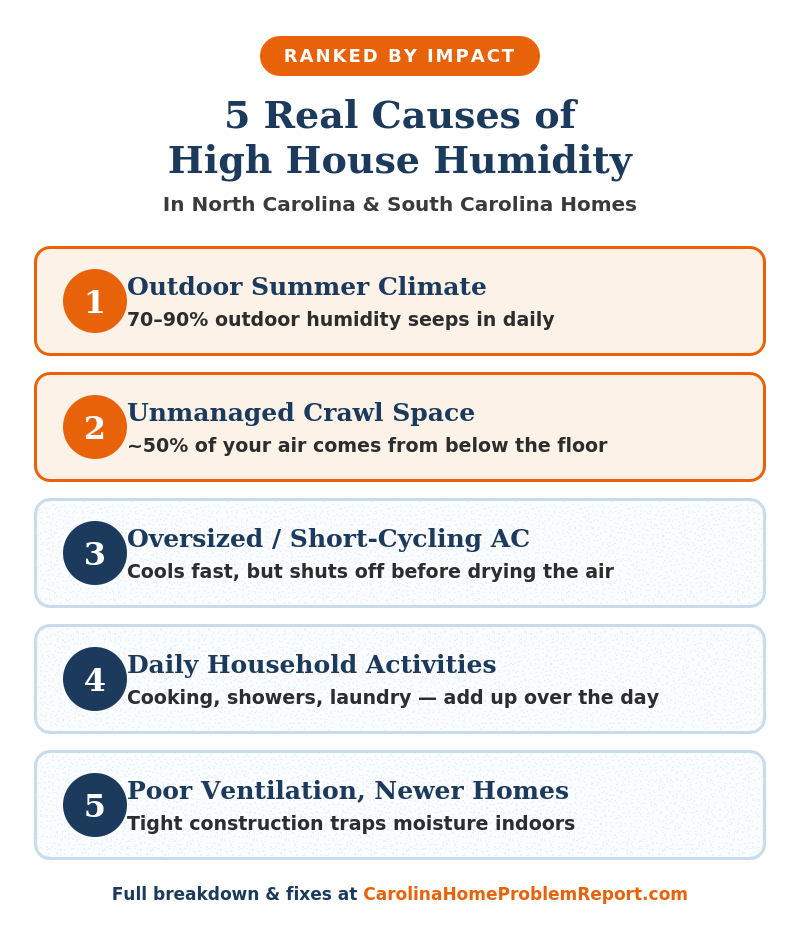
Why is my house so humid? In North Carolina and South Carolina, it almost always comes down to two things: outdoor summer humidity working its way in and an unmanaged crawl space pushing moist air upward into the living space. Daily activities like cooking, showering, and laundry add to the load, but in most Carolina homes they are not the main cause — the building itself is.
⭐ Key Takeaways
- ✓Comfortable indoor relative humidity is 30–50% year-round — above 60% is when mold, dust mites, and musty odors become active problems, not just discomfort
- ✓NC and SC summer outdoor humidity regularly runs 70–90%, and every door opening, air leak, and minute of fresh-air ventilation lets some of that in
- ✓In homes built over a crawl space — the majority of Carolina construction — roughly half the air upstairs originated in the crawl space, so an unmanaged crawl space raises whole-house humidity even with a perfectly good AC
- ✓An oversized air conditioner cools the air fast but shuts off before it has run long enough to pull moisture out — a house can feel cold and clammy at the same time
- ✓A $10–$15 hygrometer tells you your actual number in minutes — guessing is the main reason humidity problems go untreated for years
Sticky air. Damp-feeling sheets. Windows that fog up from the inside. A house that feels warmer than the thermostat says it should. If any of that sounds familiar, your home almost certainly has an indoor humidity problem — and in North Carolina and South Carolina, that is one of the most common home comfort complaints there is.
The instinct is to blame the air conditioner. Sometimes that is fair. But in most Carolina homes, high indoor humidity is caused by a combination of the regional climate, the way the home is built, and how the HVAC system is sized — not just how hard the AC is working. Understanding which of those is driving your specific problem is the difference between a fix that actually lasts and one that only helps for a few weeks.
This guide walks through the real causes of high indoor humidity in a Carolina home, what a normal number actually looks like, how to check your own house in a few minutes, and which fix matches which cause.
In This Article
The Real Causes of High Humidity in a Carolina Home
Most articles on this topic list the same generic causes — cooking, showering, houseplants — that apply anywhere in the country. Those do add moisture, but in a Carolina home they are rarely the reason humidity stays high all summer. Here are the causes ranked by how much they actually matter here.
What Humidity Level Is Actually Normal?
The generally accepted comfortable and healthy range for indoor relative humidity is 30–50%, a range referenced by both the EPA and ASHRAE (the industry body that sets HVAC comfort standards). Below 30%, air feels dry and can irritate skin, eyes, and airways — more of a winter heating-season issue in the Carolinas. Above 50%, air starts to feel noticeably sticky and uncomfortable. Above 60%, you cross into the range where dust mites thrive and mold can begin to establish on organic surfaces — at that point it is a moisture problem, not just a comfort one.
A Realistic Carolina Target
Given how humid the outdoor air is here for half the year, aiming for the lower half of that range — 40–45% indoors during summer — gives you a comfortable buffer rather than constantly hovering right at the edge of the range where mold conditions begin.
How to Check Your Actual Number
Guessing is the single biggest reason humidity problems in Carolina homes go untreated for years. A basic digital hygrometer costs $10–$15 and gives you a real reading in minutes.
Place a hygrometer in the room that feels worst
Away from direct sun, vents, and exterior doors. Let it sit for at least 30 minutes before reading it — the sensor needs time to equalize with the room.
Check morning and evening for a few days
Humidity swings through the day. A one-time reading tells you less than a pattern over 3–4 days. If it's regularly above 55% indoors, you have a real problem, not a one-off humid afternoon.
If you have a crawl space, test it too
A cheap hygrometer left in the crawl space for 24 hours tells you whether cause #2 above applies to your home. See our crawl space humidity guide for what reading counts as a problem down there.
Matching the Fix to the Cause
The right fix depends entirely on which cause above is actually driving your number. Treating the wrong one wastes money and leaves the humidity right where it was.
Frequently Asked Questions
Why is my house humid even though the AC is running constantly?
This is common enough that we built a full step-by-step diagnostic checklist for it — see why houses stay humid even with the AC running for the six things to check, starting with a thermostat setting that trips up most homeowners.
Can high indoor humidity cause mold even without a leak?
Yes. Mold needs organic material and relative humidity above roughly 60% — it does not need standing water or a leak. Sustained indoor humidity above that threshold, which is common in an unmanaged Carolina crawl space through the summer, is enough on its own.
Will a bigger, more powerful AC fix high humidity?
Usually not, and it can make it worse. A larger system cools the room faster, which means it runs for shorter cycles — and dehumidification happens over the course of a run, not at the start of one. If your current AC is already oversized, going bigger compounds the short-cycling problem rather than solving it.
How much does it cost to fix a whole-house humidity problem in NC or SC?
It depends entirely on the cause. Sealing obvious air leaks and improving bath/kitchen venting can cost under $200 in materials. A properly sized whole-home or crawl space dehumidifier typically runs $1,000–$2,500 installed. Full crawl space encapsulation with a dedicated dehumidifier is a larger investment, generally $6,000–$12,000, but addresses the root cause rather than managing the symptom indefinitely.
Key Facts About Indoor Humidity in Carolina Homes:
- Comfortable indoor relative humidity is 30–50%; above 60% is when mold and dust mites become active concerns, not just comfort issues.
- NC and SC outdoor summer humidity of 70–90% is the baseline load every Carolina home is fighting from roughly May through September.
- In crawl space homes, roughly 50% of the air upstairs originated below the floor — making an unmanaged crawl space one of the largest and most overlooked humidity sources in the region.
- An oversized or short-cycling air conditioner can cool a house quickly while barely reducing humidity, because dehumidification requires sustained runtime.
- A $10–$15 hygrometer, checked over 3–4 days in both the living space and the crawl space, identifies the real cause faster than guessing ever will.
High indoor humidity in a Carolina home is rarely just one thing. Test your actual number, check the crawl space if you have one, and match the fix to what you find — that is what makes the difference last through next summer instead of just this week.
Find a Home Moisture Professional Near You →The Carolina Home Problem Report editorial team researches and writes guides for homeowners across North and South Carolina. Our research draws on NC State Climate Office data, EPA and ASHRAE indoor air guidance, Building Science Corporation research, and insights from licensed Carolina contractors. We are not contractors or HVAC technicians — we are a research team dedicated to giving Carolina homeowners clear, locally specific, unbiased answers.
Carolina Home Problem Report is an informational resource for homeowners. We are not licensed contractors or HVAC technicians. Always consult a qualified professional before making home repair decisions. See our Disclaimer and Affiliate Disclosure.