What Humidity Level Causes Mold? The EPA and NC Thresholds Explained
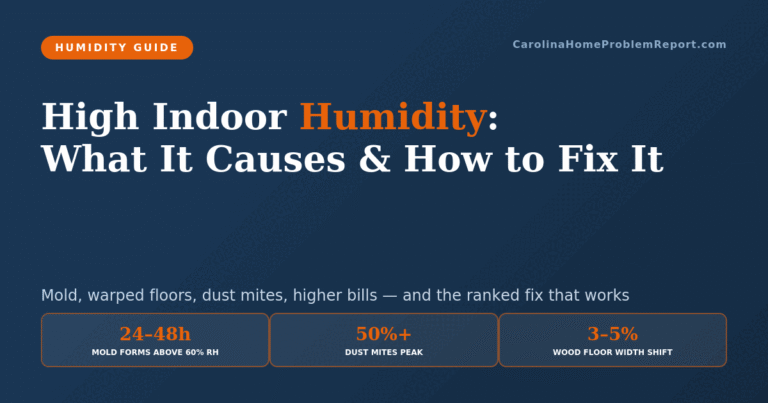
What humidity level causes mold to start growing indoors? According to the EPA, mold risk begins once relative humidity stays above 60% for any length of time, and North Carolina's own Department of Health and Human Services puts it more bluntly: above 70% for extended periods, mold "will almost certainly grow." The harder problem for a Carolina home isn't knowing the number — it's that outdoor air here regularly sits above 60% RH for months at a time, which makes the indoor threshold something you have to actively manage, not something that takes care of itself the way it might in a drier climate.
⭐ Key Takeaways
- ✓EPA: keep indoor relative humidity below 60% to prevent mold; NC DPH: above 70% for extended periods, mold will almost certainly grow — 60-70% is the real danger zone, not a hard cliff at one number
- ✓Carolina outdoor air commonly runs 60-90% RH for much of the humid season, so staying under 60% indoors takes active dehumidification here, not just closed windows
- ✓Time matters as much as the percentage — the EPA notes wet materials need to dry within 24-48 hours regardless of ambient humidity, or mold can start regardless of the room's average reading
- ✓A $15-25 hygrometer is the only reliable way to know which side of the threshold you're actually on — guessing by feel is unreliable, especially in a climate where "normal" already feels humid
In This Article
The Real Thresholds, According to EPA and NC DPH
Most sources online repeat a single "magic number" — usually 60% — as if mold either does or doesn't grow at that exact line. The actual guidance from the two authorities most relevant to a Carolina homeowner is a bit more useful than that:
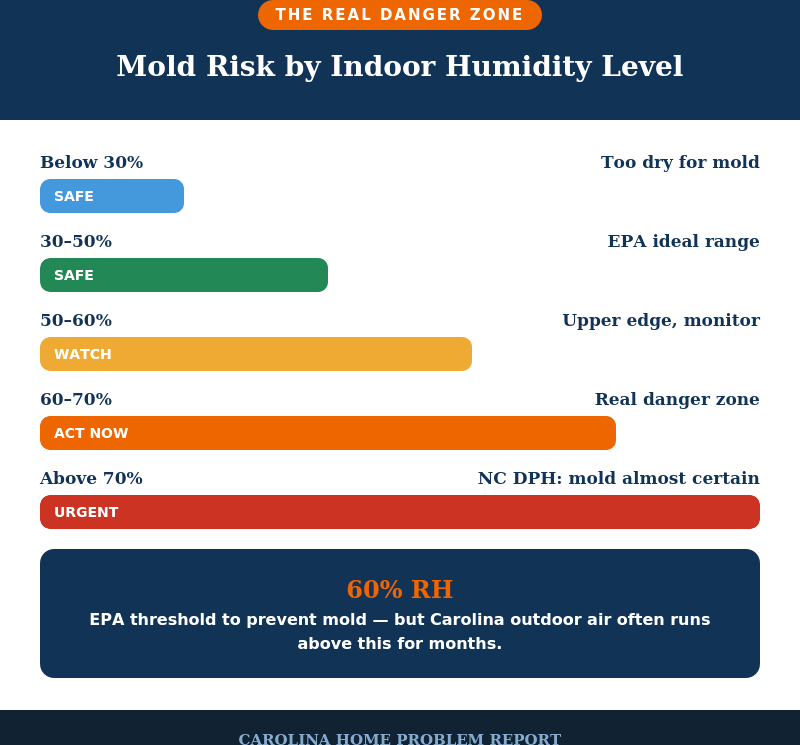
- The EPA's mold course recommends keeping indoor relative humidity below 60%, with an ideal range of 30-50%. Below that line, most building materials don't hold enough moisture for mold spores to establish and multiply.
- The North Carolina Department of Health and Human Services states it from the other direction: if relative humidity stays above 70% indoors for extended periods, mold will almost certainly grow. Below 60% with no cold-condensing surfaces, there generally isn't enough moisture in building materials for mold to take hold.
That leaves 60-70% as a genuine gray zone rather than a hard cliff — growth becomes increasingly likely the longer humidity sits in that range, especially near cooler surfaces (an exterior wall, a window frame, a closet against an unheated space) where water activity at the surface can run higher than the room's average reading. This is the single most useful thing to take from both sources: the exact number matters less than staying reliably out of the 60%+ range across the areas of a home that run cooler or damper than average — not just wherever a hygrometer happens to sit.
Why This Threshold Is Harder to Stay Under Here
Most guides that quote the EPA's 60% figure are written for a general audience, where staying under it might mean little more than running the AC on hot days. That framing doesn't hold up well in North or South Carolina. In a humid subtropical climate, outdoor relative humidity commonly runs 60-90% for a good part of spring through early fall — meaning the air a Carolina home is drawing in, or that's leaking in through gaps and a vented crawl space, already starts on the wrong side of the EPA's line for months at a time.
- Staying under 60% takes active work here, not passive avoidance. Closing windows and running a normally-sized AC gets many homes into the 50s during active cooling, but an oversized or short-cycling AC (see our guide to humidity even with the AC running) can leave a home in the 60-65% range even while it feels cool.
- The danger window is longer. A home in a drier climate might only flirt with 60%+ during a handful of humid days a year. A Carolina home dealing with a genuinely humid season (see why summer indoor humidity spikes here) can sit near or above that line for 5-6 months if nothing is actively managing it.
- A vented crawl space adds a second moisture source. Ground and outdoor air moving up through an unsealed crawl space can push living-area humidity higher independently of anything happening upstairs — worth ruling out before assuming the cause is entirely inside the room itself.
What Happens at Each Humidity Level
Why Time Matters as Much as the Percentage
A room's average humidity reading doesn't tell the whole story. The EPA is explicit that the more important number, in some cases, is time: wet building materials — a soaked carpet edge, a water-stained ceiling tile, a damp patch behind furniture — need to dry out within 24-48 hours or mold can begin regardless of what the rest of the room reads on a hygrometer. A single leak, a missed spill, or condensation that collects on a cold surface overnight can start a localized mold problem even in a home that averages a healthy 45% RH everywhere else.
This is also why a whole-house average can be misleading. A window that regularly fogs with condensation, a closet on an exterior wall, or a corner near an uninsulated crawl space can all run well above the room's average — and above the 60% line — even while the hygrometer on the other side of the house reads comfortably in the 40s.
How to Actually Check Yours
A hygrometer costs $15-25 and is the only reliable way to know which side of the threshold a specific room is actually on — guessing by feel doesn't work well in a climate where "normal" indoor air already carries more moisture than it would elsewhere.
- Check more than one room. Bathrooms, basements, and rooms above a crawl space typically run higher than a home's average — check those specifically, not just a central hallway.
- Check at the worst time of day. Early morning (before the AC has cycled) and right after showers or cooking usually show the highest readings.
- Track it for a few days, not one reading. A single high reading after a rainstorm is less concerning than a room that consistently sits at 62-65% day after day.
- If a specific spot reads high even when the rest of the house is fine, that's a localized issue (a leak, poor airflow, a cold surface) worth investigating directly rather than trying to fix with whole-home dehumidification.
If most of the home reads in the danger zone rather than one isolated spot, a properly sized dehumidifier is usually the most direct fix — see our sizing guide for how to match capacity to the space rather than guessing.
Frequently Asked Questions
Can mold grow at 50% humidity?
Growth is unlikely at a sustained 50% in most areas of a home, but a cold surface — a window, an exterior-wall closet — can have a locally higher moisture level than the room average even when the room itself reads 50%. Check cold or enclosed spots specifically rather than relying on one central reading.
Does 55% humidity cause mold?
On its own, no — 55% is within the range most sources consider acceptable, if slightly above the EPA's ideal ceiling of 50%. The concern is trend, not a single reading: a home that consistently runs at 55% in summer is closer to drifting into the 60-70% danger zone than one that sits at 40-45%.
Will running the AC lower humidity enough to stop mold?
Often, but not always. A correctly sized AC removes moisture as a byproduct of cooling and can get many Carolina homes into the 50s. An oversized AC that cools quickly and shuts off before it runs long enough can leave humidity in the 60-65% range even while the house feels cool — see our guide on humidity even with the AC running for how to tell.
How fast can mold grow once humidity crosses 60%?
Under the right conditions — a damp surface with an available food source like drywall paper or wood — visible growth can start within 24-48 hours, matching the EPA's drying-window guidance. Sustained elevated humidity without a specific wet surface tends to take longer, but the exact timeline depends heavily on the surface, temperature, and airflow involved.
What humidity level is too high for a bedroom specifically?
The same 60% threshold applies, but bedrooms often run higher than the rest of the house overnight due to breathing and body heat in a closed room. If a bedroom consistently reads 5-10 points higher than the rest of the home, that gap itself is worth addressing — cracking the door for airflow or adding a small room dehumidifier are the two most common fixes.
Is a little mold in the shower normal?
Bathrooms regularly spike well above 70% RH during and right after a shower, so some mold risk on grout and caulk is common even in well-maintained homes. Running the bathroom fan for 20-30 minutes after showering, and re-caulking when grout starts looking worn, prevents most of it from becoming a bigger problem.
Can high humidity and mold get my house condemned?
This is a common fear, but it's rare in practice. Condemnation is a structural and safety judgment, not a mold one — it generally takes extensive, long-neglected water damage (compromised framing, sustained flooding, collapsing ceilings) rather than elevated humidity or surface mold on its own. Ordinary mold from a home sitting in the 60-70% range for a season is a health and property issue worth fixing promptly, but it's not the kind of thing that puts a livable home at risk of condemnation.
🏠 CAROLINA LOCAL SUMMARY
Key Facts on the Humidity Level That Causes Mold in a Carolina Home:
- EPA: keep indoor RH below 60%, ideally 30-50%. NC DPH: above 70% for extended periods, mold will almost certainly grow.
- 60-70% is a genuine gray zone, not a hard line — risk rises the longer it sits there, especially near cold surfaces.
- Carolina's humid subtropical climate keeps outdoor air at 60-90% RH for months, making the 60% indoor ceiling something to actively manage, not something that happens on its own.
- Wet materials need to dry within 24-48 hours regardless of the room's average reading, per EPA guidance.
- A $15-25 hygrometer, checked in more than one room, is the only reliable way to know where a specific space actually stands.
Carolina Home Problem Report Editorial Team RESEARCH TEAM
The Carolina Home Problem Report editorial team researches and writes guides for homeowners across North and South Carolina. Humidity threshold guidance in this article is drawn directly from the U.S. EPA's mold course and the North Carolina Department of Health and Human Services. We are not contractors or mold remediation professionals — we are a research team dedicated to giving Carolina homeowners clear, unbiased answers.
Carolina Home Problem Report is an informational resource for homeowners. We are not licensed contractors or mold remediation professionals. Always consult a qualified professional before making home repair decisions. See our Disclaimer and Affiliate Disclosure.