Dehumidifier Cost To Run: The Hidden Driver Most Calculators Skip
Quick Answer
Most dehumidifier cost to run calculators multiply wattage by 24 hours and a flat electricity rate — a number that almost never matches reality, because a correctly operating unit doesn't run around the clock. Real cost depends far more on how many hours a day it actually cycles, your humidistat target, and how many months a year you genuinely need it running. At North Carolina's current average rate (14.74¢/kWh), a correctly sized mid-size unit run realistically for a 5-7 month humid season typically costs somewhere in the $110-$190 range for the season — not the $600+ a naive 24/7, 12-month calculation would suggest.
Key Takeaways
- A dehumidifier that genuinely runs 24/7 without cycling off is a diagnostic signal — undersized, active water intrusion, or air leaks — not a normal cost of doing business.
- Wattage draw scales with capacity: roughly 250-350W for a compact 20-30 pint unit up to 800-1,000W for a whole-home ducted system.
- Every percentage point below the EPA's 30-50% recommended range adds runtime "for little benefit," per HVAC industry guidance — chasing a lower number than you need costs real money.
- North Carolina's average residential rate is 14.74¢/kWh (as of September 2026) — about 20% below the national average, which keeps realistic running costs here lower than many national cost estimates assume.
- A full 12-month cost estimate substantially overstates real spend for most Carolina homes, which realistically run a dehumidifier for a 4-7 month humid season rather than year-round.
- A correctly-sized, more efficient unit can cost less overall than a smaller "cheaper" unit that has to run longer hours to do the same job.
Table of Contents
- The Dehumidifier Cost To Run Problem With 24/7 Math
- Wattage by Capacity: What You're Actually Paying For
- A Real Dehumidifier Cost To Run Example for NC Homes
- The Humidistat Setting Is a Real Cost Lever
- Seasonal Runtime, Not Year-Round
- Does a Dehumidifier Affect Your AC or Heating Bill?
- Why Efficiency (IEF) Still Matters, Even With All This
- Lowering Your Dehumidifier Cost To Run Before You Buy
- Putting This Together With Our Other Content
- Frequently Asked Questions
| Unit Size | Typical Wattage | Est. Seasonal Cost (NC rate) |
|---|---|---|
| Compact (20-30 pint) | 250-350W | ~$43-$70 |
| Mid-size (30-50 pint) | 350-550W | ~$110-$190 |
| Large/basement (50-70 pint) | 550-800W | ~$190-$265 |
| Whole-home ducted (70+ pint) | 800-1,000W | ~$245-$340 |
The Dehumidifier Cost To Run Problem With 24/7 Math
Search for dehumidifier cost to run and you'll find plenty of calculators that multiply a unit's wattage by 24 hours and a local electricity rate. That calculation is almost never what you'll actually pay, because a dehumidifier doesn't run continuously at full power around the clock — it cycles on and off based on its humidistat, running only until the target humidity is reached and then idling until it drifts back up.
If your unit genuinely runs around the clock without ever cycling off, that's worth treating as a diagnostic signal rather than a normal cost of doing business — it usually points to one of three things: the unit is undersized for the space, there's active water intrusion adding more moisture than the unit can keep up with, or air leaks are letting humid outside air in continuously.
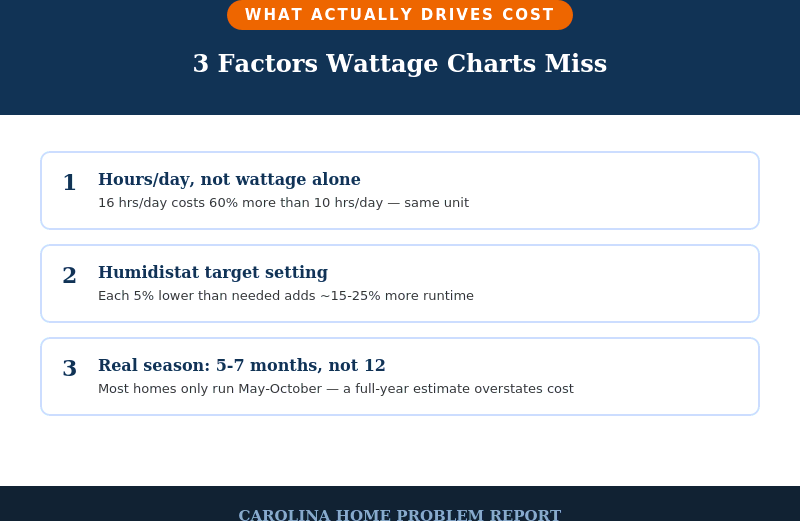
The actual runtime difference matters more than most model-to-model wattage differences: a unit running 16 hours a day is doing 60% more work (and using 60% more electricity) than the identical unit running 10 hours a day — simple arithmetic, but it's the single biggest lever most cost calculators never mention, because fixing whatever is forcing the longer runtime usually saves more than switching to a nominally "more efficient" model.
Wattage by Capacity: What You're Actually Paying For
Before runtime even enters the picture, capacity sets the baseline wattage draw. A compact 20-30 pint unit typically draws 250-350 watts; a mid-size 30-50 pint unit draws roughly 350-550 watts; a large 50-70 pint unit (common for a damp basement) draws 550-800 watts; and a whole-home ducted system rated
70+ pints draws 800-1,000 watts. These ranges (see the table above) are the starting input for any real cost estimate — but as the sections below show, wattage alone tells you less than wattage multiplied by realistic hours and realistic months.
A Real Dehumidifier Cost To Run Example for NC Homes
North Carolina's average residential electricity rate is 14.74¢ per kWh as of September 2026 — about 20% below the U.S. average, which matters because most generic online cost calculators default to a national average rate that overstates what Carolina homeowners actually pay. Running the numbers at the actual NC rate: a naive 24/7, 12-month calculation for a 500-watt mid-size unit works out to roughly $645 a year.
The same unit, correctly sized and cycling realistically — figure roughly 10-12 hours a day during an actual 5-7 month humid season rather than running continuously year-round — lands closer to $110-$190 for the season, depending on exactly how many hours and months apply to your situation. That's a naive estimate running 3-6 times higher than what a correctly operating system actually costs.
The hour and month figures in that example are illustrative, typical ranges for a correctly-sized, correctly-set unit — not a guarantee for every home — but the wattage figures and the 14.74¢/kWh NC rate behind the dollar amounts are both independently verified. Use the capacity table above to swap in your own unit's actual wattage (check the nameplate or spec sheet) for a more precise number.
The Humidistat Setting Is a Real Cost Lever
This is the detail almost no cost calculator accounts for: your target humidistat setting directly drives runtime. The EPA's own guidance sets the target range plainly: "keep indoor humidity below 60 percent (ideally between 30 and 50 percent) relative humidity." HVAC industry guidance adds the cost-relevant part of that same advice: "set it to 50%, not lower... every point lower means more run time for little benefit."
Chasing an unnecessarily low humidity target — the same over-aggressive instinct covered from the crawl-space-setup side in our crawl space dehumidifier guide — doesn't just waste energy in the abstract; it adds real, avoidable runtime without meaningfully better protection once you're already inside
the EPA's 30-50% range. If you're currently running your unit to hit 35% "to be safe," moving the target up to 45-50% is one of the few cost adjustments that costs nothing to try and has essentially no downside for mold or moisture control.
Seasonal Runtime, Not Year-Round
Another correction to a flat annual estimate: most homes don't run a dehumidifier at anything close to a constant rate all year. Industry cost guidance frames this as a choice between three realistic scenarios: "humid season only" (roughly 4 months), "spring through fall" (roughly 7 months), or year-round (12 months)
for a space with a persistent moisture problem. For most Carolina homes without an active water-intrusion issue, the 4-7 month range is the realistic one — which tracks with the region's humid subtropical climate pattern already covered in our summer humidity guide.
A basement or crawl space with a genuine year-round moisture source (a high water table, a persistent plumbing leak, poor grading) is the exception where 12-month operation is actually the correct, not excessive, answer — but for a normally damp space, a cost estimate built on 12 months of operation will substantially overstate your actual annual electricity spend compared to one that reflects the real 4-7 month operating season.
Does a Dehumidifier Affect Your AC or Heating Bill?
Most cost calculators treat a dehumidifier's electricity use in isolation, but a standard refrigerant-based unit produces waste heat as a byproduct of the compressor cycle — the same basic mechanism as a window air conditioner, just without venting the heat outside. In summer, that waste heat is released into the same conditioned space your AC is cooling, which means your air conditioner does a small amount
of extra work to remove it — a real but generally minor interaction most homeowners never think to account for. In winter, that same waste heat is a small, incidental benefit rather than a cost, since it's heat your furnace or heat pump doesn't have to generate. Neither effect is large enough to materially change the cost estimates above, but it's worth knowing the two appliances aren't operating in complete isolation from each other.
Why Efficiency (IEF) Still Matters, Even With All This
None of this makes unit efficiency irrelevant — it just means efficiency is one input among several, not the whole picture. As covered in our whole home dehumidifier guide, the integrated energy factor (IEF) measures liters of water removed per kWh — a higher number means genuinely lower cost for the same moisture removal, all else equal.
But a highly efficient unit running an unnecessary number of hours because of an overly aggressive humidistat setting can still cost more than a less efficient unit running a correctly calibrated schedule.
Efficiency rating and actual runtime behavior are two separate levers, and both need attention to control real cost — including the genuinely counter-intuitive case where a correctly-sized larger unit costs less overall than an undersized smaller one that has to run far longer to do the same job.
Lowering Your Dehumidifier Cost To Run Before You Buy
If operating cost is part of your buying decision (not just upfront price), confirm:
- The unit's actual wattage — check the nameplate, not just the pint rating, since two units with the same capacity can draw different wattage.
- Whether it's genuinely correctly sized for your space (see our dehumidifier sizing guide) — an undersized unit running long hours almost always costs more than a correctly sized one.
- The IEF rating if comparing two units of similar capacity — a meaningfully higher IEF lowers real running cost.
- Your realistic operating season — 4-7 months for most Carolina homes, 12 months only if there's a genuine persistent moisture source.
- Your humidistat target — 45-50%, not lower, unless a specific problem requires otherwise.
Note: we don't currently link to specific dehumidifier models or retailers in this section. Once we do, this is where a side-by-side IEF/wattage comparison table will go.
Putting This Together With Our Other Content
This article explains what actually drives your electricity cost up or down, regardless of which specific unit you choose. For a detailed cost comparison between specific dehumidifier models, our best dehumidifier for NC/SC guide covers that side of the decision, and our dehumidifier sizing guide covers getting the capacity decision right in the first place — getting sizing wrong is one of the most common reasons actual running cost ends up far higher than expected.
Frequently Asked Questions
How much does it actually cost to run a dehumidifier in North Carolina?
At NC's 14.74¢/kWh average rate, a correctly sized and operated mid-size unit typically runs $110-$190 for a realistic 5-7 month season — well below what a naive 24/7, 12-month calculation (often $600+) would suggest.
Is it normal for a dehumidifier to run constantly?
Not for a correctly sized unit in a normal space. Genuine 24/7 operation that never cycles off usually points to an undersized unit, active water intrusion, or ongoing air leaks — worth investigating rather than accepting as the cost of doing business.
Does setting my dehumidifier lower than 50% actually cost more?
Yes. The EPA's own target range is 30-50% (below 60% at minimum), and industry guidance is direct that every point below 50% adds runtime "for little benefit" once you're already inside that safe range.
Will running a dehumidifier raise my air conditioning bill?
Slightly, in summer — a refrigerant dehumidifier releases waste heat into the space, which your AC then has to remove. The effect is generally minor relative to the dehumidifier's own electricity cost, but it isn't zero.
🏠 CAROLINA LOCAL SUMMARY
The Bottom Line on Dehumidifier Cost To Run in NC/SC:
- Use NC's actual 14.74¢/kWh rate, not a national-average figure, for any cost estimate.
- Set your humidistat to 45-50%, not lower — it costs real money with no real benefit once you're already under 60%.
- Estimate cost over a realistic 4-7 month season, not a full year, unless you have a genuine year-round moisture source.
- Treat constant 24/7 runtime as a signal to investigate sizing or leaks, not a normal operating cost.
Get the capacity decision right first with our dehumidifier sizing guide — it's the single biggest factor behind an unexpectedly high electricity bill.
About the Author
This guide was researched using EPA indoor humidity guidance, published HVAC industry guidance on duty cycles and seasonal operating scenarios, and a verified current North Carolina average electricity rate, cross-referenced against Carolina Home Problem Report's own dehumidifier sizing and climate documentation, to explain the cost drivers most wattage-based calculators leave out.