How to Reduce Home Humidity: The Full Toolkit (Not Just “Open a Window”)
Learning how to reduce home humidity means combining behavior changes (venting bathrooms, fixing habits that add moisture), passive fixes (drying racks outdoors, sealing gaps), and mechanical solutions (AC, dehumidifiers) matched to the actual scale of the problem. One piece of near-universal national advice doesn't apply well here, though: "open a window for fresh air" is genuinely bad advice in a Carolina home for most of the humid season, since outdoor air is often more humid than the air already inside. Below is the full toolkit, organized by what actually works and when — not a generic list that ignores what season it is.
⭐ Key Takeaways
- ✓"Open a window" is common national advice that backfires in a Carolina home whenever outdoor humidity is higher than indoor — which is most of the humid season, not a rare exception
- ✓Free behavior fixes (venting exhaust fans outdoors, drying laundry outside, lidded cooking) genuinely move the needle for mild cases and cost nothing
- ✓Desiccants (silica gel, calcium chloride) work for small enclosed spaces like closets, not a room or a house
- ✓If the problem is whole-house and persistent rather than one room or one season, the fix that actually solves it is almost always mechanical (dehumidification) or structural (crawl space), not a behavior change
In This Article
Why "Open a Window" Backfires Here
Nearly every national humidity-reduction guide includes some version of "open a window for fresh air" as a top tip. That advice comes from a climate assumption that doesn't hold in North or South Carolina for a large part of the year: it only helps when outdoor air is drier than indoor air. In a humid subtropical climate, outdoor relative humidity commonly runs 60-90% through spring, summer, and early fall — often higher than a home's indoor air, especially if the AC has been running. Opening a window on one of those days doesn't ventilate humidity out; it lets more of it in.
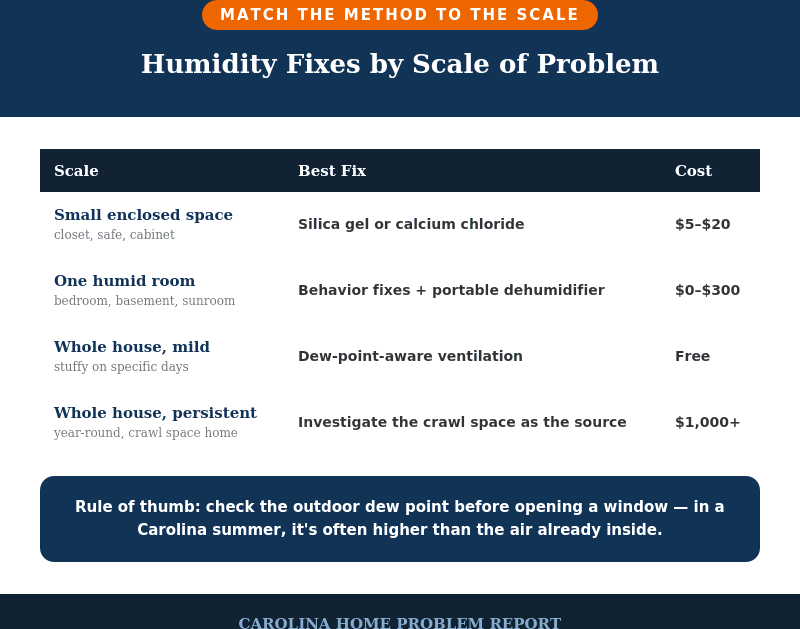
The exception: a mild, low-dew-point day — often in fall or spring — where outdoor air is genuinely drier and cooler than what's built up indoors. On those days, cross-ventilation is a real, free way to reset a stuffy room. The practical rule: check the outdoor dew point (most weather apps show it) before opening up — if it's above the mid-60s°F, keep the windows closed and use a different fix from this list instead.
Free and Near-Free Behavior Fixes
These won't solve a serious whole-house problem, but they genuinely reduce moisture load for mild cases and cost nothing to try first:
- Vent bathroom and kitchen exhaust fans outdoors, not into the attic. Run them during and for 20 minutes after showering or cooking — a single shower can add a pint or more of water vapor to the air.
- Dry laundry outside or vent the dryer outdoors. An indoor drying rack can add several pints of moisture to a room per load — meaningful in a small space.
- Cover pots while cooking. A simmering, uncovered pot releases significant water vapor over time; a lid cuts that dramatically.
- Fix dripping faucets and check under sinks. A slow, unnoticed leak can quietly push a room's humidity up for months before anyone traces the cause.
- Move houseplants out of bedrooms if you're plant-heavy. Plants release moisture through transpiration — a few plants in a small, closed bedroom can measurably raise overnight humidity.
- Take shorter, cooler showers. A long hot shower generates far more steam than a quick warm one — cutting shower length is a genuinely free way to reduce the single biggest moisture spike most bathrooms see each day.
- Keep gutters clean and grade soil away from the foundation. This one's easy to overlook because it feels like an outdoor chore, not a humidity fix — but water pooling against the foundation or dumping near a crawl space vent from a clogged gutter is a direct, avoidable moisture source feeding the space right under your floor.
Small-Space Moisture Absorbers
Desiccants work by chemically or physically binding moisture out of the air in a small, enclosed volume — a closet, a gun safe, a car interior, a cabinet under a sink. They are not a substitute for a dehumidifier in an open room or a whole floor, where far more air volume needs continuous treatment than a jar of crystals can handle.
Mechanical Fixes: AC, Fans, and Dehumidifiers
- Run the AC on a normal cooling cycle, not just fan-only. Fan-only mode moves air but removes no moisture — it can actually push already-collected condensate back into the airstream on some systems.
- Use a standalone fan to even out room-to-room differences, especially between a humid below-grade room and the rest of the house — but a fan alone doesn't remove moisture, only redistributes air.
- A portable dehumidifier is the right scale for one persistently humid room — a basement, a below-grade bedroom, a sunroom — see our dehumidifier buying and sizing guide for options matched to room size.
- If the problem is whole-house, check whether a crawl space is the actual source before investing in room-by-room fixes — treating the source is usually more cost-effective than treating every symptom room separately.
Which Fix for Your Situation
Frequently Asked Questions
Does running a ceiling fan reduce humidity?
No — a fan redistributes air and can make a room feel less sticky by improving evaporative cooling on skin, but it doesn't remove moisture from the air. It's a comfort fix, not a humidity fix.
Do houseplants reduce humidity or add to it?
Most common houseplants add humidity through transpiration, not reduce it — the popular "air-purifying plants reduce humidity" claim is largely a myth for typical indoor plant quantities. A few plants in a large, well-ventilated room won't matter much; a lot of plants in a small closed bedroom can measurably raise overnight humidity.
Is it better to run the AC or a dehumidifier?
They solve different problems. AC cools the air and removes some moisture as a byproduct, but a correctly sized system doesn't run long enough on mild days to dehumidify well. A dehumidifier removes moisture regardless of temperature, which is why a home can need both — AC for heat, a dehumidifier for the humidity the AC's short cycles leave behind.
How quickly do these fixes actually work?
Behavior fixes (venting, drying habits) show a measurable difference within a day or two. A correctly sized portable dehumidifier typically brings a room into range within a few days of continuous operation. A whole-house crawl space source usually takes one to two weeks to fully stabilize once treated.
Can I combine several of these methods at once?
Yes, and for most homes that's the realistic approach — behavior fixes cost nothing and stack well with a portable dehumidifier or AC adjustments. The one combination to avoid is opening windows while also running a dehumidifier or AC, which works against both.
My dehumidifier runs constantly but humidity is still stuck above 60% — why?
This usually means one of two things: the unit is undersized for the actual moisture load, or there's an ongoing intrusion source (a crawl space with standing water, an active leak, groundwater seeping through a foundation crack) putting in moisture faster than a room-sized unit can remove it. A dehumidifier that never catches up despite running around the clock is a sign to stop troubleshooting the appliance and start investigating the structure — especially the crawl space — rather than assuming a bigger or better unit alone will fix it.
🏠 CAROLINA LOCAL SUMMARY
Key Facts on Reducing Home Humidity in a Carolina Home:
- "Open a window" backfires most of the humid season here — check the outdoor dew point before assuming it will help.
- Free behavior fixes (exhaust fans, drying habits, lidded cooking) genuinely help mild cases at no cost.
- Desiccants work for small enclosed spaces only — not a room, and not a house.
- A persistent whole-house problem is almost always mechanical or structural, most often traced to the crawl space in this region.
- Combining fixes is fine — except opening windows while running a dehumidifier or AC, which cancels both out.
Carolina Home Problem Report Editorial Team RESEARCH TEAM
The Carolina Home Problem Report editorial team researches and writes guides for homeowners across North and South Carolina. Climate and humidity guidance in this article reflects North Carolina's humid subtropical climate as documented in NOAA's North Carolina State Climate Summary. We are not contractors or HVAC technicians — we are a research team dedicated to giving Carolina homeowners clear, unbiased answers.
Carolina Home Problem Report is an informational resource for homeowners. We are not licensed contractors or HVAC technicians. Always consult a qualified professional before making home repair decisions. See our Disclaimer and Affiliate Disclosure.