Indoor Air Quality Problems — Complete Guide to Causes, Signs, and Fixes
You can't see most of what's actually wrong with the air in your own house. According to the EPA, people in industrialized nations spend more than 90% of their time indoors — which means the air quality inside your home matters more to your day-to-day health than the air outside it, even though it's the one you think about the least.
Indoor air quality problems rarely announce themselves with a smell or a visible cloud; they show up as a headache that won't go away, allergies that seem worse at home than anywhere else, or a kid who coughs more in their bedroom than at school.
This guide covers every angle of indoor air quality problems: what actually causes them, how to recognize the signs, what they do to your health if left alone, and which fixes genuinely work versus which ones just move the problem around.
Below, you'll also find direct links to our full library of in-depth guides on each specific cause, symptom, and fix.
The practical takeaway: if your allergy or fatigue symptoms seem to spike specifically in January or February rather than during pollen season, don't rule out indoor air quality just because it's cold and the windows are shut — shut windows are often exactly the problem.
Quick Answer: Indoor air quality problems exist when pollutant levels inside a home — dust, allergens, mold spores, humidity, volatile organic compounds (VOCs), or combustion byproducts — build up faster than they're removed through ventilation or filtration.
The EPA has found indoor VOC levels running up to 10 times higher than outdoor levels in some homes. There's no single number like a thermostat setting; instead, IAQ problems are identified by a combination of symptoms, sources, and — ideally — actual air quality testing.
Most problems are fixable with source control first, then ventilation, then filtration.
Key Takeaways:
- The EPA reports people spend over 90% of their time indoors, and indoor VOC levels can run up to 10x higher than outdoor levels — making indoor air quality a bigger day-to-day health factor than most homeowners realize.
- Indoor air quality problems usually trace back to one of five sources: off-gassing from everyday materials, combustion byproducts, dust and allergens, the humidity/mold connection, or simply not enough fresh-air exchange.
- Where the problem hides matters as much as what's causing it — a crawl space, attic, or HVAC ductwork can be the real source even when the symptom shows up in a bedroom two floors away.
- Symptoms often show up as "unexplained" fatigue, headaches, or worsening allergies before anyone thinks to question the air itself.
- The fix order matters: source control first, then ventilation, then filtration — reaching for an air purifier before addressing the actual source treats the symptom, not the cause.
Table of Contents
- What Actually Counts as Indoor Air Quality Problems
- The Real Causes of Indoor Air Quality Problems
- How to Know Your Home Has an Air Quality Problem
- What Poor Indoor Air Quality Actually Does to Your Health
- Where Air Quality Problems Hide in Your Home
- Why It's Worse in Carolina Winters
- How a Minor Air Quality Problem Becomes a Major One
- How to Actually Fix Indoor Air Quality Problems
- When to Call a Professional
- Explore Every Indoor Air Quality Topic
- Frequently Asked Questions
What Actually Counts as Indoor Air Quality Problems
Indoor air quality problems don't have a single threshold the way humidity does with its 30-50% EPA benchmark. Instead, the EPA defines indoor air quality (IAQ) as "the air quality within and around buildings and structures, especially as it relates to the health and comfort of building occupants" — a definition built around occupant health rather than one measurable number. That's part of why IAQ problems are so easy to miss: there's no single gauge to check the way there is with a thermostat or a hygrometer. What does count as a real problem is a meaningful, sustained buildup of one or more pollutant categories — dust and allergens, volatile organic compounds (VOCs) from materials in the home, combustion byproducts, mold spores, or excess humidity feeding all of the above — faster than your home's ventilation and filtration can remove them. The EPA's own research found that a study spanning six U.S. communities measured indoor VOC levels running up to ten times higher than outdoor levels in the same area, which is a useful reminder that "it smells fine in here" is not the same thing as "the air in here is fine."The Real Causes of Indoor Air Quality Problems
As with most home problems we cover, it's rarely one single cause. In most homes, it's two or three of the following stacking on top of each other:1. Off-Gassing From Everyday Materials
New paint, new flooring, pressed-wood furniture, carpet adhesive, and household cleaning products all release volatile organic compounds into the air for weeks or months after installation or purchase — a process called outgassing. It's strongest right after a renovation or new furniture purchase, then tapers off, which is why a "new house smell" or "new furniture smell" is actually a VOC signal, not a neutral one.2. Combustion Byproducts
Gas stoves, fireplaces, unvented space heaters, and attached garages all introduce combustion byproducts — including carbon monoxide and carbon dioxide — directly into living space, especially without adequate venting. Secondhand tobacco smoke, a form of what researchers classify as passive smoking, falls into this same category and is one of the most thoroughly documented indoor combustion pollutants. We cover the carbon dioxide side of this specifically in CO2 levels in home.3. Dust, Allergens, and Pet Dander Buildup
Dust isn't just dead skin — it's a mix of fibers, soil particles, pollen, dust mite waste, and pet dander that accumulates fastest in carpets, bedding, and HVAC ductwork. Once airborne, it's one of the most immediate triggers for allergy and asthma symptoms. Full breakdown of where household dust actually comes from is in dust in house causes, and the allergy connection specifically is covered in indoor allergy triggers.4. The Humidity and Mold Connection
Humidity and indoor air quality are deeply linked — excess moisture feeds mold growth, and mold spores are one of the most disruptive IAQ pollutants once airborne. A crawl space or basement with a moisture problem can quietly degrade air quality two floors away. We cover this connection in full in IAQ and humidity and IAQ and mold.5. Poor Ventilation and Stale Air
None of the pollutant sources above are a serious problem in a well-ventilated home — they only build to problem levels when there isn't enough fresh-air exchange to dilute and remove them. Modern, tightly sealed homes built for energy efficiency are especially prone to this, since the same sealing that keeps conditioned air in also keeps stale, pollutant-laden air from getting out. See stale air in home and ventilation and IAQ for the full mechanism.How to Know Your Home Has an Air Quality Problem
Because there's no single gauge, spotting an IAQ problem means paying attention to a cluster of signals rather than one obvious sign:- Symptoms that improve when you leave the house and return when you're back — headaches, nasal congestion, or fatigue that seem tied to being home rather than a general illness.
- Excess dust buildup on surfaces, vents, and furniture faster than normal cleaning habits would explain.
- Musty or chemical odors that linger rather than clearing after cleaning or airing out a room.
- Visible condensation or mold in bathrooms, closets, or around windows — a strong sign humidity is compounding the problem.
- Worsening allergy or asthma symptoms specifically at home, especially in a particular room rather than throughout the house.
What Poor Indoor Air Quality Actually Does to Your Health
The EPA separates the health effects of indoor air pollutants into two distinct categories, and the distinction matters for how seriously to take early signs:- Immediate effects. Per the EPA, these "may show up shortly after a single exposure or repeated exposures to a pollutant," and include "irritation of the eyes, nose, and throat, headaches, dizziness, and fatigue" — exactly the kind of symptoms that get dismissed as unrelated to the house itself.
- Long-term effects. The EPA notes some health effects "may show up either years after exposure has occurred or only after long or repeated periods of exposure," and that these "include some respiratory diseases, heart disease and cancer" in cases of severe, sustained exposure.
Where Air Quality Problems Hide in Your Home
Indoor air quality problems rarely originate in the room where you notice them: Crawl spaces and basements feed moisture, mold spores, and sometimes soil gases upward into the living space through the stack effect — a mechanism we cover fully in crawl space and indoor air. HVAC ductwork circulates whatever it's carrying — dust, mold spores, pollen — to every room the system serves, which is why a dirty or leaky duct system can turn a one-room problem into a whole-house one. See HVAC and air quality for the full picture. Older building materials can also be a hidden source — homes built or renovated before the 1980s may contain asbestos in insulation, flooring, or ceiling materials, which is harmless until disturbed by renovation or deterioration, at which point it becomes an airborne hazard requiring professional abatement rather than a DIY fix. Attached garages are an easy-to-overlook source, especially in homes where the garage shares a wall, door, or even just HVAC return air with the living space. Idling vehicles, stored gasoline or solvents, and gas-powered yard equipment all generate fumes that can migrate indoors through gaps around the connecting door, through a garage-mounted HVAC return, or simply when the door between garage and house stays open longer than a quick pass-through. Weatherstripping that connecting door and never idling a vehicle with the garage door shut are two of the simplest fixes on this entire list.Why It's Worse in Carolina Winters
Unlike house humidity problems, which peak with the Carolinas' humid summers, indoor air quality problems tend to get worse in winter — for almost the opposite reason. Homes get sealed tighter to hold in heat, windows stay closed for months at a time, and combustion heating sources (gas furnaces, fireplaces, space heaters) see far more use, all while natural fresh-air exchange drops to its lowest point of the year.| Season | Typical Ventilation Behavior | Dominant IAQ Risk |
|---|---|---|
| Winter (Dec-Feb) | Lowest fresh-air exchange; windows sealed for heat retention. | Combustion byproducts and stale air build up fastest; VOCs linger longer indoors. |
| Fall / Spring | Moderate; windows open more often. | Pollen infiltration becomes the bigger factor for allergy sufferers. |
| Summer (Jun-Sep) | Windows closed for AC; same recirculated air runs constantly. | Humidity-driven mold risk compounds with whatever the AC filter isn't catching. |
How a Minor Air Quality Problem Becomes a Major One
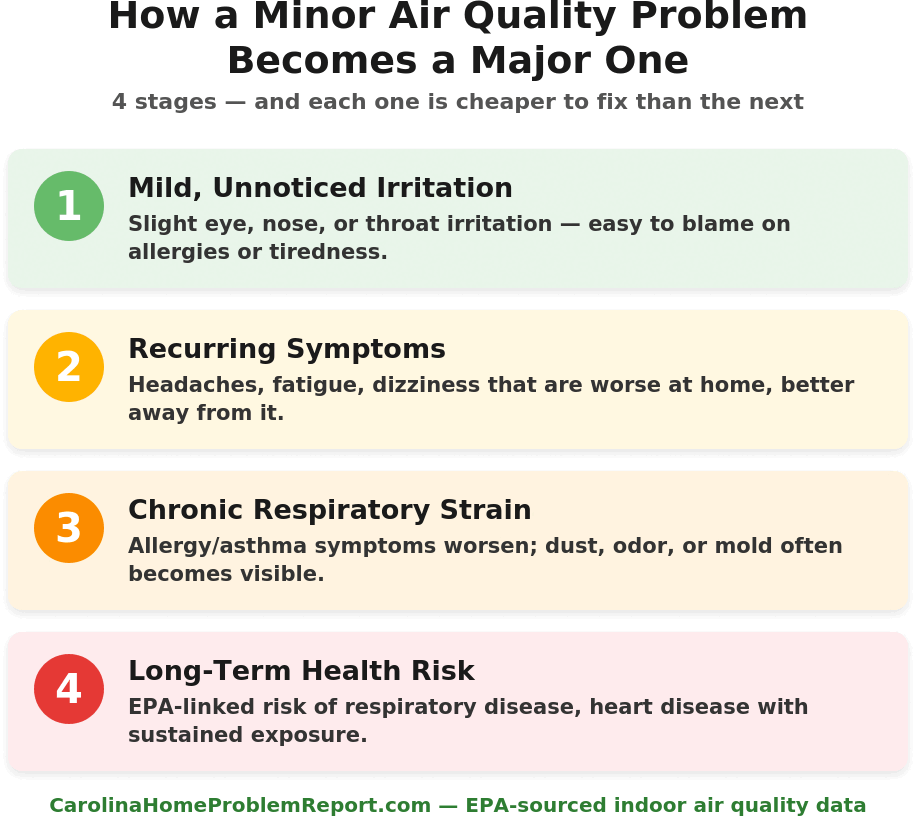
Like most home problems on this site, indoor air quality issues escalate in stages rather than arriving all at once:- Stage 1 — Mild, unnoticed irritation. Slight eye, nose, or throat irritation that's easy to attribute to something else entirely — allergy season, a cold, tiredness.
- Stage 2 — Recurring symptoms. Headaches, fatigue, or dizziness start showing a pattern — worse at home, better away from it — matching the EPA's "immediate effects" category above.
- Stage 3 — Chronic respiratory strain. Allergy and asthma symptoms worsen noticeably, illness becomes more frequent, and visible signs (dust buildup, musty odor, or mold) usually appear around this stage too.
- Stage 4 — Long-term health risk. Per the EPA's long-term effects category, sustained exposure at this stage is associated with real risk of respiratory disease, heart disease, and other serious conditions — the stage every earlier one exists to help you avoid.
How to Actually Fix Indoor Air Quality Problems
The right fix depends on which cause from the list above actually applies to your home, but the order of operations that works best is consistent:- Source control first. Identify and reduce the actual pollutant source — ventilate a gas stove properly, let new furniture off-gas in a garage before bringing it inside, fix a crawl space moisture issue at the root.
- Improve ventilation second. Make sure exhaust fans vent outside (not into the attic), and consider a dedicated ventilation strategy if the home is tightly sealed — see ventilation and IAQ for specifics.
- Address HVAC performance. A dirty filter or leaky ductwork can undermine every other fix — full detail in HVAC and air quality.
- Add filtration last, not first. A portable HEPA air purifier is genuinely useful for mold spores, dust, and allergens, but it treats the symptom, not an active source — see choosing an air purifier for mold for sizing and selection guidance.
When to Call a Professional
Most indoor air quality problems are diagnosable and at least partially fixable by a homeowner. Before deciding whether this is a DIY fix or a professional job, a few low-cost tools can tell you a lot: a plug-in carbon monoxide detector (required safety equipment near any gas appliance regardless of IAQ concerns), a basic VOC/particulate monitor in the $30-$80 range, and simply tracking when symptoms happen relative to where you are in the house. These won't replace a professional IAQ assessment, but they're enough to tell you whether you're dealing with a combustion issue, a dust/allergen issue, or something that needs lab testing. Call a professional (HVAC technician, home inspector, or an asbestos/mold remediation specialist depending on the cause) when symptoms persist despite basic fixes, or you suspect a combustion appliance is backdrafting carbon monoxide or carbon dioxide into the home. You should also call one if you find or suspect asbestos-containing material has been disturbed, or if visible mold growth accompanies the symptoms.Explore Every Indoor Air Quality Topic
This guide covers the full landscape. For the complete depth on any specific cause, symptom, or fix, use the guides below — grouped by what you're actually trying to figure out.Symptoms and Health Effects
Dust, Allergens, and Mold
The Humidity and Crawl Space Connection
Ventilation and Air Movement
HVAC and Filtration Solutions
Frequently Asked Questions
What counts as an indoor air quality problem in a house?
A sustained buildup of one or more pollutant categories — dust, allergens, VOCs, combustion byproducts, mold spores, or excess humidity — faster than your home's ventilation and filtration can remove them. There's no single number to check; it's identified through symptoms, sources, and ideally direct testing.Can indoor air really be worse than outdoor air?
Yes. The EPA has measured indoor VOC levels running up to 10 times higher than outdoor levels in the same community, and since people spend over 90% of their time indoors, that gap matters more than it might seem.Does an air purifier fix indoor air quality problems?
It helps with airborne particles like dust, pollen, and mold spores, but it doesn't address the source — a leaking crawl space, an unvented gas appliance, or off-gassing furniture. See air purifier for mold for when filtration genuinely helps versus when it's treating a symptom.Why does indoor air quality get worse in winter?
Homes get sealed tighter to retain heat, windows stay shut for months, and combustion heating sources see more use — all while natural fresh-air exchange drops to its lowest point of the year.Is new furniture or paint smell actually a health concern?
Yes, to a degree — that smell is largely volatile organic compounds off-gassing from the material, strongest right after installation or purchase and tapering off over weeks to months. Ventilating the room well during that period measurably reduces exposure.For NC and SC Homeowners: If your air quality problem seems tied to your crawl space, HVAC system, or you're not sure where to start, our Find Help directory can point you toward the right type of local professional for your specific situation.