Air Purifier For Mold: What EPA Says It Actually Fixes
Quick Answer
An air purifier for mold has one genuinely useful job — mechanically capturing airborne spores as air passes through a HEPA filter — and several jobs it can't do, according to EPA's own guidance: it doesn't kill mold effectively (EPA says typical UV/UVGI units have "limited effectiveness in killing bacteria and molds"), it doesn't reach a colony growing on drywall or subfloor, and dead spores can still trigger allergic reactions even after a purifier catches them. EPA is also direct that ozone generators — sometimes marketed as a purifier feature — "do not effectively remove... mold" at safe concentrations. An air purifier for mold belongs in the "while we fix this" phase of a mold problem, not in place of finding and fixing the moisture source.
Table of Contents
- What EPA Actually Says About an Air Purifier for Mold
- The Real Function of an Air Purifier for Mold
- Skip the Ozone and "Ionizing" Mold-Killing Claims
- Why This Matters More in a Carolina Crawl Space
- EPA's 10-Square-Foot Rule: When It's a Professional Job
- Sizing an Air Purifier for Mold Correctly, If You Buy One
- Placement and Timing That Actually Matter
- When an Air Purifier Is Actually Worth Buying
- What to Look For When Buying an Air Purifier for Mold
- Frequently Asked Questions
Key Takeaways
- EPA: typical UV/UVGI air cleaners have "limited effectiveness in killing bacteria and molds," and dead spores can still cause allergic reactions even after being neutralized.
- A HEPA air purifier's real job is mechanical — capturing airborne spores as they pass through the filter — not reaching or killing a mold colony on a surface.
- EPA is explicit that ozone generators don't effectively remove mold at safe concentrations, and the levels needed to be effective are a genuine health hazard.
- EPA's own rule of thumb: mold covering less than about 10 square feet is typically a DIY job; beyond that, or with significant water damage, hire a professional.
- AHAM's certification standard targets 4.8 air changes per hour (ACH) for a purifier's rated room size — a concrete number to check instead of relying on marketing claims.
- The right time to buy one: after the mold source is being (or has been) addressed, not as the primary response to an active, unaddressed mold problem.
| Claim | What EPA Actually Says |
| "UV purifiers kill mold in the air" | "Limited effectiveness in killing bacteria and molds" — EPA |
| "Ozone/ionizer purifiers clean mold from the air" | Doesn't effectively remove mold at safe concentrations; effective levels are a health hazard — EPA |
| "A HEPA purifier fixes a mold problem" | Captures airborne spores mechanically; has no effect on a surface colony — source control is the real fix, per EPA |
What EPA Actually Says About an Air Purifier for Mold
The U.S. Environmental Protection Agency's own guidance on air cleaners in the home is more cautious than most product marketing suggests. Two findings matter most for anyone considering an air purifier specifically for a mold problem.
First, on the devices marketed hardest for mold and allergen control — ultraviolet germicidal irradiation (UVGI) air cleaners — EPA states plainly that "typical UVGI cleaners used in homes have limited effectiveness in killing bacteria and molds." That directly contradicts marketing copy implying UV purifiers "kill" mold in the air.
Second — and this is the part almost no product page mentions — EPA notes that "dead mold spores can still produce allergic reactions, so UVGI cleaners may not be effective in reducing allergy and asthma symptoms." Killing a spore and eliminating its health effect are two different problems, and a purifier that solves the first one doesn't automatically solve the second.
The Real Function of an Air Purifier for Mold

None of this means an air purifier for mold is useless — it means its job is narrower than "fix the mold problem." A true HEPA filter captures 99.97% of particles at 0.3 microns, and airborne mold spores typically range from about 1 to 20 microns depending on species — comfortably within what HEPA media physically traps as air passes through it. That's a genuinely useful function while you're addressing an active mold source: it can reduce the concentration of spores circulating through a room in the meantime.
What it does not do is reach the mold itself. Mold grows on a surface — drywall, subfloor, framing, insulation — wherever a moisture source feeds it, and an aggressive genus like Stachybotrys (often called "black mold") colonizes exactly this way, on the surface itself, not in the air. An air purifier filters the room's air; it has no effect on a colony sitting behind a wall or under a house. EPA's broader guidance makes this same point in general terms: "the best way to address this risk is to control or eliminate the sources of pollutants." An air purifier is a supplement to that work, not a substitute for it.
Skip the Ozone and "Ionizing" Mold-Killing Claims
Beyond UV, some units marketed for mold lean on ozone generation or "ionizing" technology, framed as actively destroying mold rather than just filtering it. EPA has tested this claim directly and is unambiguous: "if used at concentrations that do not exceed public health standards, ozone applied to indoor air does not effectively remove... mold." Getting ozone to actually decontaminate air would require concentrations "5 to 10 times higher than public health standards allow" — levels EPA associates with chest pain, coughing, shortness of breath, and throat irritation, and which can worsen asthma.
In plain terms: the ozone concentration that's safe to breathe doesn't work against mold, and the concentration that might work isn't safe to breathe. That's a genuine safety consideration, not just a performance one — it's worth ruling out any unit that leads with ozone or "ionizing" mold-killing as its main selling point, regardless of price or reviews.
Why This Matters More in a Carolina Crawl Space
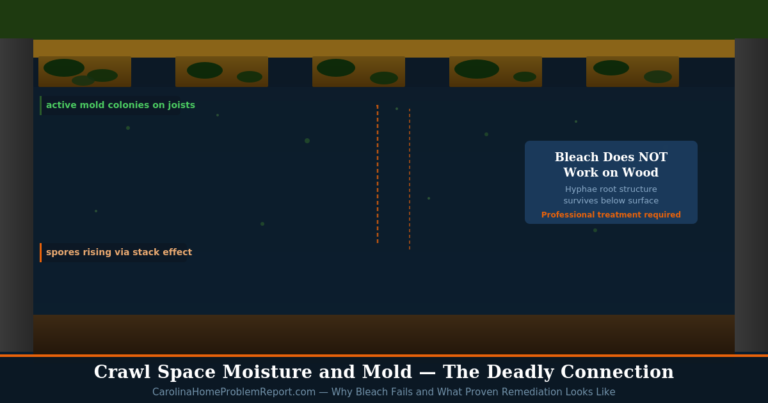
This distinction matters most for the most common mold location in this region: the crawl space. A portable air purifier placed upstairs, in a living room or bedroom, is filtering the air in that room — it has no access to a crawl space's air at all unless there's a direct pathway (like the stack-effect pathway covered in our crawl space and upstairs humidity guide) actively pulling crawl space air upward.
Running an air purifier in the living room while an active mold colony sits untouched under the floor treats a symptom several rooms away from its source — the spores keep being produced below, and the purifier can only ever catch a fraction of what makes it upstairs.
If mold is confirmed in a crawl space, the sequence that actually resolves it is the one covered in our mold in crawl space guide: identify the moisture source, remediate the existing growth, then prevent recurrence — typically with encapsulation and a dehumidifier running continuously. An air purifier for mold has no role in that sequence except as short-term relief for the living space while the real work happens.
EPA's 10-Square-Foot Rule: When It's a Professional Job
EPA's own mold cleanup guidance gives a concrete threshold that's directly relevant to deciding whether an air purifier is even a reasonable supplement right now: "if the moldy area is less than about 10 square feet (less than roughly a 3 ft. by 3 ft. patch), in most cases, you can handle the job yourself." Beyond that size, or with significant water damage, sewage contamination, or HVAC system contamination, EPA recommends hiring an experienced contractor instead.
This matters for an air-purifier decision specifically: a small, DIY-scale patch is exactly the situation where running a purifier alongside the cleanup makes sense. A patch that clears EPA's 10-square-foot threshold, or a crawl space colony of unknown size, calls for professional assessment first — buying a purifier before that assessment risks treating a problem that turns out to be much bigger than a filter (or even a homeowner) can reasonably handle.
Sizing an Air Purifier for Mold Correctly, If You Buy One
Most air purifier marketing leans on the HEPA label alone, but filter type isn't the only thing that determines whether a unit actually clears a room's air at a useful rate. The Clean Air Delivery Rate (CADR) and the room size a unit is rated for matter just as much. AHAM, the industry certification body, tests and certifies air cleaners to deliver 4.8 air changes per hour (ACH) for their stated room size — meaningfully above the roughly 3 ACH that indoor air quality researchers consider a minimum ventilation benchmark.
In practice, that means checking a unit's rated room size against the actual room it'll run in (not the largest room in the house it could theoretically cover), and favoring an AHAM Verifide-certified model over one that only advertises "HEPA" without a CADR number or room-size rating. A HEPA filter that's undersized for the room, or run in a much larger space than it's rated for, delivers far fewer effective air changes per hour than the filter type alone would suggest.
Placement and Timing That Actually Matter
Two practical details get less attention than filter type, but change how much benefit a purifier actually delivers. Placement: a unit does the most good in the specific room where exposure is highest (the bedroom of a sensitive household member, or the room closest to a confirmed source), not centrally located to theoretically cover the whole house — a single portable purifier can't meaningfully clear air in rooms it isn't in, regardless of CADR rating.
Timing matters too, particularly around active remediation work: disturbing an existing colony (removing moldy drywall, scrubbing a surface) temporarily spikes airborne spore counts well above baseline as growth that had been undisturbed gets physically dislodged. Running a purifier in the work area during and immediately after that kind of work — not just as an ongoing background appliance — is when its spore-capturing function has the most to actually catch.
When an Air Purifier Is Actually Worth Buying
An air purifier for mold makes the most sense in a specific, narrower situation: during and immediately after active remediation work, after the mold source has been remediated and the moisture problem fixed while lingering spore counts settle back down, or for a household member with heightened sensitivity who wants extra filtration in a bedroom during that period. Used this way, it's a genuinely reasonable purchase — a properly-sized, true HEPA unit, run continuously, filter changed on schedule.
Used as the primary response to an active, unaddressed mold problem, it's the wrong tool for the job. Look for a true HEPA filter rating (not just "HEPA-type"), check the CADR and room-size rating against the actual room, and skip units that lead with UV, ozone, or "ionizing" mold-killing claims as their primary selling point — EPA's own findings above are the reason to be skeptical of that specific pitch.
What to Look For When Buying an Air Purifier for Mold
If the sections above have you leaning toward buying one, the following checklist is what actually separates a unit that helps from one that's mostly marketing:
- True HEPA, not "HEPA-type" or "HEPA-like." Only a true HEPA filter is independently rated to capture 99.97% of particles at 0.3 microns. "HEPA-type" and similar marketing terms aren't held to that standard and can perform meaningfully worse.
- A published CADR number, matched to your actual room size. Skip any listing that mentions "HEPA" but doesn't publish a Clean Air Delivery Rate or a rated room size — there's no way to verify it'll actually clear the air at a useful rate in your space.
- AHAM Verifide certification. This is the industry body that independently tests the 4.8 ACH standard referenced above — a certified unit has had its room-size and CADR claims checked by a third party, not just self-reported by the manufacturer.
- An activated carbon layer, if musty odor is part of the problem. HEPA alone captures particles, not odor molecules. A HEPA + activated carbon combination unit addresses both; a HEPA-only unit will still leave musty smell behind even while filtering spores effectively.
- A noise (dB) rating you can actually live with, especially for bedroom use. A purifier that's effective but too loud to run overnight on its higher settings ends up running on a low setting that delivers far fewer effective air changes per hour than its CADR rating suggests.
- No ozone, "ionizing," or "PCO" mold-killing claims as the headline feature. Per EPA's findings above, treat any of these as a reason for extra scrutiny, not a selling point — they're the marketing claims most likely to be paired with the least-supported effectiveness data.
Pricing generally tracks room-size rating: small-room true HEPA units (up to roughly 300 sq. ft.) typically run $100–$150, mid-size units (300–500 sq. ft.) $150–$250, and larger whole-room units with AHAM certification and an activated carbon stage $250–$400+. A unit priced well below its size class usually means a corner was cut somewhere on this list.
Frequently Asked Questions
Will an air purifier for mold get rid of a mold problem on its own?
No — per EPA, source control (finding and fixing the moisture and removing the colony) is the real fix. A purifier only captures airborne spores; it has no effect on a colony growing on a surface.
Are UV or ozone air purifiers better for mold than HEPA?
No — EPA found typical UVGI units have limited effectiveness against mold, and ozone doesn't effectively remove mold at safe concentrations while effective concentrations are a health hazard. A true HEPA filter's mechanical capture is the better-supported approach.
How do I know if I can handle mold cleanup myself, or need a pro?
EPA's rule of thumb is about 10 square feet (roughly a 3 ft. by 3 ft. patch) — smaller than that is usually DIY-scale; larger, or with significant water damage, calls for a professional.
What size air purifier do I actually need?
Check its CADR and rated room size, and favor an AHAM Verifide-certified model (built to deliver 4.8 air changes per hour for its stated room size) over one that only advertises "HEPA" without a room-size rating.
Should I run an air purifier while mold remediation work is happening?
Yes, in the work area — disturbing an existing colony during cleanup temporarily spikes airborne spore counts, which is exactly when a purifier's capture function has the most to actually catch.
🏠 CAROLINA LOCAL SUMMARY
Key Facts on Air Purifier for Mold:
- EPA: UV/UVGI units have limited effectiveness against mold, and dead spores can still trigger allergic reactions.
- Ozone/ionizing "mold-killing" claims fail EPA's own safety-vs-effectiveness test — skip units that lead with this pitch.
- A crawl space colony is invisible to a living-room purifier unless a stack-effect pathway pulls that air upward.
- EPA's 10-square-foot rule and AHAM's 4.8 ACH sizing standard are two concrete numbers worth checking before buying.
Carolina Home Problem Report Editorial Team RESEARCH TEAM
The Carolina Home Problem Report editorial team researches and writes guides for homeowners across North and South Carolina. This guide is drawn from the U.S. Environmental Protection Agency's Guide to Air Cleaners in the Home, its guidance on ozone generators and mold cleanup, and AHAM's air-cleaner sizing standards, cross-referenced against our own crawl space mold remediation documentation, to give homeowners an honest answer before they spend money on an air purifier for a problem it can't fully solve.
Carolina Home Problem Report is an informational resource for homeowners. We are not licensed contractors, physicians, or allergists. Always consult a qualified professional before making home repair or medical decisions. See our Disclaimer and Affiliate Disclosure.