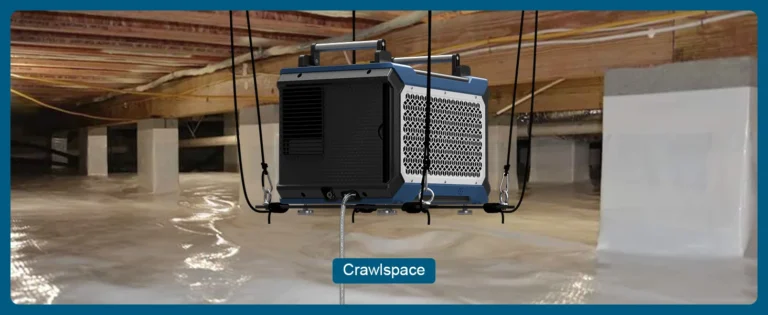
Portable vs Whole Home Dehumidifier: The Real Cost Gap
Quick Answer
Choosing between a portable vs whole home dehumidifier usually gets framed as a straightforward "bigger investment, better system" upgrade. The real numbers tell a more nuanced story: a typical portable unit runs roughly $300 versus roughly $1,500 for a ducted whole-home system — about a 5x price gap — but the efficiency difference between the two categories is marginal (both land between 2 and 2.35 liters removed per kWh). The premium buys whole-house coverage, lower noise, and automatic drainage, not meaningfully better performance per dollar of electricity.
Key Takeaways
- The price gap is roughly 5x (~$300 portable vs. ~$1,500 whole-home), before installation labor.
- Efficiency (liters removed per kWh) is nearly identical between categories — the premium isn't buying better performance per watt.
- What the premium actually buys: whole-house coverage, automatic drainage instead of a bucket, lower noise in living spaces, and ductwork integration.
- A single problem room or isolated space is almost always better served by a portable unit, regardless of budget.
- A genuine whole-house humidity problem with existing central air is where a ducted system's coverage advantage pays off.
- Running ductwork now (during other planned work) while starting with portables keeps both options open without committing early.
Table of Contents
- Portable vs Whole Home Dehumidifier: The Price Gap Is Bigger Than Expected
- The Efficiency Difference Is Surprisingly Small
- Drainage: Daily Bucket vs. Automatic
- The Maintenance Burden: One System vs. Several Appliances
- A Middle-Ground Strategy Worth Considering
- When Portable Actually Makes More Sense
- When Whole-Home Actually Makes More Sense
- Before You Choose: A Portable vs Whole Home Dehumidifier Checklist
- Frequently Asked Questions
| Portable | Whole Home (Ducted) | |
|---|---|---|
| Typical price | ~$300 | ~$1,500 |
| Efficiency (L/kWh) | 2.0 - 2.35 | 2.0 - 2.35 |
| Drainage | Manual bucket (unless hose-drained) | Automatic, continuous |
| Coverage | Single room | Whole house via ducts |
Portable vs Whole Home Dehumidifier: The Price Gap Is Bigger Than Expected
Choosing between a portable vs whole home dehumidifier usually gets framed as a straightforward upgrade decision — bigger house, bigger investment, better system. The actual price numbers tell a more nuanced story, and understanding the real gap between the two categories can save you from overpaying for a whole-home system when a portable unit (or a portable-now, ducted-later plan) would do the job just as well.
Real-world pricing discussed among building professionals puts this in concrete terms: a typical portable dehumidifier runs "like $300," while a ducted, whole-home unit from a brand like Santa Fe or AprilAire runs "like $1,500." That's roughly a 5x price difference before installation labor is even factored in — a meaningfully larger gap than the "somewhat more expensive" framing most product pages use.
Other buying guides put whole-home unit-plus-installation costs even higher, commonly $1,000-$3,000 depending on the specific system and ductwork complexity — so $1,500 is a reasonable mid-range figure, not a ceiling.
The Efficiency Difference Is Surprisingly Small
Here's the part that complicates the simple "you get what you pay for" assumption: the efficiency gap between the two categories, measured by liters of water removed per kWh, is described as marginal — "the efficiency boost only looks marginal (they're all between 2 and 2.35 L/kWh)."
A whole-home unit costing five times as much isn't removing moisture five times more efficiently, or even meaningfully more efficiently on a per-kWh basis. The premium buys something other than raw operating efficiency.
Worth noting for anyone shopping right now: a federal rule limiting the global warming potential of refrigerants used in dehumidifiers phases in soon, which is expected to bring a new generation of models with somewhat better performance — a reason not to over-index on today's specific efficiency numbers holding steady for either category going forward.
What the price premium actually buys is whole-house coverage without a visible unit in every room, generally lower decibel levels in the living space (the equipment is typically installed in a mechanical space rather than the living area), and integration with existing ductwork rather than a standalone appliance you have to find floor space for.
Those are real, legitimate reasons to choose a whole-home system — but they're comfort and convenience reasons, not efficiency reasons, and it's worth being clear-eyed about which one is actually driving your decision.
Drainage: Daily Bucket vs. Automatic
This is one of the least-discussed parts of the comparison, and it's a genuine day-to-day quality-of-life difference rather than a one-time spec. A portable unit's standard collection tank has to be emptied manually — in a genuinely damp space, that can mean daily emptying, or running a gravity hose to a nearby drain if the unit supports it and one is within reach.
A whole-home ducted system drains automatically and continuously through plumbing run during installation, with no routine emptying at all. For a single room with light-to-moderate moisture, manual emptying is a minor inconvenience; for a consistently damp whole-house situation, it becomes a genuine daily chore that factors into the real cost of the "cheaper" option.
The Maintenance Burden: One System vs. Several Appliances
If a single portable unit isn't enough to cover a whole house, the realistic comparison isn't "one portable vs. one whole-home system" — it's "several portables vs. one whole-home system," and that changes the maintenance math considerably. Each portable unit has its own filter to clean, its own tank or drain line to check, and its own coil that can need periodic attention.
A whole-home system is maintained more like the rest of your HVAC equipment: periodic filter changes and an annual service check, but one system rather than three or four scattered units each needing their own attention on their own schedule.
This is where the "several portables start to approach the cost of one whole-home system anyway" point (covered more in the Whole-Home section below) compounds: it's not just the purchase price of multiple units getting closer to one ducted system's price, it's also multiple maintenance schedules, multiple potential points of failure, and multiple appliances taking up floor space in multiple rooms.
A Middle-Ground Strategy Worth Considering
One practical approach discussed among contractors splits the difference rather than forcing an all-or-nothing choice: "I would install the ducting for the ducted, so you can do that direction if you need, but initially I would go with portable units." In practice, this means having ductwork run or accessible during other work (a renovation, new HVAC install) so a whole-home unit can be added later,
while starting with one or more portable units to solve the immediate moisture problem at a fraction of the upfront cost. If the portable approach proves sufficient, you've saved the $1,200+ premium; if it doesn't keep up, the ducting groundwork is already in place for an upgrade.
When Portable Actually Makes More Sense
A single problem room or an isolated space — a specific bedroom, a home office, a basement not connected to the rest of the house's ductwork — is a case where a portable unit is the more sensible choice regardless of budget, since a whole-home system ties into ducts that may not even reach that space efficiently.
Our dehumidifier sizing guide covers how to size a portable unit correctly for exactly this kind of connected-or-isolated-space calculation, and our dehumidifier cost to run guide covers what a portable unit actually costs to operate once it's sized correctly.
When Whole-Home Actually Makes More Sense
A whole-house humidity problem — consistently elevated readings throughout the living space, not concentrated in one room — combined with existing central air conditioning is the scenario where a whole-home system's coverage advantage genuinely pays off, since running multiple portable units in
every affected room quickly approaches (or exceeds) the cost of a single ducted system anyway, while adding multiple points of maintenance and multiple visible appliances. Our whole home dehumidifier guide covers ENERGY STAR's specific trigger (55%+ RH consistently throughout the house) for when this category is worth considering.
Before You Choose: A Portable vs Whole Home Dehumidifier Checklist
Before deciding, confirm:
- Is the problem in one room or the whole house? One room almost always means portable, regardless of budget.
- Do you already have central air with accessible ductwork? If not, a whole-home system adds significant installation cost and complexity beyond the unit price itself.
- How many portables would it actually take? If the honest answer is three or more, run the real math against one whole-home system before assuming portable is cheaper.
- Can you tolerate manual tank emptying, or does the space need unattended, continuous operation?
- Is renovation or new HVAC work already planned? That's the cheapest time to run ducting for a future whole-home system, even if you start with portables now.
Note: we don't currently link to specific portable or whole-home models or retailers in this section. Once we do, this is where a side-by-side specific-model comparison table will go.
Frequently Asked Questions
Is a whole-home dehumidifier worth the extra cost?
It depends on what you're solving for. If it's a genuine whole-house humidity problem with existing central air, yes — the coverage, automatic drainage, and lower noise are real benefits. If it's one damp room, no — you're paying a 5x premium for coverage you don't need.
Can several portable dehumidifiers replace a whole-home system?
Functionally, often yes for moisture removal — but once you need three or more units to cover the house, the combined purchase price, maintenance burden, and multiple appliances start to erode the cost advantage that made portable attractive in the first place.
Does a whole-home dehumidifier use less electricity than a portable one?
Not meaningfully, per unit of moisture removed — both categories measure between 2 and 2.35 liters per kWh. A whole-home system may use more total electricity simply because it's covering more square footage, not because it's less efficient per kWh.
Do I need to empty a whole-home dehumidifier's tank?
No. Whole-home units drain automatically and continuously through plumbing installed with the system — no tank, no manual emptying. That's one of the real conveniences the price premium buys.
🏠 CAROLINA LOCAL SUMMARY
The Bottom Line on Portable vs Whole Home Dehumidifier:
- A whole-home dehumidifier costs roughly 5x more than a portable unit but isn't meaningfully more efficient per kWh.
- The premium buys coverage, automatic drainage, lower noise, and duct integration — not raw performance.
- One damp room or a tight budget: go portable. A genuine whole-house problem with existing central air: the ducted system's convenience can be worth it.
- Running ductwork during other planned work, even while starting with portables, keeps both options open.
Whichever you choose, get the sizing right first with our dehumidifier sizing guide.

About the Author
This guide was researched using discussion among building-science professionals on GreenBuildingAdvisor regarding whole-home versus portable dehumidifier cost and efficiency, cross-referenced against published HVAC industry comparisons on drainage and maintenance, and Carolina Home Problem Report's own sizing and product documentation, to separate the comfort/convenience reasons for choosing a whole-home system from the efficiency reasons — which the numbers don't actually support as strongly as most buying guides imply.