This article does not contain affiliate links.
If your house feels humid, smells stale, or just never seems comfortable no matter what you do to the thermostat, the problem usually isn't one thing. It's one of four distinct categories, and knowing which one you're dealing with changes everything about how you actually fix it — rather than throwing money at the wrong solution.
Quick Answer
Humidity and air quality problems in NC and SC homes fall into 4 categories: (1) house humidity levels being too high or uneven, (2) indoor air quality issues like dust, VOCs, and allergens, (3) choosing and sizing the right dehumidification or ventilation equipment, and (4) HVAC mechanical problems that cause both humidity and comfort complaints.
Most homeowners are actually dealing with more than one category at once. Use the symptom-matching table below to find which pillar covers your specific problem, then start there.
Key Takeaways
- Humidity and air quality are related but separate problems. Fixing one doesn't automatically fix the other.
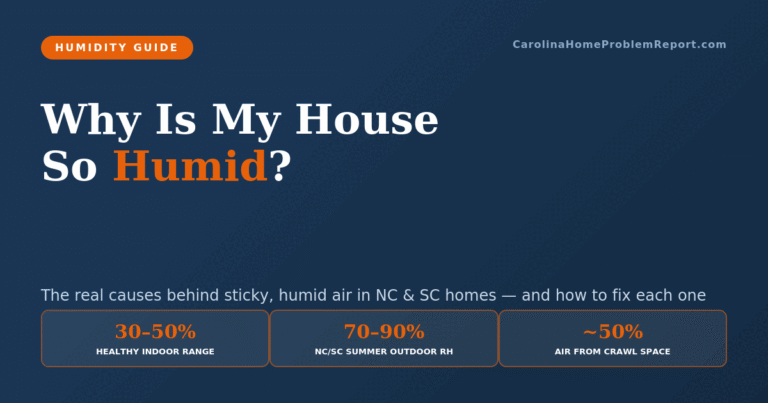
- EPA guidance targets 30–60% indoor relative humidity. Above 60% is roughly where dust mites, mold, and most IAQ complaints accelerate.
- A wet or unencapsulated crawl space is the single most common root cause connecting all four pillars in Carolina homes.
- HVAC sizing and mechanical problems are frequently the real cause behind "my house is humid even with the AC on," not the AC unit itself.
- North Carolina and South Carolina's humid subtropical climate (Cfa under the Köppen classification) makes these problems more frequent and more severe here than in most of the country.
Table of Contents
The 4 Pillars of Humidity & Air Quality Problems
North Carolina and South Carolina's climate puts homes under a specific, predictable kind of stress. Long, wet summers push moisture into living spaces from multiple directions at once: the ground beneath the house, outside air infiltrating through small gaps, and everyday activities like cooking, showering, and breathing.
Meanwhile, HVAC systems sized primarily around temperature often fail to keep pace with the humidity load that climate creates. Across hundreds of homeowner questions and symptom patterns we've researched, these problems consistently sort into four distinct categories.
1. House Humidity Problems
Too-high or uneven humidity throughout the house: the general "why does my house feel damp or sticky" category, including condensation, seasonal swings, and humidity that's worse upstairs than downstairs.
Read the full pillar guide →
2. Indoor Air Quality Problems
Dust, allergens, stale air, VOCs, CO2 buildup, and the pollutants that make a house feel unhealthy rather than just uncomfortable.
Read the full pillar guide →
3. Home Humidity Control Systems
Choosing and sizing dehumidifiers, bathroom and attic ventilation fans, and ERV/HRV systems: the equipment side of the fix, once you know what you're fixing.
Read the full pillar guide →
4. HVAC Moisture & Comfort Problems
Mechanical causes, short cycling, duct leaks, oversized units, that create humidity and comfort complaints even when the AC is technically "working."
Read the full pillar guide →
Each pillar guide above is a full standalone resource in its own right, and each one links down to its complete set of symptom-specific, cause-specific, and fix-specific articles. This page is designed to point you to the right one, not to repeat their content.
Match Your Symptom to the Right Pillar
Most homeowners arrive with a symptom, not a diagnosis. Use this table to find the pillar that actually addresses what you're experiencing, rather than guessing and buying the wrong fix.
| If you're experiencing… |
Start here |
| General stuffiness, condensation on windows, a humid feeling throughout the house |
House Humidity Problems |
| Dust, allergy symptoms, a stale smell, or concern about pollutants and VOCs |
Indoor Air Quality Problems |
| Trying to decide what equipment to buy: a dehumidifier, a ventilation fan, an ERV/HRV |
Home Humidity Control Systems |
| AC runs constantly or short-cycles, or the house stays humid despite the AC working |
HVAC Moisture & Comfort Problems |
| A musty smell, visible mold, or a damp crawl space underneath the house |
Crawl Space category |

Why This Is a Bigger Problem in NC and SC Than Elsewhere
Most of North and South Carolina sits within a humid subtropical climate zone (Cfa under the Köppen climate classification), characterized by hot, humid summers and relatively mild, wet winters.
This matters for your home because it means outdoor dew points stay high for months at a time, which puts constant pressure on a home's building envelope to keep moisture out rather than just keep temperature stable.
Contrast that with a drier climate, where an air conditioner's main job is removing heat and dehumidification happens almost as a side effect. In the Carolinas, moisture removal has to be treated as a deliberate, separate design goal, not an assumption that comes free with cooling.
Homes built, sized, or renovated using national-average assumptions — rather than Carolina-specific ones — are the ones that show up in our research with the most severe, hardest-to-diagnose humidity and air quality complaints.
A second regional factor is housing stock. A large share of homes across both states, particularly outside major metro cores, are built on crawl space foundations rather than basements or slabs. That foundation choice interacts directly with all four pillars above, which is covered in its own section below.
The EPA's indoor air quality guidance treats humidity and air quality as connected for a specific physical reason: relative humidity above roughly 60% is close to the threshold where dust mites, mold spores, and several other indoor allergens begin reproducing more aggressively.
That means a house with a humidity problem (Pillar 1) is very likely to develop a genuine air quality problem (Pillar 2) within weeks if the humidity isn't addressed first, not just a discomfort issue.
The equipment decisions in Pillar 3 and the mechanical diagnosis in Pillar 4 are frequently two sides of the same issue, too. A homeowner who buys an undersized or wrongly-placed dehumidifier is often unknowingly trying to compensate for an oversized, short-cycling AC unit that removes heat faster than it removes moisture, which is a Pillar 4 problem, not a Pillar 3 one.
Fixing the equipment without first fixing the mechanical cause behind it tends to produce temporary relief at best, and a lot of wasted money at worst.
This is the main reason the four pillar guides linked above are built to cross-link rather than stand alone. Working through just one pillar in isolation, without checking whether a related pillar is contributing to the same symptom, is the single most common mistake we see homeowners make when trying to self-diagnose.
What It Costs to Ignore These Problems
Humidity and air quality problems rarely stay small. Left unaddressed, elevated indoor humidity accelerates the degradation of wood flooring, trim, and furniture through repeated cupping and gapping cycles as moisture content swings with the seasons.
It also shortens the realistic service life of HVAC equipment, since a system working overtime to compensate for poor humidity control cycles more often and wears out components, especially capacitors and compressors, faster than a properly matched system would.
On the air quality side, prolonged exposure to elevated indoor allergens and, in more severe cases, mold growth is associated with worsened asthma and allergy symptoms according to CDC and EPA guidance on indoor environmental health. These aren't abstract risks.
They're the kind of complaint — a cough that won't go away, allergy symptoms that are worse at home than anywhere else — that often traces back to one of the four pillars above once a homeowner actually investigates.
There's also a financial dimension beyond repair costs. A home with documented humidity or mold history can face buyer hesitation or inspection flags at resale, even after the underlying issue has been fixed, simply because the evidence (stained wood, musty odor in enclosed spaces) can linger.
Addressing the root cause early is almost always cheaper than addressing both the root cause and its downstream damage later.
The Crawl Space Connection
For NC and SC homes specifically, there's a fifth factor that doesn't fit neatly into any of the four pillars above but touches all of them: the crawl space.
As noted earlier, a large share of homes across the Carolinas are built on crawl space foundations, and an unencapsulated, poorly managed crawl space is one of the most common root causes behind humidity and air quality complaints showing up in the living space above it.
Moisture rising from a damp, unsealed crawl space travels upward into the living space through the stack effect, the same pressure dynamic that pulls basement air upward in homes built with basements.
Warm air rising through the house creates a slight negative pressure at the lowest point of the structure, pulling in whatever air, and whatever moisture, is sitting in the crawl space below.
This is why homes with a wet or vented-but-unmanaged crawl space often show humidity complaints that are worse on the ground floor and taper off upstairs, a pattern that's easy to misdiagnose as an HVAC zoning problem when the real cause is underneath the house.
If you've worked through the four pillars above and the humidity or air quality problem persists, or if you've noticed a musty smell with no obvious source, the crawl space is the next place to check. Our
Crawl Space category guide covers moisture diagnosis, encapsulation, mold, and structural issues specific to crawl space foundations in detail.
How This Guide Is Different From Our Glossary
If you've also seen
The Complete Humidity & Air Quality Glossary, you might wonder how it's different from this page. The two serve deliberately different purposes.
The Glossary is a reference tool: it defines 35 technical terms you'll encounter across this category, A to Z, and indexes all 42 individual articles by pillar so you can find a specific piece once you already know roughly what you're looking for.
This page is a starting point, not a reference. It's built for the homeowner who's arriving with a symptom and no idea which of the four pillars, or which specific article, actually addresses it. If the Glossary is the table of contents, this page is the triage desk that gets you to the right section of the book in the first place.
Frequently Asked Questions
Do I need to fix my humidity problem before my air quality problem?
Generally yes. Humidity above the EPA's recommended 30–60% range accelerates dust mite and mold growth, two of the most common indoor air quality complaints.
Addressing humidity first often resolves a meaningful share of air quality symptoms before you spend money on air purification equipment that's treating a symptom rather than the cause.
My AC is working fine, so why is my house still humid?
Temperature and humidity are controlled differently, and an AC that's correctly sized for cooling can still be poorly matched for dehumidification, especially if it's oversized and short-cycling, which cools the air quickly without running long enough to pull moisture out of it.
This mechanism is covered in detail in the HVAC Moisture & Comfort Problems pillar.
Is this the same as your Crawl Space guide?
No. This page covers humidity and air quality problems throughout the living space. The
Crawl Space guide covers the foundation-level moisture, mold, and structural issues that are a common underlying cause of the problems described here.
The two categories link to each other because they're frequently connected, not because they cover the same ground.
How do I know if my problem is humidity-related or a genuine air quality issue?
A useful starting test: if a hygrometer reading in the affected room is consistently above 60%, start with the House Humidity Problems pillar regardless of what other symptoms you're noticing, since high humidity is very likely contributing to or causing them.
If humidity reads normal and you're still experiencing dust, odors, or allergy symptoms, go directly to the Indoor Air Quality Problems pillar.
Can one piece of equipment fix all four of these problems at once?
Not reliably. A whole-home dehumidifier addresses Pillar 1 and supports Pillar 2, but it can't correct an oversized or malfunctioning HVAC system (Pillar 4), and buying one without first diagnosing whether your real problem is mechanical is one of the most common wasted purchases we see homeowners describe.
The Home Humidity Control Systems pillar walks through which equipment fits which diagnosis.
Still not sure where your problem fits, or want a professional opinion rather than a DIY diagnosis? Our
vetted local contractor directory can connect you with HVAC, dehumidification, and indoor air quality specialists in North and South Carolina.
Carolina Home Problem Report Editorial Team — We research every guide using EPA, ASHRAE, CDC, and other authoritative sources to give North and South Carolina homeowners clear, locally specific answers about the problems affecting their homes.