House Humidity Problems: The Complete Guide to Causes, Signs, and Fixes
If your house feels damp no matter what you do — windows sweating, closets smelling musty, the AC running constantly but the air still feeling thick — you're dealing with a house humidity problem, and you're far from alone.
It's one of the most common complaints among homeowners in North Carolina and South Carolina, where the humid subtropical climate means outdoor moisture is pressing against your home's envelope for most of the year.
This guide covers every angle of house humidity problems: what actually causes them, how to tell whether your home has crossed from "normal" into "problem" territory, what high humidity damages if it's left alone, and which fixes actually work.
Below, you'll also find direct links to our full library of in-depth guides on each specific cause, symptom, and fix.
Notice winter doesn't mean humidity problems disappear — it means the source shifts from outdoor climate to everyday indoor moisture generation (Cause #2 above), which is why a house can still feel damp in January even though the air outside is dry.
Quick Answer: A house humidity problem exists when indoor relative humidity stays above roughly 50-55% for sustained periods.
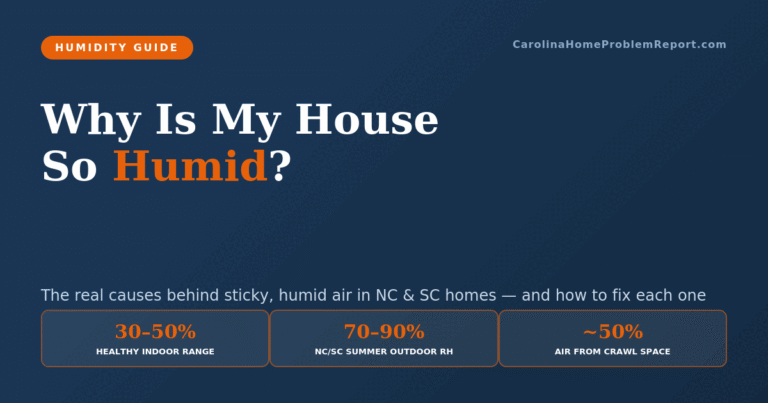
The EPA recommends keeping indoor relative humidity between 30% and 50%, ideally below 60%, specifically because mold growth, dust mites, and structural moisture damage all become significantly more likely above that range.
Common causes include poor ventilation, an oversized or short-cycling AC system, moisture migrating up from a crawl space, and the Carolinas' naturally humid climate. Most problems are fixable with a combination of source control, ventilation, and — in persistent cases — a properly sized dehumidifier.
Key Takeaways:
- The EPA's benchmark is indoor relative humidity between 30% and 50%, kept below 60% — above that, mold and dust mites become measurably more likely.
- House humidity problems usually come from one of five sources: outdoor climate, bathroom/kitchen moisture, an AC system that's oversized or short-cycling, a damp crawl space or basement feeding moisture upward, or simply not enough ventilation.
- Upstairs rooms and rooms over a crawl space are disproportionately affected — the cause is rarely "that one room" in isolation.
- A $15-$30 hygrometer is the single most useful diagnostic tool a homeowner can buy before spending money on a fix.
- Left unaddressed, high humidity doesn't just feel uncomfortable — it accelerates mold growth, warps wood flooring, and worsens allergy and asthma symptoms.
Table of Contents
- What Actually Counts as a House Humidity Problem
- The Real Causes of House Humidity Problems
- How to Know Your House Has a Humidity Problem
- What High Humidity Actually Damages
- Where Humidity Problems Show Up Worst
- Why It's Worse in Carolina Summers
- How a Minor Problem Becomes a Major One
- How to Actually Fix a House Humidity Problem
- When to Call a Professional
- Explore Every House Humidity Topic
- Frequently Asked Questions
What Actually Counts as House Humidity Problems
House humidity problems start with a number most homeowners have never actually checked: relative humidity (RH), the percentage of moisture the air is holding compared to the maximum it could hold at that temperature. According to the U.S. Environmental Protection Agency, indoor relative humidity "should be kept below 60 percent — ideally between 30 percent and 50 percent, if possible" — in other words, the moisture your air is holding needs to stay in a fairly narrow band. That's not an arbitrary comfort guideline; it's the range below which mold spores struggle to germinate and dust mites struggle to reproduce. Most homes without a working humidistat or hygrometer sit somewhere between 55% and 70% RH for long stretches of the year without anyone noticing — until a window starts sweating, a closet starts smelling musty, or a Rank Math-style "is this normal?" search brings them here. The gap between "slightly humid" and "a real problem" isn't a feeling — it's whether your home is consistently above that 50-60% line long enough for mold, wood damage, or allergy symptoms to start building.The Real Causes of House Humidity Problems
There is rarely one single cause. In most Carolina homes we've researched, it's two or three of the following stacking on top of each other:1. The Carolinas' Climate Itself
North Carolina and South Carolina sit squarely in a humid subtropical climate zone, meaning outdoor water vapor pressure stays high enough that dew points regularly sit in the 65-75°F range for much of the summer. Every door opening, every air exchange, and every bit of imperfect sealing lets that outdoor moisture load into the house. This is the baseline almost every other cause below is stacked on top of.2. Everyday Moisture Generation
A single shower adds roughly half a pint of water vapor to the air if the bathroom fan isn't vented outside. Cooking, boiling water, houseplants, and even breathing and sweating while you sleep all add up — a family of four can generate several gallons of water vapor indoors per day through ordinary living. A single load of laundry drying indoors can add close to a gallon of water vapor on its own, and an unvented gas range adds combustion moisture on top of ordinary cooking moisture every time it's used. None of this is a problem in a well-ventilated home — it only becomes one when that moisture has nowhere to go, which is exactly why Cause #5 (ventilation) below matters as much as where the moisture comes from in the first place.3. An AC System That's Fighting the Wrong Battle
Air conditioners remove humidity as a side effect of cooling, not as their primary job. An oversized AC cools the air quickly, shuts off before it has run long enough to pull real moisture out, and starts again soon after — a pattern called short-cycling. The result: a house that feels cold and clammy instead of cool and dry, even with the AC running constantly.4. Crawl Space or Basement Moisture Migrating Upward
Warm, moist air rises. In homes built over a vented or poorly sealed crawl space, ground moisture and outdoor humid air entering through foundation vents gets pulled upward into the living space through the stack effect, often concentrating in the rooms directly above. This mechanism is covered in full in our dedicated guide on how crawl space moisture affects upstairs humidity.5. Insufficient Ventilation
Modern, tightly sealed homes hold onto humidity that older, leakier homes would have let escape. Without mechanical ventilation (a bathroom fan vented outside, a kitchen hood, or a whole-home ventilation system) to replace that moist indoor air with drier outdoor air, humidity has nowhere to go.How to Know Your House Has a Humidity Problem
Before spending money on a fix, confirm the problem is real and measure how bad it is. Here's the order we recommend:- Buy a hygrometer. A basic digital hygrometer costs $15-$30 and is accurate within 2-3%. Place it in the room you're most concerned about, away from direct sunlight or exterior walls, and check it at different times of day for a week.
- Watch for condensation on windows, especially single-pane or older double-pane windows — this is often the earliest visible sign, and we cover exactly what it does and doesn't mean in our guide on condensation on windows.
- Notice musty smells, especially in closets, basements, and rooms that don't get much airflow.
- Check for a "sticky" feeling even when the thermostat says the house is at temperature — this usually means the AC is cooling but not dehumidifying.
- Look at wood trim, doors, and flooring for swelling, sticking, or gaps that open and close with the seasons.
What High Humidity Actually Damages
Sustained high humidity isn't just uncomfortable — it causes measurable, often expensive damage over time:- Mold growth. Most household mold species need surface moisture and RH consistently above 60-70% to establish. See the specific threshold in what humidity level causes mold.
- Wood floor and trim damage. Wood is hygroscopic — it absorbs and releases moisture from the air, expanding and contracting with it. Repeated humidity swings cause cupping, gapping, and in severe cases permanent warping. Full detail in humidity and wood floors.
- Worsened allergy and asthma symptoms. High humidity is one of the few environmental factors that simultaneously supports dust mites, mold spores, and reduced air quality — covered in humidity and allergies.
- HVAC strain. A system fighting constant high indoor humidity runs longer and less efficiently, which shows up directly on energy bills.
- Structural moisture over time. Chronic humidity against framing, subfloor, or drywall can eventually lead to rot — a slower, less visible version of the water damage covered in our Mold & Moisture category.
Where Humidity Problems Show Up Worst
Humidity is rarely even throughout a house. Two patterns come up constantly in Carolina homes: Upstairs rooms run hotter and more humid than the rest of the house, for reasons that compound each other — rising heat, attic heat radiating down, and often a single HVAC zone trying to cool two very different floors at once. We break down the full mechanism in why it's hotter and more humid upstairs. Rooms directly above a crawl space are disproportionately affected when the crawl space itself has a moisture problem, since that moisture has a direct path upward through the subfloor and stack effect. If your humidity problem seems concentrated in specific rooms rather than the whole house, start with crawl space affecting upstairs humidity before assuming it's an HVAC issue.Why It's Worse in Carolina Summers
Outdoor dew points in the Carolinas regularly exceed 70°F from June through September, meaning the outdoor air itself is carrying more water vapor than an air conditioner alone is always designed to remove — especially in an oversized or short-cycling system (see Cause #3 above). This is why so many homeowners notice their humidity problem is seasonal rather than constant. Full seasonal detail, including what's actually different about summer versus winter humidity indoors, is in summer humidity inside the house. For hard numbers on just how humid the air gets across the region, see our data reference, Average Humidity in the Carolinas, built from NOAA climate-station data.| Season | Typical Outdoor RH (Carolinas) | What It Means Indoors |
|---|---|---|
| Summer (Jun-Sep) | 70-90% | Highest indoor-humidity risk; AC sizing and short-cycling matter most now. |
| Fall / Spring | 55-70% | Moderate risk; ventilation habits matter more than AC performance. |
| Winter (Dec-Feb) | 40-55% | Lowest outdoor contribution; indoor sources (cooking, showers, drying laundry) become the dominant cause. |
How a Minor Humidity Problem Becomes a Major One
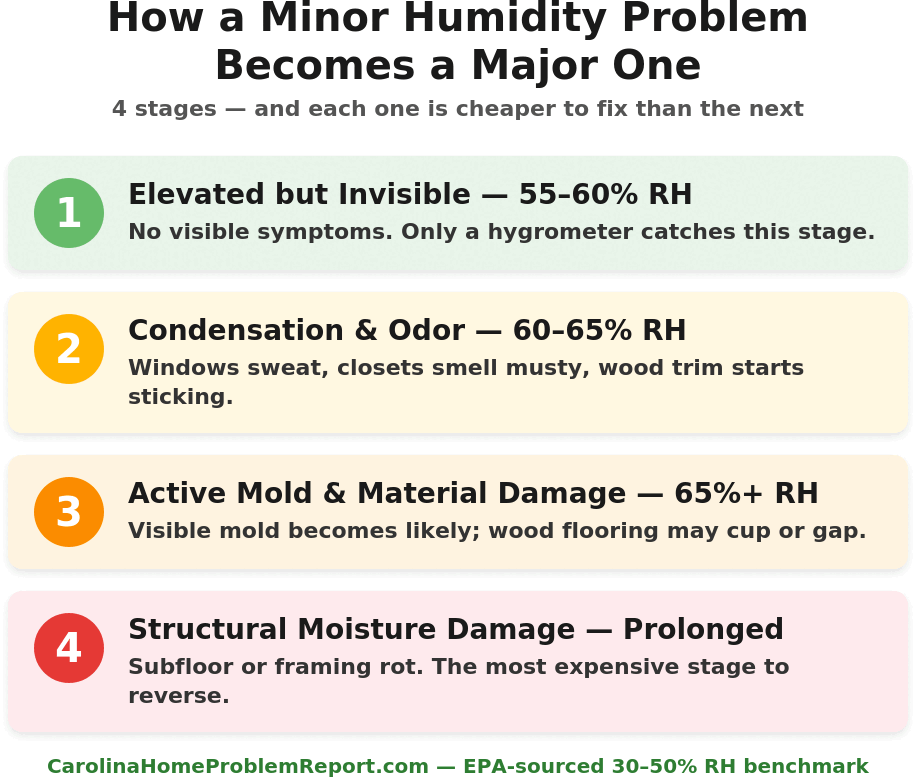
House humidity problems rarely arrive as a single dramatic event — they escalate in stages, and each stage is cheaper to fix than the one after it:- Stage 1 — Elevated but invisible (55-60% RH). No visible symptoms yet. The only way to catch this stage is with a hygrometer, which is exactly why Section 3 above recommends buying one before anything else.
- Stage 2 — Surface condensation and odor (60-65% RH). Windows sweat, closets and bathrooms start to smell musty, and wood trim may begin sticking. This is usually the first stage a homeowner actually notices.
- Stage 3 — Active mold and material damage (65%+ RH, sustained). Visible mold growth becomes likely, wood flooring may begin cupping or gapping, and allergy symptoms often worsen noticeably. This is the stage that typically requires professional remediation rather than a DIY fix.
- Stage 4 — Structural moisture damage (prolonged, untreated). Chronic exposure can lead to subfloor or framing rot, particularly when the source is a crawl space or basement rather than ambient air. This is the most expensive stage to reverse and the one every earlier stage exists to help you avoid.
How to Actually Fix a House Humidity Problem
The right fix depends on which cause (or combination of causes) from the list above actually applies to your home — there is no single universal solution. In general, the order of operations that works best is:- Source control first. Vent bathroom and kitchen fans to the outside (not into the attic), fix any crawl space moisture issues at the source, and seal obvious air leaks.
- Improve ventilation. Make sure exhaust fans are actually working and being used, and consider a whole-home ventilation strategy if the house is tightly sealed.
- Address AC sizing and run time if short-cycling is part of the picture — sometimes a simple thermostat fan-setting change helps; sometimes it requires an HVAC technician.
- Add a properly sized dehumidifier if the above steps don't fully solve it, especially for a specific problem room or zone — sizing matters more than most people expect; an undersized unit runs constantly without ever catching up, while an oversized one short-cycles the same way an oversized AC does.
When to Call a Professional
Most house humidity problems are diagnosable and at least partially fixable by a homeowner. Call a professional (HVAC technician, home inspector, or crawl space specialist depending on the cause) when: humidity stays above 60% even after basic fixes, or you can see or smell active mold growth. Also call one if your AC is short-cycling and you're not comfortable adjusting settings yourself, or the source appears to be structural (crawl space, roof, or foundation moisture).Explore Every House Humidity Topic
This guide covers the full landscape. For the complete depth on any specific cause, symptom, or fix, use the guides below — grouped by what you're actually trying to figure out.Understanding Why Your House Is Humid
- Why Is My House So Humid?
- High Indoor Humidity: Causes and What's Normal
- Humidity Even With the AC Running
Spotting and Confirming the Problem
Where and When It's Worse
- Why It's Hotter and More Humid Upstairs
- Summer Humidity Inside the House
- Crawl Space Affecting Upstairs Humidity
What Humidity Damages
Fixing It
Frequently Asked Questions
What humidity level is considered a problem in a house?
The EPA recommends keeping indoor relative humidity between 30% and 50%, and below 60% at all times. Sustained readings above 60% are when mold risk and comfort problems become significant.Can a house be too humid even with air conditioning running?
Yes. Air conditioners remove humidity as a byproduct of cooling, not as their main function. An oversized or short-cycling system can keep a house cool without actually removing enough moisture — see humidity even with AC for the full explanation.Does a whole-home dehumidifier actually fix house humidity problems?
It can, but only after source control (ventilation, moisture entry points) has been addressed — a dehumidifier working against an ongoing moisture source will run constantly without ever catching up. See how to reduce home humidity for the full decision process.Why is my upstairs more humid than downstairs?
Heat and moisture both rise. Combined with attic heat radiating down and a single HVAC zone often serving very different floor levels, upstairs rooms consistently run warmer and more humid than the rest of the house. Full mechanism in why it's hotter and more humid upstairs.How long does it take to fix a house humidity problem?
Source-control fixes (sealing, venting fans outside, fixing a crawl space issue) can show improvement within days. Structural moisture damage that's already occurred takes longer and may need professional remediation.For NC and SC Homeowners: If your humidity problem seems tied to your crawl space, foundation, or you're not sure where to start, our Find Help directory can point you toward the right type of local professional for your specific situation.