Mold in HVAC System: Why Duct Cleaning Won’t Fix It
Mold in your HVAC system almost always starts in one of two places: the evaporator coil or the condensate drain pan, not inside the ductwork itself. Both stay wet for hours after every cooling cycle, which makes them the actual breeding ground — the ductwork is usually just where the spores get carried to and deposited.
That's why a duct cleaning alone, without addressing the coil and drain pan, is a common reason the musty smell or allergy symptoms come right back within a season.
⭐ Key Takeaways
- ✓Mold typically starts on the evaporator coil or in the condensate drain pan — both stay wet for hours after the AC shuts off
- ✓A musty smell specifically when the system first turns on is one of the clearest signals, since it means the odor is coming from inside the equipment itself
- ✓Mold on the coil or deep inside ductwork is not a safe DIY cleaning job — the EPA and HVAC manufacturers both recommend a licensed technician for anything beyond a visible, accessible supply register
- ✓An oversized AC unit that short-cycles is a common, overlooked root cause — it cools the air without running long enough to actually remove humidity
- ✓A clogged condensate drain line is one of the single fastest fixes available and is worth checking before anything else
If a musty smell rolls out of the vents the moment the AC kicks on, or you've had the ducts cleaned and the smell came back within a few months, the usual explanation isn't the ductwork at all.
Your HVAC system has two components that are wet, dark, and poorly lit almost every single day: the evaporator coil, which produces condensation every time the system cools, and the drain pan underneath it, which collects that water before it drains away. Mold doesn't need the ductwork to get started — it just needs one of those two spots.
This guide covers how to identify mold specifically inside your HVAC system (coil, drain pan, and ductwork), tell it apart from a few look-alike causes, and understand what's actually safe to handle yourself versus what needs a licensed technician.
If your mold smell seems to be coming from the room itself rather than specifically from the vents, our Mold Smell But No Visible Mold guide walks through a full room-by-room, whole-house triage process that covers the HVAC system alongside the crawl space, walls, and attic.
In This Article
- 5 Signs of Mold in HVAC System Problems
- Where It Actually Starts: Coil vs Drain Pan vs Ductwork
- What Causes Mold in HVAC System Equipment
- Why NC & SC HVAC Systems Are More At Risk
- What NOT to Do: The DIY Duct-Spray Mistake
- Mold in HVAC System: DIY vs Professional Cleaning
- Preventing It From Coming Back
- Frequently Asked Questions
5 Signs of Mold in HVAC System Problems
Some of these are things you can smell and see; others only show up once you know what to listen for in how your system is behaving.
Where It Actually Starts: Coil vs Drain Pan vs Ductwork
Most homeowner advice treats "mold in the HVAC system" as one problem with one fix — usually "get the ducts cleaned." That misses that these are three genuinely different locations with different moisture conditions and different remediation needs.
The evaporator coil is where refrigerant absorbs heat from indoor air, and in the process, moisture in that air condenses on the coil's cold metal fins — every single cooling cycle, for as long as the system has been running. That makes it one of the wettest surfaces in your entire house, hidden inside a dark, enclosed cabinet with limited airflow.
The condensate drain pan sits directly below the coil and collects the water dripping off it before a drain line carries it away. When that drain line is even partially clogged, water backs up and sits in the pan far longer than it should — a near-ideal mold environment that often goes unnoticed because the pan isn't visible without opening the air handler.
Ductwork, by contrast, is normally dry. It becomes a mold site mainly when it runs through a humid, unconditioned space (a crawl space or attic), when there's a physical leak letting outside moisture in, or when spores generated at the coil get carried downstream and settle somewhere the duct interior stays damp.
This is exactly why duct cleaning alone — without addressing the coil or drain pan — so often fails to solve the problem for good: it cleans the delivery system without touching the source.
What Causes Mold in HVAC System Equipment
A clogged condensate drain line. Algae, dust, and debris build up inside the drain line over time and slow or fully block drainage, which is one of the fastest and cheapest things to check and clear — and one of the most common root causes found.
An oversized AC unit that short-cycles. An AC unit that's too large for the space cools the air quickly and shuts off before it has run long enough to actually pull humidity out of it. The result is a house that feels cool but stays humid, and a system that cycles on and off far more often than it should.
Each cycle leaves the coil freshly wet, with less run time to help it dry back out between cycles. Our Oversized AC and Indoor Humidity guide covers this mechanical cause in depth.
A dirty air filter restricting airflow. Reduced airflow across the coil can cause it to run colder than it should, which can lead to ice buildup — and ice that later melts dumps far more water onto the coil and into the drain pan than normal condensation ever would.
Visibly sweating ducts or vents. When a duct surface is cold enough and the surrounding air humid enough, condensation forms directly on the outside of the ductwork itself, often where insulation is thin or missing — feeding mold on the duct's exterior and surrounding insulation. Our Sweating Air Vents and Ducts guide covers diagnosing and fixing this specific mechanism.
General indoor humidity above roughly 60% gives all of the above a head start, which is also covered from the drain-line angle specifically in our AC Condensate Drain Line Clogged guide if a slow or backed-up drain is what you're seeing.
Why NC & SC HVAC Systems Are More At Risk
North and South Carolina's long, humid cooling season means the average Carolina AC system runs far more hours per year — and therefore produces far more condensation at the coil — than a system in a drier or shorter-summer climate.
That extra runtime isn't inherently a problem on its own; a correctly sized, well-maintained system is built to handle it continuously.
The risk shows up when a system is oversized for the home (common when a unit was swapped without a proper load calculation), when the drain line hasn't been checked in years, or when the ductwork runs through a hot, humid, unconditioned attic common in Carolina construction.
In practice, this means a Carolina homeowner has less margin for deferred HVAC maintenance than someone in a milder climate — a condensate line that would take two seasons to cause a real problem elsewhere can get there in one here.
What NOT to Do: The DIY Duct-Spray Mistake
A common DIY instinct is to buy a bleach or commercial mold-killing spray and apply it directly into a supply vent or return grille, hoping it reaches whatever is growing further inside.
This creates two real problems. First, it almost never reaches the actual source — the coil or drain pan is typically feet away from the nearest vent opening, well beyond where a spray can travel.
Second, and more seriously, running the system afterward aerosolizes whatever chemical residue is left and distributes it through every room the system serves — turning a localized mold problem into a whole-house air quality problem.
Don't run the system while diagnosing a suspected coil or drain pan problem. If you suspect mold at the coil or pan, switch the system to fan-only or off while you investigate, rather than continuing to run full cooling cycles that keep redistributing spores.
Don't assume a duct cleaning alone solved it. If the smell or symptoms return within a season of a duct cleaning, that's a strong sign the actual source (coil or drain pan) was never addressed, not that the cleaning failed to work.
Mold in HVAC System: DIY vs Professional Cleaning
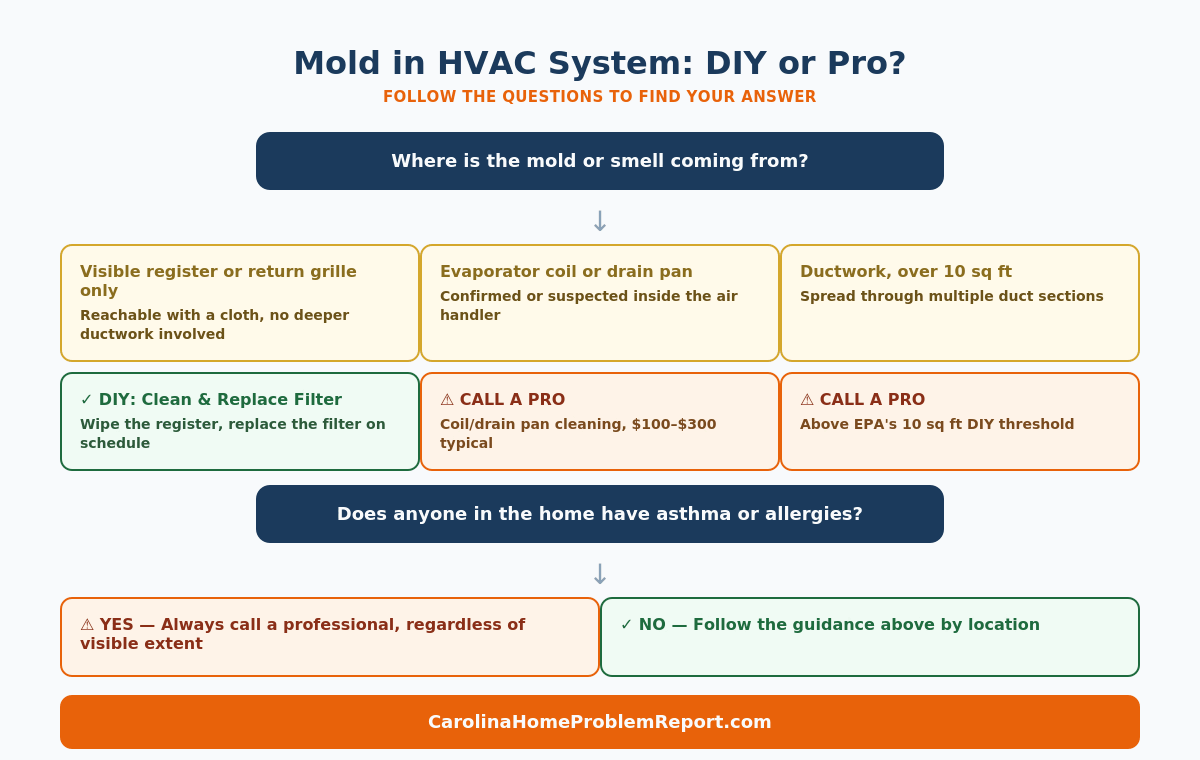
✅ Reasonable to handle yourself if:
- Growth is limited to a visible, easily reached supply register or return grille cover
- You're simply replacing the air filter on a normal schedule
- You're flushing an accessible condensate drain line with a wet/dry vacuum or vinegar, per the manufacturer's manual
⚠️ Call a professional if:
- Mold is confirmed or suspected on the evaporator coil itself
- The condensate drain pan shows standing water, film, or visible growth
- Contamination inside the ductwork covers more than roughly 10 sq ft, the EPA's own DIY-vs-pro threshold
- Anyone in the household has asthma, allergies, or another respiratory sensitivity
Coil cleaning by a licensed HVAC technician typically costs $100–$300 on its own, while professional duct cleaning adds roughly another $100–$400 depending on home size and duct access.
For a confirmed, more extensive HVAC mold problem that needs full professional remediation — coil, drain pan, and ductwork together — the typical cost range runs $1,125–$3,439, averaging around $2,254, according to current industry cost data.
Preventing It From Coming Back
Change the air filter every 1–3 months
A clean filter keeps airflow across the coil where it should be, which helps prevent the icing-and-melting cycle that dumps excess water into the drain pan.
Flush the condensate drain line twice a year
A cup of distilled vinegar poured into the drain access point (consult your system's manual for its location) once at the start and once midway through cooling season helps keep algae growth from building into a clog.
Have your system's sizing checked if it short-cycles
If your AC runs in short bursts rather than longer, steady cycles, ask an HVAC technician to verify it was sized with a proper load calculation rather than just matched to the old unit's tonnage — a surprisingly common shortcut when a system is replaced.
Consider a UV light installed near the coil
A UV germicidal light installed by a technician inside the air handler continuously discourages mold and bacterial growth directly on the coil surface — a genuine prevention tool rather than a one-time fix, typically worth discussing during your next HVAC service visit.
Frequently Asked Questions
Will running the AC on fan-only instead of cooling help?
Temporarily, yes — fan-only mode doesn't produce new condensation at the coil, so it can slow a suspected mold problem while you arrange a technician visit. It's not a fix, though; the coil and drain pan still need to be inspected and cleaned.
How often should ducts actually be cleaned?
Industry guidance generally suggests every 3–5 years for a typical home with no specific problem, though a confirmed mold issue, recent renovation, or pest infestation in the ductwork warrants cleaning sooner regardless of schedule.
Is it the mold itself making me sick, or something else?
Both mold spores and the microbial volatile organic compounds (MVOCs) they release as they grow can trigger allergy-type symptoms in sensitive people, which is part of why symptoms can appear before any visible growth is ever found — the smell itself is a sign something is releasing compounds into the air.
Can a dirty HVAC system actually raise my energy bill?
Yes — mold and debris buildup on the coil or inside ductwork restricts airflow and reduces heat-transfer efficiency, forcing the system to run longer to reach the same temperature. A professional coil cleaning that resolves a mold problem often comes with a real, measurable efficiency improvement as a side benefit.
Key Facts About Mold in HVAC Systems in Carolina Homes:
- Mold usually starts at the evaporator coil or condensate drain pan, not inside the ductwork itself.
- A musty smell right when the system turns on is the clearest sign of a coil or drain pan problem.
- Duct cleaning alone, without addressing the coil or drain pan, is a common reason the problem returns within a season.
- NC and SC's long, humid cooling season means more hours of coil condensation per year than in milder climates.
- Mold on the coil, in the drain pan, or covering more than 10 sq ft of ductwork calls for a licensed technician, not a DIY spray.
If your mold smell isn't clearly tied to the HVAC system turning on, the Mold Smell But No Visible Mold guide walks through a full whole-house triage process, and the Mold Risk Calculator can help gauge your overall risk level.
The Carolina Home Problem Report editorial team researches and writes guides for homeowners across North and South Carolina.
Our research draws on EPA mold guidance, ENERGY STAR HVAC maintenance guidance, and insights from licensed Carolina HVAC technicians and mold assessors. We are not contractors or mold assessors — we are a research team dedicated to giving Carolina homeowners clear, locally specific, unbiased answers.
Carolina Home Problem Report is an informational resource for homeowners. We are not licensed contractors or mold assessors. Always consult a qualified professional before making home repair decisions. See our Disclaimer and Affiliate Disclosure.