Mold Behind Drywall: The Outlet-Plate Test That Finds It Without Cutting a Hole
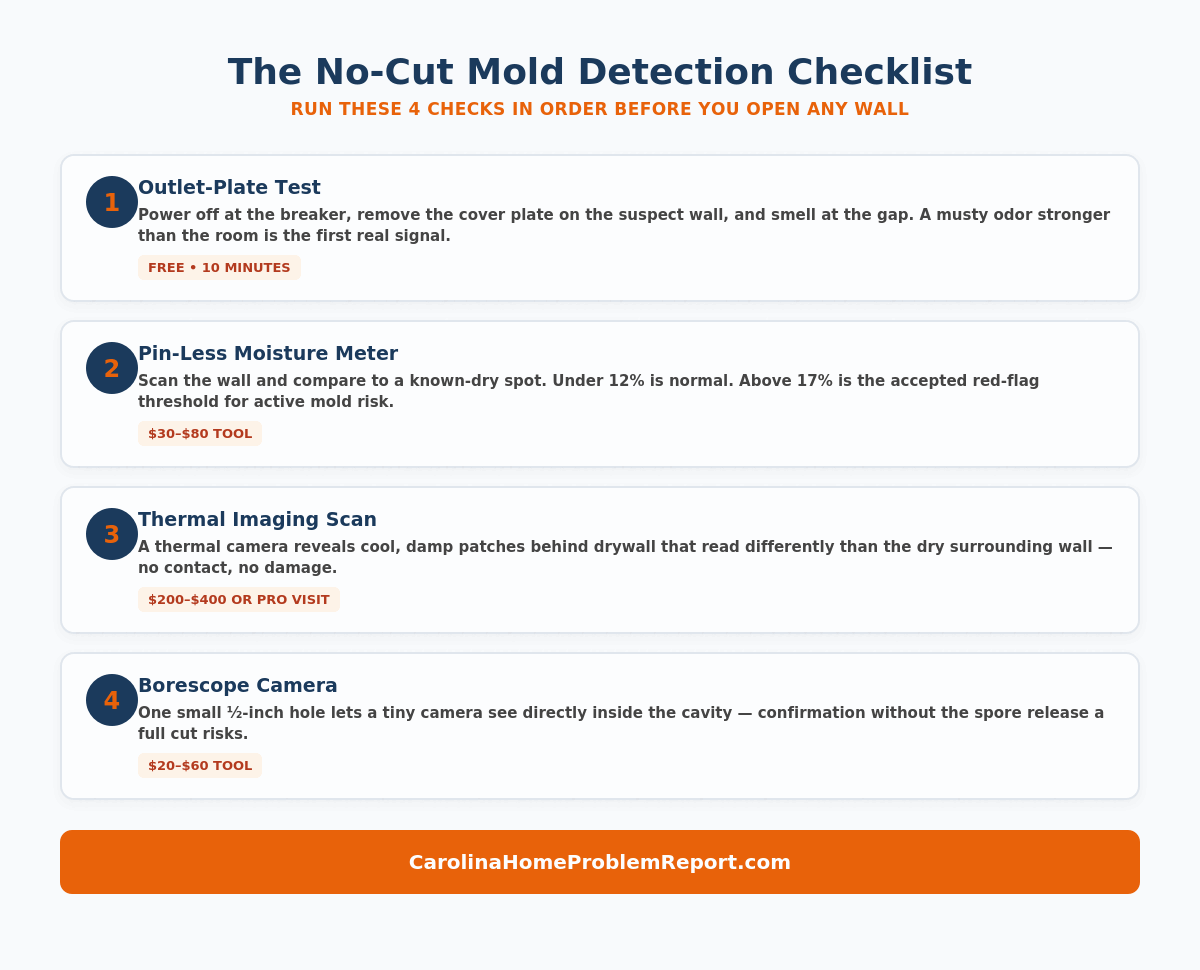
You can usually tell if there’s mold behind drywall without cutting into it. Start with the outlet-plate test (smell at an electrical outlet on the suspect wall), then check the wall with a pin-less moisture meter — a reading above 17% on drywall is a red flag.
If both point to a problem, a thermal camera or a tiny borescope through a small hole confirms it without ever opening the wall. In NC and SC homes, this usually traces back to a slow plumbing leak, a window or roof intrusion, or humidity condensing inside an exterior wall during the humid season.
⭐ Key Takeaways
- ✓The outlet-plate test takes under 2 minutes — remove an outlet cover on the suspect wall and smell at the gap, since wall cavities vent musty air through electrical penetrations
- ✓A pin-less moisture meter reading above 17% on drywall is the generally accepted threshold where mold risk becomes real, not just theoretical
- ✓Drywall’s paper facing is itself an organic food source for mold — it doesn’t need wood framing to be present, just moisture against the paper
- ✓The EPA specifically warns against ripping open a suspect wall yourself — disturbing a contaminated cavity can release a large burst of spores into the room
- ✓In NC and SC homes, exterior walls are the most common location — humid outdoor air meets air-conditioned interior surfaces inside the cavity, creating condensation even with zero leaks
You’ve noticed something — a faint musty smell near one wall, a spot where the paint looks slightly bubbled, or maybe nothing visible at all but a nagging feeling something’s not right behind that drywall. The obvious next step feels like cutting a hole to look. It’s also usually the wrong first step.
Mold behind drywall is genuinely difficult to confirm by eye, because the one surface that would show it — the back of the drywall, facing into the wall cavity — is the one surface you can’t see without removing material. But you don’t need to.
Several non-invasive checks, used in sequence, can tell you with real confidence whether there’s a problem behind a specific wall — before you cut, call anyone, or spend money on a full inspection.
This guide walks through those checks in the order that makes sense to actually use them: free sensory checks first, then simple tools, then the professional-grade options if you still need confirmation. It also covers why this happens more often in Carolina homes specifically, and the one thing the EPA says you should never do once you suspect it.
In This Article
- 5 Real Signs of Mold Behind Drywall
- The Outlet-Plate Test: Check in Under 10 Minutes
- Moisture Meter Readings: Normal vs a Red Flag
- When DIY Signs Aren’t Enough: Thermal Imaging & Borescopes
- Why This Happens More in NC & SC Homes
- How Fast It Spreads Once It Starts
- What NOT to Do If You Suspect It
- DIY vs Professional: When to Call Someone
- Frequently Asked Questions
5 Real Signs of Mold Behind Drywall
Before reaching for any tool, these five signs are worth checking first — they cost nothing and take minutes.
The Outlet-Plate Test: Check for Mold Behind Drywall in Under 10 Minutes
This is the single most useful free check, and almost nobody knows about it. Every outlet and light switch on a wall is a small gap cut straight into the wall cavity behind the drywall — and that gap lets air (and odor) escape, especially when there’s any air pressure difference between the cavity and the room, which there almost always is.
Turn off power to that outlet at the breaker
Always do this first. You’re about to remove a cover plate, and you don’t need the circuit live to smell air coming through a gap.
Remove the outlet or switch cover plate on the suspect wall
A single screw holds most plates in place. Set it aside and look at the gap between the electrical box and the drywall cutout — do not touch any wiring.
Lean in close and take a slow breath through your nose
A distinct earthy, musty odor noticeably stronger than the air in the rest of the room is the sign you’re checking for. A faint “electrical” or dusty smell with no musty character is normal and not a concern.
Repeat at 2–3 outlets on the same wall to confirm the pattern
One outlet smelling slightly musty could be a fluke. The same smell at every outlet along one wall, and not at outlets on other walls, is a confirmed localized signal — move on to the moisture meter check next.
Moisture Meter Readings: What’s Normal vs a Red Flag
A pin-less (non-invasive) moisture meter costs $30–$80 and reads moisture content through the drywall surface without puncturing it — the same basic tool many home inspectors carry. Set it to the drywall/gypsum material setting if it has one, and scan the suspect area along with several “known dry” spots on an interior wall elsewhere in the house for comparison.
A single high reading in one spot, surrounded by normal readings everywhere else, is a strong confirmation of a localized problem — and a useful way to mark exactly where any further investigation or repair needs to focus, rather than guessing at the whole wall.
When DIY Signs Aren’t Enough: Tools That Confirm Mold Behind Drywall
If the outlet test and moisture meter both point to a problem but you want visual confirmation before cutting anything — or before paying for a full inspection — two tools close that gap without any demolition.
Either tool can be rented or bought for a one-time check, or a mold inspector will bring both as part of a paid visit — typically $300–$600 in North Carolina, discussed further in the DIY vs Professional section below.
Why Mold Behind Drywall Spreads Faster in NC & SC Homes
Two things make this more common, and faster-developing, in the Carolinas than in a drier climate.
The first is the raw humidity. Summer relative humidity across most of NC and SC regularly runs 70–90%, well above the roughly 60% threshold mold needs to actively grow.
That means a wall doesn’t need an obvious leak to develop a mold problem — humid outdoor air meeting a cooler, air-conditioned interior wall surface inside the cavity can condense enough moisture on its own, especially in exterior walls with gaps in the vapor barrier or insulation that let warm, moist air reach a cold surface.
Why Drywall Itself Is the Perfect Growth Surface
Drywall is a gypsum core wrapped in paper facing on both sides. That paper is essentially cardboard — a cellulose-based organic material mold can digest directly.
This matters because it means mold doesn’t need exposed wood framing to be present behind a wall; the drywall itself, once wet, is a sufficient food source. According to the EPA, “the key to mold control is moisture control” — and on drywall specifically, there is no version of “a little moisture is fine” once the paper facing stays wet for more than a day or two.
The second factor is how NC/SC homes are built and plumbed relative to older housing stock elsewhere: exterior walls with brick veneer or vinyl siding over a drainage gap, bathroom plumbing frequently run inside exterior walls.
Add to that window flashing details that, when installed imperfectly, let a small amount of rainwater track down into the wall during heavy storms — which the region gets often.
None of these are defects exactly; they’re just places where a small installation gap, combined with the climate, turns into a slow, invisible moisture problem over months or years.
How Fast It Spreads Once It Starts
Mold begins establishing on wet drywall paper once moisture has been present continuously for this window, per EPA guidance — this is the practical deadline for drying out any known wet spot.
Visible colonization on the hidden face of the drywall if moisture continues — still not visible from the room, but the odor typically becomes noticeably stronger during this window.
Structural softening of the drywall itself begins, along with growth migrating into adjacent insulation and, in some cases, wood framing — this is the point where remediation reliably requires drywall removal rather than treatment in place.
What NOT to Do If You Suspect Mold Behind Drywall
Once the signs above point to a real problem, the instinct is to cut the drywall open and look. The EPA specifically warns against this as a first move.
Disturbing a contaminated cavity — cutting into it, pulling back wallpaper over it, or even just prying off a section of drywall — can release a large burst of mold spores into the room, far more than what was escaping through the gaps the outlet test picks up on.
The agency’s own guidance notes that removing wallpaper over hidden mold specifically “can lead to a massive release of spores.” The same principle applies to drywall.
The borescope approach above exists precisely to avoid this: one small, controlled hole gives a direct look without the uncontrolled release a full cut produces.
If the finding is significant — a large area, a strong confirmed reading, or anyone in the household with respiratory sensitivity — the EPA’s advice is to bring in an experienced professional for the opening and remediation step, not to do that part yourself.
DIY vs Professional: When to Call Someone
Everything through the borescope check above is safe and appropriate to do yourself. What you do with the finding depends on what you confirm.
✅ Reasonable to continue monitoring if:
- Moisture meter reads 12–17% with no musty odor or visible growth on the borescope
- The moisture source (a known spill, a brief leak) has already been fixed and dried
- No household member has respiratory symptoms tied to that room
⚠️ Call a mold assessor or remediation company if:
- Moisture reading is above 17% and/or the borescope shows visible growth
- The moisture source is ongoing or hasn’t been identified yet
- The affected area is larger than roughly 10 square feet
- Anyone in the household has asthma, allergies, or another respiratory sensitivity
A professional visit in North Carolina for this kind of localized wall check typically runs $300–$600 and includes the thermal and borescope work described above, often with an air sample.
If mold is confirmed, remediation that includes replacing the affected drywall section generally runs $1,500–$5,000 depending on how much material needs to come out — and fixing the moisture source itself, not just the drywall, is what actually prevents it from coming back in the same spot.
Frequently Asked Questions
Can mold grow behind drywall with no visible stain on the front?
Yes, and this is actually the more common situation when the issue is caught early. A stain on the front of the drywall usually means moisture has already soaked all the way through the board — by that point, mold has typically had time to establish on the hidden back face for a while already.
The outlet test and moisture meter check above are designed specifically to catch the problem before it progresses to a visible front-facing stain.
Do I need to cut a hole to confirm mold behind drywall?
Not necessarily. The outlet-plate test, a pin-less moisture meter, and a thermal imaging scan are all genuinely non-invasive and together give a strong read on whether a problem exists. A borescope is the one step that requires an opening, but it’s a single small hole (typically ½ inch) rather than removing a section of drywall, and it’s easily patched afterward.
Is it safe to just paint over a suspected area instead of checking?
No. Painting over bubbled or discolored drywall covers the symptom without addressing the underlying moisture, and if mold is actively growing behind it, paint does nothing to stop that growth or the spores it releases into the room’s air.
If anything, a fresh coat of paint can mask the exact visual signs you’d otherwise notice getting worse over time, delaying when the problem finally gets addressed.
What moisture meter should I use for drywall?
Look for a pin-less (also called non-invasive or non-penetrating) moisture meter rather than a pin-type meter, since pin-less models read through the drywall surface using an electromagnetic sensor pad without puncturing it.
Most consumer models in the $30–$80 range include a drywall or gypsum material setting, which is the one to use for this check — a wood setting on the same meter will read differently on the same wall.
How do I know if it’s mold behind the wall or something else, like crawl space or HVAC mold?
Wall cavity mold tends to concentrate the smell in one room or one section of a wall, rather than spreading evenly through the house, and it doesn’t get noticeably stronger the moment the HVAC system kicks on — both of which point elsewhere.
If the smell is whole-house, strongest at floor level, or spikes specifically when the AC starts, a different location is more likely the source, and the outlet-plate and moisture-meter checks on a specific wall will come back normal.
Key Facts About Mold Behind Drywall in Carolina Homes:
- The outlet-plate test and a $30–$80 pin-less moisture meter together catch most wall-cavity mold problems without cutting into anything.
- A moisture reading above 17% on drywall is the generally accepted red-flag threshold — below 12% is normal.
- NC and SC’s 70–90% summer humidity means exterior walls can develop condensation-driven mold with no leak at all, not just after a plumbing or storm event.
- A thermal camera or a single small borescope hole confirms a finding without the spore release the EPA warns against from cutting a wall open directly.
- Mold begins establishing on wet drywall paper within 24–48 hours, so a known wet spot has a short real deadline, not an open-ended one.
If several of these checks point to a confirmed problem, the Mold Risk Calculator is a quick next step to get a fuller picture of your overall risk level before deciding between monitoring and calling a professional.
The Carolina Home Problem Report editorial team researches and writes guides for homeowners across North and South Carolina.
Our research draws on EPA mold guidance, NC State Climate Office data, and insights from licensed Carolina mold assessors and home inspectors. We are not contractors or mold assessors — we are a research team dedicated to giving Carolina homeowners clear, locally specific, unbiased answers.
Carolina Home Problem Report is an informational resource for homeowners. We are not licensed contractors or mold assessors. Always consult a qualified professional before making home repair decisions. See our Disclaimer and Affiliate Disclosure.