Mold Under Carpet: The EPA’s THROW-AWAY Rule Explained
You can usually confirm mold under carpet without pulling up a single tack strip. Lift a corner at a seam or along a baseboard, press a probe-type moisture meter into the padding, and check for a musty smell that's strongest in one specific spot rather than the whole room.
If any two of those three checks point the same direction, the EPA's own guidance is blunt about what comes next: porous material like carpet padding that's gone moldy almost always has to be thrown away, not cleaned.
In NC and SC, this shows up most often in basements and ground-floor rooms over a concrete slab, where moisture moves up through the slab into the carpet from underneath.
⭐ Key Takeaways
- ✓The edge-and-seam lift test takes under 5 minutes and needs no tools — most carpet comes up easily at a seam or along a wall without cutting anything
- ✓According to the EPA, absorbent or porous materials like carpet "may have to be thrown away if they become moldy" — cleaning often isn't a realistic option once padding is contaminated
- ✓Carpet padding is almost always the real problem, not the carpet fibers themselves — foam padding holds moisture against the subfloor far longer than the carpet above it
- ✓Vacuuming or shampooing carpet you suspect has mold underneath can push spores deeper into the padding and spread them into the air you breathe
- ✓In NC and SC, carpet laid directly over a concrete slab is the single biggest risk factor — moisture vapor moves up through the slab itself, with zero leak required
The carpet looks fine. That's usually the problem. Mold under carpet almost never shows up as a visible stain on the surface fibers first — by the time you can see it from above, it's usually been growing in the padding underneath for weeks.
What you're more likely to notice first is a smell, a cold or slightly damp feeling underfoot in one specific area, or allergy symptoms that seem to get worse in one particular room. None of those confirm mold on their own — but together, and checked the right way, they can tell you with real confidence whether there's a problem before you pull up a single section of flooring.
This guide walks through exactly how to check, in an order that doesn't require tools you don't already own, and what the EPA actually recommends you do once mold is confirmed — it's more final than most people expect.
It also covers why carpet over a concrete slab — common in Carolina basements, converted garages, and ground-floor additions — is a different and often more persistent problem than carpet over a wood subfloor.
In This Article
- 5 Real Signs of Mold Under Carpet
- The Edge-and-Seam Test: Check Without Cutting Anything
- Using a Moisture Meter on Carpet and Padding
- Why Carpet Padding Is the Real Problem, Not the Carpet
- Carpet Over a Concrete Slab: Why It's Different
- Why NC & SC Homes See This More
- What NOT to Do If You Suspect It
- DIY vs Professional: What the EPA's Own Size Bands Say
- Frequently Asked Questions
5 Real Signs of Mold Under Carpet
These five signs cost nothing to check and take only a few minutes each — worth running through before reaching for any tool.
The Edge-and-Seam Test: Check for Mold Under Carpet Without Cutting Anything
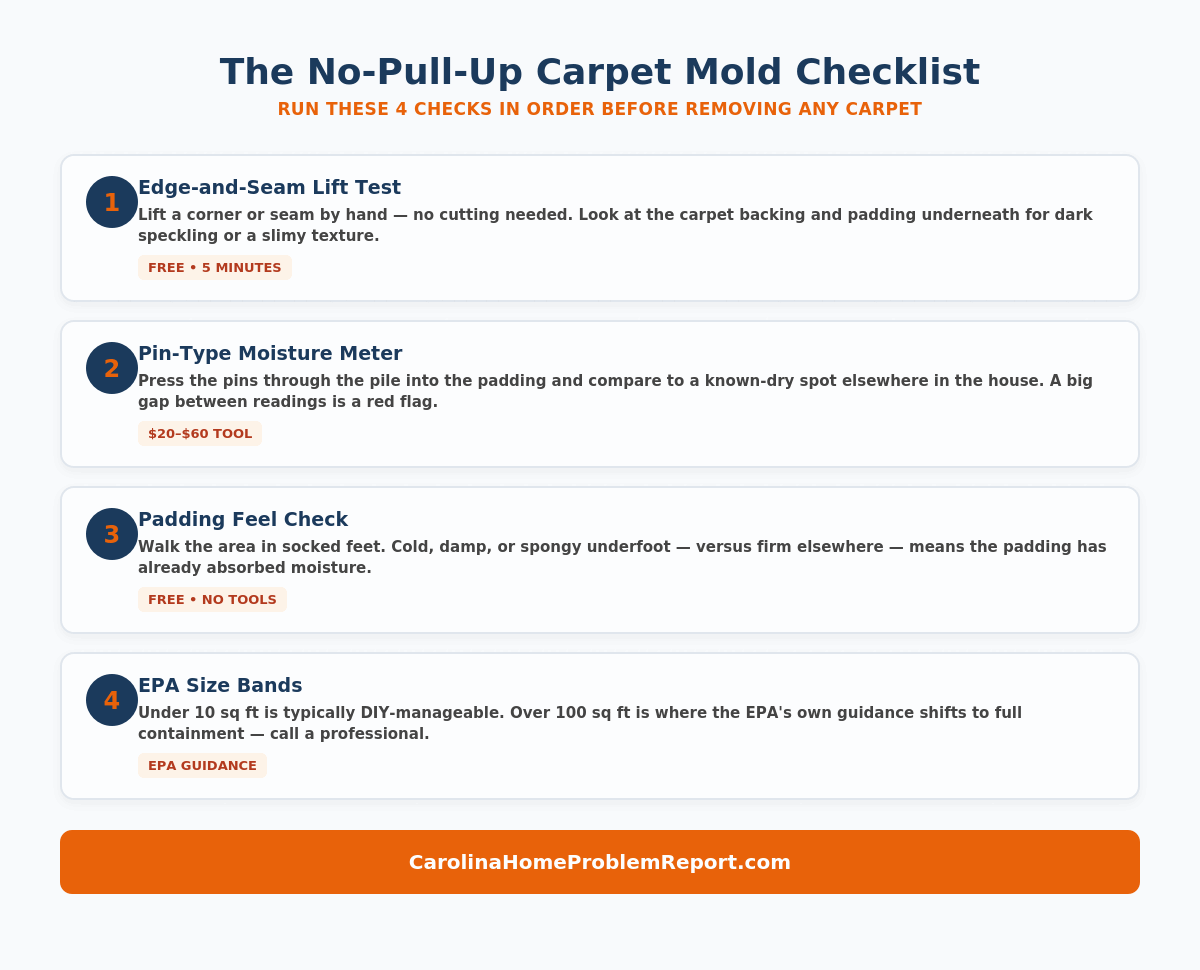
Most residential carpet isn't glued down edge to edge — it's stretched over tack strips around the perimeter of the room and simply laid in place elsewhere. That means in most homes, you can lift a corner or an edge to look underneath without cutting, gluing, or damaging anything, which makes this the single most useful free check for carpet specifically.
Find the nearest corner, seam, or doorway transition
A room corner or the spot where carpet meets tile, vinyl, or hardwood is almost always the easiest place to get a grip and lift without force.
Gently pull the carpet back a few inches, not more
It should separate from the tack strip with moderate hand pressure. If it resists heavily or feels stuck down, stop — that area may need a different approach, covered in the moisture meter section below.
Look at the underside of the carpet and the padding itself
Dark speckling, a fuzzy or slimy texture, or a visibly darker patch on the foam padding is a direct confirmation — this is one of the only places in the whole check process where you may actually see it, not just infer it.
Repeat at 2–3 points around the suspect area
A single damp spot could be a fluke from recent cleaning. Dampness or discoloration at multiple points around the same general area is a confirmed localized pattern — move on to the moisture meter check next for a number, not just a visual impression.
Using a Moisture Meter on Carpet and Padding
A pin-type moisture meter ($20–$60) is the better tool for carpet specifically, since it's designed to be pressed directly into soft or fibrous material rather than scanned across a hard surface like drywall.
Press the pins through the carpet pile into the padding underneath at the suspect spot, and compare the reading against a "known dry" area of carpet elsewhere in the house.
These size bands come directly from the EPA's own mold remediation guidance for schools and commercial buildings, which is written for professionals but uses the same practical logic homeowners can apply: the more square footage involved, the more the calculus shifts away from doing it yourself.
Why Carpet Padding Is the Real Problem, Not the Carpet
Most people picture "mold on the carpet" as mold growing on the visible pile — the fibers you walk on. In practice, the carpet fibers themselves are usually the last part of the system to show a problem, not the first.
Underneath nearly every carpet is a layer of carpet padding, almost always a foam cushion, laid over the subfloor. Foam padding is both absorbent and slow to dry — it can hold onto moisture for days after the carpet above it already feels dry to the touch, trapped between the carpet backing above and the subfloor below with very little airflow to speed up evaporation.
That combination — organic growth medium, moisture retention, and near-zero airflow — is close to ideal for mold, which is why padding is so often the actual source even when the visible carpet above it looks completely normal.
What the EPA Actually Says About Cleaning It
According to the EPA, "absorbent or porous materials, such as ceiling tiles and carpet, may have to be thrown away if they become moldy," because mold can penetrate into the empty spaces and crevices of a porous material and complete removal is nearly impossible once that happens.
In practice, this means a carpet shampoo, a store-bought mold spray, or even a professional steam clean is unlikely to fully resolve padding that's already contaminated — it may reduce the smell and visible surface growth temporarily while leaving the underlying problem in place.
This is also why mycotoxin exposure comes up specifically in carpet mold discussions more than in some other locations: certain mold species that favor damp cellulose and foam environments produce mycotoxins, compounds that can remain in contaminated material even after visible growth is cleaned from the surface.
That's another reason the EPA's default guidance leans toward removal over surface treatment for padding specifically.
Carpet Over a Concrete Slab: Why It's a Different Problem
Carpet laid directly over a concrete slab — common in basements, converted garages, and ground-floor additions across the Carolinas — behaves differently than carpet over a wood subfloor, and it's worth understanding why before assuming a leak is the only explanation.
Concrete slabs are porous and sit in direct contact with the ground. Even with no visible leak anywhere nearby, soil moisture can move upward through the slab as vapor — a process called moisture vapor transmission — and condense against the cooler underside of the carpet padding resting on top of it.
That means a slab-level room can develop mold under carpet with no spill, no plumbing failure, and no storm damage at all — just ordinary ground moisture meeting a cold slab under a layer of foam padding with nowhere to escape to.
This is especially common in older Carolina homes built without a vapor barrier beneath the slab, which was less consistently required decades ago than it is now.
Rooms directly above an unconditioned crawl space can see a related effect from below rather than from a slab — humid crawl space air reaching the underside of the subfloor and raising moisture levels in the padding above it, which is one reason carpeted rooms over a crawl space sometimes develop this problem even when the slab issue above doesn't apply.
Why NC & SC Homes See Mold Under Carpet More Often
Summer relative humidity across most of North and South Carolina regularly runs 70–90%, well above the roughly 60% threshold mold needs to actively grow. That ambient humidity works its way into carpet padding the same way it works into any other absorbent material in the house — slowly, and often without anyone noticing until the smell is already there.
Add the region's building patterns — a large share of homes with slab-on-grade construction in newer subdivisions, plenty of older homes with crawl spaces that were never properly vapor-sealed, and a humid subtropical climate with heavy seasonal rainfall.
Carpet sits at the intersection of several moisture sources most homeowners never think to connect to the carpet in their living room or bedroom.
None of this means every carpeted room in the Carolinas has a mold problem. It does mean the baseline moisture load carpet padding has to contend with here is simply higher than in a drier climate, which is why the checks above are worth running proactively in basements and slab-level rooms rather than waiting for a smell to show up first.
What NOT to Do If You Suspect Mold Under Carpet
Once the signs above point to a real problem, a few common instincts actually make things worse rather than better.
Don't vacuum it. Standard vacuums aren't sealed against mold spores, and running a vacuum over contaminated carpet can aerosolize spores that were otherwise mostly contained within the padding, spreading them through the room's air and potentially into the vacuum itself for future use.
Don't shampoo or steam-clean it first. Adding more water to carpet that already has a moisture problem, before the source is identified and fixed, can push the existing problem deeper into the padding and subfloor rather than resolving it.
Don't just cover it with a rug or furniture. This hides the visible sign without addressing the moisture underneath, and the growth continues — often worsening — out of sight.
If the affected area is large, if anyone in the household has asthma or another respiratory sensitivity, or if you're not confident identifying and fixing the actual moisture source yourself, the EPA's guidance points toward bringing in an experienced professional for the removal step rather than handling it solo.
DIY vs Professional: Removing Mold Under Carpet
For a small, confirmed area, the EPA's own guidance supports a careful homeowner handling removal directly, provided the moisture source is already identified and fixed.
✅ Reasonable to handle yourself if:
- The affected area is under roughly 10 square feet, per EPA guidance
- The moisture source (a known spill, a brief leak) has already been fixed and the area is now dry
- No household member has asthma, allergies, or another respiratory sensitivity
- You're prepared to cut out and bag the affected carpet and padding rather than attempt to clean and reuse it
⚠️ Call a mold remediation company if:
- The affected area is larger than roughly 10 square feet
- The moisture source is a slab condensation issue or crawl space humidity problem you can't easily fix yourself
- The carpet runs under built-in cabinetry, stairs, or other fixed obstacles that complicate removal
- Anyone in the household has asthma, allergies, or another respiratory sensitivity
A professional mold assessment and removal visit in North Carolina for a localized carpet issue typically runs $300–$600, often including a moisture source investigation rather than just the carpet removal itself.
Replacing carpet and padding in an affected room generally runs $3–$8 per square foot for mid-range materials, and fixing the underlying moisture source — a slab vapor barrier, crawl space encapsulation, or a plumbing repair — is what actually prevents the same spot from developing the same problem again within a year or two.
Frequently Asked Questions
Can mold under carpet make you sick?
Yes, it's a genuine possibility, not an exaggerated fear. Walking on contaminated carpet releases spores into the air of the room, and ongoing exposure has been linked to allergy-type symptoms — sneezing, congestion, itchy or red eyes — and, for sensitive individuals, more significant respiratory irritation.
The edge-and-seam test and moisture meter check above are designed to catch the problem early, before exposure has had time to build up in a room you or your family spend significant time in.
Can you clean mold out of carpet instead of replacing it?
Sometimes, for surface growth on the carpet fibers themselves caught very early, with a small area and no odor penetrating the padding. But once the padding underneath is involved — which it usually is by the time symptoms are noticeable — the EPA's own guidance leans toward replacement, since porous material that's absorbed mold often can't be fully cleaned.
Is it safe to just remove the carpet myself without testing first?
For a small, clearly-identified area, yes — wearing an N95 mask, gloves, and goggles, and bagging the removed material immediately rather than carrying it loose through the house. For a larger or uncertain area, confirming the extent first with a moisture meter avoids starting a removal project that turns out to be bigger than expected once you're partway through it.
Why does my basement carpet smell musty even though I don't see any mold?
This is one of the most common patterns with slab-level carpet specifically. Moisture vapor moving up through a concrete slab can create ideal mold conditions in the padding well before any growth becomes visible from above.
The smell is often the first sign you get, which is exactly why the edge-lift and moisture meter checks matter more in a basement than almost anywhere else in the house.
What moisture meter should I use for checking carpet?
A pin-type meter, not the pin-less kind used on drywall or hard flooring. Pin-type meters have small probes that push through the carpet pile and into the padding, which gives a direct reading of the material that's actually holding the moisture, rather than scanning across the surface.
Key Facts About Mold Under Carpet in Carolina Homes:
- The edge-and-seam lift test and a $20–$60 pin-type moisture meter together catch most carpet mold problems without any demolition.
- Carpet padding, not the visible carpet fibers, is almost always the real source — and the EPA's guidance leans toward replacing it rather than cleaning it once contaminated.
- Carpet laid directly over a concrete slab can develop mold with zero leak at all, through ordinary moisture vapor moving up from the ground.
- NC and SC's 70–90% summer humidity adds a baseline moisture load to carpet padding that drier climates simply don't have to contend with.
- The EPA's own size bands (under 10 sq ft, 10–100 sq ft, over 100 sq ft) are a practical guide for when a careful homeowner can handle removal versus when to call a professional.
If several of these checks point to a confirmed problem, the Mold Risk Calculator is a quick next step to get a fuller picture of your overall risk level before deciding between a DIY fix and calling a professional.
The Carolina Home Problem Report editorial team researches and writes guides for homeowners across North and South Carolina.
Our research draws on EPA mold and remediation guidance, NC State Climate Office data, and insights from licensed Carolina mold assessors and home inspectors. We are not contractors or mold assessors — we are a research team dedicated to giving Carolina homeowners clear, locally specific, unbiased answers.
Carolina Home Problem Report is an informational resource for homeowners. We are not licensed contractors or mold assessors. Always consult a qualified professional before making home repair decisions. See our Disclaimer and Affiliate Disclosure.