Mold Risk Calculator
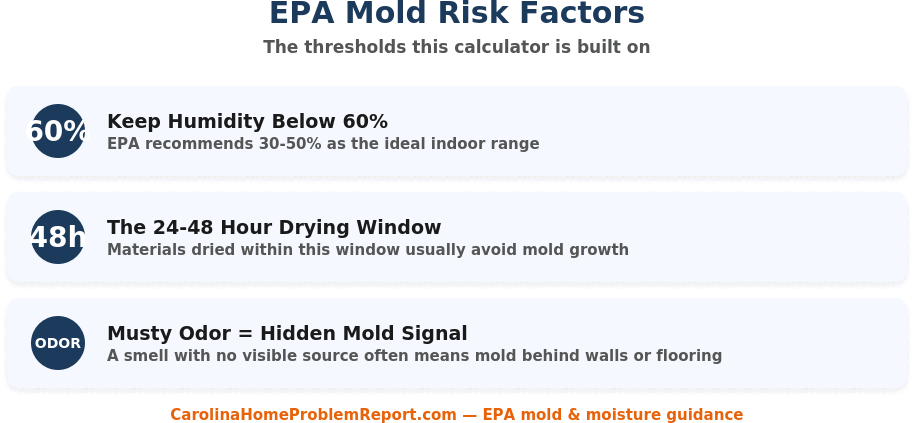
This free mold risk calculator checks your space against the EPA's own published mold-prevention guidance — the 60% humidity threshold, the 24-48 hour drying window, and musty odor as a hidden-mold signal.
Check the boxes that apply to your space, and you'll get a risk level plus the right next step for your situation.
This calculator gives a general risk indication based on EPA mold-prevention guidance, not a professional mold inspection or air quality test.
How This Calculator Works
Each box you check adds weight toward a risk score, based on how strongly the EPA's own mold-prevention guidance ties that factor to actual mold growth — not every risk factor counts equally. A musty smell and an undried leak carry more weight than general humidity, because the EPA specifically identifies odor as a sign of hidden mold and the 24-48 hour drying window as the critical threshold for whether mold takes hold at all. If you've already checked "visible mold," the calculator skips straight to that result, since at that point you're past assessing risk and into addressing an active problem.Why Catching Risk Early Actually Matters
Mold is far cheaper and easier to prevent than to remove. A space that's caught at the "moderate risk" stage usually just needs better humidity control or ventilation — a space that's progressed to visible growth often means replacing drywall, insulation, or flooring. The EPA's 24-48 hour drying window is the single most actionable number in this whole topic: it's the real deadline for drying out a wet area before mold has a meaningful chance to establish itself, not a soft guideline. Humidity above 60% doesn't cause mold by itself, but it creates the sustained conditions mold needs to keep growing once a spore has somewhere to land — which is most of the time, since mold spores are present in nearly all indoor air.What This Calculator Doesn't Account For
This tool is a general risk indicator built from self-reported, visible signs — it isn't a substitute for an actual moisture meter reading, air quality test, or professional mold inspection. It also can't see inside walls, under flooring, or behind cabinets, where a meaningful amount of hidden mold growth can exist with no visible or smellable trace reaching the room you're actually standing in. If you've checked several boxes here, or just have a specific concern a general checklist can't resolve, that's the point to bring in a professional rather than keep self-diagnosing.Frequently Asked Questions
Because the EPA specifically treats musty odor as a sign of mold that may be growing somewhere you can't see — behind wallpaper, under flooring, or inside a wall cavity. It's weighted heavily here for that reason.
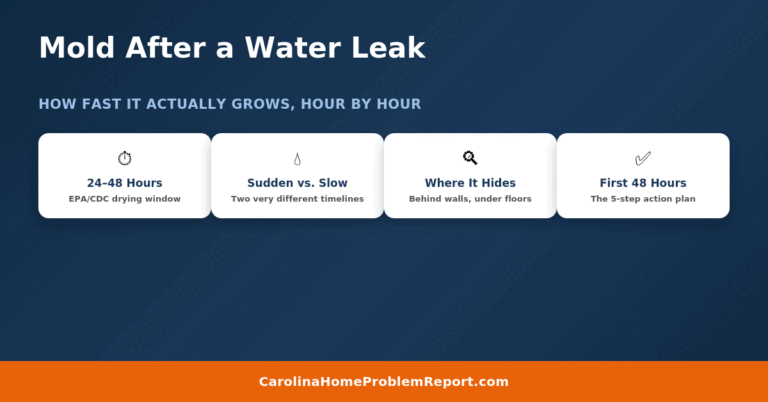
That's the window the EPA names directly in its own mold guidance — materials dried within 24-48 hours of getting wet usually don't develop mold, while materials left wet longer than that usually do.
No — it means the common visible and self-reportable risk factors aren't present right now. Mold can still exist in places a checklist can't see. Low risk is reassuring, not a guarantee.
Address whatever's keeping the space wet or humid first — a leak, poor ventilation, or high humidity — since fixing the moisture source matters more than any cleaning product. Then bring in a professional if there's any visible growth beyond a small, easily-reachable area.
We research and verify home-problem solutions specific to Carolina homes and climate, so you can fix issues right the first time — or know exactly what to ask a pro before you hire one.
This calculator is for general informational purposes based on EPA mold-prevention guidance and is not a substitute for a professional mold inspection or air quality test.