Bathroom Mold That Keeps Coming Back: How to Stop It
Bathroom mold that keeps coming back almost never means you're cleaning it wrong. It usually means the mold isn't actually on the surface you're scrubbing — it's in the grout underneath the top layer, behind the tile against the backer board, or inside the caulk itself where a sponge can't reach.
Scrubbing the visible surface clean treats the symptom, not the source. Until the hidden moisture behind the surface is addressed, the same dark line comes back in the same spot — usually within a few weeks.
⭐ Key Takeaways
- ✓Grout and caulk fail differently — grout is a porous, cement-based material mold can grow into, while caulk is a flexible sealant that fails when it cracks, shrinks, or separates from the surface
- ✓Tile backer board behind a shower wall is moisture-resistant, not waterproof — water can work its way behind improperly sealed tile and feed mold you'll never see from the room
- ✓Under the sink and around the toilet base are two commonly skipped mold spots that have nothing to do with the shower at all
- ✓According to the EPA, running the bathroom exhaust fan or opening a window during every shower is the single most effective, lowest-cost prevention step
- ✓In NC and SC, 70–90% summer humidity means a bathroom with even a slightly undersized fan runs behind on moisture removal all season long
You scrub the grout line, it looks clean for a week or two, and then the same dark streak shows up in the exact same spot. If this has happened more than once, the problem was never really the cleaning.
Recurring bathroom mold is a pattern, and patterns have causes. Almost every case traces back to moisture that's reaching a surface faster than it can dry, or to mold growing somewhere a sponge genuinely cannot reach — inside the grout itself, behind the tile, or inside a failed bead of caulk.
This guide focuses specifically on bathroom walls, fixtures, and surfaces — the grout, caulk, tile, sink, and toilet areas where mold shows up independent of the ceiling.
If your mold problem is specifically on the bathroom ceiling, our Mold on Ceiling guide covers the ceiling-specific causes, including the commonly missed exhaust-fan venting defect, in more depth than we'll repeat here.
In This Article
- 5 Signs Your Bathroom Mold Is a Recurring Problem
- Grout vs Caulk: Why They Need Different Fixes
- The Hidden Moisture Check: What's Behind the Tile
- Under the Sink and Around the Toilet: The Spots People Skip
- Shower Curtains and Liners: The Quick Win
- Why NC & SC Bathrooms See This More
- What NOT to Do: The Bleach-Only Trap
- How to Remove It and Re-Seal Properly: DIY Steps
- DIY vs Professional: When to Call Someone
- Frequently Asked Questions
5 Signs Your Bathroom Mold Is a Recurring Problem
Occasional surface mildew after a humid week is normal and usually wipes away easily. These five signs point to something that needs more than a sponge.
Grout vs Caulk: Why Bathroom Mold Needs Different Fixes
These two materials sit right next to each other in almost every shower, but they're fundamentally different, and treating them the same way is a common reason mold keeps coming back.
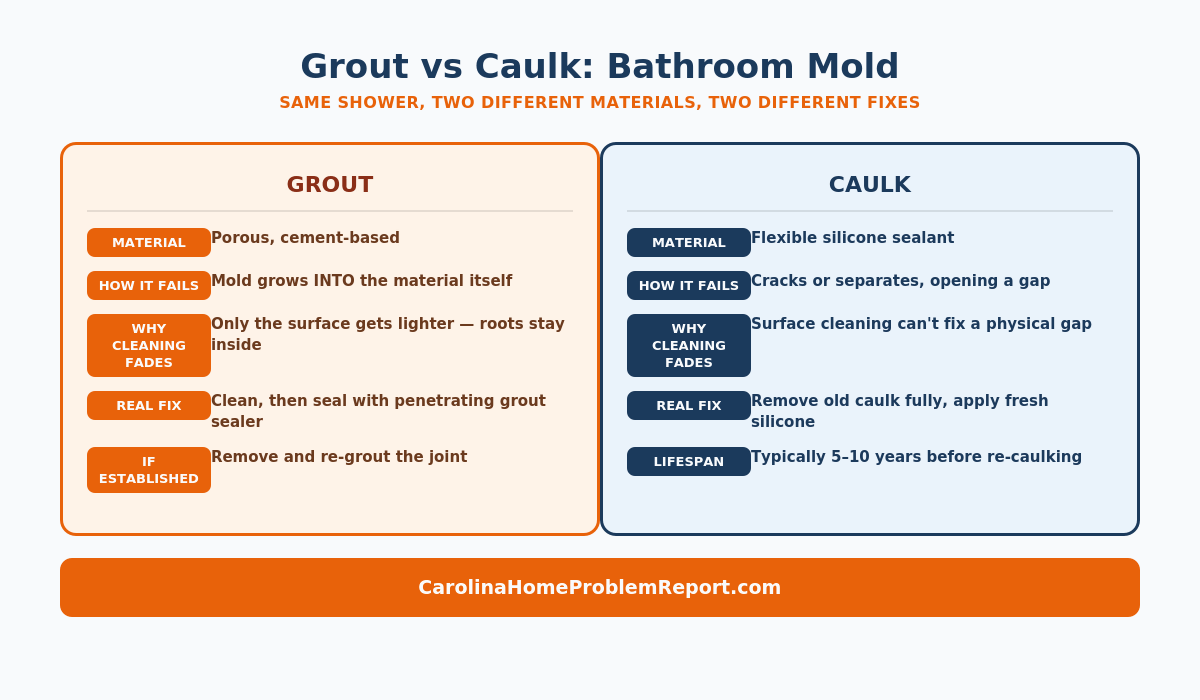
Grout is a cement-based, porous material that fills the gaps between tiles. Because it's porous, mold can actually grow into the material itself, not just sit on top of it — which is exactly why a dark grout line often lightens with cleaning but never fully disappears.
Sealing grout with a penetrating grout sealer after cleaning helps slow this, but it doesn't reverse mold that's already established inside it.
Caulk is a flexible sealant — usually silicone in bathrooms — applied at corners and transitions, like where the tub meets the wall. Unlike grout, caulk doesn't fail by absorbing moisture into itself; it fails when it cracks, shrinks, or separates from the surface, creating a gap that lets water behind it.
That difference changes the fix: grout mold is addressed with cleaning plus sealing (or, if established, removal and re-grouting), while caulk mold almost always means the old caulk needs to be fully removed and replaced — cleaning the surface of failed caulk is a short-term patch at best.
The Hidden Moisture Check: What's Behind the Tile
If the signs above point to a recurring problem and the grout and caulk both look intact, the next place to think about is what's behind the tile itself.
Most tiled shower walls are built over a cement board or similar backer board, chosen specifically because it resists moisture far better than regular drywall. The key word is resists — not blocks entirely.
Moisture-Resistant Is Not the Same as Waterproof
Cement board handles incidental moisture well, but it isn't waterproof on its own — it depends on a proper waterproofing membrane or coating behind or over it, plus intact grout and caulk at every seam, to actually keep water out long-term.
When that waterproofing was skipped, installed poorly, or has broken down at a seam over time, water works its way behind the tile and reaches the backer board — and from there, mold can establish on a surface you'll never see without removing tile.
This is genuinely hard to confirm without professional tools or removing a tile, which is exactly why repeated, unexplained recurrence after properly fixed grout and caulk is one of the clearest signals it's time to call a professional rather than keep re-cleaning the same spot.
Under the Sink and Around the Toilet: The Spots People Skip
Most bathroom mold attention goes to the shower, but two other spots cause recurring problems just as often and have nothing to do with shower steam.
Under the sink cabinet: A slow drain-pipe or supply-line drip is easy to miss since it's hidden behind cabinet doors. Check monthly for dampness at the base of the pipes, a musty smell when you open the cabinet, or soft spots on the cabinet floor itself.
Around the toilet base: A worn wax ring seal at the base of the toilet can leak small amounts of water with every flush — often enough to feed mold in the flooring or baseboard around the toilet without ever creating an obvious puddle. A toilet that rocks slightly when you sit, or discoloration on the floor right at the base, both point to this.
Shower Curtains and Liners: The Quick Win
This one is worth mentioning because it's the easiest fix on this entire list, and it's often overlooked while people focus on the grout.
A vinyl shower curtain liner left bunched up and wet against itself after a shower is close to ideal mold conditions — damp, dark, and no airflow.
Spreading the curtain out flat after each use so it dries fully, and simply replacing a liner once it's visibly spotted (most cost under $10), resolves this particular source completely, with no cleaning or sealant work involved at all.
Why NC & SC Bathrooms See This More
Summer relative humidity across most of NC and SC regularly runs 70–90%, well above the roughly 60% threshold mold needs to grow. A bathroom is already the most humidity-intensive room in the house on an ordinary day — add a baseline outdoor humidity load that high, and the margin for error on ventilation shrinks considerably.
A bathroom exhaust fan sized correctly for a drier climate can genuinely struggle to clear humidity fast enough in a Carolina summer, which is part of why recurring grout and caulk mold shows up more here than in homes in milder regions — the fan is working, it's just working against a much bigger moisture load.
This isn't a reason to assume every Carolina bathroom will develop recurring mold. It does mean ventilation habits and caulk maintenance matter more here, and a slightly undersized fan has less room to coast through the humid months than it would elsewhere.
What NOT to Do: The Bleach-Only Trap
Reaching for bleach is the instinctive first move for almost everyone, and it's worth understanding exactly where it helps and where it doesn't.
Bleach is genuinely effective at killing surface mold and lightening the staining it leaves behind on non-porous surfaces like tile or tub enamel.
On porous materials like grout, though, bleach typically only bleaches what it can reach at the surface — it doesn't penetrate deeply enough to kill mold growing further into the material, which is exactly why a bleached grout line often looks better for a week and then darkens again.
Don't caulk over moldy caulk. Applying a fresh bead directly over an existing moldy or failed caulk line traps the problem underneath rather than solving it — the old caulk needs to come out completely first.
Don't ignore recurrence after two honest cleaning attempts. If properly cleaning and re-sealing grout and caulk doesn't stop the problem within a month, that's the signal to investigate what's behind the surface rather than trying a third round of the same cleaning approach.
How to Remove Bathroom Mold and Re-Seal Properly: DIY Steps
For grout and caulk that's small in scope and not tied to a confirmed behind-the-tile problem, this sequence addresses both the visible mold and the seal that's supposed to prevent it.
Clean the grout thoroughly first
Use a 3% hydrogen peroxide solution or a dedicated grout cleaner with a stiff (not wire) brush. Let it sit 10 minutes before scrubbing, then rinse well and let it dry fully — ideally overnight.
Apply a penetrating grout sealer once dry
This step is frequently skipped, but it's what actually slows mold from re-establishing inside the grout rather than just removing what's already there.
Remove old caulk completely
A caulk-removal tool or plastic putty knife works without scratching tile or tub enamel. Get all of the old bead out — any leftover residue keeps new caulk from bonding properly.
Let the area dry completely, then apply fresh 100% silicone caulk
Choose a caulk labeled specifically for kitchen and bath use, which typically includes a mold-resistant additive. Apply in a steady, continuous bead and smooth it with a caulk tool or a wet finger.
Let the caulk cure fully before the next shower
Check the product label — most need 24 hours before they're safe to get wet. Showering too soon is a common reason fresh caulk fails early and the cycle starts over again.
DIY vs Professional: When to Call Someone
✅ Reasonable to handle yourself if:
- Mold is limited to grout and/or caulk, with no soft spots or spongy flooring nearby
- This is the first or second time it's recurred, not an ongoing multi-month cycle
- No household member has asthma, allergies, or another respiratory sensitivity
⚠️ Call a professional if:
- Mold keeps returning after two honest attempts at proper cleaning and re-caulking
- There's a soft or spongy feel in the wall or floor near the tub or shower
- A toilet rocks slightly or you suspect a wax ring leak
- Anyone in the household has asthma, allergies, or another respiratory sensitivity
A professional mold assessment for a recurring bathroom problem in North Carolina typically runs $300–$600 and can include moisture mapping behind tile without full demolition.
If a behind-the-tile moisture problem is confirmed, re-tiling a shower surround with proper waterproofing generally runs $2,000–$6,000 depending on size and tile choice — a real cost, but one that actually stops the cycle rather than buying another few weeks before the next clean.
Frequently Asked Questions
Is bathroom mold mold or mildew?
The dark staining on grout and caulk is usually mold rather than mildew, though the terms get used interchangeably. Mildew tends to be a surface-level, powdery growth that's genuinely easier to wipe away; mold is more likely to have some root structure into the material.
In practice, the distinction rarely changes what to do — the cleaning and re-sealing steps above address both.
Can I just replace the caulk without removing the mold first?
No — new caulk applied over a surface that still has mold or mold residue on it won't bond properly and traps the existing problem underneath. Clean and fully dry the area before applying any new caulk.
How often should bathroom caulk be replaced?
Quality 100% silicone caulk in a well-ventilated bathroom typically lasts 5–10 years before it needs replacing, though a poorly ventilated bathroom or one with heavy daily use can see it fail sooner. Checking it during an annual deep clean catches failure before it becomes a recurring mold problem.
Does a bathroom exhaust fan actually make a difference, or is it mostly the humidity?
Both matter, but the fan is the one variable you control directly. The EPA's own guidance specifically recommends running the bathroom exhaust fan or opening a window during every shower as the core prevention step — in a high-humidity region like the Carolinas, consistently skipping this is one of the fastest ways to end up with a recurring mold problem.
Key Facts About Bathroom Mold in Carolina Homes:
- Mold that returns in the same spot after cleaning is almost always hidden in the grout, behind failed caulk, or behind the tile itself.
- Grout and caulk fail differently and need different fixes — grout is sealed, caulk is fully replaced.
- Under the sink and around the toilet base are commonly skipped spots unrelated to the shower.
- NC and SC's 70–90% summer humidity puts extra strain on bathroom exhaust fans sized for a drier climate.
- Mold recurring after two honest cleaning and re-caulking attempts is the clearest sign to call a professional for a behind-the-tile check.
If your bathroom mold is specifically on the ceiling, the Mold on Ceiling guide covers that separately, and the Mold Risk Calculator can help gauge your overall risk level.
The Carolina Home Problem Report editorial team researches and writes guides for homeowners across North and South Carolina.
Our research draws on EPA mold guidance, NC State Climate Office data, and insights from licensed Carolina mold assessors and home inspectors. We are not contractors or mold assessors — we are a research team dedicated to giving Carolina homeowners clear, locally specific, unbiased answers.
Carolina Home Problem Report is an informational resource for homeowners. We are not licensed contractors or mold assessors. Always consult a qualified professional before making home repair decisions. See our Disclaimer and Affiliate Disclosure.