Condensate Drain Line Clog: Why Your AC Shuts Off (On Purpose)
A condensate drain line clog happens when biofilm, mineral deposits, and mold build up in the constantly-moist drain line — nearly inevitable in a humid Carolina cooling season. When it clogs, most systems have a float switch that's specifically designed to shut your AC off before the backed-up water damages ceilings, walls, or floors. A sudden mid-summer shutdown with no obvious cause is often this safety feature working exactly as intended — the fix is clearing the clog at the cleanout, not replacing the AC.
⭐ Key Takeaways
- ✓Drain lines clog from biofilm and microbial growth, plus mineral deposits and mold, thriving in a constantly moist environment
- ✓A float switch is designed to trip before the drain pan overflows, shutting the system down before it causes water damage
- ✓Breaking the thermostat's "R" (power) circuit, not just "Y" (cooling call), is generally recognized as better practice to prevent short cycling
- ✓First response is usually DIY: locate the cleanout, wet/dry vacuum the outdoor termination, and flush periodically
- ✓Repeated clogging despite regular flushing points to a line-pitch or chronic biological-growth issue worth a technician's attention
A condensate drain line clog is one of the most common summer AC problems in a humid Carolina climate — and it's also one of the few HVAC issues that's specifically designed to shut your system down before it causes real damage. If your AC is already running long hours to fight the structural dehumidification ceiling covered elsewhere on this site, understanding both halves of this issue — why it clogs, and why the shutoff happens — changes how you respond to it.
In This Article
- Why the Line Clogs in the First Place
- What Happens When It Clogs
- The Float Switch: Protecting Your House
- A Detail Almost No Homeowner Guide Mentions
- It's Not Always a Clog: Other Reasons the Switch Trips
- How to Actually Clear a Condensate Drain Line Clog
- Where This Fits With Broader Humidity Management
- Frequently Asked Questions
Why a Condensate Drain Line Clog Happens in the First Place
HVAC product manufacturer RectorSeal explains the underlying mechanism: the slimy biofilm buildup found in condensate lines "is often a result of microbial growth, including bacteria and fungi, thriving in the moist environment" inside the drain — a dark, damp, nutrient-rich space that's close to ideal for microbial colonization. Beyond biological buildup, "mineral deposits and mold can also clog condensate pipes." In a humid climate where your AC runs for months at a time, condensate lines are producing that moist environment almost continuously.
What Happens When a Condensate Drain Line Clog Is Left Alone
The consequences RectorSeal lists are specific: a blockage "impeding the flow of condensation" causes water to back up into the system, which "can lead to water damage to ceilings, walls, and floors," and standing water left behind "can promote the growth of mold and mildew, posing health risks." Left completely unaddressed, the guidance notes the buildup can eventually contribute to "complete system failure."
⚠️ Why This Isn't Just a Nuisance
A clogged drain line isn't just an inconvenient shutdown — left unmanaged, it's a direct path to ceiling, wall, and floor water damage and the mold growth that follows. That's exactly why the safety feature covered next exists.
The Float Switch: Why Your AC Shutting Off Is Actually Protecting Your House
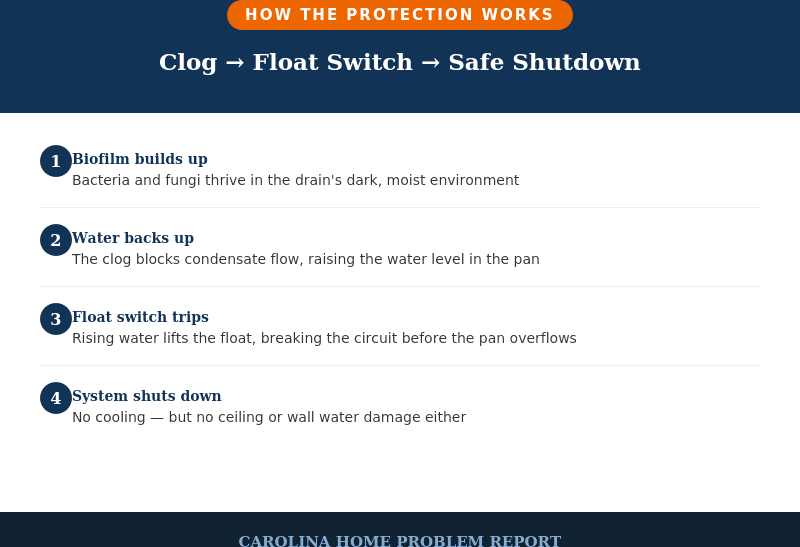
Here's the part most homeowner guides skip entirely. Most residential systems have a float switch installed specifically to catch a clogged drain before it causes the water damage described above. HVAC trade-education resource HVAC School explains its purpose directly: the switch is designed to remain closed during normal drainage and trip before the drain pan overflows,
shutting the system down rather than letting it keep running and producing water it can no longer drain. If your AC suddenly stops cooling in mid-summer with no obvious cause, a tripped float switch — not a broken AC — is one of the most common explanations, and it's doing exactly what it's supposed to do.
A Detail Almost No Homeowner Guide Mentions
The guidance also surfaces a genuine point of professional debate that affects how reliably your switch actually protects you: whether the switch should interrupt the thermostat's "R" (power) circuit or the "Y" (cooling call) circuit when it trips. HVAC School notes it's "generally recognized that breaking R is a better practice to prevent short cycling"
— meaning a properly wired switch should fully de-energize the control circuit, not just stop the compressor while leaving the fan and controls cycling. It's also worth knowing that "it is the level of the aux drain port that holds back the water, not the pitch of the drain" — a subtlety that matters if a technician is troubleshooting why a switch isn't tripping reliably.
It's Not Always a Clog: Other Reasons the Switch Trips
Most homeowner guides (and this one, up to this point) treat a tripped float switch as shorthand for "the drain line is clogged" — but that's only one of several genuine causes, and clearing a line that was never actually blocked wastes time while the real problem continues. A failed or power-interrupted condensate pump can let water back up exactly the way a clog does, with no blockage anywhere in the line itself.
A frozen evaporator coil — usually from restricted airflow, a dirty filter, or low refrigerant — can also trip the switch indirectly: once the system shuts off and the ice melts, it can release more water at once than the drain is built to handle in a short burst, overwhelming the pan even though the line itself is perfectly clear. A cracked or improperly seated auxiliary pan, and simple mechanical binding or wiring faults in the switch itself, round out the list of non-clog causes.The practical takeaway: before assuming a clog and reaching for a vacuum, check whether the coil or indoor unit shows obvious ice, whether a condensate pump (if your system uses one) is actually running, and whether water is visibly present in the pan at all. If there's no visible water and no ice, the fault may be in the switch's wiring or mechanism rather than anything related to drainage — a case where resetting it repeatedly without finding the actual cause isn't a real fix.
How to Actually Clear a Condensate Drain Line Clog
If you've confirmed it genuinely is a clog (water visible in the pan, no ice on the coil, pump running normally if present), the first step is locating the drain line's cleanout — often a T-shaped PVC fitting with a removable cap near the indoor unit. From there, two methods do most of the real work, and they work better combined than either alone:
- Wet/dry vacuum suction: Remove the cap at the outdoor termination point, seal a wet/dry shop vacuum's hose over the opening, and run it for 2-3 minutes to pull the clog out from the far end.
- Vinegar or hydrogen peroxide flush: Pour about a cup of distilled white vinegar (or hydrogen peroxide) down the indoor cleanout, let it sit roughly 30 minutes to break down biofilm, then flush with hot water.
⚠️ Never mix cleaning agents: don't combine vinegar with bleach or hydrogen peroxide in the same flush — mixing these produces a toxic reaction. Pick one, flush thoroughly, and let the line dry before trying a different agent on a future cleaning.
For prevention, flushing the line every 1-3 months is the commonly recommended interval — lean toward the more frequent end of that range in a humid Carolina cooling season, or if the household has pets shedding into nearby filters. A professional cleaning, if you'd rather not DIY it,
typically runs somewhere in the $75-$200 range depending on access and how established the clog is — useful context for deciding whether a given situation is worth a service call or a 15-minute DIY flush.
If the line clogs repeatedly despite regular flushing on that schedule, that points toward a line pitched incorrectly or a chronic biological-growth problem worth having a technician address directly, rather than something to keep clearing manually every few weeks.
Where This Fits With Broader Humidity Management
A drain line running constantly, day after day through a long Carolina cooling season, is simply more exposed to this buildup than one that only occasionally handles condensate. If your AC is already working overtime due to the structural dehumidification ceiling covered elsewhere on this site,
that extended runtime also means more condensate volume moving through this same line — one more reason chronic humidity problems and chronic drain-line problems tend to show up together. If you're also seeing moisture on your ductwork itself rather than a drip from one point, that's a different mechanism covered in our sweating ducts and vents guide.
Frequently Asked Questions
Why did my AC suddenly stop cooling with no warning?
A tripped float switch is one of the most common causes. It's designed to shut the system down before a clogged condensate line backs up and causes water damage — it's a safety feature working correctly, not a sign your AC has failed.
Why does the drain line clog in the first place?
Biofilm from bacteria and fungi thrives in the moist, dark environment inside the line, and mineral deposits and mold add to the buildup. A humid climate where the AC runs for months keeps that environment moist almost continuously.
Can I clear a condensate drain clog myself?
Often, yes. Locate the cleanout near the indoor unit and use a wet/dry vacuum at the outdoor termination point to pull the clog free, then flush the line periodically to discourage regrowth.
When should I call a technician instead of clearing it myself?
If the line clogs repeatedly despite regular flushing, that points toward an incorrectly pitched line or a chronic biological-growth problem that's worth having a professional address directly.
Does a tripped float switch always mean a clogged drain line?
No. A failed condensate pump, a frozen coil releasing a burst of meltwater, a cracked pan, or a wiring fault in the switch itself can all trip it with no actual clog in the line. Check for visible water and ice before assuming it's a clog.
Key Facts About Condensate Drain Line Clogs:
- Drain lines clog from biofilm and microbial growth, plus mineral deposits and mold, in the line's constantly moist interior.
- A float switch is built to trip before the drain pan overflows, shutting the system down before water damage occurs.
- Breaking the "R" power circuit, not just "Y," is the better-practice wiring to prevent short cycling.
- First response is usually DIY: locate the cleanout, wet/dry vacuum the outdoor termination, and flush periodically.
- Repeated clogging despite regular flushing signals a line-pitch or chronic biological-growth issue for a technician.
If your float switch keeps tripping despite regular flushing, an HVAC professional can diagnose whether it's a line-pitch or chronic biological-growth issue.
Find an HVAC Professional Near You →This guide was researched using RectorSeal's published guidance on condensate drain clogging and HVAC School's trade-education content on float switch design and installation, cross-referenced against Carolina Home Problem Report's existing HVAC and humidity documentation, to explain a common summer AC shutdown that most homeowner guides misdiagnose as equipment failure. We are not contractors or HVAC technicians — we are a research team dedicated to giving Carolina homeowners clear, locally specific, unbiased answers.
Carolina Home Problem Report is an informational resource for homeowners. We are not licensed contractors or HVAC technicians. Always consult a qualified professional before making home repair decisions. See our Disclaimer and Affiliate Disclosure.