Crawl Space Dehumidifier Size Calculator
This free crawl space dehumidifier size calculator uses the same AHAM-based sizing chart as our full crawl space dehumidifier sizing guide to recommend a pint capacity range for your crawl space.
Enter your crawl space's square footage and whether it's encapsulated or vented, and you'll get a recommended range in seconds.
This calculator gives a starting estimate, not a professional load calculation. For a living space rather than a crawl space, see our dehumidifier sizing calculator, which uses different sizing logic.
How This Calculator Works
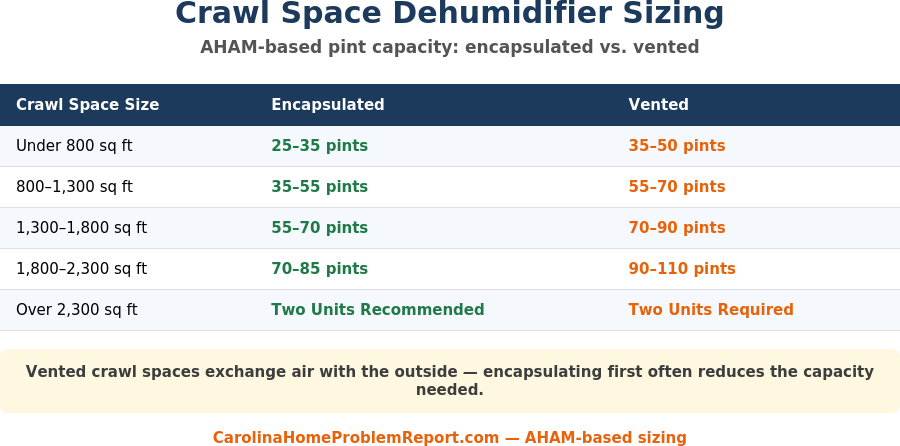
This tool uses the same AHAM-based capacity bands as our full crawl space dehumidifier sizing guide — five square-footage tiers, each with a separate range for encapsulated versus vented crawl spaces. Encapsulated crawl spaces need less capacity because a sealed vapor barrier and closed vents remove most of the ongoing moisture sources, leaving the dehumidifier to handle only residual humidity. Vented crawl spaces need meaningfully more, since open foundation vents keep letting humid outside air in. Spaces over 2,300 sq ft switch to a two-unit recommendation rather than a single larger capacity number, since a single unit struggles to distribute airflow evenly across a space that large.Why Encapsulated vs. Vented Changes the Math
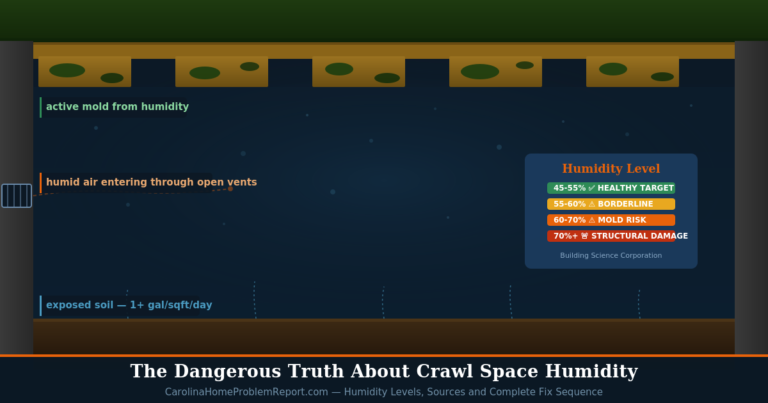
A vented crawl space is essentially connected to the outside air through its foundation vents, so on a humid Carolina summer day, it's constantly pulling in more moisture than an encapsulated space ever sees. That's why the gap between the two columns is so large — it's not a minor adjustment, it roughly doubles the recommended capacity at the same square footage. Buying for a vented space using encapsulated numbers is one of the most common undersizing mistakes homeowners make. If your crawl space is vented and you're finding the recommended capacity surprisingly high, encapsulating first is often the more cost-effective long-term fix — it reduces how hard any dehumidifier has to work, rather than just buying a bigger unit to fight an open system.What This Calculator Doesn't Account For
This tool gives a solid starting range, not a professional load calculation. It doesn't account for standing water, a missing or damaged vapor barrier, exposed soil, or an unusually high water table — all of which add moisture load beyond what square footage alone predicts. It also doesn't account for ceiling height significantly above a typical crawl space, or a crawl space connected to an unusually large attached area like a basement. If any of these apply to your situation, treat this calculator's result as a floor, not a final answer, and consider sizing toward the higher end of the range it gives you.Frequently Asked Questions
Encapsulating first is usually the better long-term investment — it reduces the moisture load itself rather than asking a dehumidifier to keep fighting an open system. Many homeowners end up doing both, but in that order.
Because open foundation vents mean the crawl space is continuously exchanging air with the outside, rather than being a sealed, controlled space. On a humid day, that's a near-constant moisture source an encapsulated space doesn't have.
It's accurate enough to shop within the right range using the same chart as our full sizing guide. If your crawl space has standing water or a damaged vapor barrier, address that first — a bigger dehumidifier isn't a fix for an open moisture source.
Treat it as vented for sizing purposes until the encapsulation is complete — a partial vapor barrier or a few remaining open vents still let in meaningful outside moisture, so sizing for the easier "encapsulated" case would likely leave you undersized.
We research and verify home-problem solutions specific to Carolina homes and climate, so you can fix issues right the first time — or know exactly what to ask a pro before you hire one.
This calculator is for general informational purposes and provides an estimate, not a professional load calculation. For standing water, structural moisture, or an unusually high water table, consult a crawl space specialist.