Home Humidity Control Systems — Complete Guide to Dehumidifiers and Ventilation
Once you've confirmed your house actually has a humidity or air quality problem, the next question is almost always the same one: what do I actually buy or install to fix it? That's where most homeowners get stuck.
Not because the fixes are complicated, but because "dehumidifier" and "ventilation" cover a surprisingly wide range of genuinely different equipment, each suited to a different problem, a different part of the house, and a different budget.
This guide covers every home humidity control system available to Carolina homeowners: what each one actually does, which problem it solves, how to know which one you need, and what it costs to get it wrong.
Below, you'll also find direct links to our full library of in-depth guides on sizing, cost, and choosing between specific options.
If you're sizing equipment using a national average or a chart that doesn't account for your specific region, there's a real chance you'll under-buy on the coast or over-buy in the mountains.
In order, here's how to approach the decision once you've identified which category above applies:
Quick Answer: Home humidity control systems fall into two families: dehumidification (whole-home ducted units, portable/room units) and ventilation (bathroom/kitchen exhaust fans, attic ventilation, and whole-home ERV/HRV systems).
The EPA notes that HVAC systems are partly designed to "remove moisture from the air before the air is distributed throughout the building," but a standard AC alone often isn't enough in the Carolinas' humid climate.
The right system depends on scope (one room vs. the whole house), the source of the moisture, and your budget — and picking the wrong one typically means paying twice: once for the wrong equipment, and again for the right one.
Key Takeaways:
- Home humidity control systems split into two families: dehumidification (removes moisture already in the air) and ventilation (replaces humid indoor air with drier outdoor air, or vice versa in winter).
- Whole-home ducted dehumidifiers and portable room units solve different scopes of problem — whole-house dampness vs. a single damp room or crawl space.
- Undersized or oversized equipment is the single most common expensive mistake — it runs constantly without ever catching up, or short-cycles the same way an oversized AC does.
- Bathroom and kitchen ventilation fans are humidity-control equipment too, not just odor control — and a disconnected or undersized one is a leading cause of attic and crawl space moisture problems.
- Coastal, Piedmont, and mountain regions of the Carolinas have meaningfully different humidity-control needs — a system sized for Charlotte isn't automatically right for Wilmington or Asheville.
Table of Contents
- What Actually Counts as Home Humidity Control Systems
- The Real Options for Home Humidity Control Systems
- How to Know Which System You Actually Need
- What the Wrong System Costs You
- Where Humidity Control Matters Most in a Carolina Home
- Why One-Size-Fits-All Doesn't Work Across the Carolinas
- From Minor Inefficiency to Major Expense
- Choosing the Right System: A Decision Framework
- When to Call a Professional
- Explore Every Dehumidifier and Ventilation Topic
- Frequently Asked Questions
What Actually Counts as Home Humidity Control Systems
Home humidity control systems are the mechanical equipment — beyond your standard air conditioner — that actively manage how much moisture is in your home's air and how often that air gets replaced. The EPA notes that "one function of the building heating, ventilation and air conditioning (HVAC) system is to remove moisture from the air before the air is distributed throughout the building," but a standard residential AC is designed primarily for temperature, with dehumidification as a side effect rather than its main job. That gap is exactly what dedicated humidity-control equipment exists to close — and it matters beyond comfort alone: thermal comfort research treats humidity as every bit as important as temperature in how a space actually feels, which is why a house can be set to 72°F and still feel unpleasant if the humidity is wrong. These systems fall into two families that solve different problems: dehumidification equipment actively pulls existing moisture out of the air, while ventilation equipment manages how fresh air moves in and stale, humid air moves out. Most Carolina homes with a persistent humidity or air quality problem eventually need some combination of both, not just one.The Real Options for Home Humidity Control Systems
Here's what's actually available, and what each one is genuinely good at:1. Whole-Home (Ducted) Dehumidifiers
Installed directly into your HVAC ductwork, these units use the same basic refrigerant-based cooling-coil cycle as your AC to pull moisture out of the air, but run independently of your thermostat on their own humidistat, dehumidifying the entire house automatically. They're the right call when humidity is a whole-house problem rather than confined to one room. Full detail in whole home dehumidifiers.2. Portable (Room) Dehumidifiers
Standalone units that plug into a wall outlet and dehumidify a single room or zone. Lower upfront cost and no installation, but limited coverage and a tank that needs regular emptying unless it's plumbed to a drain. The right call for an isolated problem room or a crawl space rather than the whole house. See portable vs. whole-home dehumidifiers for the full comparison, and our crawl space dehumidifier guide for that specific use case.3. Bathroom and Kitchen Exhaust Ventilation
Often overlooked as "just" odor control, a properly vented bathroom fan or range hood is genuinely humidity-control equipment — removing shower steam and cooking moisture at the source before it spreads through the house. A disconnected fan (one that vents into the attic instead of outside) is one of the most common hidden causes of attic moisture problems we see. Full detail in bathroom ventilation fans.4. Attic Ventilation
Proper attic ventilation (soffit and ridge vents, or powered attic fans) keeps humid air from accumulating under the roof deck, where it can condense, feed mold, and shorten shingle and roof-decking lifespan. This matters year-round, not just in summer. See attic ventilation for NC homes.5. ERV/HRV Whole-Home Ventilation
Energy Recovery Ventilators and Heat Recovery Ventilators are a form of balanced mechanical ventilation that continuously exchanges stale indoor air for fresh outdoor air while recovering most of the energy (and in an ERV's case, some of the humidity) that would otherwise be lost. That's the right solution for a tightly sealed, energy-efficient home that needs fresh air without undoing its insulation. The core difference between the two: an ERV transfers some humidity along with heat between the incoming and outgoing air streams, while an HRV transfers only heat — which is why climate matters when choosing between them. Full comparison in ERV vs. HRV ventilation.How to Know Which System You Actually Need
Before buying anything, figure out the scope and source of the problem:- Is it one room or the whole house? A single damp bedroom or crawl space points toward a portable unit; humidity throughout every room points toward a whole-home system.
- Is the AC already running constantly without fixing it? That's a sign dehumidification, not more cooling, is what's actually missing — see HVAC and dehumidification.
- Do bathrooms or the kitchen stay steamy long after use? That points toward a ventilation fix, not a dehumidifier.
- Is the attic unusually hot or showing moisture signs? That's an attic ventilation question, separate from whole-house humidity control entirely.
- Is the home tightly sealed and energy-efficient but still feels stuffy? That's the specific scenario an ERV or HRV is designed to solve.
What the Wrong System Costs You
Getting the equipment choice wrong isn't just inconvenient — it's expensive in specific, predictable ways:- Undersized dehumidifiers run constantly without ever catching up to the moisture load, which both fails to solve the problem and runs up the electricity bill for nothing. Full detail in dehumidifier sizing guide.
- Oversized dehumidifiers short-cycle the same way an oversized AC does — they satisfy the humidistat quickly, shut off, and start again soon after, which adds wear on the compressor without actually running long enough to dehumidify effectively.
- Ongoing electricity cost varies dramatically by unit size and run time — see our real-world breakdown in dehumidifier cost to run before buying anything.
- A bathroom fan vented into the attic instead of outside doesn't remove moisture — it just relocates it, often creating a second, hidden moisture problem above the ceiling.
- Buying the wrong brand or capacity for Carolina conditions specifically is common enough that we built a dedicated local buying guide: best dehumidifier for NC homes.
Where Humidity Control Matters Most in a Carolina Home
Crawl spaces are the single highest-value place to get humidity control right in this region, since crawl space moisture migrates upward into the living space through the stack effect — covered fully in crawl space dehumidifier guide. Bathrooms generate more moisture per square foot than almost any other room in the house, which is exactly why exhaust ventilation there matters disproportionately to its size. Attics trap heat and moisture under the roof deck if ventilation is inadequate, directly shortening roofing material lifespan regardless of what's happening in the living space below. Basements, while less common than crawl spaces in much of the Carolinas, show up more often in Piedmont and mountain-region homes. A below-grade basement is naturally cooler than the rest of the house, which means it holds a higher relative humidity at the same absolute moisture level. That often makes a basement the first room in the house to show condensation, musty odor, or mold, even when every other room reads normal on a hygrometer.Why One-Size-Fits-All Doesn't Work Across the Carolinas
North Carolina and South Carolina span three genuinely different climate zones, and a dehumidification or ventilation setup sized for one can under- or over-perform in another:| Region | Typical Humidity Load | What It Means for Equipment Choice |
|---|---|---|
| Coastal Plain (Wilmington, Myrtle Beach, Charleston) | Highest year-round humidity load; salt-air considerations. | Often needs the largest-capacity whole-home dehumidification and crawl space-specific solutions. |
| Piedmont (Charlotte, Raleigh, Columbia) | Moderate-to-high, strongly seasonal. | Mid-sized whole-home or portable systems typically sized correctly using standard manufacturer charts. |
| Mountains (Asheville, Greenville foothills) | Lower average humidity, but higher rainfall and fog in valleys. | Ventilation and crawl space moisture control often matter more than whole-house dehumidification capacity. |
From Minor Inefficiency to Major Expense
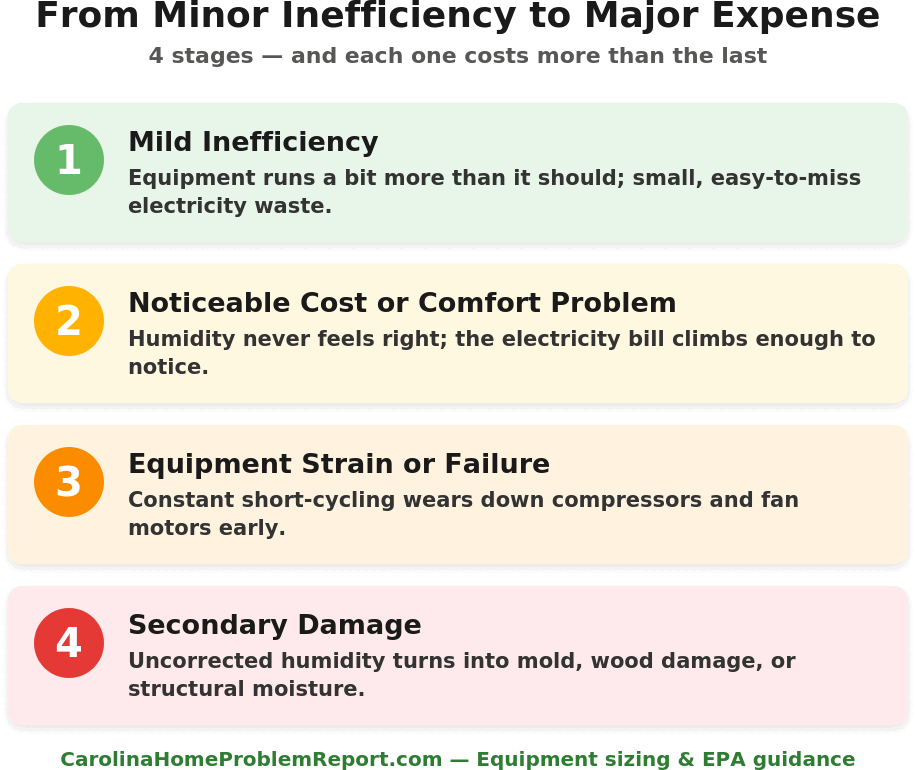
Picking the wrong humidity control system doesn't usually fail all at once — it escalates in stages, and each stage costs more to fix than the one before it:- Stage 1 — Mild inefficiency. The equipment runs a bit more than it should, or doesn't quite reach the target humidity — a small, easy-to-miss waste of electricity.
- Stage 2 — Noticeable cost or comfort problem. Humidity never feels quite right despite the system running, and the electricity bill climbs enough to notice — often the point where a homeowner starts researching, which is how most people find this guide.
- Stage 3 — Equipment strain or failure. Constant short-cycling or running flat-out adds real wear to compressors and fan motors, shortening the equipment's lifespan well below its rated years.
- Stage 4 — Secondary damage. Persistent, uncorrected humidity converts into the problems covered elsewhere on this site — mold growth, wood floor damage, and in crawl spaces, structural moisture — turning an equipment-sizing mistake into a much larger repair bill.
Choosing the Right System: A Decision Framework
If you'd rather start from your symptom than from a product category, this quick-reference table maps the most common complaints to the system that actually addresses them:| What You're Noticing | Likely Cause | System to Consider |
|---|---|---|
| Humidity high in every room | Whole-house moisture load exceeding AC's dehumidification capacity | Whole-home ducted dehumidifier |
| One damp room or a musty crawl space | Localized moisture source | Portable/room dehumidifier |
| Bathroom mirror stays fogged long after a shower | Missing, disconnected, or undersized exhaust fan | Bathroom ventilation fan |
| Attic feels like an oven, shingles aging early | Inadequate soffit/ridge airflow | Attic ventilation |
| House feels stuffy despite being well-insulated | Not enough fresh-air exchange in a tightly sealed home | ERV/HRV ventilation |
- Measure first. A $15-$30 hygrometer in the problem room (or several, if the issue seems whole-house) tells you whether you're actually dealing with a dehumidification problem, a ventilation problem, or both.
- Match the system to the scope. Whole-house symptoms call for whole-home equipment; a single room or crawl space calls for a targeted, portable solution.
- Size it correctly before buying. Square footage, current humidity level, and target humidity all factor in — see dehumidifier sizing guide rather than guessing from a box label.
- Factor in real running cost, not just purchase price — a cheaper unit that runs constantly can cost more over a year than a pricier, correctly sized one. See dehumidifier cost to run.
- Don't forget ventilation. A dehumidifier fighting a disconnected bathroom fan or a sealed-up attic is fighting a losing, expensive battle — fix the ventilation side alongside, not instead of, dehumidification.
When to Call a Professional
Whole-home ducted dehumidifiers, ERV/HRV systems, and any ductwork modification should be installed by a licensed HVAC contractor — these integrate with your home's existing systems in ways that are genuinely risky to get wrong. Call a professional when: you're considering a whole-home or ducted system, your current HVAC system seems undersized for dehumidification even after basic fixes, or you suspect improperly vented bathroom or kitchen exhaust has already caused attic or wall moisture damage. A home energy audit — often available through a local utility at low or no cost — is also worth considering before investing in a whole-home system. An auditor can confirm whether your actual issue is dehumidification capacity, air sealing, insulation, or some combination. That kind of audit can save you from buying equipment that treats a symptom of a leakier underlying problem.Explore Every Dehumidifier and Ventilation Topic
This guide covers the full landscape. For the complete depth on any specific system, sizing question, or cost comparison, use the guides below — grouped by what you're actually trying to decide.Whole-Home vs. Portable
Sizing and Cost
Crawl Space and HVAC Integration
Ventilation Systems
Frequently Asked Questions
What are the main types of home humidity control systems?
Two families: dehumidification (whole-home ducted units and portable room units) and ventilation (bathroom/kitchen exhaust fans, attic ventilation, and whole-home ERV/HRV systems). Most homes with a persistent problem eventually need some combination of both.Do I need a whole-home dehumidifier or just a portable one?
If the humidity problem affects every room, a whole-home ducted unit is usually the better long-term investment. If it's confined to one room or a crawl space, a correctly sized portable unit is often sufficient — see portable vs. whole-home dehumidifiers.Is a bathroom fan really part of humidity control?
Yes — a properly vented bathroom or kitchen exhaust fan removes moisture at the source, before it spreads through the house, and a disconnected one (venting into the attic instead of outside) is a common hidden cause of attic moisture problems.How much does an oversized or undersized dehumidifier actually cost me?
An undersized unit runs constantly without solving the problem; an oversized one short-cycles and adds compressor wear. Both waste money in different ways — full real-world numbers are in dehumidifier cost to run.Does where I live in the Carolinas change what system I need?
Yes — coastal, Piedmont, and mountain regions carry meaningfully different humidity loads, so a system correctly sized for one region can under- or over-perform in another.Does an ENERGY STAR or AHAM certification actually matter when buying?
Yes, for dehumidifiers specifically — AHAM (the Association of Home Appliance Manufacturers) sets the standard testing protocol most capacity ratings are based on, and ENERGY STAR-certified units typically use meaningfully less electricity to remove the same amount of moisture. That matters most for equipment that runs for months at a time.For NC and SC Homeowners: If you're not sure whether your situation calls for a dehumidifier, a ventilation fix, or both, our Find Help directory can point you toward the right type of local professional for your specific situation.